Pleistocene Ecosystems31022 BCE
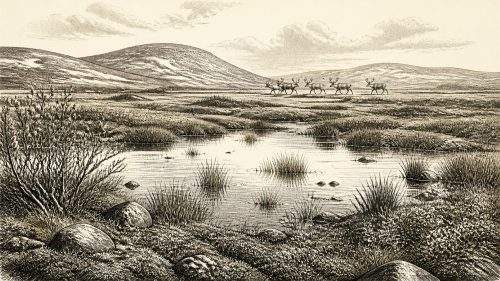
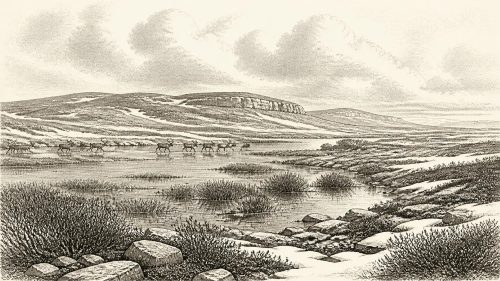
Approximately 31,022 BCE, Ireland lay within the unstable Late Pleistocene climate of Marine Isotope Stage 3, not a precisely datable historical moment. Derryvree, County Fermanagh, preserves wetland sediments between glacial tills, revealing treeless tundra, mosses, sedges, bogbean and other cold-adapted plants amid freshwater pools. Castlepook Cave, County Cork, records diverse fauna, including reindeer, mammoth, giant deer, hyena, wolves and lemmings, although deposits span long periods. A marked reindeer bone may indicate brief human butchery, yet remains inconclusive. No settled population, institutions or culture can be established. Subsequent ice-sheet expansion destroyed much evidence, leaving exceptional environmental and faunal archives in Ireland.
Dateline
Modern calendar-year precision is not available for Ireland in 31,022 BCE. This number is a convenient position on a retrospective calendar, not a date at which archaeology can identify an event, community or individual. In radiocarbon terms it sits at roughly 33,000 years before present, within Marine Isotope Stage 3 (MIS 3), a long and highly unstable part of the Late Pleistocene. The closest unusually informative Irish environmental sequence, at Derryvree near Maguirebridge in County Fermanagh, has a calibrated range of about 36,900–31,700 years before present. It therefore overlaps the broad timescale of this entry, but cannot illuminate one particular year. Its value is that it preserves a rare window onto an Irish landscape that later ice buried and reshaped.
A Wetland Between Glaciers
At Derryvree, roadworks in 1969 cut through a drumlin: one of the streamlined hills formed by moving glacier ice. Beneath and above the exposed deposit lay two separate sheets of till, unsorted sediment left directly by ice. Between them was a freshwater sequence of silts and fine sands, including organic material. A conventional radiocarbon determination from that deposit, Birm-166, was 30,500 years before present, with a substantial error range. Calibration converts it into a wider calendar range rather than a single date. The basic conclusion is robust: before a later ice advance overwhelmed the location, freshwater pools and wet ground existed there during a cold phase of the last glacial cycle.
This is an important corrective to any image of a uniformly ice-covered Ireland at all times in the Ice Age. The island experienced repeated climatic changes, and the British–Irish Ice Sheet grew, retreated and reorganised over many millennia. Around the broad interval relevant to 31,022 BCE, conditions were cold and periglacial in at least parts of Ireland: shaped by frost, seasonal thaw, sparse vegetation and nearby or recurrent glaciation. Yet the Derryvree deposit proves that a local wetland ecosystem could function between glacial episodes. It should not be expanded into a complete map of the island. Southern coastlands, uplands, river valleys and the Irish Sea basin may have differed sharply in ice cover, drainage and habitability.
The Evidence of Moss and Sedge
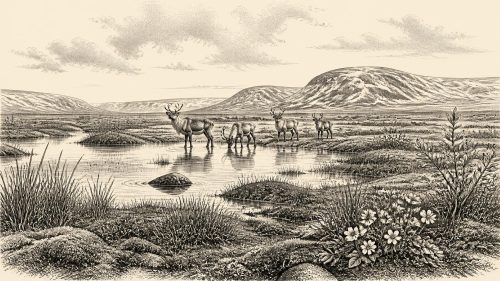
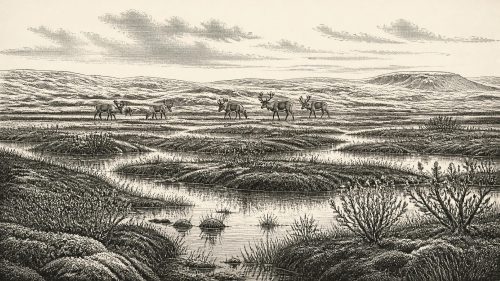
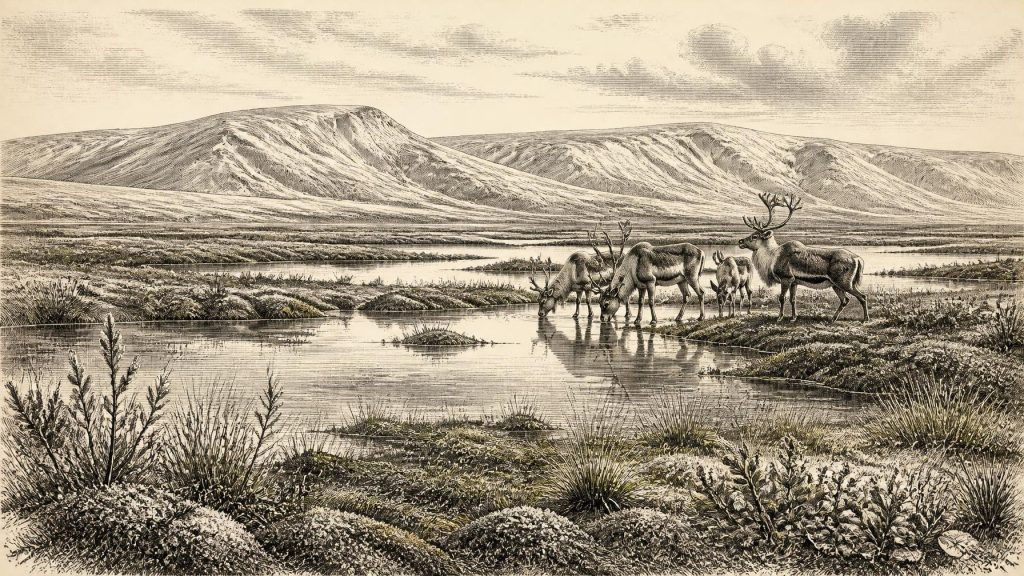
Derryvree’s pollen, plant macrofossils, mosses and insects offer the clearest evidence for everyday conditions, although “everyday” here means ecological rather than human life. The assemblage points to open tundra and a treeless muskeg: waterlogged ground with mossy vegetation, sedges, grasses and herbs, broken by pools rich in plant matter. Finds associated with the deposit include plants with modern northern or alpine affinities, among them bogbean (Menyanthes trifoliata), mountain-avens and dwarf willow. Juniper and other dwarf shrubs may have occurred in the wider open ground. Tree pollen was extremely limited and is not reliable evidence for a forest; it may have travelled far or been redeposited from older sediments.
This was no pristine white desert. In the growing season, low vegetation and wetland plants could make sheltered ground productive, while winter brought severe cold. The landscape was probably patchy: shallow freshwater, sedge margins, stony or sandy ground, moss mats and exposed herb-rich terrain. Insects from the deposit reinforce the interpretation of a cold, open setting. What the record does not provide is a complete climatic diary. It cannot establish the temperature on a given day in 31,022 BCE, annual snowfall, or whether the site was continuously ice-free throughout the whole date range. It demonstrates conditions when the sediments accumulated.
An Island of Large Mammals
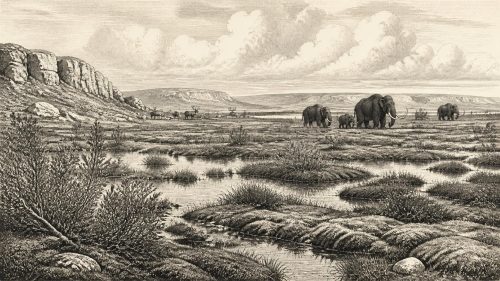
Far to the south, Castlepook Cave, also known as Mammoth Cave, near Doneraile in County Cork, provides a complementary but complicated animal archive. Excavations begun in 1904 recovered bones from cave sands and passages. The National Museum of Ireland holds part of this collection, including remains of spotted hyena. Re-dating and reassessment have shown that several animals represented in the cave belong much earlier in MIS 3 than older twentieth-century dates had suggested. The cave is consequently central evidence that Ireland was reached by a remarkably diverse cold-stage fauna before the Last Glacial Maximum.
The securely identified faunal list associated with this broad period includes reindeer, woolly mammoth, giant deer, mountain hare, fox, wolf, brown bear, spotted hyena, Arctic lemming and Norway lemming, as well as birds. Not every species necessarily lived beside every other at the same moment, nor should all finds be assigned to exactly 31,022 BCE. Cave deposits accumulate over long spans, while carnivores, water, falling sediment and earlier excavation methods can mix material. Nonetheless, the combined evidence establishes that Ireland supported, or was repeatedly visited by, large herbivores and formidable predators during favourable portions of MIS 3.
Reindeer are especially revealing because they imply open country with extensive grazing and browsing opportunities, not a closed woodland. Mammoths and giant deer indicate that substantial herbivore biomass could intermittently be sustained. Spotted hyenas add a different dimension. Their remains may reflect a denning or scavenging use of caves, rather than an open-air hunting scene, but they confirm that Ireland’s food webs then included large carnivores absent from the modern island. The animal evidence is more secure than any reconstruction of a particular herd route, migration season or population size.
The Reindeer Bone Question
One Castlepook reindeer femur has attracted particular attention because it bears a deep mark interpreted as having been made on fresh bone by a sharp stone implement. If that diagnosis is confirmed, it would be evidence that a person or a very small party processed a reindeer in Ireland during MIS 3, vastly earlier than the long-established record of post-glacial settlement. It is a consequential possibility, but it must be expressed cautiously. A radiocarbon determination dates the animal bone, while the identification of a surface mark as a human tool cut is a separate taphonomic judgement. The early excavations also did not preserve the stratigraphic controls expected of a modern excavation.
Thus, the marked femur is not evidence for a village, a permanent population, a named people or a settled Irish Palaeolithic society. Nor does it establish that humans were present in the calendar year 31,022 BCE. At most, the responsible interpretation is of potential brief human activity within a broad Late Pleistocene interval: perhaps carcass processing by mobile hunter-gatherers who had reached Ireland during an accessible phase. Renewed fieldwork at Castlepook in 2022 located surviving deposits and has begun testing the cave’s archaeological potential, but it also demonstrates why undisturbed, well-dated contexts are essential before large claims are made.
No Politics, But Real Social Limits
There is no evidence from Ireland at this depth of time for political institutions, rulers, diplomacy, territorial states, formal warfare or writing. There are no known houses, hearths, graves, tool assemblages, monuments or artworks securely attributable to this date. Accordingly, an account of “politics” must begin with absence: none can responsibly be reconstructed. If people did visit, their social organisation, language, kinship, beliefs and cultural affiliation are unknown. Comparisons with Upper Palaeolithic groups elsewhere in north-west Europe can suggest that small, mobile bands may have organised seasonal hunting, shared skills and maintained wide social networks, but that is comparative interpretation, not direct Irish evidence.
The same restraint applies to religion and learning. Caves can later acquire cultural significance, but Castlepook’s Pleistocene bones do not demonstrate ritual, cave art, myth or funerary practice. The likely expertise involved in travelling through a cold and changeable landscape, finding prey, working stone and processing hides would have depended on knowledge transmitted between people. Yet no artefact from this interval in Ireland currently allows that knowledge to be described. There is likewise no evidence for exchange networks or trade in the normal archaeological sense. Any human arrival would have required movement across a changing maritime and glacial landscape, but the route—whether by exposed coastal terrain, short water crossings, ice margins or a combination—remains unresolved.
The Coming Transformation
The greatest historical development relevant to this date was environmental. MIS 3 did not lead smoothly towards warmer conditions. Climatic oscillations continued, and the major expansion of the British–Irish Ice Sheet came later, principally during MIS 2. At its maximum, broadly after about 26,000 calibrated years before present, ice covered much or all of Ireland and profoundly altered its terrain. Earlier soils, campsites and animal traces were eroded, buried or redeposited. That destructive history helps explain why the evidence for the island around 31,022 BCE is so slight and so dependent on exceptional sealed contexts: a Fermanagh wetland between tills, a Cork cave archive, and bones preserved in museum collections.
Ireland at this time was therefore neither a blank nor a comprehensible human homeland. It was a changing northern landscape in which freshwater wetlands briefly persisted, tundra plants grew, and cold-adapted mammals ranged across at least some regions. The possibility of an ephemeral human encounter with reindeer is important precisely because it remains small and testable. The firm story is environmental and archaeological: around the broad timespan denoted by 31,022 BCE, Ireland lay within a volatile Ice Age world whose surviving evidence records resilient ecosystems, mobile animals and the approach of renewed ice.
Source References
Hover over a number to see the source. Select it to open the source.

- [1] A Middle Midlandian Freshwater Series at Derryvree, Maguiresbridge, County Fermanagh, Northern Ireland
- [2] A reconsideration of the radiocarbon dating of the Marine Isotope Stage 3 fauna from southern Ireland
- [3] The Irish Quaternary Fauna Project
- [4] Spotted Hyena Skull
- [5] 2022:564 - Castlepook Cave, Castlepook South, Cork
- [6] Palaeoecology
- [7] The Subdivision of the Quaternary Period in Ireland
- [8] Episodic speleothem deposition tracks the terrestrial impact of millennial-scale last glacial climate variability in SW Ireland
- [9] Spatio-temporal dynamics of speleothem growth and glaciation in the British Isles
- [10] The timing and magnitude of the British–Irish Ice Sheet between Marine Isotope Stages 5d and 2: implications for glacio-isostatic adjustment, high relative sea levels and ‘giant erratic’ emplacement
- [11] Maximum extent and dynamic behaviour of the last British–Irish Ice Sheet west of Ireland
- [12] The Geology of Ireland: Cenozoic, Tertiary and Quaternary
- [13] Occurrence of mammalia relicts at site Castlepook Cave
- [14] The Exploration of Castlepook Cave, County Cork
- [15] The exploration of Castlepook Cave, Co. Cork. With 3 plates.
- [16] New insights on the fauna of Ireland's Younger Dryas and Early Holocene from Alice & Gwendoline Cave
- [17] The Mesolithic in Ireland: when was it?
- [18] Heritage Artefacts of County Cork
- [19] Menyanthes trifoliata
- [20] Dryas octopetala
- [21] Introduction to the Glacial Sand and Gravel Landscapes of Northern Ireland
- [22] Irish Pleistocene biostratigraphy
Primary Sources
- A Middle Midlandian Freshwater Series at Derryvree, Maguiresbridge, County Fermanagh, Northern Ireland
- A reconsideration of the radiocarbon dating of the Marine Isotope Stage 3 fauna from southern Ireland
- The Irish Quaternary Fauna Project
- Spotted Hyena Skull
- 2022:564 – Castlepook Cave, Castlepook South, Cork
- Palaeoecology
- The Subdivision of the Quaternary Period in Ireland
- Episodic speleothem deposition tracks the terrestrial impact of millennial-scale last glacial climate variability in SW Ireland
- Spatio-temporal dynamics of speleothem growth and glaciation in the British Isles
- The timing and magnitude of the British–Irish Ice Sheet between Marine Isotope Stages 5d and 2: implications for glacio-isostatic adjustment, high relative sea levels and ‘giant erratic’ emplacement
- Maximum extent and dynamic behaviour of the last British–Irish Ice Sheet west of Ireland
- The Geology of Ireland: Cenozoic, Tertiary and Quaternary
- Occurrence of mammalia relicts at site Castlepook Cave
- The Exploration of Castlepook Cave, County Cork
- The exploration of Castlepook Cave, Co. Cork. With 3 plates.
- New insights on the fauna of Ireland's Younger Dryas and Early Holocene from Alice & Gwendoline Cave
- The Mesolithic in Ireland: when was it?
- Heritage Artefacts of County Cork
- Menyanthes trifoliata
- Dryas octopetala
- Introduction to the Glacial Sand and Gravel Landscapes of Northern Ireland
- Irish Pleistocene biostratigraphy