Clubmoss Tundra30975 BCE
30,975 BCE is a modern label within Marine Isotope Stage 3, not a precisely datable Irish event. At Derryvree, County Fermanagh, freshwater organic sediments between tills record a cold, treeless wetland during an interglacial interval, dated broadly to 36,900–31,700 calibrated years BP. Fossils indicate sedges, grasses, mosses and arctic-alpine vegetation. Castlepook Cave, County Cork, preserves a mixed Late Pleistocene fauna including mammoth, reindeer and predators, showing intermittent connections with north-west Europe. A marked reindeer femur may indicate human butchery, but remains unconfirmed and cannot prove settlement. Growing ice sheets later overwhelmed many Irish landscapes, leaving fragmentary environmental evidence in Ireland.
Dateline
30,975 BCE is a modern chronological label, not a year that anyone in Ireland recorded or recognised. At this depth in time, modern calendar-year precision is unavailable. The label falls roughly 32,924 years before AD 1950, the conventional reference point for radiocarbon chronology, but that arithmetic conversion must not be mistaken for an archaeological date. The responsible setting is a broad Late Pleistocene interval within Marine Isotope Stage 3 (MIS 3), the fluctuating cold phase before the Last Glacial Maximum. Ireland can be illuminated here by calibrated ranges, buried sediments, fossils and landforms—not by a year-specific event, named person or political narrative.
A Wetland Between Glaciers
The most informative Irish evidence close to this notional date comes from Derryvree near Maguiresbridge, County Fermanagh. Roadworks in 1969 cut through a drumlin and revealed freshwater silts, fine sands and organic deposits sealed between two distinct layers of till: unsorted sediment left by glacier ice. The stratigraphy gives a secure relative sequence. Ice had deposited the lower till; later, the locality supported open water and wet ground long enough for sediments, plants and animals to accumulate; then another advance of ice buried the deposit beneath upper till. This is exceptionally valuable evidence, because later glaciation removed or obscured many older Irish landscapes.
Organic material from the Derryvree freshwater series produced a radiocarbon determination of about 30,500 ± 1,170 radiocarbon years BP. On modern calibration, its wide probability range has been placed broadly around 36,900–31,700 calibrated years BP, approximately 34,950–29,750 BCE. The requested date lies within that long interval, but it cannot be tied to a particular sediment layer, season or generation. Nor does one Fermanagh wetland prove that all of Ireland shared the same conditions at precisely the same time. It does, however, demonstrate that an inland locality was not continuously overridden by ice during this part of the last cold stage.
Cold Water, Open Ground
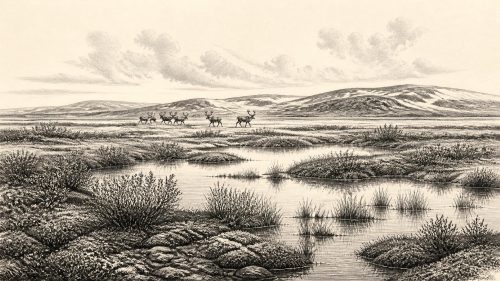
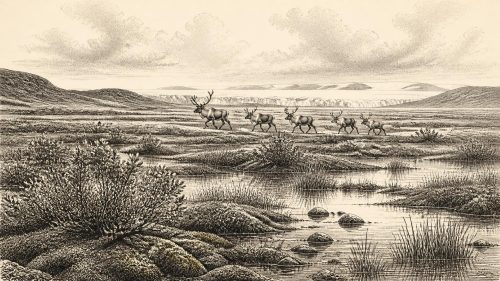
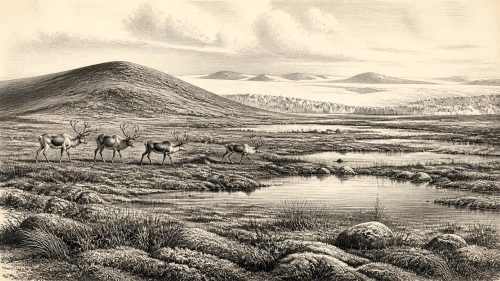
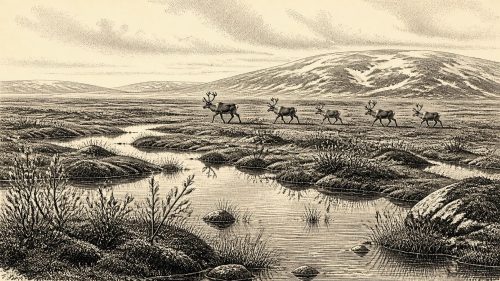
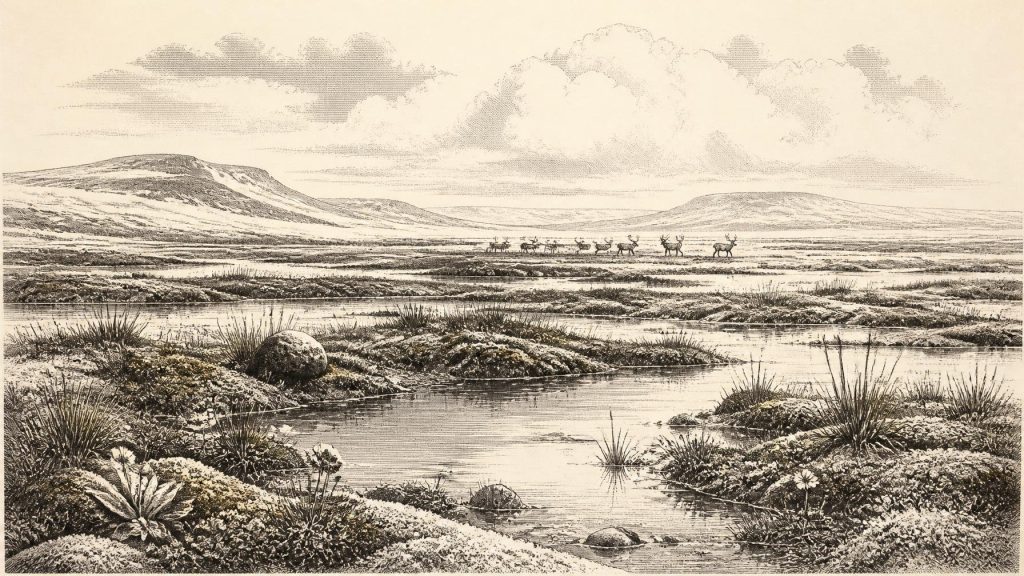
Derryvree’s pollen, plant macrofossils, mosses, insects and small-animal remains point to treeless, cold-stage country. Sedges, grasses, mosses and herbs grew around shallow or slow-moving freshwater. Arctic-alpine plants, including lesser clubmoss, indicate short growing seasons and severe winter conditions. The older term muskeg has been used for the deposit’s wet, organic-rich character, but it should not suggest a modern peat bog transplanted intact into the Ice Age. The evidence supports a mosaic of pools, silty margins, marshy ground and more exposed mineral surfaces, shaped by frost, thaw and seasonal runoff.
This was not necessarily a lifeless white expanse. Summer thaw permitted plant growth and made wetlands locally productive, while winter frost, low light and wind imposed extreme limits. A few grains of tree pollen in such deposits cannot establish nearby woodland: pollen can travel very long distances, and the wider Derryvree assemblage is overwhelmingly consistent with open vegetation. The strongest factual claim is therefore local: a cold freshwater environment existed at Derryvree during an interval between ice advances. Reconstructing a wider tundra-like landscape is a cautious interpretation, well supported by the fossils and regional climatic evidence but still broader than the deposit itself.
Castlepook’s Animal Archive
In the south, Castlepook Cave near Doneraile in County Cork provides the principal Irish animal archive for the period leading towards the Last Glacial Maximum. The cave’s early excavations recovered more than 2,000 bones. Subsequent radiocarbon work and reassessment have shown that its fauna accumulated over a long and complicated span, rather than during one occupation or one ecological moment. Finds include woolly mammoth, reindeer, giant deer, brown bear, wolf, Arctic fox, hare, lemmings and spotted hyaena. Their presence demonstrates that cold-adapted and open-country mammals reached Ireland in several Late Pleistocene phases.
Caves are not neutral stores of evidence. Carnivores could drag carcass parts underground; animals could die naturally in or near entrances; water could move bones; and early twentieth-century excavation disturbed original relationships between deposits. Castlepook therefore cannot be read as a tidy inventory of animals that stood together outside the cave on a single day. Yet the cumulative faunal evidence is important. It indicates an Ireland connected, at least intermittently, to the wider north-west European world of grazing herds, predators and scavengers. Lower sea levels exposed far more land on the continental shelves than exists today, although the exact routes, timings and ease of animal crossings remain matters of research rather than certainty.
The Reindeer Femur Question
Castlepook is also central to a major, unresolved question in Irish prehistory. A reindeer femur from the cave, re-examined by Ruth Carden, bears a deep mark interpreted as compatible with butchery using a stone tool. The animal bone has been publicised as approximately 33,000 years old, making the find potentially relevant to the broad period represented by this article. If the modification is securely anthropogenic, it would be the earliest currently claimed indication that people handled an animal in Ireland, far earlier than the long-established record of post-glacial settlement.
Its importance should not be exaggerated. A marked bone would document an action, not a settled community. The age of the bone is not an exact date for the mark, and the find lacks a securely associated hearth, stone-tool assemblage, occupation floor, dwelling, burial or repeated concentration of butchered remains. There is no basis for naming the people involved, assigning them an ethnic identity or reconstructing their language. It is possible that a small group briefly reached Ireland, killed or processed an animal, and left little else that survived later glaciation. It is equally essential to acknowledge that the interpretation requires continued scrutiny and publication of the cave’s stratified deposits.
No Polities, No Proven Trade
Political affairs, diplomacy and warfare cannot responsibly be supplied for Ireland at this point. There are no written records, settlements, weapons assemblages, boundaries, graves or monuments from which to infer leaders, alliances or territorial communities. The evidence does not support claims for tribes, kingdoms or an organised Irish population. The possible Castlepook intervention, if confirmed, belongs to a much smaller scale: a transient encounter between people, an animal and a demanding landscape.
Likewise, there is no evidence for agriculture, herding, permanent villages, pottery, long-distance commerce or formal trade in Ireland around this date. The economic framework visible in the fossils is ecological rather than institutional. Reindeer and other herbivores would have converted sparse vegetation into mobile food resources for predators, scavengers and, perhaps, passing hunters. Any human group present would have depended on close knowledge of animal movements, weather, shelter and the seasonal availability of fuel and water. That is a reasonable inference from Late Upper Palaeolithic lifeways elsewhere in north-west Europe, but it is not direct evidence for an Irish camp.
Culture Beyond Recovery
Religion, art, storytelling, kinship and learning surely mattered to any humans who may have entered this landscape, but none is recoverable from the Irish evidence of this age. No figurative art, engraved object, musical instrument, ritual deposit or human burial can be assigned securely to Ireland around 30,975 BCE. Silence in the record is not proof that people had no culture; it is a limit imposed by preservation and discovery. The later ice sheet was an especially destructive historical force, eroding ground surfaces and redepositing sediments across much of the island.
For the same reason, absence of an excavated camp should not be equated mechanically with absence of every person. The archaeological claim must remain proportionate: there is no confirmed occupation site of this age in Ireland. Castlepook offers a potentially transformative but isolated trace; Derryvree offers a rich environmental sequence rather than a human one. Together they make a historical landscape visible without allowing it to be overpopulated with imagined scenes.
Ice Was Building
The fuller expansion of the last British–Irish Ice Sheet lay ahead, though ice growth was already reshaping the wider archipelago. A widely used chronological model places major British–Irish Ice Sheet build-up after about 35–32 thousand years ago, with maximum extent broadly around 27–21 thousand years ago; other reconstructions stress strong regional variation in the timing and thickness of ice. Ireland was thus entering a period in which local ice margins, sea level, drainage and habitable ground could change greatly over millennia. Derryvree’s upper till is physical testimony that conditions there did not remain benign.
The most meaningful development around this notional year was therefore environmental instability. In Fermanagh, freshwater life occupied a cold interlude between glacier advances. In Cork, cave deposits preserve the remains of a varied Ice Age fauna, together with the contested possibility of human butchery. These are not fragments of an annual chronicle; they are the surviving evidence of a changing Pleistocene Ireland. They show an island—or, more accurately, a changing north-western peninsula and shelf-edge landscape—whose ecological opportunities were real but narrow, and whose human history remains tantalisingly difficult to prove.
Source References
Hover over a number to see the source. Select it to open the source.

- [1] A Middle Midlandian Freshwater Series at Derryvree, Maguiresbridge, County Fermanagh, Northern Ireland
- [2] The Stratigraphic Position and Age of the Gortian
- [3] Introduction to the Late Quaternary and Holocene of Northern Ireland
- [4] Soils of County Waterford
- [5] Exploring the chronostratigraphy of the last glacial cycle in Ireland
- [6] The Irish Quaternary Fauna Project
- [7] A Reconsideration of the Radiocarbon Dating of the Marine Isotope Stage 3 Fauna from Southern Ireland
- [8] Castlepook Cave: Cork County Geological Site Report
- [9] Heritage Artefacts of County Cork
- [10] Areas of Scientific Interest in County Cork
- [11] Castlepook Cave, Castlepook South, County Cork: Excavation Report 2022
- [12] Archaeology Research Excavation Grant 2022: Final Report
- [13] Dimensions and Chronology of the Last Ice Sheet in Western Ireland
- [14] Extent and Timing of the Last Glacial Maximum in Britain and Ireland: A Review
- [15] Last Glacial Maximum Cirque Glaciation in Ireland and Implications for Reconstructions of the Irish Ice Sheet
- [16] Trimlines, Blockfields and the Vertical Extent of the Last Ice Sheet in Southern Ireland
- [17] First Evidence of a Late Upper Palaeolithic Human Presence in Ireland
- [18] The Colonization of Ireland: A Human Ecology Perspective
- [19] New Insights on the Fauna of Ireland's Younger Dryas and Early Holocene from Alice & Gwendoline Cave
- [20] Occurrence of Mammalia Relicts at Site Castlepook Cave
- [21] The Caves of Ireland: An Introduction to the Karst Landscape
- [22] IntCal20 Northern Hemisphere Radiocarbon Age Calibration Curve (0–55 cal kBP)
Primary Sources
- A Middle Midlandian Freshwater Series at Derryvree, Maguiresbridge, County Fermanagh, Northern Ireland
- The Stratigraphic Position and Age of the Gortian
- Introduction to the Late Quaternary and Holocene of Northern Ireland
- Soils of County Waterford
- Exploring the chronostratigraphy of the last glacial cycle in Ireland
- The Irish Quaternary Fauna Project
- A Reconsideration of the Radiocarbon Dating of the Marine Isotope Stage 3 Fauna from Southern Ireland
- Castlepook Cave: Cork County Geological Site Report
- Heritage Artefacts of County Cork
- Areas of Scientific Interest in County Cork
- Castlepook Cave, Castlepook South, County Cork: Excavation Report 2022
- Archaeology Research Excavation Grant 2022: Final Report
- Dimensions and Chronology of the Last Ice Sheet in Western Ireland
- Extent and Timing of the Last Glacial Maximum in Britain and Ireland: A Review
- Last Glacial Maximum Cirque Glaciation in Ireland and Implications for Reconstructions of the Irish Ice Sheet
- Trimlines, Blockfields and the Vertical Extent of the Last Ice Sheet in Southern Ireland
- First Evidence of a Late Upper Palaeolithic Human Presence in Ireland
- The Colonization of Ireland: A Human Ecology Perspective
- New Insights on the Fauna of Ireland's Younger Dryas and Early Holocene from Alice & Gwendoline Cave
- Occurrence of Mammalia Relicts at Site Castlepook Cave
- The Caves of Ireland: An Introduction to the Karst Landscape
- IntCal20 Northern Hemisphere Radiocarbon Age Calibration Curve (0–55 cal kBP)