Fermanagh’s Intertill Waters30680 BCE
30,680 BCE is an imprecise modern label within Marine Isotope Stage 3, not a datable Irish historical year. At Derryvree, County Fermanagh, freshwater organic sediments between glacial tills, radiocarbon dated broadly around 30,500 BP, show cold, treeless wetlands with mosses, sedges and open tundra vegetation during an interval between ice advances. Other northern sites support local non-glacial conditions. Castlepook Cave, County Cork, preserves diverse cold-stage fauna, demonstrating changing ecological opportunities but not a single contemporaneous community. A possibly tool-marked reindeer bone may indicate brief Upper Palaeolithic human activity, yet no settlement evidence exists. Ireland remained a glaciated Late Pleistocene landscape.
Dateline
The label 30,680 BCE gives an appearance of precision that the evidence cannot sustain. Nobody in Ireland recorded a year, season or event at this depth of time, and no archaeological layer can be assigned securely to this single modern calendar year. Expressed against the conventional radiocarbon reference year of AD 1950, it falls roughly 32,630 years before present. It belongs to the final part of the Middle Midlandian in Irish terminology, within Marine Isotope Stage 3, a long and unstable phase of the Late Pleistocene. The Middle Midlandian is generally placed at about 58,000–31,000 years before present, but its climates, ice limits and habitats changed markedly within that span.
The responsible history of Ireland at this point is therefore not a chronicle of rulers or battles. It is an account assembled from sediments, fossil plants, insects, animal bones, cave deposits and the marks of advancing ice. These sources can reveal environments and possibilities for life; they cannot identify a people, a language, a polity or a named community. Their greatest value lies in showing that the island’s past was not a simple alternation between total ice cover and later human settlement. Local landscapes could be cold, exposed and biologically active even as the wider north-west European climate moved towards more severe glaciation.
A Number Within Deep Time
Radiocarbon dating does not turn directly into an exact BCE date. A laboratory measurement records the remaining carbon-14 in once-living material; because atmospheric carbon-14 has varied, the result must be calibrated against independently dated environmental records. IntCal20, the principal Northern Hemisphere calibration curve, extends to 55,000 calibrated years before present, but uncertainty becomes substantial so far back. Consequently, a nominal year such as 30,680 BCE is best treated as a point within a broad chronological window, not as an anniversary.
The closest important Irish environmental evidence comes from Derryvree townland, about two kilometres north-east of Maguiresbridge in County Fermanagh. Road works in 1969 cut through a drumlin and revealed a remarkable sequence: freshwater silts and fine sands, containing organic material, lay between two thick and distinct tills. Till is sediment deposited by glacier ice. The sequence demonstrates an earlier phase of glaciation, an intervening period in which water and organic-rich sediment accumulated, and a later glacial episode that sealed the deposits. That relative order is firm. The duration of each phase, and its exact relation to 30,680 BCE, is not.
Organic sediment from Derryvree, sample BIRM-166, produced a conventional radiocarbon determination of 30,500 years BP, with an uncertainty of +1,170/−1,030 years. Such a result belongs to a multi-millennial calibrated probability range rather than one calendar year. It nevertheless makes Derryvree indispensable for understanding Ireland in the broader Middle Midlandian world. Nearby Fermanagh sites at Hollymount and Greenagho likewise preserve evidence for cold, non-glacial intervals. Together, they show that parts of northern Ireland were not continuously buried beneath ice throughout this period.
Fresh Water Between Glaciers
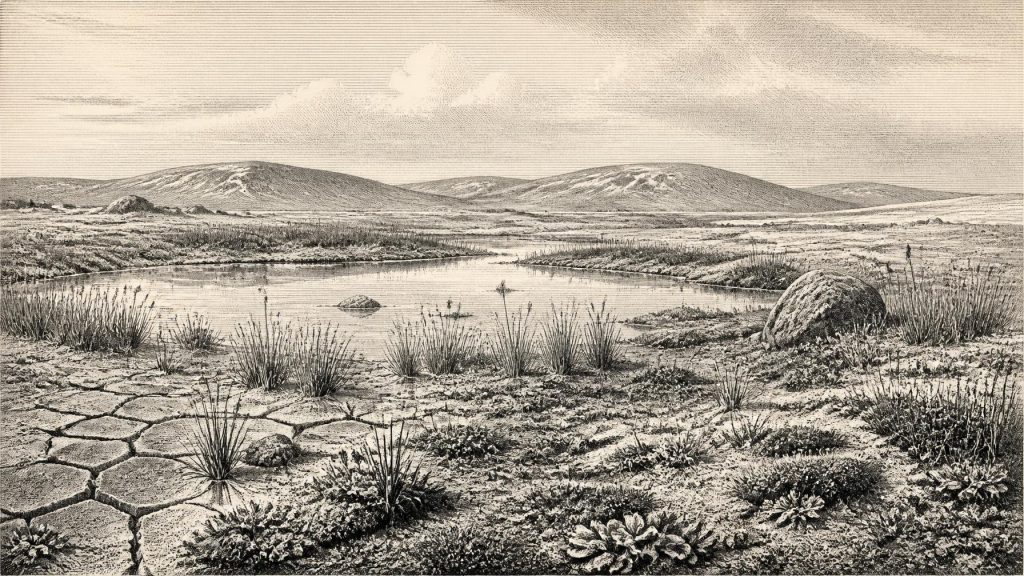
Derryvree is not evidence for a mild Irish landscape. Its plants and insects indicate a full-glacial, periglacial setting: a treeless country shaped by frost, seasonal cold and short growing seasons. The freshwater deposit contained mosses and sedges, while the fossil assemblage also points to hardy plants adapted to wet ground and open tundra-like terrain. The important observation is local persistence of fresh water. A shallow pool, marshy basin or wet hollow could support aquatic plants, invertebrates and waterside vegetation despite the severe wider climate.
Such evidence asks us to picture a varied landscape rather than a featureless white expanse. Low vegetation, sedgy margins, mossy ground, bare mineral sediment and pools could occur in sheltered depressions; more exposed ground would have been vulnerable to wind, freezing and thawing. Yet this reconstruction remains an interpretation. The fossils are direct evidence for organisms deposited at Derryvree; they do not provide a panoramic view of the whole island, nor do they prove that every part of Ireland had the same conditions at the same time.
Regional change was the dominant political fact of the age, if the word “political” is used only metaphorically. Ice expansion and retreat repeatedly altered ground surfaces, drainage, coastlines and routes across the Irish Sea region. Modern reconstructions of the British–Irish Ice Sheet indicate rapid growth after about 31,000 years ago, with ice building over Ireland and Britain through the following millennia. Around the nominal date considered here, Ireland was entering an era in which glaciation would increasingly reshape and erase older landscapes. The timing and extent of local ice were not uniform, so it would be wrong to imagine one island-wide ice margin on one particular day.
Caves and Cold-Stage Fauna
At the opposite end of the island, Castlepook Cave near Doneraile in County Cork preserves another crucial but differently limited archive. Excavations and later study have produced Ireland’s richest well-known collection of pre-Last Glacial Maximum vertebrate remains. The cave fauna includes animals associated with cold-stage environments, among them reindeer, woolly mammoth, giant deer, red deer, wolf, fox, Arctic fox, brown bear, hare, lemmings and spotted hyaena. It demonstrates that southern Ireland was at times part of a wider north-west European zone in which substantial grazing animals and predators could occur.
However, cave bone collections are not a census of one moment. Bones may have been brought in by carnivores, accumulated over long periods, disturbed by excavation, or redeposited within complex cave sediments. Modern redating has shown that several older determinations for southern Irish cave fauna were too young, pushing important remains further back into Marine Isotope Stage 3. The revised work suggests that some animals, notably giant deer and spotted hyaena, may already have disappeared locally before the Last Glacial Maximum. Castlepook can thus illuminate the ecological range of the broader period, but cannot prove that each listed species stood in Cork in 30,680 BCE.
The cave record also warns against treating “Ice Age” as a single environment. Mammoth-steppe and tundra systems could be productive where vegetation, seasonality, terrain and animal movement aligned favourably. Reindeer and other herbivores would have made use of open country; large carnivores and scavengers could exploit them. This is an ecological inference supported by the fauna, not evidence for a settled human hunting economy in Ireland.
The Human Question
The possibility of people in Ireland during this broad period has become one of the most significant and carefully qualified questions in Irish prehistory. A reindeer femur from Castlepook has been reported as bearing a deep modification interpreted by zooarchaeologist Ruth Carden as a cut or chop made on fresh bone with a sharp stone tool. Public reporting has associated the specimen with an age of about 33,000 years. If that interpretation and association are confirmed through further contextual research, it would be evidence that a person processed a reindeer carcass in Ireland during the Upper Palaeolithic.
That conclusion must not be enlarged beyond the bone. No securely associated hearth, stone-tool assemblage, dwelling, burial, occupation floor or durable settlement has yet been identified at Castlepook for this episode. One modified bone cannot establish whether people hunted the animal, scavenged it, visited briefly, returned seasonally, travelled by a particular route or left descendants. Nor does it supply a name, language, social organisation or belief system. The marked femur is potentially momentous precisely because the rest of the human record is so slight.
What Cannot Be Written
There is no responsible evidence for political institutions, diplomacy, warfare, territorial lordship, farming, trade networks, ritual monuments, formal religion or learning in Ireland at this date. There are no known houses, graves, tools securely attributable to a local population, or material signs from which to reconstruct everyday family life. It would be misleading to fill these silences with generic stories of “tribes”, shamans or hunters. Mobile people elsewhere in Upper Palaeolithic Europe certainly possessed sophisticated social knowledge and technologies, much of it made from perishable materials, but importing that record into Ireland would be analogy, not Irish evidence.
The year’s proper historical emphasis is therefore environmental opportunity constrained by instability. Fermanagh’s intertill sediments show that cold-stage wetlands and open vegetation could survive between glacial phases. Cork’s caves show that a varied fauna occupied or reached Ireland during parts of Marine Isotope Stage 3. The possible reindeer cut mark raises the prospect of fleeting human activity. There is, nevertheless, no evidence for continuity from any such visit into the much later, securely documented post-glacial settlement of Ireland.
For 30,680 BCE, Ireland is best understood as a changing Late Pleistocene landscape rather than a country with annual history. Water gathered in a Fermanagh hollow; sedges and mosses grew at its margins; ice had already transformed the land and would do so again. In Cork, caves accumulated bones that would survive where almost all open-air traces were lost. Those modest, durable fragments are enough to make the period historically meaningful, but not enough to turn an uncertain climatic interval into a calendar-year narrative.
Primary Sources
- A Middle Midlandian Freshwater Series at Derryvree, Maguiresbridge, County Fermanagh, Northern Ireland
- Early Midlandian–Middle Midlandian, Pleistocene, Northern Ireland
- A Reconsideration of the Radiocarbon Dating of the Marine Isotope Stage 3 Fauna from Southern Ireland
- The Irish Quaternary Fauna Project
- The IntCal20 Northern Hemisphere Radiocarbon Age Calibration Curve (0–55 cal kBP)
- The IntCal20 Northern Hemisphere Radiocarbon Age Calibration Curve (0–55 cal kBP)
- Growth and Retreat of the Last British–Irish Ice Sheet, 31,000 to 15,000 Years Ago: the BRITICE-CHRONO Reconstruction
- BRITICE-CHRONO Maps and GIS Data of the Last British-Irish Ice Sheet 31 to 15 ka
- BRITICE Glacial Map, Version 2: a Map and GIS Database of Glacial Landforms of the Last British–Irish Ice Sheet
- The Timing and Magnitude of the British–Irish Ice Sheet Between Marine Isotope Stages 5d and 2
- Data – Ice Samples – Software
- Figure 6.— The Subdivision of the Quaternary Period in Ireland
- References and Recommended Reading
- Archaeological Heritage of County Cork
- Heritage Artefacts of County Cork
- Castlepook Caves
- Mammoth Cave, County Cork
- New Insights on the Fauna of Ireland’s Younger Dryas and Early Holocene from Alice & Gwendoline Cave
- Aghnadarragh
- Geology of Northern Ireland: Our Natural Foundation
- Conserving Quaternary Geoheritage in Northern Ireland
- Reindeer Bone Found in Cork Cave Shows Human Activity in Ireland 33,000 Years Ago