Maguirebridge’s Periglacial Ledger30565 BCE
About 30,565 BCE, Ireland lay in the volatile MIS 3 phase of the Late Pleistocene, not a date recoverable as a single historical year. Freshwater sediments at Derryvree, County Fermanagh, dated broadly to this period, show an interval between glacial advances when treeless tundra wetlands supported mosses, sedges and Arctic-alpine plants. Cave deposits at Castlepook, County Cork, document cold-adapted fauna including reindeer, mammoth and hyaena. An incised reindeer bone may indicate brief human butchery, but cannot establish settlement. Later glaciation destroyed much evidence. No reliable evidence supports claims about population, society, culture or politics; environmental change dominates the Irish record.
Dateline
The label 30,565 BCE is useful for arranging a modern timeline, but it cannot identify an event that happened in a single Irish calendar year. Nobody in Ireland then used writing, a numbered calendar or an annalistic system, and no archaeological deposit can be dated to this precise point. In simple arithmetic, the label falls about 32,514 years before AD 1950, the conventional ‘present’ of radiocarbon science. The responsible setting is the later part of the Late Pleistocene, within Marine Isotope Stage 3 (MIS 3), an unstable interval of the last Ice Age. Evidence comes in broad calibrated ranges, not in annual entries.
The closest relevant Irish environmental chronology is a freshwater deposit exposed during roadworks at Derryvree, near Maguiresbridge in County Fermanagh. Its conventional radiocarbon age, BIRM-166, was 30,500 radiocarbon years before present, with a substantial uncertainty. Published calibrations have placed the deposit broadly at c. 36,900–31,700 calibrated years before present, or approximately 34,950–29,750 BCE. The modern label used here falls inside that wide span. This does not mean that the Derryvree wetland can be pictured on one particular day in 30,565 BCE; it means that its buried sediments are the best local evidence for conditions in roughly this phase of Ireland’s past.
A Landscape Between Ice Advances
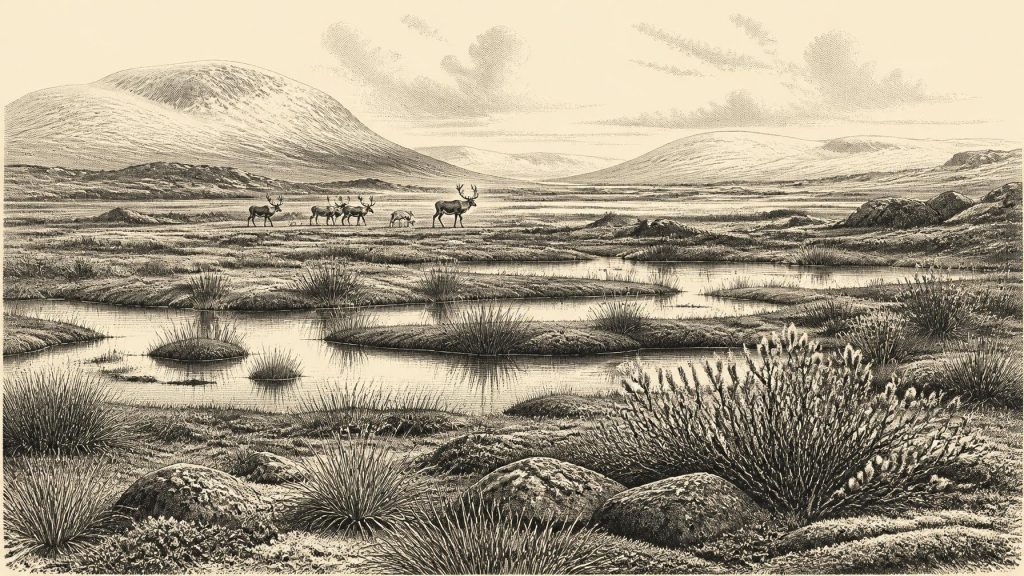
Derryvree was an important discovery because its silts and fine sands lay between two layers of till, the unsorted debris deposited by moving glacier ice. The sequence records three large-scale environmental facts: ice had previously affected the locality; an interval followed in which fresh water and wet ground existed there; and later glacial deposition sealed the evidence. It is therefore a warning against treating Ice Age Ireland as uniformly, continuously ice-covered. At least in this part of Fermanagh, conditions were locally ice-free for a time during MIS 3.
The sediments nevertheless describe a severe world. Plant pollen was poorly preserved, but mosses, seeds and other macrofossils, together with insect evidence, point to open, treeless tundra or muskeg: wet, peaty ground broken by shallow pools, sedge-rich margins and sparse vegetation. Grasses and sedges were prominent. Dwarf willow, juniper and Arctic-alpine plants, including mountain avens and bogbean, belong to the wider picture reconstructed from the deposit. These were not forests, fields or settled pasture. They indicate a periglacial landscape where seasonal thaw could produce surface water above long-frozen ground, while winters were harsh and the growing season short.
This is local evidence, not a complete map of the island. Conditions could differ sharply with altitude, proximity to ice, drainage and coast. Still, Derryvree provides a rare, direct glimpse of an Irish terrestrial environment at an age relevant to 30,565 BCE. It shows that life persisted in cold habitats and that freshwater ecosystems existed during a climatically volatile period.
Climate Change on an Ice-Age Island
Ireland’s position on the western edge of Europe made its climate especially sensitive to changes in Atlantic circulation, temperature and ice-sheet behaviour. MIS 3 was not a single unchanging freeze. Greenland ice-core records reveal abrupt alternations between colder stadials and relatively milder interstadials, while Irish cave deposits offer compatible evidence for episodic environmental improvement. Uranium-thorium dates from stalagmites in Crag Cave, County Kerry, show that liquid water was able to percolate through shallow cave systems during particular warmer phases of the last glacial cycle. Such evidence does not provide a weather report for 30,565 BCE, but it confirms that the Irish climate changed sharply on millennial timescales.
There is an important tension in the evidence. Other records show that an Irish ice sheet had already been substantial during parts of the period before the conventional Last Glacial Maximum, and that its margins could advance and retreat rapidly. The Derryvree deposits show local ice-free conditions; they do not prove that all Ireland was open, nor that any route across the Irish Sea was consistently passable. Around this point in time, the island should be understood as a shifting mosaic of glacial, periglacial and perhaps more sheltered habitats, rather than as either an entirely habitable plain or an unbroken cap of ice.
Animals at the Western Edge of Europe
Cave deposits in north County Cork add a different kind of evidence. Castlepook Cave, near Doneraile and sometimes called Mammoth Cave, produced a remarkable collection of Late Pleistocene animal remains during early twentieth-century excavations. The assemblage includes reindeer, woolly mammoth, giant deer, brown bear, spotted hyaena, wolf, Arctic fox, lemmings and mountain hare. Taken together, these animals indicate that Ireland participated in the wider north-west European mammoth-steppe and tundra world, although individual bones accumulated over long periods and should not be treated as one simultaneously living herd.
Castlepook was not necessarily a human camp. Carnivores could drag bones into caves, gnaw them, scatter them and mix remains of different ages. Hyaena activity is particularly important when interpreting the site. Modern re-dating and improved pretreatment of bone collagen have also shown that some older radiocarbon determinations from Irish cave collections require revision. The scientifically secure conclusion is that a diverse cold-climate fauna used or reached southern Ireland during MIS 3. It is less secure to specify exactly when every species was present, how large local populations were, or whether their movements followed a single route from Britain or continental Europe.
Reindeer are especially relevant to the period. A reindeer femur from Castlepook has been identified by Ruth Carden as bearing a deep incision consistent with a sharp stone tool used on fresh bone. County Cork heritage material dates the object broadly to c. 31,000 BCE and interprets it as evidence of butchery by Palaeolithic hunters. If that interpretation is sustained, it would push possible human activity in Ireland far back into MIS 3. Yet the claim must remain carefully bounded: the bone is not from a securely excavated occupation floor, and no associated lithic assemblage, hearth, shelter, burial or human remains of comparable age has been recovered there.
People: A Possibility, Not a Population
The marked femur may record a short visit by mobile hunters who encountered or processed a reindeer carcass. It cannot establish a permanent settlement, a named people, a language, a political community or continuity with later inhabitants of Ireland. Nor can it prove whether people killed the animal, found it already dead, butchered it near the cave, or how its remains entered the cave system. Later glaciation, erosion and sea-level change have removed or buried much of the evidence that might once have answered those questions.
The distinction matters because the earliest well-supported evidence for human activity in Ireland remains much later. At Alice and Gwendoline Cave in County Clare, a butchered brown-bear patella has been independently dated to about 12,810–12,590 calibrated years before present. That terminal-Pleistocene find is supported by direct dating, but it is separated from the possible Castlepook signal by roughly twenty millennia of climatic disruption and an extremely sparse archaeological record. For 30,565 BCE, the honest conclusion is not that Ireland had a known human population, but that a single bone raises the possibility of a fleeting Upper Palaeolithic presence.
Society Beyond Recovery
No evidence can responsibly describe political affairs, diplomacy, warfare, leadership or territorial boundaries in Ireland at this date. There are no settlements from which household size or social hierarchy can be measured, and no artefacts that reveal exchange networks. Likewise, there is no Irish evidence for farming, domestic animals, cultivation, metalworking, pottery, weaving or trade. If people briefly visited, their economy may plausibly have involved highly mobile hunting and scavenging in a landscape used by reindeer and other large mammals, but that is an inference from the environmental setting and a contested bone modification, not a demonstrated Irish lifeway.
Religion, art, formal learning and language are equally beyond recovery for this moment. Human communities elsewhere in Upper Palaeolithic Europe possessed rich traditions of symbolic practice, technology and social knowledge, but those broader European facts must not be projected automatically onto Ireland. No cave art, engraved object, ornament, burial or ritual place of this age has been securely identified on the island. Absence of evidence does not prove absence of thought or culture among any visitors; it defines what the Irish record can presently support.
An Uneven Survival of Evidence
The most important development around this notional year was environmental rather than political: Ireland lay within a changing Ice Age zone where local wetlands, tundra plants and cold-adapted animals survived between episodes of glaciation. Derryvree’s freshwater silts preserve this ecological fact with unusual clarity. Castlepook preserves a complementary but more complex faunal archive, and its incised reindeer femur keeps open a consequential question about early human movement.
Those fragments are all the more valuable because the subsequent growth and movement of ice profoundly remodelled Ireland. Glaciers eroded surfaces, redistributed sediments and obscured older landscapes; later rising seas altered coasts and separated Ireland more decisively from Britain. What can be written for 30,565 BCE is therefore necessarily modest: not an annual chronicle, but a carefully dated reconstruction of a cold, open and unstable Irish world, rich in animal life and possibly, for a brief moment, touched by people.
Primary Sources
- A Middle Midlandian Freshwater Series at Derryvree, Maguiresbridge, County Fermanagh, Northern Ireland
- Palaeoecology: Irish Quaternary Association Field Guide No. 16
- Irish Pleistocene Biostratigraphy
- Landscapes and Environments of the Last Glacial-Interglacial Transition: A Time of Amazingly Rapid Change in Ireland
- The Irish Quaternary Fauna Project
- A Reconsideration of the Radiocarbon Dating of the Marine Isotope Stage 3 Fauna from Southern Ireland
- Heritage Artefacts of County Cork
- Castlepook Cave, Co. Cork: Archaeological Assessment 2022
- Radiocarbon Constraints on the History of the Western Irish Ice Sheet Prior to the Last Glacial Maximum
- Radiocarbon Constraints on the Age of the Maximum Advance of the British-Irish Ice Sheet in the Celtic Sea
- The Deglaciation of the Western Sector of the Irish Ice Sheet from the Inner Continental Shelf to its Terrestrial Margin
- Early Deglaciation of the Western Sector of the British-Irish Ice Sheet
- Extent and Deglacial Chronology of the Last British-Irish Ice Sheet; Implications of Exposure Dating Using Cosmogenic Isotopes
- Trimlines, Blockfields and the Vertical Extent of the Last Ice Sheet in Southern Ireland
- Episodic Speleothem Deposition Tracks the Terrestrial Impact of Millennial-Scale Last Glacial Climate Variability in SW Ireland
- The IntCal20 Northern Hemisphere Radiocarbon Age Calibration Curve (0–55 cal kBP)
- IntCal Publications
- First Evidence of a Late Upper Palaeolithic Human Presence in Ireland
- First Evidence of a Late Upper Palaeolithic Human Presence in Ireland
- New Insights on the Fauna of Ireland’s Younger Dryas and Early Holocene from Alice & Gwendoline Cave
- New Insights on the Fauna of Ireland’s Younger Dryas and Early Holocene from Alice & Gwendoline Cave
- New Data for the Last Glacial Maximum in Great Britain and Ireland