Crag Cave’s Interrupted Dripstone30541 BCE
Around 30,541 BCE, Ireland lay within an unstable later-Pleistocene cold stage, before the Last Glacial Maximum, rather than a landscape describable through annual history. Derryvree, County Fermanagh, preserves freshwater sediments between glacial tills, indicating locally ice-free, treeless tundra with wetland plants during an environmental interval. Cave fauna demonstrate changing access for cold-adapted and large mammals, although deposits span different dates. Crag Cave stalagmites record episodic milder conditions permitting water circulation. Possible butchery marks on a Castlepook reindeer bone raise, but do not prove, Upper Palaeolithic human activity. Evidence reveals climatic variation, not societies, events or precise calendar chronology at all.
Dateline
30,541 BCE is not a date at which Irish history can be narrated year by year. No people in Ireland used a calendar resembling the modern BCE system, and neither written records nor archaeological deposits allow an event to be assigned to this particular year. It is best understood as a modern label for a point about 32,490 calendar years before AD 1950, within the later Pleistocene, broadly Marine Isotope Stage 3. The responsible evidence comes in wide scientific ranges, not annual entries: radiocarbon results with statistical uncertainties, calibrated ranges, cave deposits and traces of changing ice. The closest local chronological anchor is a freshwater deposit at Derryvree, near Maguiresbridge in County Fermanagh, dated conventionally to 30,500 radiocarbon years BP with a substantial error range. Calibration places its formation across millennia, rather than at one precise calendar date.
An Island in a Long Cold Stage
At this point in the last glacial cycle, Ireland was neither the familiar green, wooded island of later prehistory nor necessarily a single uniform wilderness of ice. It lay in an unstable northern Atlantic world in which climate could alter markedly over centuries and millennia. The Last Glacial Maximum, when the British–Irish Ice Sheet reached its greatest overall extent, lay ahead: its broad time window is conventionally placed around 27,500–19,000 years ago. Around 30,541 BCE, glaciers and ice sheets were building towards that later maximum, while their margins, thickness and timing varied regionally. It is therefore unsafe to colour every part of Ireland as either wholly ice-covered or wholly habitable at this single notional moment.
The Derryvree sequence is important precisely because it preserves evidence of an interval when ground in south Fermanagh was not buried beneath the later ice that formed the enclosing drumlin. Road works in 1969 exposed organic silts and fine sands between two thick till sheets. The lower and upper tills record separate glacial episodes; the intervening freshwater sediments record a period of open water, sediment accumulation and plant growth. Modern reassessments rightly treat this old radiocarbon determination cautiously when reconstructing ice-sheet limits, but it remains strong evidence for ice-free conditions at Derryvree before the later advance. It is evidence for a local environmental window, not a map of all Ireland.
Fermanagh’s Freshwater Tundra
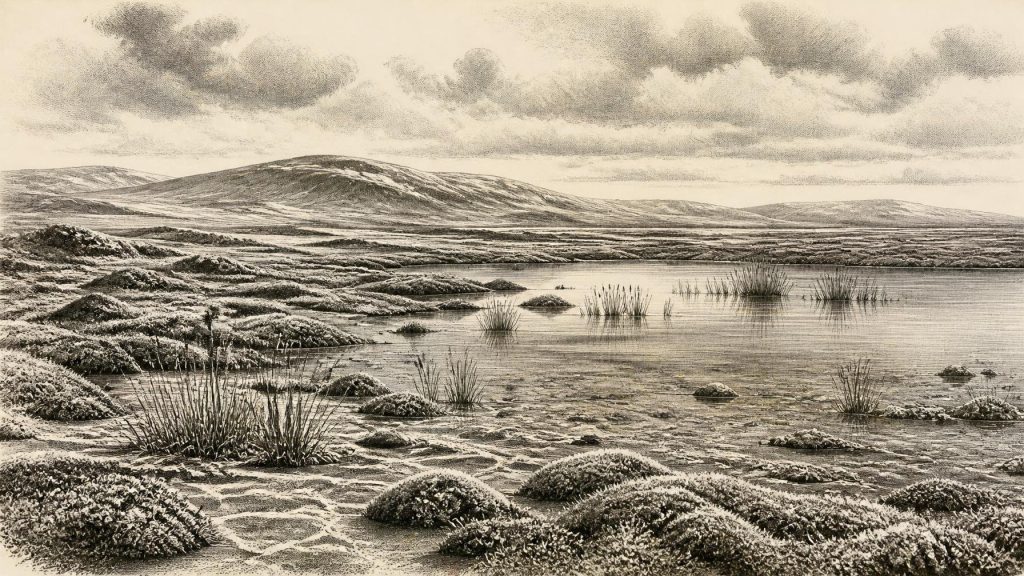
The organisms preserved in the Derryvree silts offer the clearest responsible picture of an Irish landscape relevant to this era. Pollen survived poorly, but plant macrofossils, mosses and insect remains indicate a cold, treeless, periglacial setting. Tundra should not be imagined as lifeless snowfield. It denotes open vegetation adapted to short summers, frost, exposed soils and severe winters: patches of sedges, mosses and low herbaceous plants around wet ground, with aquatic plants in the water itself. Bogbean and water-milfoil among the recorded fossils show that shallow freshwater habitats could support vegetation during the growing season. The surrounding dry ground may often have carried sparse cover rather than continuous grassland or woodland.
Such a scene had strong seasonal contrasts. Meltwater, shallow pools and sedgy margins could be productive in summer, while frozen ground, wind exposure and limited plant growth constrained life through much of the year. Periglacial does not simply mean “near ice”: it refers to a landscape shaped by intense freezing and thawing, even where glacier ice was absent. Frost could disturb soils, alter drainage and restrict trees. Derryvree therefore provides an environmental history rather than an episode of political or human history. Its freshwater bed makes clear that the island’s pre-maximum glacial history included ecological complexity, but it cannot tell us what conditions prevailed simultaneously in Cork, Kerry, Antrim or the western seaboard.
Caves, Animals and Uneven Evidence
Cave assemblages, especially in southern Ireland, supplement the Fermanagh evidence. The Irish Quaternary Fauna Project established that a diverse range of mammals reached Ireland during the broad period from at least about 45,000 to 20,000 years ago. Bones from cave collections include reindeer, mammoth, giant deer, brown bear, hare, fox, lemming and carnivores including spotted hyaena. This is compelling evidence that Ireland was intermittently connected to, or accessible from, wider north-west European animal populations during the Pleistocene. It does not license a reconstructed parade of all these species across the island in 30,541 BCE: caves often contain material of different ages, and many early excavations disturbed or mixed deposits.
Nevertheless, the faunal record accords with the broad ecology implied by Derryvree. Reindeer and lemmings are especially suggestive of cold, open habitats; mammoth and giant deer point to the capacity of at least some pre-maximum landscapes to sustain large herbivores. Red deer also occurred in Ireland before the glacial maximum, though the dated evidence is comparatively scarce. These animals would have responded to shifting vegetation, snow conditions, access routes and the advance or retreat of ice. Their presence in Irish deposits is a record of changing biogeography, not proof of a stable resident herd at a specified place or season.
Crag Cave, near Castleisland in County Kerry, adds a different kind of evidence. Uranium-series dating of its stalagmites shows that dripstone formation during the last glacial period was episodic and associated with comparatively milder Greenland Interstadials. Stalagmite growth requires water to percolate through soil and bedrock, so its occurrence demonstrates intervals sufficiently temperate and unfrozen for that process; its absence may reflect colder, drier or permafrost-affected conditions. It should not be treated as a thermometer for one year, but it confirms that south-west Ireland experienced pronounced climatic oscillation before the ice sheet reached its later maximum.
The Unresolved Human Question
The possibility of people in Ireland at this remote point remains important but unresolved. A reindeer femur from Castlepook Cave near Doneraile, County Cork, has been reported as roughly 33,000 years old and bears a deep surface modification interpreted by zooarchaeologist Ruth Carden as a mark made during butchery with a stone tool. If that interpretation is sustained by further study, it would show a human encounter with a reindeer carcass in Ireland during the Upper Palaeolithic, well before the later, securely documented post-glacial settlement of the island. It would not demonstrate a village, a permanent population, a named culture or occupation in 30,541 BCE.
Caution is essential because Castlepook’s historically excavated deposits have complicated histories. A date on bone establishes the age of the animal’s death, while identifying a mark as humanly made requires a separate taphonomic judgement. Nor can a find from one cave establish whether people lived locally, arrived for a short hunting or scavenging expedition, or entered Ireland only rarely during favourable environmental windows. Recent work at Castlepook seeks undisturbed deposits, fresh environmental samples and artefacts such as lithics or charcoal that could test the hypothesis. Until such contextual evidence is recovered, the most that can be responsibly said is that pre-maximum human activity in Ireland is a credible research question, not a settled chapter of settlement history.
No Polities, No Diplomacy
There is no evidence for political affairs, diplomacy, territorial states, leaders, warfare, ritual institutions or organised religion in Ireland at this date. There are no houses, burials, hearths, tools, monuments, artworks or settlements that can securely be assigned to this narrow point in time. If people did reach Ireland, comparisons with Upper Palaeolithic groups elsewhere in Europe make small, mobile foraging parties more plausible than sedentary communities. But that is an interpretation based on a wider European context, not direct Irish proof. It must not be mistaken for evidence of an Irish society with known customs, language or identity.
For the same reason, an economy cannot be reconstructed in the usual historical sense. There was no farming, metalworking, coinage, market exchange or documented sea trade. The only possible economic act directly relevant to the period is carcass processing implied by the contested Castlepook bone mark: the removal of meat, hide, sinew or marrow from a large animal. Even this is conditional. Animal movements between Ireland and neighbouring lands demonstrate ecological connectivity, but they do not prove that people crossed the sea at the same time or that any regular route existed. Lower sea levels changed coastlines, yet Ireland’s precise accessibility to humans depended on sea gaps, weather, boats, ice and local geography that cannot be reduced to a single answer.
What This Date Can Mean
The most meaningful development around 30,541 BCE was environmental rather than political: Ireland stood within a changing cold-stage mosaic before the later glacial maximum. At Derryvree, freshwater and tundra vegetation existed between episodes of glaciation. In southern caves, animal remains preserve a longer record of Pleistocene visitors and inhabitants, although the dates and contexts vary. At Crag Cave, mineral growth records periods when south-western conditions allowed water to circulate through the karst. Together, these archives replace the outdated image of an unchanging, entirely frozen island with one of regional variation, climate pulses and advancing ice.
The limits of the record are as historically significant as its contents. Modern calendar precision is unavailable; “30,541 BCE” is a point imposed on evidence that is measured in ranges of centuries and millennia. The archaeological picture is therefore not of kings, conflicts or communities, but of water, frost, plants, animals and the possibility—still awaiting decisive confirmation—of a brief human presence. Ireland’s history at this depth of time survives not in annals, but in buried mud beneath a Fermanagh drumlin, animal bones in limestone caves and interrupted layers of calcite in a Kerry cavern.
Primary Sources
- A Middle Midlandian Freshwater Series at Derryvree, Maguiresbridge, County Fermanagh, Northern Ireland
- The Irish Quaternary Fauna Project
- The IntCal20 Northern Hemisphere Radiocarbon Age Calibration Curve (0–55 cal kBP)
- Episodic Speleothem Deposition Tracks the Terrestrial Impact of Millennial-Scale Last Glacial Climate Variability in SW Ireland
- The Evolution of the Terrestrial-Terminating Irish Sea Glacier During the Last Glaciation
- Maximum Extent and Readvance Dynamics of the Irish Sea Ice Stream and Irish Sea Glacier Since the Last Glacial Maximum
- Exploring Controls of the Early and Stepped Deglaciation on the Western Margin of the British-Irish Ice Sheet
- Spatio-Temporal Dynamics of Speleothem Growth and Glaciation in the British Isles
- Phylogeographic, Ancient DNA, Fossil and Morphometric Analyses Reveal Ancient and Modern Introductions of a Large Mammal: The Complex Case of Red Deer (Cervus elaphus) in Ireland
- New Insights on the Fauna of Ireland’s Younger Dryas and Early Holocene from Alice & Gwendoline Cave
- Archaeology Research Excavation Grant 2022: Castlepook Cave Project Report
- 32564: Castlepook Cave, County Cork
- Ireland Through Geological Time
- Quaternary
- Palaeoecology
- The Mesolithic in Ireland: When Was It?
- Archaeological Heritage of County Cork
- Heritage Artefacts of County Cork
- Archaeological Excavations at Killuragh Cave, Co. Limerick
- Last Glacial Maximum Cirque Glaciation in Ireland and Implications for Reconstructions of the Irish Ice Sheet
- New Data for the Last Glacial Maximum in Great Britain and Ireland
- Geology of Ireland