The Castlepook Reindeer Inquiry30535 BCE
Around 30,535 BCE, Ireland’s history is reconstructed from geological and biological evidence rather than dated events. Derryvree sediments in Fermanagh, preserved between glacial tills, indicate cold, treeless freshwater and tundra habitats during a Marine Isotope Stage 3 interval. Castlepook Cave in Cork yielded mammoth, reindeer, giant deer, bear, wolf and hyaena remains, demonstrating a varied pre-maximum glacial fauna, though not a contemporaneous community. A cut-like mark on a reindeer femur may be early evidence of human carcass processing, but remains unconfirmed and cannot prove settlement. Approaching ice-sheet expansion later erased much evidence, leaving fragmentary records of environments and possible mobility.
Dateline
30,535 BCE is a useful modern label, but it cannot identify an event in Ireland that happened in a recoverable calendar year. At this depth of time, evidence comes in broad calibrated ranges, not annual chronicles. The date falls within the later part of Marine Isotope Stage 3, a long, climatically unstable phase of the last Ice Age, before the fullest expansion of the British–Irish Ice Sheet. The responsible history of Ireland at this point is therefore not a record of rulers, wars or named communities. It is an account assembled from buried wetland sediments, cave bones, radiocarbon measurements, glacier deposits and the careful testing of a single, controversial-looking mark on a reindeer bone.
A Date Within Ranges
Archaeologists and Quaternary scientists use several chronological languages. “Before present” normally counts backwards from AD 1950; radiocarbon years are not identical to calendar years; and calibration converts radiocarbon results into probability ranges using changing atmospheric carbon-14 records. The numbered year 30,535 BCE lies roughly 32,485 calendar years before AD 1950, but it must not be treated as a precise timestamp for an Irish site. At such antiquity, uncertainty can amount to centuries or millennia.
The closest environmental anchor is Derryvree, near Maguiresbridge in County Fermanagh. Roadworks exposed an extraordinary sequence within a drumlin: an older glacial till, freshwater sands and silts with organic material, and a later till laid down when ice returned. The organic deposit produced the conventional radiocarbon determination BIRM-166, 30,500 years BP with a substantial uncertainty. Modern calibration places it broadly at c. 36,900–31,700 calibrated years BP, or approximately 34,950–29,750 BCE. Thus 30,535 BCE falls within the wide interval to which this local archive may be relevant, but cannot be tied to a particular season, layer or occurrence in the old wetland.
Fresh Water Beneath Later Ice
Derryvree’s value is geological and ecological. Its position between tills demonstrates that, at some point within its dated range, the locality was sufficiently free of glacier ice for a body of slow-moving or standing fresh water to form and for sediments rich in organic remains to accumulate. The later ice sheet then sealed that evidence beneath glacial debris. This is direct evidence for a freshwater habitat in one part of Fermanagh; it is not proof that the whole island was simultaneously ice-free, nor a detailed climate diary for every Irish region.
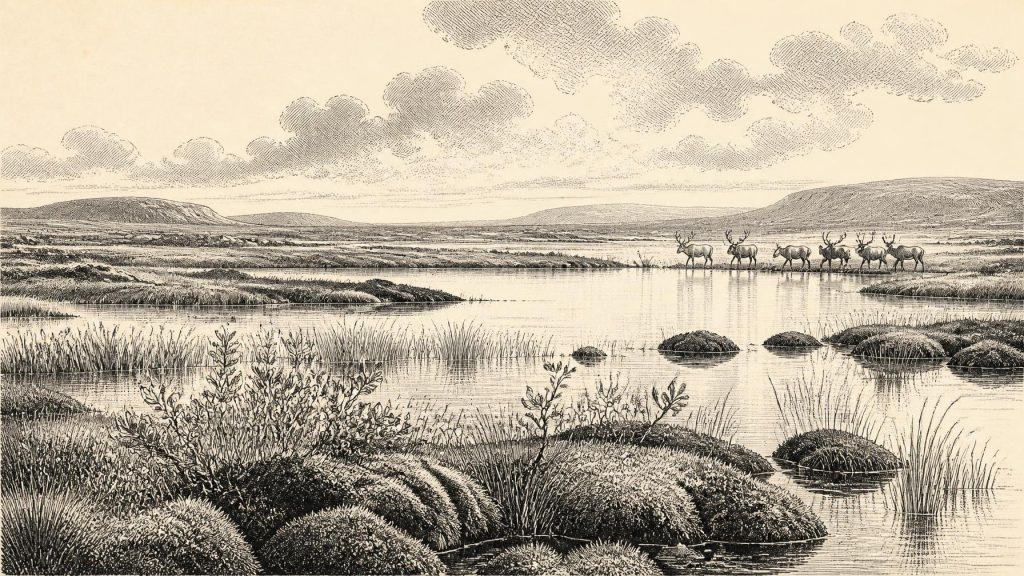
Plant macrofossils, pollen and insects recovered from the deposit point to a cold, largely treeless, periglacial landscape. Fossil records include bogbean, dwarf willow and mountain avens, species associated with damp ground, open tundra or Arctic-alpine conditions. Mosses, sedges and aquatic plants indicate a mosaic rather than an empty white wilderness: shallow water, wet margins and open vegetation could coexist in a severe climate. Such evidence is especially important because later ice erosion removed or disturbed vast tracts of the older land surface.
It would be misleading, however, to turn these fossil plants into an idyllic “Irish summer” scene. Their presence shows that particular habitats existed and that living communities occupied them. It does not give a precise annual temperature, nor show how long every species persisted. The broader North Atlantic climate was subject to abrupt shifts. Local open water and tundra vegetation may have been viable during an interval that was, in geological terms, short-lived, before advancing ice transformed the landscape again.
Castlepook’s Animal World
For animals, the principal Irish archive is Castlepook Cave, also called Mammoth Cave, near Doneraile in north County Cork. Excavations in the early twentieth century, and subsequent work on museum collections, recovered a striking late-Pleistocene fauna. It includes woolly mammoth, reindeer, giant deer, brown bear, wolf and spotted hyaena; other material has added to a picture of an Irish landscape that could support both grazing mammals and formidable carnivores before the Last Glacial Maximum.
These cave assemblages were not deposited as a neat census of animals living side by side on one day. Bones may have entered caves through carnivore activity, natural deaths, water movement, scavenging and early excavation practices that did not meet modern standards of recording. Improved radiocarbon dating and bone pretreatment have nevertheless shown that at least part of the southern Irish cave fauna belongs to Marine Isotope Stage 3, broadly before the maximum late-glacial ice expansion. Castlepook therefore demonstrates genuine ecological richness, while demanding caution about exact association and timing.
The named animals also reveal regional change. Ireland’s later historic fauna was shaped by extinction, recolonisation and human action, but the pre-maximum faunal record contains species now absent from the island. A spotted hyaena skull from Castlepook, held by the National Museum of Ireland, is a particularly vivid reminder that caves formed part of a predator-rich landscape. Hyaenas could accumulate and modify bones; they were competitors for carcasses, not evidence of human conflict. Mammoth and reindeer remains likewise attest to large-animal habitats, not to a stable, island-wide population count.
The Reindeer Femur
The most arresting object for this broad period is a reindeer femur from Castlepook. Ruth Carden has interpreted a mark on the bone as an incision made by a sharp stone tool while fresh tissue was being removed. Public discussion has often described the bone as about 33,000 years old, while County Cork heritage material has placed it broadly around 31,000 BCE. Either formulation is necessarily approximate, and neither can identify activity in 30,535 BCE itself.
If the mark is confirmed as a human-made cut mark and is contemporaneous with the bone’s age, it would be exceptionally early evidence that people handled an animal in Ireland. It might represent butchery after hunting, scavenging or the encounter with an already-dead reindeer. It does not establish which explanation is correct. Nor does one marked bone demonstrate a camp, a permanent settlement, a resident population, a migration route, or continuous occupation across generations.
This distinction matters. No securely excavated hearth, stone-tool assemblage, built shelter, burial, human skeleton, artwork or occupation floor has yet been demonstrated in Ireland for this date horizon. The reindeer femur is best understood as a potentially momentous but tightly limited trace. It invites further microscopic study, renewed excavation and secure contextual dating; it cannot bear the weight of a fully populated narrative on its own.
People, Politics and Belief
There is no evidence from Ireland around this time for political institutions, leaders, territories, diplomacy or organised warfare. It would be anachronistic to describe “Irish” peoples in any later ethnic, linguistic or national sense. If humans did visit, they were almost certainly highly mobile hunter-gatherers, comparable in broad economic terms to Upper Palaeolithic groups elsewhere in north-west Europe. That comparison is an interpretation, not a fact supplied by an excavated Irish camp.
Equally, nothing presently recovered can responsibly reconstruct language, kinship, ritual, religion, artistic traditions or teaching. Absence of evidence does not mean that visitors lacked beliefs, social relationships or knowledge. It means that the Irish record has not preserved material with which to identify them. The most defensible cultural statement is modest: successful movement, carcass processing and survival in a cold, shifting landscape would have required practical skill and shared knowledge, if the Castlepook mark is indeed human-made.
Movement and Connection
Lower sea levels and expanding ice changed the geography around Ireland, Britain and continental Europe, but the exact routes available to animals and people remain debated. Older arguments about a simple, continuous Irish land bridge have been challenged; ice cover, shallow seas, exposed shelves and temporary connections did not necessarily create an easy overland passage. Recent sedimentary ancient-DNA research from Castlepook supports broad faunal connectivity between Irish mammals and Eurasian populations before the Last Glacial Maximum. It strengthens the case that animals could reach Ireland, without proving a particular human journey.
Trade in the later prehistoric sense cannot be demonstrated. There is no evidence here for exchanged prestige goods, farming produce, metal, pottery or permanent markets. Nor can archaeologists identify territorial boundaries or negotiated access to hunting grounds. At most, the ecological record suggests a changing north-west European margin in which mammal movements, and perhaps brief human movements, were possible during favourable windows.
Ice Was Approaching
The largest development looming over this landscape was ice-sheet growth. Reconstructions differ in detail because individual sectors of the British–Irish Ice Sheet advanced and retreated at different times, but they agree that major expansion followed this broad period. Marine and terrestrial evidence places maximum extent in different sectors between roughly 30,000 and 22,000 years ago, with many reconstructions placing the greatest overall ice volume nearer 23,000 years BP. Much of Ireland would later be overridden, reshaped or buried by ice.
That future glaciation helps explain the fragmentary human record. It cannot be used as an excuse to invent missing sites, but it is a real taphonomic force: advancing ice eroded soils, reworked sediment and removed places where camps or trackways might once have survived. Derryvree endured because it was buried between tills; Castlepook endured because a limestone cave protected bones. Their survival is unusual, and their evidential limits are part of their importance.
Ireland around 30,535 BCE was therefore neither a blank nor a documented homeland. It was a cold, environmentally varied place, with freshwater hollows in at least some ice-free localities, open tundra vegetation, large mammals and predators. The Castlepook femur offers a provocative possibility of human action, while Derryvree gives firmer evidence for the kind of landscape that action, if real, entered. The history of this nominal year is not an episode but an inquiry: one in which sediments, bones and calibrated ranges set the boundaries of what can honestly be said.
Primary Sources
- A Middle Midlandian Freshwater Series at Derryvree, Maguiresbridge, County Fermanagh, Northern Ireland
- Middle Midlandian Interstadial Deposits at Greenagho, Near Belcoo, County Fermanagh, Northern Ireland
- Freshwater Organic Deposits and Stratified Sediments Between Early and Late Midlandian (Devensian) Till Sheets, at Aghnadarragh, County Antrim, Northern Ireland
- A Reconsideration of the Radiocarbon Dating of the Marine Isotope Stage 3 Fauna from Southern Ireland
- The Irish Quaternary Fauna Project
- Preliminary Assessment of the Archive of Faunal Remains from Excavated Irish Cave Sites
- Castlepook Cave, Castlepook South, County Cork: Excavation Report 2022
- Spotted Hyena Skull
- Learn About: The Ice Age
- Ice Age Ireland: Cool Fossils!
- Growth and Retreat of the Last British–Irish Ice Sheet, 31,000 to 15,000 Years Ago: the BRITICE-CHRONO Reconstruction
- Pattern and Timing of Retreat of the Last British-Irish Ice Sheet
- New Age Constraints for the Maximum Extent of the Last British-Irish Ice Sheet (NW Sector)
- Marine Geophysical Evidence for Late Pleistocene Ice Sheet Extent and Recession off Northwest Ireland
- Growth, Dynamics and Deglaciation of the Last British-Irish Ice Sheet: the Deep-Sea Ice-Rafted Detritus Record
- Trimlines, Blockfields and the Vertical Extent of the Last Ice Sheet in Southern Ireland
- The Problem of a Late Quaternary Landbridge Between Britain and Ireland
- The Island of Ireland: Drowning the Myth of an Irish Land-Bridge?
- Deglaciation, Earth Crustal Behaviour and Sea-Level Changes in the Determination of Insularity: A Perspective from Ireland
- The IntCal20 Northern Hemisphere Radiocarbon Age Calibration Curve (0–55 cal kBP)
- IntCal20 Issue
- Sedimentary Ancient DNA Reveals Late Pleistocene Faunal Connectivity Between Ireland and Eurasia
- Stoats (Mustela erminea) Provide Evidence of Natural Overland Colonization of Ireland
- The Archaeological Heritage of County Cork