Woolly Mammoth30521 BCE
Around 30,521 BCE, Ireland was a changing later Pleistocene landscape, not a place with a recordable annual history. At Derryvree, County Fermanagh, organic freshwater sediments between glacial tills demonstrate a cold, open, tundra-like environment during an interval between ice advances. Castlepook Cave, County Cork, contains a complex, long-lived assemblage of Ice Age fauna, including mammoth, giant deer, reindeer, hyaena, bears and later cold-adapted species. A marked reindeer femur may preserve evidence of human butchery around 31,000 BCE, but lacks secure archaeological context. The evidence supports possible episodic human presence, not established settlement, while emphasising climatic instability, shifting ice and uncertainty.
Dateline
The label 30,521 BCE cannot describe a recorded Irish year. No community in Ireland then used a calendar, writing or institutions whose actions can be assigned to a particular twelve-month period. In archaeological terms, it falls roughly 32,470 years before the conventional radiocarbon reference year of AD 1950, within the later Pleistocene and broadly Marine Isotope Stage 3. At that depth of time, the responsible approach is to use ranges, layers and changing environments rather than invent an event for a numbered year.
The evidence most relevant to this point is uneven but important. A freshwater sequence at Derryvree near Maguiresbridge, County Fermanagh, records a cold, open landscape in north-central Ireland before later glacier ice sealed it beneath till. Cave deposits at Castlepook, near Doneraile in north County Cork, preserve the remains of large Ice Age mammals and a disputed but consequential possible indication of human carcass-processing. Together, these sources show that Ireland was neither a familiar island countryside nor simply a blank expanse of permanent ice. It was a changing northern landscape in which water, frost, animals and advancing ice determined what was possible.
A Date Without an Anniversary
Radiocarbon chronology is essential here, but it does not turn the past into a diary. A radiocarbon determination measures the remaining carbon-14 in once-living material and must be calibrated against long-term variations in atmospheric carbon. The resulting calendar estimates can span many centuries or millennia, especially beyond 30,000 years ago. They date the death of an animal or the formation of organic sediment, not necessarily the time when an associated bone was moved, marked or excavated.
The key Derryvree determination, BIRM-166, gave an age of 30,500 radiocarbon years before present, with a sizeable uncertainty of +1,170 and −1,030 years. Later discussion has expressed this as a broad calibrated range of approximately 36,900–31,700 calibrated years before present. The modern label 30,521 BCE lies within that broad horizon, but the deposit cannot establish precisely what happened at Derryvree in that individual year. Its value is different and greater: it securely demonstrates that an interval of freshwater sedimentation and tundra-like ecology occurred between episodes of glacial deposition.
The Derryvree Freshwater Interval
Roadworks in 1969 cut through a drumlin at Derryvree townland, about two kilometres north-east of Maguiresbridge. The exposure revealed silts and fine sands, rich in organic material, enclosed between two thick sheets of till. Till is debris deposited by glacier ice or directly associated meltwater: an unsorted mixture whose presence above and below the freshwater bed gives the Derryvree sequence its special force. A wetland or shallow-water environment had developed after one phase of ice action and before another.
Plant and animal remains in these organic silts indicated an open tundra vegetation and a periglacial regime. “Periglacial” does not mean that the site itself was under ice. It denotes a cold, frost-dominated environment near an ice-sheet margin, where seasonal freezing, thawing, sparse plant cover and mobile surface sediments could shape the ground. The evidence therefore contradicts any simple picture of Ireland as uniformly ice-covered throughout the last glacial cycle. It does not, however, prove that all regions were ice-free at once, nor that the island possessed a single uniform climate.
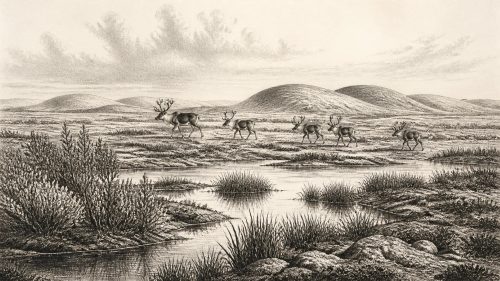
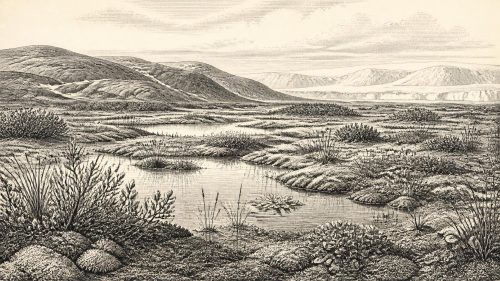
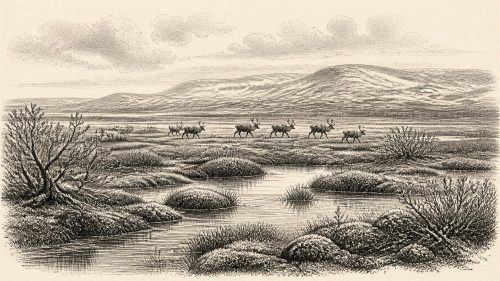
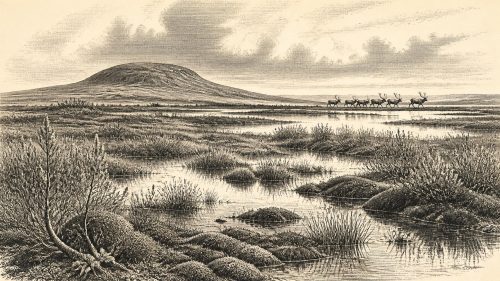
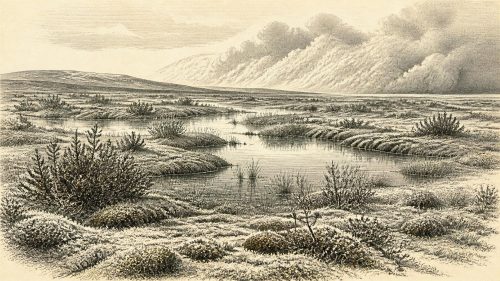
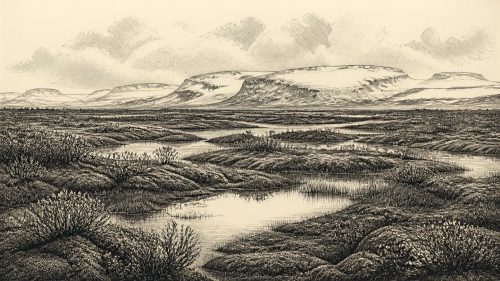
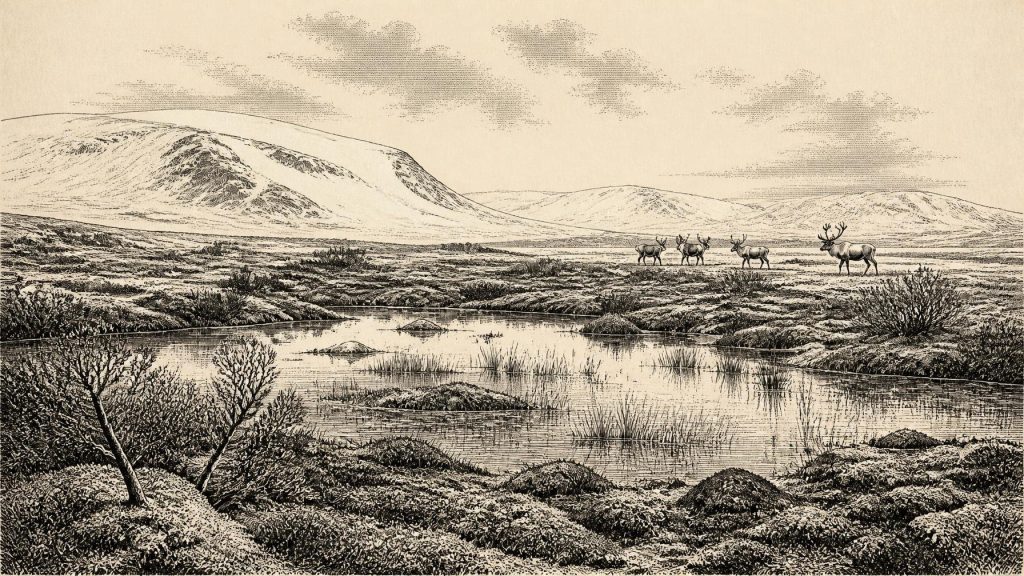
The local scene was probably treeless or almost treeless. Low-growing herbs, sedges, mosses and cold-adapted shrubs could occupy wet margins, bare mineral ground and shallow pools, while wind and frost restricted woodland development. The freshwater deposits indicate that liquid water persisted seasonally or locally even in a severe climate. Such a setting would have been ecologically patchy: wet basins and sedgy margins beside drier gravelly ground, exposed slopes and terrain affected by frost. This was not an Irish bog landscape in the later historic sense, but a cold wetland within a broader open environment.
At the scale of the island, glaciers and ice sheets were dynamic agents rather than a fixed backdrop. Their growth, withdrawal and rerouting changed drainage, buried earlier surfaces and destroyed or reworked deposits. This is a principal reason why the record is so fragmentary. A rare organic layer protected below till may survive; an occupation place on exposed ground may have been eroded, carried away or remain undiscovered beneath later sediment and sea.
Castlepook’s Mammal Archive
Castlepook Cave, also known as Mammoth Cave or Doneraile Cave, offers a complementary view from the south. Formed in Carboniferous limestone, the cave yielded more than 2,000 bones during excavations conducted mainly between 1904 and 1918. Its collections are Ireland’s richest known archive of vertebrate life leading up to the Last Glacial Maximum. Modern redating has shown that several animal remains are substantially older than earlier determinations suggested, placing important elements of the fauna in Marine Isotope Stage 3.
The cave’s Ice Age fauna includes woolly mammoth, giant deer, reindeer, brown bear and spotted hyaena; later cold-stage material includes Arctic fox, wolf, Norwegian lemming and collared lemming. These remains do not mean that every species lived together at every moment, or that all parts of the cave preserve a single undisturbed deposit. Water movement, repeated use of the cave, historic excavation practices and the mixing of material have complicated the sequence. Castlepook is best understood as a long-lived bone repository, not a snapshot of one day’s landscape.
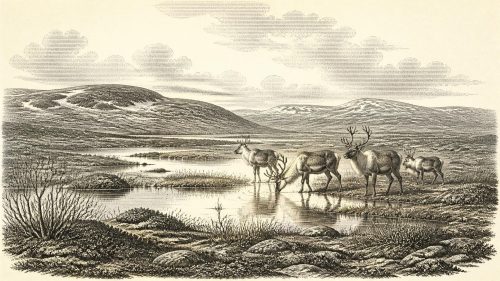
Even so, the assemblage establishes a formidable animal world. Reindeer and giant deer point towards open habitats with substantial grazing and browsing opportunities. Mammoth remains evoke wider cold-stage grassland and herb-rich environments, while hyaena, wolves and bears show that large carcasses could be scavenged, transported and consumed by predators. The cave itself may have been especially important to carnivores. Bones within it need not record where an animal died; they may record where another animal dragged part of it.
The Reindeer Femur
The most arresting possible human evidence is a reindeer femur from Castlepook. It has been reported as dating to about 31,000 BCE and bears a deep linear mark interpreted by zooarchaeologist Ruth Carden as having been made with a sharp stone implement during butchery. If that interpretation is upheld, it would show that people handled and processed a reindeer in Ireland during the Upper Palaeolithic, vastly earlier than the island’s well-established post-glacial settlement record.
That conclusion must remain carefully limited. The femur is not part of a recently excavated, sealed camp floor containing hearths, tools, shelters, burials and refitting animal bones. No securely associated Upper Palaeolithic stone-tool assemblage has yet been published from Ireland for this period. The radiocarbon date concerns the animal bone, while identification of a human cut mark depends on separate anatomical and taphonomic judgement. The old excavation context also prevents a confident reconstruction of whether people killed the reindeer, processed it elsewhere, briefly visited the cave, or whether carnivores later carried the discarded bone inside.
Nonetheless, the find matters because it turns a former certainty into a question requiring further excavation and analysis. In 2022, archaeologists re-examined Castlepook in the hope of locating intact deposits and recovering environmental, microscopic and dating evidence capable of reconnecting museum collections with stratified cave sediments. The appropriate historical statement for this period is therefore not that Ireland had an established hunter population, but that the evidence permits a serious possibility of episodic human presence.
People, Politics and Daily Life
There are no political affairs, leaders, alliances, diplomatic contacts or named conflicts to narrate for Ireland around this date. There is likewise no evidence for farming, livestock, metalwork, pottery, permanent villages, monuments, formal burial grounds, religion or artistic traditions within Ireland at this time. It would be misleading to fill those absences with stories borrowed from better-known Upper Palaeolithic communities elsewhere in Europe.
If people did reach Ireland, the most defensible interpretation is of small, mobile foraging parties moving through a harsh and seasonally variable world. They would have required knowledge of animals, weather, terrain and stone-working, but none of those capacities can be reconstructed in Irish detail from the Castlepook femur alone. Reindeer meat, hide, sinew, marrow and bone would have been valuable resources to hunters; that is a reasonable general inference, not proof of a particular Irish hunting camp or social custom.
Nor can trade be demonstrated. There are no sourced stone tools, ornaments, exchange goods or navigational equipment from Ireland that can be assigned to this horizon. Whether movement into the island required crossings over water, ice or exposed coastal terrain is still bound up with uncertain reconstructions of sea level, ice extent and Irish Sea geography. The presence of mammals proves that some animals reached Ireland during the wider period; it does not by itself reveal the route or ease of human access.
An Unfinished Irish Past
The central development illuminated by 30,521 BCE is environmental, not political: Ireland lay amid a climatically unstable Ice Age interval before the fullest expansion of the last ice sheet. Derryvree preserves a rare cold freshwater and tundra environment later overwhelmed by glacial sediment. Castlepook preserves a long and complicated mammal archive, and perhaps a humanly modified reindeer bone. These are powerful traces, but they are traces of processes and broad intervals rather than a calendar-year chronicle.
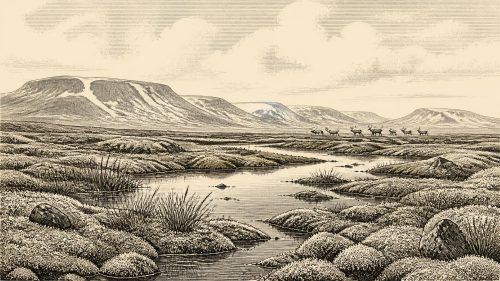
For that reason, the Ireland of this date should be imagined with disciplined restraint: shallow water among sedges and mosses in Fermanagh; open, frost-affected ground beyond; great herbivores and carnivores in the southern landscape; and a possible, still unconfirmed human episode represented by one marked bone. Future work may refine the dates, recover tools or show that a mark has another explanation. At present, uncertainty is not a failure of the record. It is one of the most important facts that the record can honestly teach.
Source References
Hover over a number to see the source. Select it to open the source.

- [1] Middle Midlandian Freshwater Series at Derryvree, Maguiresbridge, County Fermanagh, Northern Ireland
- [2] Middle Midlandian Freshwater Series at Derryvree, Maguiresbridge, County Fermanagh, Northern Ireland
- [3] A Reconsideration of the Radiocarbon Dating of the Marine Isotope Stage 3 Fauna from Southern Ireland
- [4] The Irish Quaternary Fauna Project
- [5] Castlepook Cave: County Geological Site Report
- [6] The Exploration of Castlepook Cave, County Cork
- [7] Occurrence of Mammalia Relicts at Site Castlepook Cave
- [8] Pleistocene Vertebrates in the British Isles
- [9] Archaeology Research Excavation Grant 2022: Castlepook Cave Final Report
- [10] Castlepook Cave, Cork, 2022 Excavation Report
- [11] Heritage Artefacts of County Cork
- [12] New Insights on the Fauna of Ireland’s Younger Dryas and Early Holocene from Alice & Gwendoline Cave
- [13] Quaternary Deposits and Glacial Stratigraphy in Ireland
- [14] Trimlines, Blockfields and the Vertical Extent of the Last Ice Sheet in Southern Ireland
- [15] Exploring Controls of the Early and Stepped Deglaciation on the Western Margin of the British-Irish Ice Sheet
- [16] The Problem of a Late Quaternary Landbridge Between Britain and Ireland
- [17] On the Postglacial Isostatic Adjustment of the British Isles and the Shallow Viscoelastic Structure of the Earth
- [18] Subglacial Bedforms of the Irish Ice Sheet
- [19] Quaternary Geology of Ireland
- [20] Quaternary Sediments 1:50,000 Ireland (ROI) ITM
- [21] The Mesolithic in Ireland: When Was It?
- [22] Irish Caves Database: Mammoth Cave
Primary Sources
- Middle Midlandian Freshwater Series at Derryvree, Maguiresbridge, County Fermanagh, Northern Ireland
- Middle Midlandian Freshwater Series at Derryvree, Maguiresbridge, County Fermanagh, Northern Ireland
- A Reconsideration of the Radiocarbon Dating of the Marine Isotope Stage 3 Fauna from Southern Ireland
- The Irish Quaternary Fauna Project
- Castlepook Cave: County Geological Site Report
- The Exploration of Castlepook Cave, County Cork
- Occurrence of Mammalia Relicts at Site Castlepook Cave
- Pleistocene Vertebrates in the British Isles
- Archaeology Research Excavation Grant 2022: Castlepook Cave Final Report
- Castlepook Cave, Cork, 2022 Excavation Report
- Heritage Artefacts of County Cork
- New Insights on the Fauna of Ireland’s Younger Dryas and Early Holocene from Alice & Gwendoline Cave
- Quaternary Deposits and Glacial Stratigraphy in Ireland
- Trimlines, Blockfields and the Vertical Extent of the Last Ice Sheet in Southern Ireland
- Exploring Controls of the Early and Stepped Deglaciation on the Western Margin of the British-Irish Ice Sheet
- The Problem of a Late Quaternary Landbridge Between Britain and Ireland
- On the Postglacial Isostatic Adjustment of the British Isles and the Shallow Viscoelastic Structure of the Earth
- Subglacial Bedforms of the Irish Ice Sheet
- Quaternary Geology of Ireland
- Quaternary Sediments 1:50,000 Ireland (ROI) ITM
- The Mesolithic in Ireland: When Was It?
- Irish Caves Database: Mammoth Cave