Dublin Castle’s European Debut1975 CE
In 1975, Ireland hosted the first formal European Council meeting at Dublin Castle during its EEC presidency, signalling an expanded international role. Northern Ireland remained unstable despite IRA ceasefires: the Constitutional Convention favoured majority rule, while violence claimed 260 lives, including three Miami Showband members. Security policy proposed ending special-category prisoner status and building Maze H-Blocks. In the Republic, recession raised insured unemployment to 12 per cent, exposing dependence on British and European markets. Lasting changes included establishment of the Law Reform Commission, commencement of equal-pay legislation, and Oliver Plunkett’s canonisation. The year combined engagement, hardship, reform and national conflict.
Dateline
In 1975, Ireland’s public life was shaped by two sharply contrasting realities. In Dublin, the State briefly stood at the centre of European diplomacy, hosting leaders of the nine-member European Communities. Across the Border, however, the renewed Irish Republican Army ceasefire neither ended political violence nor produced agreement on Northern Ireland’s government. The Republic itself was entering a recession whose effects were increasingly felt in workplaces, homes and public finances. Yet the year also brought durable institutions and changes: the Law Reform Commission was created, equal-pay law came into force, and an Irish martyr, Oliver Plunkett, was canonised in Rome.
A European Meeting in Dublin
Ireland held the rotating Presidency of the Council of the European Communities from January to June 1975, only two years after joining the EEC alongside Britain and Denmark. Taoiseach Liam Cosgrave’s Fine Gael–Labour government thereby acquired an international convening role out of proportion to the country’s size. Garret FitzGerald, the Minister for Foreign Affairs, was an important public face of an outward-looking policy at a moment when the Community was coping with recession, inflation and the aftermath of the 1973 oil shock.
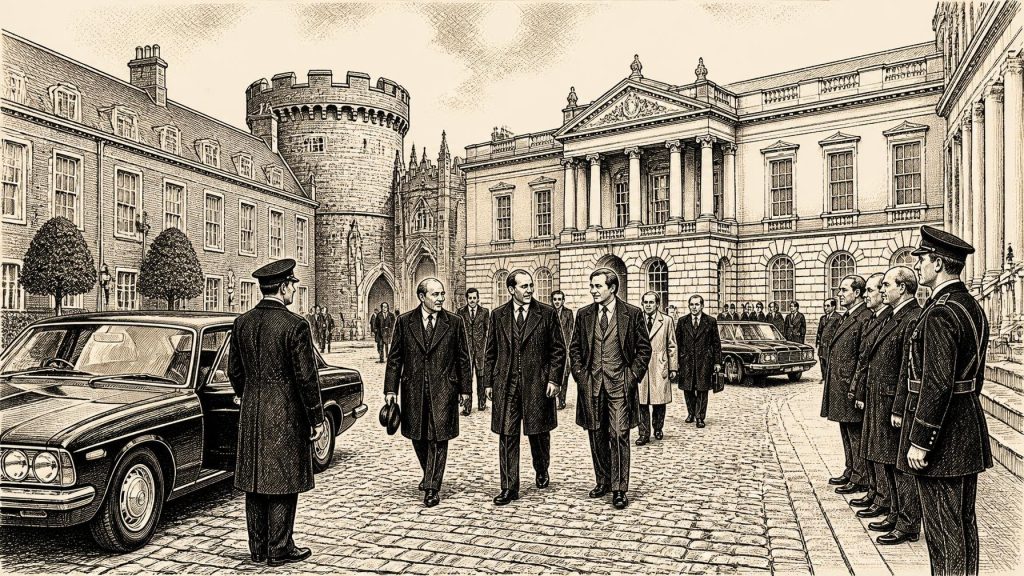
The clearest landmark came on 10 and 11 March, when Dublin Castle hosted the first formal meeting of what became the European Council: the gathering of the heads of state or government intended to give political direction to the Communities. Its significance should not be exaggerated into an Irish creation of Europe’s later institutions. The decision to establish regular summits had been taken by the Community’s leaders in Paris in December 1974. But Dublin gave the new arrangement its first formal setting. For a State long accustomed to defining its external position through neutrality, relations with Britain and the United States, this was a conspicuous demonstration that European membership had become practical business as well as aspiration.
Ceasefire Without Settlement
Northern Ireland remained the gravest Irish question. An IRA ceasefire, begun in December 1974 amid contacts between republican representatives and British officials, broke down on 17 January 1975. A further ceasefire began on 10 February and was presented by the IRA as indefinite. It reduced neither fear nor political uncertainty to a simple before-and-after story. The truce was accompanied by continuing violence, disputed interpretations of unofficial contacts, and Sinn Féin-run “incident centres” in nationalist districts that monitored alleged breaches and liaised with the Northern Ireland Office.
The British government nevertheless pressed ahead with a constitutional initiative. On 1 May, voters elected 78 members to the Northern Ireland Constitutional Convention by single transferable vote. The United Ulster Unionist Council won 47 seats and 54.8 per cent of first-preference votes; the SDLP won 17 seats, Alliance eight, the Unionist Party of Northern Ireland five, and the Northern Ireland Labour Party one. The figures showed both the strength of unionist opposition to compulsory power-sharing and the difficulty of designing institutions acceptable to both communities.
The Convention first met on 8 May under the chairmanship of Lord Chief Justice Robert Lowry. On 7 November, by 42 votes to 31, it endorsed a report proposing restored majority-rule government, supplemented by departmental scrutiny committees. The report was published on 20 November. Its majority recommendation did not meet the British government’s requirement for arrangements commanding broad acceptance, and it offered nationalists no convincing guarantee of a share in power. Thus 1975 ended not with a settlement, but with direct rule from Westminster continuing and the constitutional argument deferred.
Violence and a Showband Road
The year’s death toll demonstrates why the political process could not be separated from daily insecurity. Malcolm Sutton’s index records 260 conflict-related deaths in 1975: 125 attributed to republican groups, 123 to loyalist groups, nine to British forces and three to other causes. Such totals are a necessary measure of the conflict’s scale, but they cannot convey the individual bereavements, segregated neighbourhoods, military checkpoints and apprehension surrounding ordinary travel, work, worship and entertainment.
One attack became an especially lasting symbol of the danger faced by people who crossed communal and jurisdictional lines. On 31 July, the Ulster Volunteer Force stopped the Miami Showband’s minibus at a bogus checkpoint near Buskhill, County Down, as the musicians travelled south after playing in Banbridge. Three band members were killed after a bomb being handled by the attackers exploded prematurely; two UVF men also died. The Miami Showband was a well-known, widely popular dance band, and its members’ work depended on moving between towns and audiences throughout Ireland. Their killing made plain that cultural familiarity offered no protection from sectarian violence.
Security policy was also evolving. The Gardiner Report, published on 30 January, examined anti-terrorist measures in relation to civil liberties and recommended ending special-category status for paramilitary prisoners, while retaining detention without trial under the Secretary of State’s control. On 5 February the Northern Ireland Office announced plans for new cellular H-Blocks at the Maze while awaiting a prison at Maghaberry. These were decisions of 1975, not yet the prison protest that would later make the H-Blocks internationally notorious; nevertheless, they set part of the institutional ground on which that later confrontation developed.
Recession at Home
In the Republic, European engagement occurred amid economic contraction. The OECD’s survey published in November found that unemployment had risen sharply as demand weakened: between the first quarter of 1974 and the second quarter of 1975, the seasonally adjusted rate rose from 7 to 12 per cent of the insured labour force, a total of 75,000 people including those on short time. Its measures do not describe every person without work, but they register an abrupt deterioration. Weak overseas markets, particularly recession in Britain, hurt exports and employment, while the higher cost of imported energy bore down on businesses and household budgets.
The strain was felt unevenly. Industrial workers faced short time and closures; school-leavers encountered fewer openings; farmers and rural households confronted higher input and living costs; and the State had to sustain rising social expenditure as revenue came under pressure. Earlier improvements in employment had helped check the familiar pattern of mass outward migration, but recession made the country’s dependence on conditions in Britain and wider Europe newly apparent. Ireland’s EEC membership opened markets and policy connections, yet it did not insulate the State from an international downturn.
Reform, Pay and Public Standards
Two developments in the Republic’s legal and social framework deserve notice. The Law Reform Commission Act received assent on 16 April. The Commission itself came into being on 20 October, with a statutory task to keep the law under review, conduct research and formulate proposals for reform. Its arrival created a standing body intended to make the often piecemeal statute book more coherent, modern and accessible. That was a quiet constitutional development, but an enduring one.
On 31 December, the Anti-Discrimination (Pay) Act 1974 came into operation. It provided an entitlement to equal pay for men and women employed on like work, made such an entitlement an implied term of employment, and provided investigative and Labour Court procedures. The measure did not end unequal treatment in employment or remove the wider barriers that shaped women’s working lives. Its importance lies in changing the legal baseline: sex could no longer lawfully determine remuneration for like work. The timing also connected domestic law to Ireland’s obligations and debates as a member of the European Communities.
A Saint for a Violent Time
Religion remained an important source of identity, public ritual and moral language across the island. On 12 October Pope Paul VI canonised Oliver Plunkett, the seventeenth-century Archbishop of Armagh executed in London in 1681. Speaking in Irish as well as other languages, the Pope presented Plunkett as a martyr and a figure of forgiveness, peace and reconciliation. In a year marked by killings committed in the name of competing national and communal loyalties, the ceremony gave those themes exceptional contemporary resonance. It also joined Rome, Armagh and Drogheda—where Plunkett’s relics were venerated—in a shared Irish Catholic memory.
By year’s end, 1975 had supplied no resolution to the conflict and no escape from economic anxiety. Its more lasting record lay in the tensions it exposed: European responsibility alongside domestic recession, constitutional discussion alongside coercion, and inherited religious authority alongside emerging equality law. Dublin Castle’s European meeting and the Miami Showband killings belonged to the same calendar year, but they pointed towards profoundly different possibilities for Ireland’s future.
Primary Sources
- CAIN: A Chronology of the Conflict – 1975
- CAIN: Northern Ireland Constitutional Convention – A Chronology of Main Events
- CAIN: Northern Ireland Constitutional Convention Report, 20 November 1975
- Sutton Index of Deaths – extracts from Sutton's book
- Sutton Index of Deaths: Annual Deaths by Year
- Northern Ireland Constitutional Convention, Hansard, 10 November 1975
- OECD Economic Surveys: Ireland 1975
- OECD Economic Surveys: Ireland 1975 (PDF)
- The Irish Economy
- A Symposium on Increasing Employment in Ireland
- National Economic and Social Council Report No. 32
- Economy Statistical Yearbook of Ireland 2018: Earnings
- Anti-Discrimination (Pay) Act 1974
- Anti-Discrimination (Pay) Act 1974: Commencement and Effects
- Law Reform Commission Act 1975
- Law Reform Commission Act 1975: Commencement and Effects
- Law Reform Commission’s Role
- Ireland and the EU: Timeline of Key Events
- Ireland in the European Union
- Ireland’s Presidency of the Council of the European Union
- History of the European Union: 1970-79
- 12 October 1975: Canonization of the Irish Martyr Oliver Plunkett
- Statutory Instruments 1975
- The President: Cearbhall Ó Dálaigh