Treaty Ports1938 CE
In 1938, the new Constitution acquired practical force as Ireland developed its institutions and position. Douglas Hyde, cultural revivalist and Church of Ireland scholar, became first President, symbolising an inclusive national identity, though disputes persisted. April agreements ended the Economic War: Ireland paid £10 million, Britain removed special duties, and the Treaty Ports at Cork Harbour, Berehaven and Lough Swilly returned to Irish control. Fianna Fáil then won an overall majority. Labour legislation addressed shop workers’ conditions, but poverty, emigration and agricultural dependence continued. Partition remained unchanged despite discussions with Britain and Northern Ireland, while port recovery strengthened future neutrality.
Dateline
In 1938 Ireland moved decisively from constitutional transition to practical statehood. The new Constitution had come into operation only on 29 December 1937, and its first full calendar year brought institutions, symbols and diplomatic gains that made its claims more tangible. Éamon de Valera’s government secured a clear electoral mandate, Douglas Hyde entered office as the first President of Ireland, and the long Anglo-Irish economic dispute was settled alongside the return of the Treaty Ports. None of this ended partition, poverty or dependence on British markets. Yet 1938 changed the terms on which the Irish state faced Britain, Northern Ireland and an increasingly dangerous Europe.
A Constitution in Operation
The Constitution gave the state a new public vocabulary. Article 4 named it Éire, or Ireland in the English language; the head of government was now the Taoiseach rather than President of the Executive Council. Articles 2 and 3 expressed a national claim to the whole island while recognising that, pending reintegration, the laws enacted by the Oireachtas applied only to the twenty-six counties. That distinction mattered greatly. The Constitution articulated an all-Ireland aspiration, but it did not alter the authority of the Northern Ireland government at Stormont or the constitutional position of Northern Ireland within the United Kingdom.
During 1938, departments adjusted their language and procedures to the new order. A March instruction encouraged official use of “Ireland” and “Irish” in English where possible rather than the forms “Éire” and “of Éire”. Such details were not merely clerical. They were part of an effort to present the state as a normal and self-governing polity, while London’s preference for “Eire” signalled that the question of constitutional status remained politically charged. The constitutional settlement had removed the office of Governor-General, but the new presidency still needed a first holder.
Douglas Hyde Takes Office
Douglas Hyde became President on 25 June 1938. His selection was deliberately unifying. Hyde was a distinguished scholar, folklorist and former president of Conradh na Gaeilge, the Gaelic League, rather than a combatant from the recent revolutionary and Civil War years. Known in Irish as Dubhghlas de hÍde and by the pen-name An Craoibhín Aoibhinn, he embodied the cultural revival that had helped shape modern Irish nationalism. His long association with Irish-language scholarship gave the new office a powerful cultural character from its outset.
The setting of the inauguration in St Patrick’s Hall, Dublin Castle, carried its own symbolism. A former centre of British administration in Ireland became the place where the head of the new constitutional state assumed office. Hyde, a member of the Church of Ireland, was also an especially resonant choice in a country whose public life was predominantly Catholic. His presidency did not dissolve religious or political divisions, but it suggested that Irish national identity could encompass more than one inherited tradition. In his inaugural address, delivered in Irish, Hyde asked for the wisdom to fulfil his duties for Ireland’s benefit: a restrained formulation appropriate to an office designed to stand above party conflict.
The year also exposed the frictions within cultural nationalism. In November the Gaelic Athletic Association removed Hyde as a patron after he attended an international association-football match in his official capacity, an episode connected to the GAA’s then prohibition on members participating in or attending certain “foreign” games. It was a small incident beside the great affairs of state, but it showed that the boundaries of Irish cultural respectability were still actively policed, even when the person involved was the President and a formative figure in the language revival.
The April Settlement
The most consequential event of the year came in London on 25 April, when Irish and British representatives signed three linked agreements on finance, trade and defence. They ended the Anglo-Irish Economic War, the tariff conflict that had run since 1932 after de Valera’s government withheld land-annuity payments claimed by Britain. The dispute had struck particularly hard at cattle farmers and exporters because the British market remained vital to the southern economy. British special duties on Irish goods and Irish retaliatory measures had raised costs, disturbed long-established trade and aggravated rural hardship during the wider depression.
The settlement was neither a simple Irish victory nor a return to the commercial habits of the 1920s. Ireland agreed to pay a lump sum of £10 million to settle outstanding financial claims, including the land-annuity dispute. Britain agreed to remove the special duties imposed on imports from Ireland. The accompanying trade agreement restored more workable conditions for commerce but retained detailed arrangements on tariffs, preferences and agricultural supports. For a government committed both to protection and to rebuilding agricultural exports, this was a pragmatic compromise. It relieved a damaging conflict while leaving Irish policymakers room to continue their wider project of domestic industrial development.
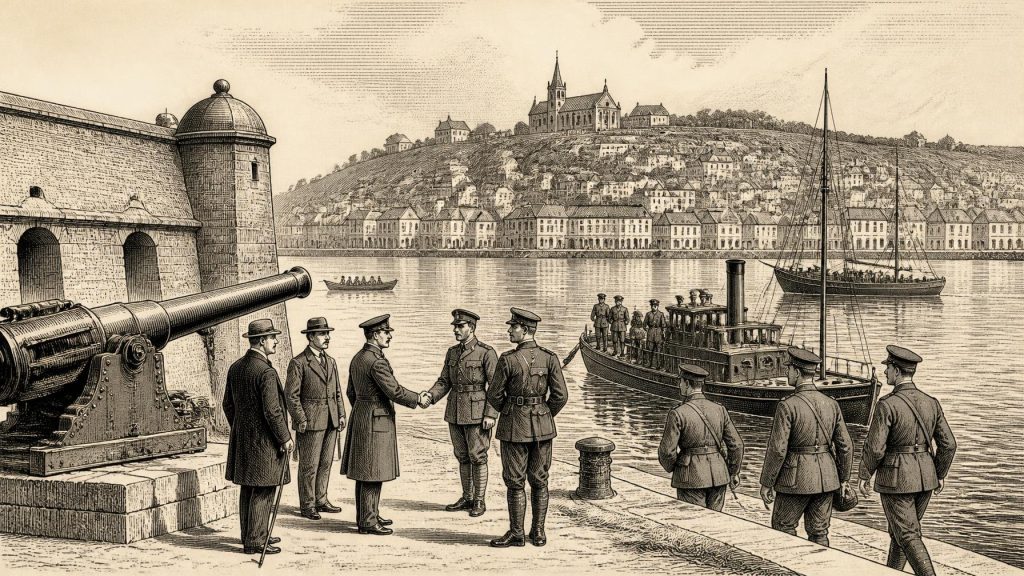
Politically, the financial payment was easier for Fianna Fáil to defend because the agreements delivered something with exceptional emotional and strategic value: the return of the Treaty Ports. Under the 1921 Treaty Britain had retained rights at Berehaven in County Cork, Cork Harbour at Cobh and Lough Swilly in County Donegal. Their continued occupation had been a conspicuous limitation on Irish control of its own coastline. The 1938 agreement ended the relevant Treaty provisions and required the transfer of Admiralty property, harbour defences, armaments and associated rights by the end of the year.
Coasts Reclaimed
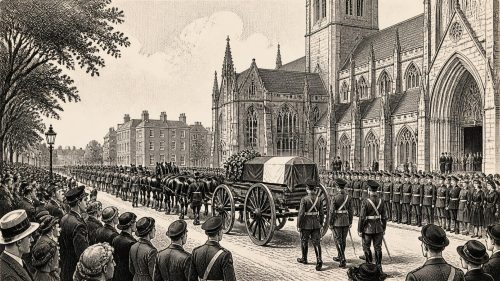
The transfers followed in stages. The Cork Harbour defences, including the installations associated with Spike Island near Cobh, passed to Irish control on 11 July. Berehaven followed on 29 September and Lough Swilly on 3 October. These dates gave physical form to an agreement negotiated months earlier: forts, magazines, guns and naval sites ceased to be British enclaves. For local communities, the change affected places long marked by naval garrisons and imperial infrastructure; for Dublin, it was a highly visible assertion of territorial authority.
The strategic consequences were larger than the equipment received. Europe was moving towards war: Germany annexed Austria in March and the Munich crisis erupted in September. Irish ministers increasingly considered how a small state might avoid being drawn into a European conflict. The port transfers did not make Ireland militarily secure, nor did they settle the question of defence in the North. They did, however, remove a British treaty right to use bases in the state and strengthened the practical basis on which Ireland could later pursue neutrality. In 1938, that future was not predetermined, but the return of the ports made independent control of Irish territory more credible.
Election and Everyday Pressures
The political reward for Fianna Fáil was immediate. The 9th Dáil was dissolved in late May, before a President had taken office, so a Presidential Commission performed the necessary constitutional function. At the general election on 17 June, Fianna Fáil won 77 of the 138 seats in the 10th Dáil, its first overall parliamentary majority. When the new Dáil met on 30 June, it confirmed de Valera as Taoiseach. The result gave his government a stronger hand to implement the April agreements and to operate the new constitutional system without dependence on opposition votes.
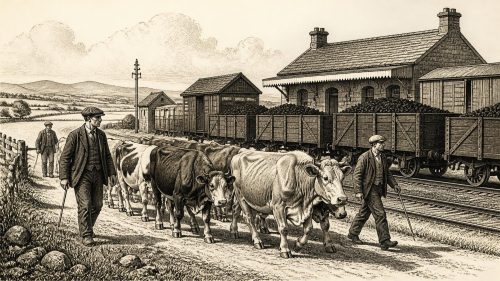
For many people, however, constitutional achievement sat alongside tight household circumstances. The state remained predominantly rural, and much of its export income still depended on agriculture and the British market. Protectionist policy had encouraged manufacturing employment during the 1930s, but industrial work was concentrated unevenly, while underemployment, insecure incomes and emigration remained enduring features of life. The end of the trade dispute offered hope to cattle producers and traders, but it could not instantly repair years of lost income or transform small farms into prosperous businesses.
Legislation affecting urban working life also appeared in 1938. The Shops (Conditions of Employment) Act, enacted in February, made further provision for shop workers’ conditions and fair rates of pay; the Shops (Hours of Trading) Act came into force in May. Their detailed rules on employment and opening hours remind us that the year’s history was not confined to treaties and ceremonies. In towns and cities, retail staff, employers and customers encountered the state through the regulation of ordinary working days.
Partition Unresolved
The Anglo-Irish negotiations did not bridge the island’s central political division. At a British-Irish conference in January, de Valera pressed the issue of unity, while Neville Chamberlain insisted that Britain could not alter Northern Ireland’s position without the consent of Northern Ireland. That principle ensured that the April agreements, important as they were, left partition untouched. The new Constitution’s territorial language was viewed with suspicion by unionists, while the Dublin government regarded partition as unfinished national business.
There were nevertheless efforts in 1938 to explore practical contact between Dublin and Belfast, particularly as the international crisis raised questions of common concern. Documents from Irish foreign policy show that tentative discussions faltered by October amid renewed disagreement over constitutional and political issues. The episode is important precisely because it was limited: it demonstrates that the prospect of war encouraged consideration of co-operation, but did not overcome the distrust created by partition.
By the close of 1938, Ireland had acquired its first President, a firmer parliamentary government and control of former British naval bases. These were substantial gains for a state still young, poor and geographically divided. The year did not resolve the deepest problems of Irish life, but it gave the constitutional Ireland of 1937 a more solid political, territorial and international reality.

Primary Sources
- Agreements between the Government of Ireland and the Government of the United Kingdom, London, 25 April, 1938
- British-Irish Tripartite Agreement on Trade, Finance and Defence, 25 April 1938
- British-Irish Conference, 17 January 1938
- Transfer of Treaty Ports, 1 June 1938
- Volume 5: Documents on Irish Foreign Policy, 1936–1939
- Ireland Through the Decades
- Dáil and Seanad Election Results
- Constitution of Ireland
- Constitution (Consequential Provisions) Act, 1937
- Douglas Hyde
- Inauguration Address by President Douglas Hyde
- The President: Interactive Timeline
- Hyde, Douglas (de hÍde, Dubhghlas)
- Shops (Conditions of Employment) Act, 1938
- Shops (Hours of Trading) Act 1938
- Census 1936 Volume 1: Population, Area and Valuation of Each DED and Each Larger Unit of Area
- Irish GDP Since Independence
- The Irish Economy During the Century After Partition
- Éire and the British Commonwealth
- The Anglo-Irish Treaty, 1921
- Eire (Confirmation of Agreements) Bill, House of Commons Debate, 10 May 1938
- The Irish Free State/Éire/Republic of Ireland/Ireland: “A Country by Any Other Name”?
- Cabinet Papers of the Stormont Administration, Northern Ireland, 1921–1972
- Constitution of Ireland