The Irish Press and Westminster1931 CE
In 1931 the Irish Free State gained legislative autonomy through the Statute of Westminster, while unresolved Treaty issues, partition and political rivalry persisted. Cosgrave’s government faced Fianna Fáil’s growing constitutional challenge, republican fears and economic depression affecting farming, exports, employment and emigration. The Public Safety Act introduced emergency powers after Saor Éire’s congress, revealing anxieties about violence. The Four Courts reopened, symbolising post-Civil War recovery. Flooding struck Cork, while An Óige encouraged rural travel. The Irish Press began publication, strengthening nationalist political communication. Dublin’s first state-sponsored St Patrick’s Day parade projected order, although industrial unemployment remained severe in Northern Ireland.
Dateline
In 1931 Ireland stood at an important, uneasy threshold. The Irish Free State was not yet ten years old, and W. T. Cosgrave’s Cumann na nGaedheal administration still governed from Dublin. Yet the assumptions that had sustained the new state after the Civil War were under pressure: the world economic slump was weakening farm incomes and employment; republican militancy had not disappeared; and Éamon de Valera’s Fianna Fáil was preparing to challenge the government with a more forceful nationalist programme. Across the border, Northern Ireland remained within the United Kingdom under the Unionist government at Stormont, with its industrial districts exposed to the same international depression. The island was politically divided, but economic anxiety, migration and the search for workable public institutions were shared realities.
A Dominion Gains Legal Latitude
The year’s most consequential development came on 11 December, when the British Parliament enacted the Statute of Westminster. It applied to the Irish Free State alongside the other self-governing dominions. In constitutional terms, it ended the general power of Westminster to legislate for a dominion without that dominion’s request and consent, removed the old rule that colonial legislation could be invalid because it conflicted with British law, and recognised dominion power to legislate beyond its territory. For the Free State, this confirmed in law a degree of legislative autonomy that Irish representatives had increasingly asserted in practice through diplomacy and participation in the League of Nations.
The statute did not settle every argument embedded in the Anglo-Irish Treaty settlement. The Oath of Allegiance, the office of governor-general, the constitutional place of the Crown and partition all remained live political questions. Nor did it itself change daily life in December 1931. Its importance lay in the new legal room it gave an Irish parliament. That room would soon enable Fianna Fáil, after taking office in 1932, to dismantle several Treaty-linked constitutional provisions. In 1931, however, the statute was best understood as a decisive alteration in the framework within which future Irish governments could act, rather than as the instant completion of independence.
Cosgrave’s government could therefore point to a substantial diplomatic achievement, even as it confronted a more unsettled domestic atmosphere. The Free State had held a seat on the Council of the League of Nations since September 1930, a visible sign that it was acting internationally in its own right. At home, however, opposition politics were sharpening. Fianna Fáil had entered the Dáil in 1927 after modifying its earlier abstentionist position, and its presence made the next general election, due early in 1932, increasingly consequential. De Valera’s party offered dissatisfied voters a constitutional nationalist alternative to Cumann na nGaedheal’s emphasis on public order, balanced finance and gradual state-building.
Order, Fear and Emergency Powers
The limits of constitutional politics were exposed in the autumn. On 26–27 September, Saor Éire held its first national congress at Iona Hall in Dublin. The organisation tried to join republican objectives to a programme of working-class and socialist transformation; its discussions included an attack on both capitalism and imperialism. Its delegates came from both the Free State and Northern Ireland. The congress was small in relation to the national electorate, but it was politically potent because the government and much of public opinion associated its radical language with the continuing armed tradition of the IRA.
The response was the Constitution (Amendment No. 17) Act, enacted on 17 October and commonly known at the time as the Public Safety Act. It inserted Article 2A into the Free State constitution. The measure authorised exceptional procedures during serious disorder, including military tribunals for specified offences, restrictions on publications issued for unlawful associations, and powers to prohibit meetings in particular places. Supporters presented it as a necessary safeguard for representative government against intimidation and violence. Its critics argued that it placed striking coercive powers in the hands of the executive and weakened ordinary legal protections. The legislation illustrates a central paradox of 1931: a state acquiring greater external autonomy while also expanding extraordinary internal powers.
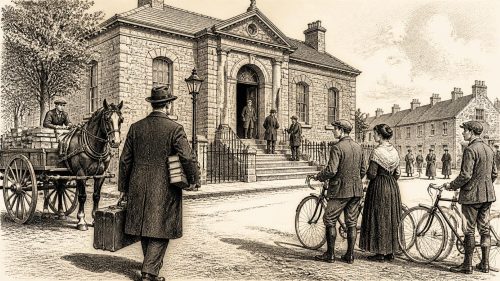
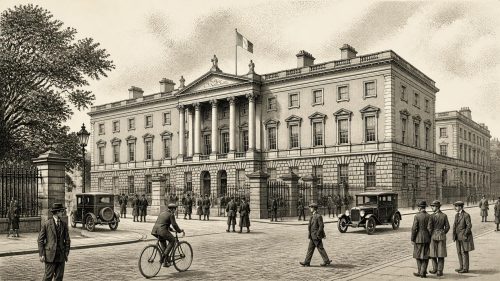
Fear of renewed violence was not merely rhetorical. The Civil War was only eight years past, its memories were personal and its destruction remained conspicuous. The restoration of the Four Courts became a powerful counter-image. Ruined in June 1922 during the opening battle of the Civil War, the complex returned to use in 1931; court sittings resumed there on 12 October, without the public ceremony once contemplated. The restrained reopening reflected official concern for security, but it also marked a practical recovery. The re-established building housed courts serving a state whose authority had once been violently disputed.
Depression Reaches the Farm
The international slump increasingly shaped the Free State’s prospects. Agriculture remained the principal industry, and exports of live cattle, pigs, sheep, butter and other foodstuffs were heavily dependent on the British market. A Department of External Affairs assessment in August acknowledged that the depressed condition of markets in Great Britain and Northern Ireland was already harming Irish exports. Livestock prices had fallen severely in the first part of 1931, while the value of dairy exports had declined markedly between 1929 and 1930. For farming households, such movements could mean reduced cash income, postponed improvements and difficult decisions about labour, credit and migration.
Officials nevertheless stressed that the Free State had not, by 1931, suffered the full shock endured by some agricultural exporters. Ireland’s grass-based livestock economy, proximity to Britain and freedom from major animal diseases gave its producers advantages. Public finances had also been kept comparatively stable. Those qualifications should not disguise the strain. The traditional outlet of emigration was becoming less dependable as employment contracted in Britain and the United States. Unemployment rose as people who might formerly have left remained at home, intensifying demands for protective economic measures. Import tariffs introduced in November to prevent dumping signalled that the Free State, like many countries, was moving away from the earlier preference for open trade.
Northern Ireland faced a harsher industrial version of the downturn. Belfast’s shipbuilding, engineering and linen economy depended on markets far beyond the island, and unemployment was a persistent and growing problem. Westminster’s tariff policy and agricultural support offered Northern Ireland some protection, but Stormont had limited capacity to create replacement industries. The contrast mattered: the Free State’s anxieties centred heavily on agricultural prices and underemployment, while the north-east’s were bound especially to industrial contraction. Partition had produced separate governments, but it had not insulated either part of Ireland from the global collapse in demand.
Water, Roads and Countryside
Environmental disruption was also immediate. Heavy rain in early April brought major flooding along the River Lee. In Cork city and surrounding districts, water entered homes and businesses; local recollections from Blarney describe houses in the lower village inundated as the river rose. Such an event was not simply a dramatic news item. It exposed the vulnerability of low-lying neighbourhoods, transport routes and small traders, and reminded residents that public health, food deliveries and work could be interrupted by weather as readily as by politics.
Other initiatives pointed towards different uses of the landscape. An Óige, the Irish Youth Hostel Association, was founded in 1931, and its early activity included a hostel at Glendalough in County Wicklow. Its objectives combined inexpensive travel, appreciation of the countryside, heritage and international cooperation. The scheme was modest, but it represented an emerging idea of the Irish countryside as a place to be explored by young people rather than only worked, left behind, or romantically invoked. Rural voluntary activity associated with Canon John Hayes also developed during the year, foreshadowing the community-development work later identified with Muintir na Tíre.
Print, Ceremony and Public Imagination
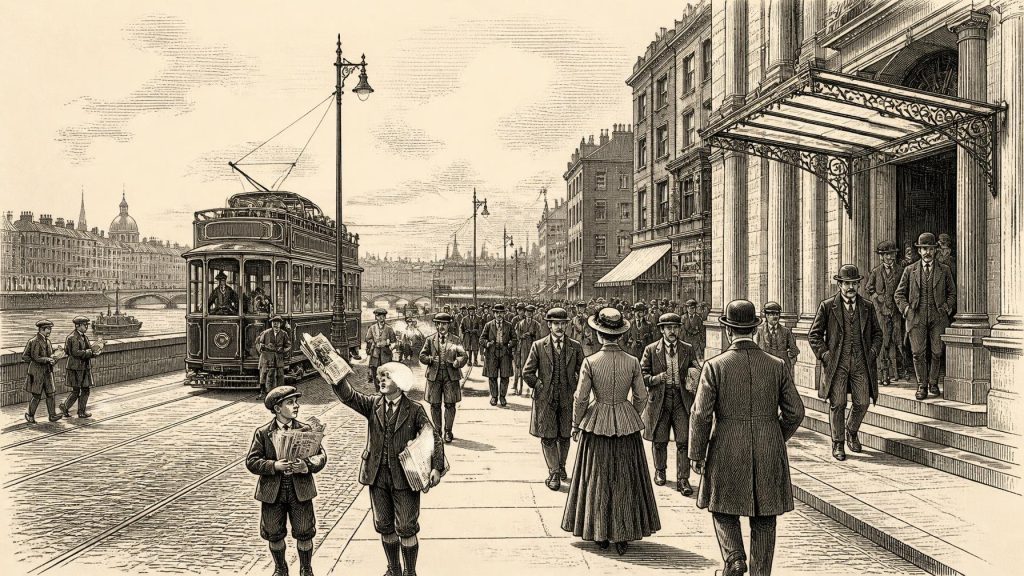
Public culture acquired a major new voice on 5 September, when the first issue of The Irish Press appeared. Established by Éamon de Valera and edited initially by Frank Gallagher, the daily was financed from funds connected with the old Dáil loan campaign in the United States. Its creation was a political, commercial and cultural intervention. Existing Dublin newspapers served established readerships and political outlooks; the new paper sought to give Fianna Fáil and its wider nationalist constituency a modern mass-circulation platform. It was sold for one penny and placed politics, Irish affairs and Gaelic games before readers in a form designed to be accessible and national in reach.
The paper did not merely report a changing political landscape; it helped make one. Its close association with de Valera meant that the boundary between journalism and party political communication was conspicuous. Yet that connection also reveals the importance attached to newspapers in an era before television: a daily paper could bind dispersed supporters, frame economic grievances, advertise meetings and create a shared political vocabulary. The launch came only months before the electorate removed Cosgrave’s government, although it would be too simple to treat the newspaper alone as the cause of that result.
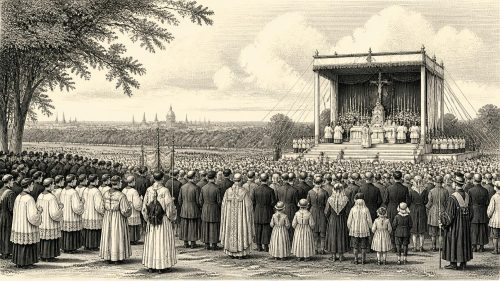
On 17 March Dublin also held the first official state-sponsored St Patrick’s Day parade. Reviewed by the Minister for Defence, Desmond FitzGerald, it placed military display and civic ceremony at the centre of a feast day that had long been marked religiously and celebrated spectacularly among Irish emigrant communities. The occasion expressed the Free State’s wish to present itself as orderly, national and durable. At the same time, the continuing ban on alcohol sales on St Patrick’s Day in the Free State showed how public celebration remained shaped by Catholic moral expectations and legislation.
By the close of 1931, Ireland had acquired neither social calm nor constitutional finality. What it had gained was a more autonomous legal position, alongside institutions and media through which competing visions of the nation could be advanced. The rebuilt Four Courts, the new Irish Press, the state parade and the Statute of Westminster all projected confidence. Flooded streets, falling farm prices, industrial unemployment and emergency powers told a more troubled story. Together they make 1931 a year in which the structures of independent Ireland grew firmer even as the arguments over what independence should mean became sharper.
Primary Sources
- Statute of Westminster 1931
- Constitution (Amendment No. 17) Act, 1931
- Constitution (Amendment No. 17) Bill, 1931—Allocation of Time Motion
- Timeline of Events, 1919–69
- Impact of Economic Depression
- Political Economy of Secession: Lessons from the Early Years of the Irish Free State
- The Statute of Westminster, 1931 – An Irish Perspective
- The Irish Press
- To Introduce the Irish Press: Ireland's New National Morning Newspaper
- Newspaper Descriptors Project: The Irish Press
- End for The Irish Press?
- Fianna Fáil Party Descriptive Catalogue
- Women in 20th-Century Ireland, 1922–1966: Sources from the Department of the Taoiseach
- Building a New Courts Administration – the Immediate Challenges
- The Walls Came Tumbling Down
- A Short History of the St Patrick's Day Parade Home and Away
- An Óige
- 50 Years of An Óige
- Rynne, Stephen
- Lower Lee (Cork City) Flood Relief Scheme: History of Flooding in Cork City
- Rainstorm 1931, Colthurst, An Bhlárna
- History of Government
- History In-Service Team Resource Pack for De Valera