Waterford’s Freeholder Summer1826 CE
In 1826, Ireland saw organised Catholic politics challenge landlord authority without achieving emancipation. Daniel O’Connell’s reconstituted Catholic Association mobilised parish networks, subscriptions and forty-shilling freeholders around religious rights, education and electoral action. County Waterford’s election symbolised this change: Henry Villiers Stuart, a Protestant emancipation supporter, defeated Lord George Beresford, demonstrating tenants’ capacity to resist estate influence. Pro-emancipation gains elsewhere reinforced warning to government. Sterling replaced Irish currency, integrating financial administration with Britain. An education inquiry exposed fragmented, denominational schooling, while land legislation addressed complex tenancies amid rural hardship. Arklow received Ireland’s lifeboat station, and Tyrone Power advanced his London career.
Dateline
In 1826, Irish public life acquired a new and unsettling political rhythm. The decisive developments did not amount to Catholic emancipation, which was still three years away, nor to a wholesale remaking of the country. Rather, they showed how an organised Catholic movement could turn religious grievance, local electoral organisation and the still-extant forty-shilling franchise into a visible challenge to landlord influence. The summer election in County Waterford became the year’s defining Irish event. Around it lay other, quieter changes: a common sterling currency was imposed across the United Kingdom; an official inquiry laid out a remarkably detailed, if retrospective, picture of schooling; and a lifeboat was placed at Arklow, marking an early institutional response to the dangers of Ireland’s coast.
A Sterling Ireland
On 5 January, the Currency Act of 1825 took effect in Ireland. It assimilated Irish currency to that of Great Britain, establishing sterling as the uniform money of account throughout the United Kingdom. This was not simply a matter of coin in a purse. The Irish pound had stood at a different value from sterling: a British pound had formerly been reckoned as £1 1s. 8d. Irish. The new arrangement required contracts, rents, debts, bank business, public accounts and ordinary commercial calculations to be understood in British currency. The Act expressly sought to prevent disturbance between debtors and creditors, but its practical effect was to make Ireland’s financial language more directly uniform with that of Britain.
For merchants, bankers, shopkeepers and officials this reduced a long-standing complication in transactions crossing the Irish Sea. For many rural households, whose dealings with cash were intermittent and whose livelihoods rested on small plots, seasonal labour and credit, the change was less likely to be experienced as a grand constitutional reform than as altered figures in accounts, receipts and rent demands. Yet it was another reminder that Ireland, though retaining distinctive institutions and conflicts, was governed within an increasingly integrated United Kingdom.
The Association Reassembled
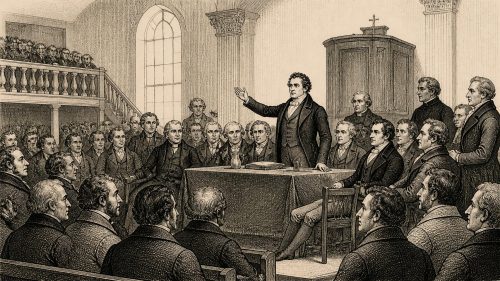
The year opened with Daniel O’Connell and his allies rebuilding political machinery after the suppression of the original Catholic Association in 1825. The statute against unlawful societies had prohibited political associations continuing beyond fourteen days. Rather than abandon the campaign, supporters used carefully structured short-lived meetings and a remodelled body usually called the New Catholic Association. Surviving reports from the Chief Secretary’s Office provide unusually close evidence of this activity. On 14 January, a meeting at Dublin’s Corn Exchange considered subscriptions, parish collectors, the safeguarding of association funds and plans connected with the education of the poor. Two days later, O’Connell told another meeting that the organisation would submit to the law, but not go beyond what the law required.
These meetings demonstrate that emancipation was not treated as a narrow question of whether a handful of Catholic gentlemen might enter parliament. The Association linked it to practical and communal concerns: education, burial rights, tithes, the defence of Catholics in local disputes, and the collection of the Catholic rent. Its modest subscriptions connected the Dublin leadership with parish networks across the island. Priests, lawyers, merchants, landholders and poorer contributors occupied very different stations, but the movement supplied them with a common political vocabulary. Its central demand remained “total and unqualified emancipation”: removal of the remaining religious disabilities that excluded Catholics from parliament and important offices.
This did not mean that Ireland spoke with one Catholic voice, or that religious identity neatly determined every political choice. The Association itself contained disagreement over tactics and over concessions that might accompany relief. Protestant supporters of emancipation also mattered greatly. Nevertheless, the meetings of January showed a campaign learning how to operate within restrictive law while retaining a national reach. That capacity was tested when the United Kingdom general election was called for the summer.
The Election as a Contest of Power
Polling across the general election ran from 7 June to 12 July. In Ireland, the contest made Catholic emancipation an unusually direct electoral issue. Catholics could vote in county elections if they possessed the necessary property qualification, including the much-discussed forty-shilling freehold, but they could not themselves take their seats at Westminster without an oath incompatible with Catholic belief. The political importance of the vote was therefore sharpened: men excluded from parliament could still help decide which Protestants would represent their counties.
The forty-shilling freeholder was neither an abstract democratic symbol nor invariably an independent voter. Such freeholds had often been created by landlords to enlarge their own influence. Many voters held land precariously, depended on access to turf, employment or accommodation, and could face severe pressure if they displeased an estate. Contemporary parliamentary evidence acknowledged these dependencies. What made 1826 significant was not the disappearance of landlord power, but the ability of organised Catholic voters, clergy and campaigners in several constituencies to defy it openly.
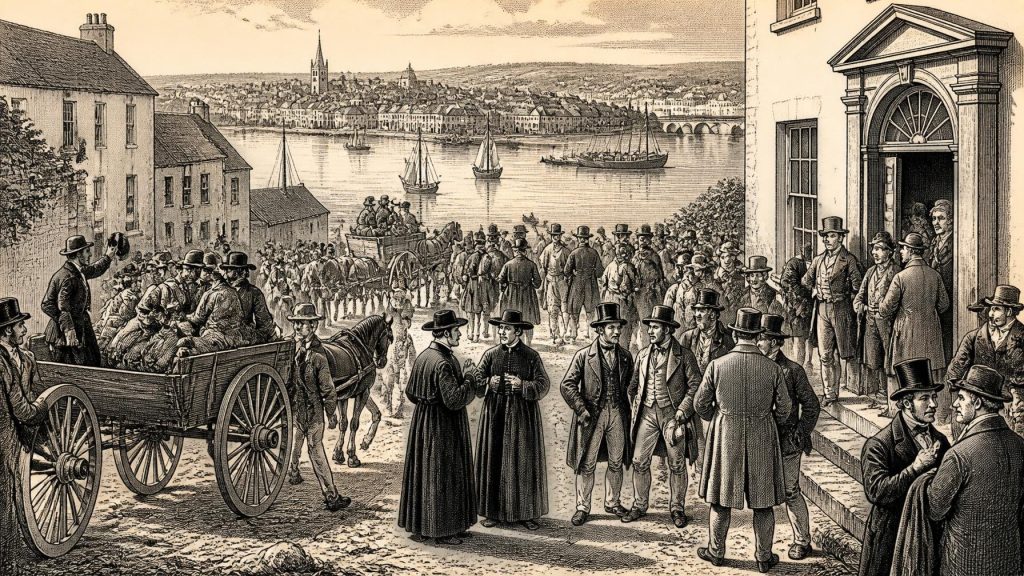
County Waterford supplied the clearest example. The Association and O’Connell backed Henry Villiers Stuart, a Protestant supporter of Catholic rights, against Lord George Beresford, a Tory opponent of emancipation and a member of a family long dominant in the county. Richard Power, whose position was secure, was also returned. When the poll closed, Power had 1,424 votes, Stuart 1,357, and Beresford only 528. Stuart’s return on 1 July displaced Beresford and punctured the assumption that an Ascendancy interest, rooted in great estates, could simply command a county seat.
The Waterford contest was labour-intensive as well as rhetorical. Voting took place in the county town, so freeholders from outlying districts needed the means to travel, lodge and remain near the poll. The Association’s local network helped turn sympathy into attendance. O’Connell’s presence and speeches gave the campaign national attention, while Thomas Wyse and other Waterford figures contributed organisation and local knowledge. The visible mobilisation of tenants was itself consequential. It made the relationship between landlord and voter a public political question, rather than an arrangement settled privately on an estate.
Waterford was not alone. Pro-emancipation candidates made important gains in county contests including Louth, Monaghan and Westmeath. The details varied from place to place, and no single result transformed the parliamentary majority at Westminster. The ministry did not concede Catholic relief in 1826. Still, the contests showed that an electorate often portrayed as passive could be coordinated around a programme, and that Protestant candidates could gain from embracing Catholic claims. The election was a rehearsal for the more dramatic Clare by-election of 1828, not its equivalent; O’Connell was not elected for Clare until two years later. Its immediate achievement was to establish a credible electoral threat.
Faith, Schooling and Public Provision
Religion remained inseparable from questions of learning. The Commissioners of Irish Education Inquiry produced their substantial second report in 1826, dated at Dublin on 16 September. It drew largely on returns gathered for 1824, so it should not be read as a census of school attendance in the calendar year 1826. It is nevertheless a major contemporary record placed before government that year. Running to more than 1,300 pages with appendices, it documented schools, teachers, buildings, fees, localities and the religious affiliations of pupils across Ireland.
The inquiry revealed a broad and uneven educational world rather than a single national system. Later parliamentary discussion based on its returns referred to more than 11,000 schools and nearly 569,000 children receiving some instruction. Many schools were small, locally sustained and dependent on fees, charitable bodies or religious patronage. The central difficulty was not merely supplying books or schoolrooms. Catholics objected, with reason, to systems in which Bible reading or instruction could conflict with clerical direction. In parliamentary debate during 1826, advocates of reform increasingly articulated a principle that would shape later policy: children might learn common secular subjects together, while receiving religious instruction separately and without insult to their faith. The national school system itself did not begin until 1831, but the arguments and information assembled in 1826 helped define the problem it would address.
Land, Poverty and the Coast
Parliament also passed the Assignment and Sub-letting of Land (Ireland) Act 1826, commonly described as a landlord-and-tenant measure. It dealt technically with the relationship between superior landlords, immediate lessees and under-tenants, including the notice procedures through which superior landlords could intervene in rent arrangements. It did not settle the Irish land question. Indeed, the need for such legislation reflected the intricate chains of lease, sublease and dependency through which much land was occupied. For tenants and cottiers, security of holding, rent, access to fuel and the possibility of a small potato plot could matter more immediately than the wording of Westminster statutes.
Broader conditions made such insecurity acute. Ireland remained overwhelmingly rural and agricultural, while post-war stagnation, low or irregular employment and high pressure on small holdings continued to bear heavily on poorer households. Modern economic research identifies 1826 as one of a sequence of significant pre-Famine food crises. It would be misleading to treat it as a precursor identical to the catastrophe of the 1840s; it was not. But the year belongs to the longer history of an increasingly vulnerable rural population, in which an interruption to crops or earnings could rapidly become a crisis of purchasing power and subsistence.
At Arklow in County Wicklow, meanwhile, the National Institution for the Preservation of Life from Shipwreck placed a lifeboat during 1826, its first station in Ireland. The gesture was practical and local, prompted by the hazards of an exposed coast and a busy maritime world of fishing vessels, coasters and traffic serving Dublin and ports on both sides of the Irish Sea. The station did not yet represent the dense rescue network familiar in later generations, but it marks the beginning of an organised lifeboat presence in Ireland.
An Irish Voice on Stage
There was also a small but telling cultural development beyond Ireland. In October, the Waterford-born actor Tyrone Power gained his opportunity at Covent Garden after the death of the established Irish comedian Charles Connor. Within a month Power was appearing in Connor’s parts and establishing the career that would make him a celebrated performer of Irish roles. His success belonged to London theatre, but it also illustrates how Irish identity was being performed, marketed and contested before audiences far beyond the island.
Thus 1826 did not deliver emancipation or land reform. It did something more preliminary and durable: it made organised Catholic political action impossible to dismiss as merely a petitioning interest. In Waterford especially, freeholders demonstrated that traditional deference could be challenged at the poll. The year’s currency, educational, legal and maritime developments were quieter, but together they show an Ireland whose institutions and daily calculations were changing even as its deepest political exclusion endured.
Primary Sources
- Currency Act 1825 (6 Geo 4 c.79, 27th June 1825)
- The Registered Papers of the Chief Secretary's Office: National Archives: Catholic Association (Browse records)
- O'Connell, Daniel | Dictionary of Irish Biography
- Protestants and the 1826 Waterford County Election
- Waterford (county) 1802-1885 | Historic Hansard
- To the forty shilling freeholders | National Library of Ireland Catalogue
- Elective Franchise in Ireland Bill, 26 April 1825 | Historic Hansard
- Elective Franchise in Ireland Bill, 9 May 1825 | Historic Hansard
- Catholic Emancipation, 8 February 1827 | Historic Hansard
- Second Report of the Commissioners on Education in Ireland
- New Collection in DRI – Ireland’s Educational Foundations: Digitising and Mapping the 1826 Education Inquiry
- Education in Ireland, 20 March 1826 | Historic Hansard
- Irish Charter Schools, 5 May 1826 | Historic Hansard
- The Registered Papers of the Chief Secretary's Office: National Archives: 1826 (Browse records)
- An Act to amend the Law of Ireland respecting the Assignment and Subletting of Lands and Tenements
- RNLI timeline: 1922 Foundation of the Irish Free State
- Geographies of Pawnbroking in pre-Famine Ireland: profit, precarity and impoverishment, 1787–1824
- History of the Commercial and Financial Relations between England and Ireland: Part 17
- Land | Ulster Historical Foundation
- Contents of the Registered Papers 1818–1833: Catholic Association and Orange Order
- Power, Tyrone | Dictionary of Irish Biography
- 19th Century Elections in Waterford City