Fever Crisis1817 CE
In 1817, Ireland faced severe scarcity, unemployment and typhus amid poor harvests and post-Napoleonic depression, though not an island-wide famine comparable to the Great Famine. Dublin fever surged in September, prompting Dr Steevens’ Hospital to open emergency wards for labourers, artisans and servants. Relief depended on fragmented charities, local bodies and government employment schemes, while new legislation addressed public works, grand-jury finance and institutional care. Fiscal integration with Britain advanced, and Catholic emancipation remained unresolved. Despite crisis, the Royal Canal reached Cloondara, Dunleary harbour construction began, temperance emerged in Skibbereen, and O’Reilly published an Irish-English dictionary, carefully preserving linguistic knowledge.
Dateline
Scarcity Becomes Epidemic
In 1817 Ireland was caught in the sharpest phase of a crisis that had begun with the bad weather and poor harvest of 1816. Cold, wet conditions had damaged the potato crop in many districts; the wider post-war slump that followed the end of the Napoleonic Wars reduced employment and purchasing power. For labourers, cottiers and smallholders whose survival depended upon a narrow margin of food, fuel, seasonal earnings and informal credit, this combination was ruinous. The year is therefore often placed within the famine-and-fever emergency of 1816–19. Yet care is needed with the word “famine”. Recent scholarship has argued that Ireland did not experience a single island-wide collapse of food supply on the later, catastrophic scale of the Great Famine. What is beyond doubt is that severe scarcity, unemployment, rising prices and disease exposed profound insecurity in both town and countryside.
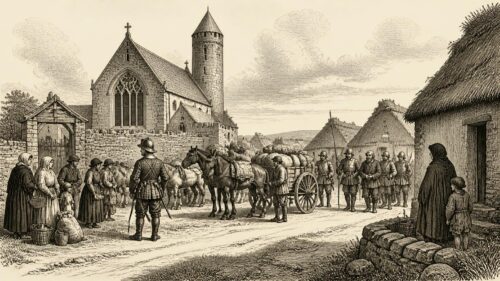
The burden fell unevenly. Those with little land, no stored grain and no secure wage suffered first when potatoes failed or work disappeared. In many areas the potato remained the indispensable food of poorer households, while oats, grain, livestock and dairy produce entered markets shaped by rents, debts and commercial demand. Food could exist in a district without being accessible to the people who most needed it. Families responded as poor households commonly did: by reducing meals, selling or pawning belongings, seeking work, relying on kin, begging, or moving towards towns and relief centres. Such expedients could preserve life for a time, but they also increased crowding and weakened bodies already vulnerable to infection.
Contemporaries called the disease that spread in these circumstances simply “fever”. Modern historians identify typhus as the principal epidemic disease, though not every recorded fever case can safely be assigned to one illness. Lice-borne typhus flourished where people were crowded together, inadequately clothed and unable to wash or change bedding. It was not hunger itself that transmitted the infection, but hunger, displacement and poverty created conditions in which it travelled rapidly. The events of 1817 made that connection starkly visible to doctors, clergy, magistrates and officials, even if their medical understanding of contagion and prevention was incomplete.
Dublin’s Emergency Wards
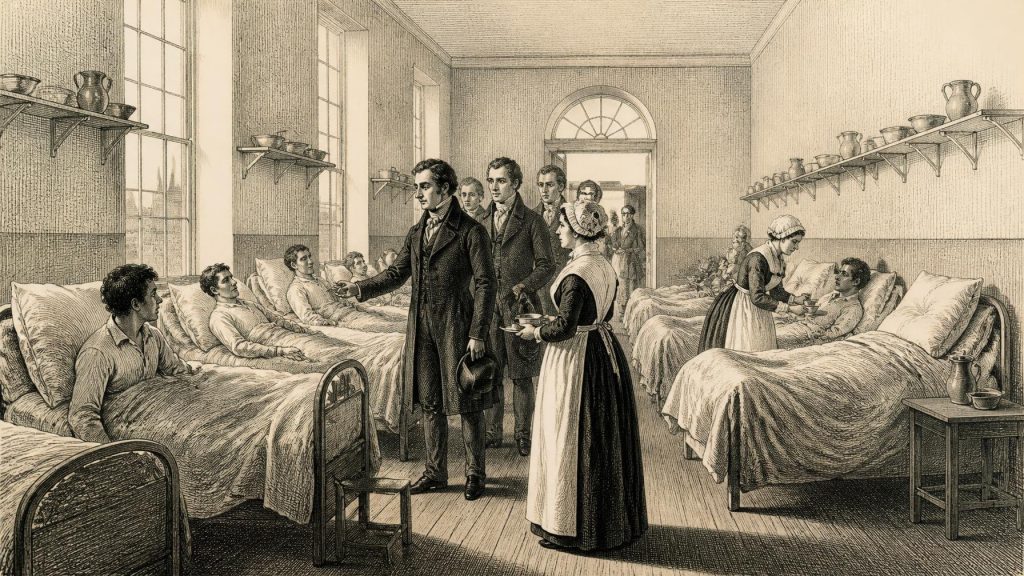
Dublin provides unusually close evidence for the acceleration of the epidemic. John Crampton, physician at Dr Steevens’ Hospital, later recorded that fever had already been prevalent in the city but increased suddenly in September 1817. Government directed the hospital to open additional accommodation for fever patients, and its previously unused upper storey was assigned to the purpose. This was an emergency adaptation, not the creation of a wholly new institution. It nevertheless showed that the existing charitable and voluntary hospital system could be pushed beyond its normal limits when disease and destitution converged.
Crampton’s later figures also reveal something of the social geography of illness. The people admitted to the fever department included labourers, artisans and domestic servants; labourers were the largest group. He noted patients connected with public works, including repairs to the Liffey wall, the Custom House docks, Dunleary and Howth, as well as workers from breweries and distilleries. Shoemakers, tailors, bakers, smiths, bricklayers and painters appeared among the tradesmen treated. Servants out of employment were particularly exposed. These observations do not mean that work caused the epidemic. Rather, they show how workers dependent on casual labour, lodgings and crowded workplaces were caught between unemployment and exposure.
Dr Steevens’ was one part of a larger, improvised response. Dublin already possessed the Cork Street Fever Hospital, founded in 1804, but the new pressure required more beds. Across Ireland, local initiatives and charitable subscriptions remained central because there was no comprehensive Irish poor law and no national health service. The state could advise, sanction and subsidise, but relief was fragmented among hospitals, grand juries, parish officers, landlords, clergy and private benefactors. On 30 September a national fever committee was appointed to distribute government assistance to victims of the epidemic. The committee’s appointment was firmly dated; its effectiveness, however, depended on local institutions whose capacity varied greatly from place to place.
Government, Work and Local Rates
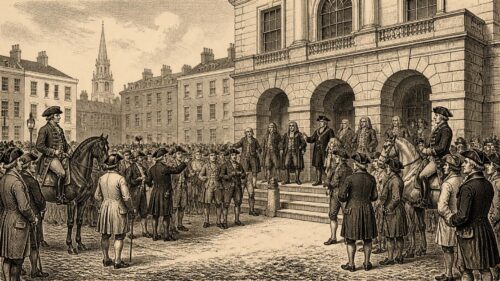
The Westminster government faced the Irish emergency while also responding to post-war distress throughout the United Kingdom. On 16 June the Poor Employment Act received royal assent. Its guiding idea was revealing: public money should be advanced for useful works so that the labouring poor might earn wages rather than receive unrestricted maintenance. Parliamentary debate openly acknowledged the combination of declining demand for labour, depressed land values, manufacturing difficulties and the recent bad harvest. Critics questioned whether loans, repayable with interest and often dependent on local security, could meet immediate need. The measure was relief through employment, not a guarantee of food or an Irish system of poor relief.
In Ireland, county grand juries and local ratepayers already had an important role in roads, bridges and other public works. Legislation of 11 July sought more deliberate scrutiny of grand-jury presentments for roads and works, and required clearer accounting for money raised through them. The same day, an act provided for the establishment of asylums for poor people classed at the time as “lunatic”. Its language belongs to its age, but the measure is significant as an acknowledgement that people without property and family protection required institutional provision. Neither law solved the immediate emergency. Both indicate a state beginning to legislate more visibly around poverty, public infrastructure and institutional care.
Political authority itself was in transition. The Irish and British exchequers had been unified from 5 January 1817, carrying the financial integration promised by the Act of Union further into practice. This did not end Irish administration, but it reduced the fiscal separateness that had survived the Union. At Dublin Castle, Charles Whitworth remained lord lieutenant through most of the year; after his successor Charles Chetwynd-Talbot, second Earl Talbot, arrived, Whitworth departed Ireland on 17 September. The change came as fever was intensifying in Dublin. Robert Peel was still chief secretary, directing a government more accustomed to order and administration than to sustained welfare provision.
Canals, Harbours and Employment
The year was not defined only by suffering. It also marked important material changes in the connections between Dublin, the midlands and the Irish Sea. On 26 May the Royal Canal reached its final destination at Cloondara, County Longford, completing the through route from Dublin towards the Shannon system. Begun in the late eighteenth century, the canal was intended to carry passengers and freight, including agricultural produce, turf and manufactured goods. Its completion was a substantial engineering achievement, although its financial history had been troubled and its commercial future would be challenged by railways later in the century. In 1817, however, it represented the hope that water transport might draw the midlands more closely into Dublin’s trading orbit.
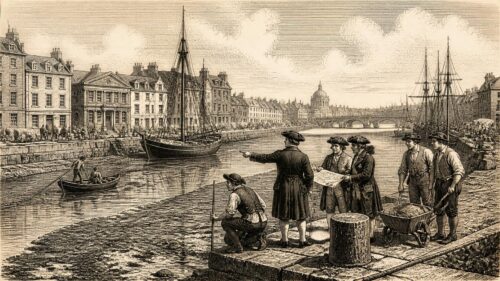
Five days later, on 31 May, Lord Lieutenant Whitworth laid the first stone of the new eastern pier at Dunleary, the harbour later known as Kingstown and now Dún Laoghaire. The project arose from the dangerous conditions of Dublin Bay and the need for an asylum harbour for vessels in distress. Engineer John Rennie’s plans promised a safer refuge and, eventually, a more reliable packet route to Britain. Construction also offered work in a period when employment was desperately scarce, though hard labour on exposed coastal works was no cure for the wider economic depression. The ceremony therefore carried two meanings: an assertion of official confidence in improvement, and a reminder that such improvement was being built amid social emergency.
Religion, Rights and Cultural Work
Religious and constitutional questions remained inseparable from Irish politics. In April and May, petitions from Irish Roman Catholics again brought the question of further political relief before Parliament. The debates exposed the familiar divide. Supporters argued for the removal of remaining civil disabilities; opponents portrayed Catholic admission to Parliament as a threat to the Protestant constitution and the established church. No emancipation settlement came in 1817. The episode nevertheless demonstrates that Irish Catholic political organisation had not disappeared after the Union, even while hunger and fever made everyday survival the more urgent concern for much of the population.
Religious communities were also practical agents in the emergency. Clergy of several denominations were among those reporting distress, raising subscriptions, visiting the sick and helping to organise relief. Such work could cross confessional boundaries, but it did not erase the inequalities of a society in which most poor people were Catholic while political power, much landed wealth and the established church’s privileges remained Protestant. The crisis gave social questions a bodily immediacy: rent, employment, diet, housing, sanitation and access to care were matters of life and death.
In Skibbereen, County Cork, Geoffrey Sedwards and associates established an abstinence society during the year, generally recognised as an exceptionally early organised temperance initiative. Its significance should not be overstated: it was a small local association rather than a national movement. Still, it anticipated the later prominence of temperance in Irish social and religious life. Its emergence in a period of hardship also suggests how moral reform, mutual discipline and concern about household expenditure could be linked in popular thinking.
Another quieter landmark was Edward O’Reilly’s An Irish-English Dictionary, published in 1817. Drawing upon a large body of vocabulary and textual learning, it made Irish-language material more accessible to English-reading scholars and readers. It did not reverse the social pressures bearing upon Irish speakers, especially in poorer western districts, nor should it be treated as the beginning of a modern language revival. But it preserved and organised linguistic knowledge at a time when Irish remained the daily language of many communities, while government, law, commerce and much formal education operated principally in English.
Thus 1817 joined visible projects of improvement to a grave human emergency. A canal was completed, a harbour foundation stone was laid, statutes addressed works and institutions, and learned culture continued. Yet the defining experience for countless people was scarcity followed by fever. The added wards at Dr Steevens’ Hospital stand as a precise Dublin image of the year: an existing building altered in haste because the ordinary arrangements of society could not contain the consequences of poverty, unemployment and epidemic disease.
Primary Sources
- An historic sketch of the causes, progress, extent, and mortality of the contagious fever epidemic in Ireland during the years 1817, 1818, and 1819
- Medical Report of the Fever Department in Steevens' Hospital: containing a brief account of the late epidemic in Dublin, from September 1817, to August 1819
- Fever: The Fever Epidemic of 1817–1819 at Dr Steevens’ Hospital
- Content of the Registered Papers, 1818–1833
- The Office of the Chief Secretary of Ireland: Chronology
- Poor Employment Bill
- Petition of the Roman Catholics of Ireland
- Roman Catholic Question, 8 May 1817
- The Royal Canal – Rise, Fall, Rebirth
- Pivot Points 11 – Building for Transport III: Harbours
- President Attends the Official Commemoration of the Bicentenary of Dún Laoghaire Harbour
- The History of Dún Laoghaire Harbour: Construction and Compromise
- Asylums for Lunatic Poor (Ireland) Act 1817
- Grand Jury Presentments (Ireland) Act 1817
- Public Works Loans Act 1817
- Whitworth, Charles
- Part 18 of History of the Commercial and Financial Relations between England and Ireland from the Period of the Restoration
- An Interleaved and Annotated Copy of Edward O'Reilly's Irish-English Dictionary (publ. 1817)
- Irish-English Dictionary: an interleaved copy of Edward O'Reilly's An Irish-English Dictionary, 1817
- The ‘Oldest Pledged Teetotaller’ in Skibbereen
- Moral Reform and Financial Innovation: Temperance Tontines in Ireland, c.1833–1850
- The Introduction and Functioning of the Poor Laws in Ireland
- The Famine That Wasn’t: Ireland’s 1817–19 Crisis
- Oireachtas Library and Research Service Display Case