Bread Riots1740 CE
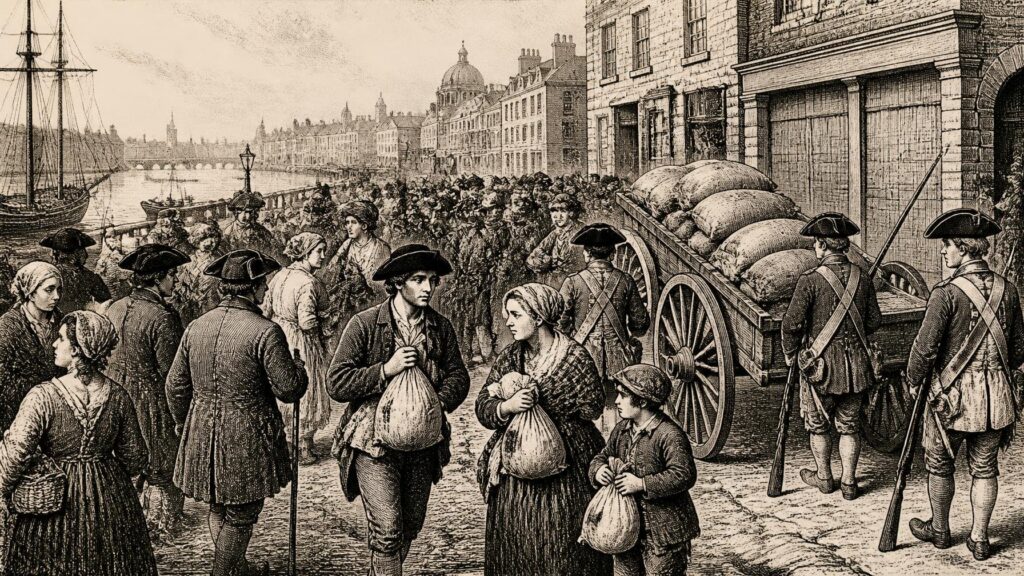
In 1740, severe frost followed by drought disrupted Ireland’s potatoes, grain, livestock and food distribution, initiating the famine 1741. Rising prices made provisions inaccessible to labourers and cottiers, while Dublin crowds rioted from 31 May to 2 June, seizing and redistributing bread, meal and beef at lower prices. Authorities banned food exports, pursued alleged market manipulators, imposed port restrictions and offered rewards, but parliament did not organise comprehensive relief. Archbishop Boulter and charities provided fragmented assistance. The crisis exposed inequalities in landholding, markets and welfare, while autumn brought no recovery before renewed winter, fever and dysentery worsened famine in 1741.
Dateline
In 1740 Ireland entered a crisis so severe that later generations remembered its wider course as bliain an áir, the “year of slaughter”. That name properly belongs above all to 1741, when famine and epidemic mortality reached their most terrible intensity. Yet 1740 was the decisive first year: an extraordinary frost, followed by drought, devastated the food system on which labourers, cottiers and town-dwellers depended. By the end of the calendar year, hunger had become a political problem in Dublin, an emergency for churches and charities, and a grave danger in much of the countryside.
The evidence does not permit a neat national death toll for 1740 alone. Parish and institutional records are incomplete, and the heaviest mortality extended into 1741 and, in some places, beyond. What can be said firmly is that the weather shocks, harvest failure, price rises, public disorder and limited relief measures of 1740 set the famine in motion. Ireland was not a passive stage for a natural disaster: the shape of landholding, poverty, food markets and government determined who was most exposed.
The Great Frost
The crisis began in the closing days of 1739, but its effects belonged emphatically to 1740. The “Great Frost” persisted through the opening months of the year. Contemporary observers, including the Dublin physician John Rutty, recorded an unusually severe and prolonged cold season. Water and transport were disrupted, and the frost struck at food already stored for winter as well as at the prospects of the coming agricultural year.
This was not the nineteenth-century potato blight repeated in another age. In 1740 potatoes were already important to many poor households, especially as a cheap and productive food, but oats and other grains were also central to the diet of much of the labouring population. The frost damaged potatoes held in pits and stores, while the difficult winter depleted fodder and put livestock under pressure. Milk and livestock products mattered greatly to household nutrition, so a shortage of fodder was itself a food crisis.
When the frost eased, recovery did not follow. Spring and summer brought unusually dry, often cold conditions. Fields could be hard to work, sowing was delayed or ineffective, and crops suffered for want of rain. The preceding autumn had also been wet enough to compromise the 1739 harvest in some districts. The result was a succession of blows rather than one failed crop: damaged potato supplies, a weak grain harvest, reduced animal produce and a constricted ability to mill, move and buy food. The countryside’s ordinary seasonal rhythm—saving winter stores, planting, harvesting and bringing grain to market—was badly broken.
A Dearer Meal
For people with money, scarcity meant rising expenditure and anxiety. For people paid by casual labour or living on minute holdings, it meant the disappearance of a margin already perilously small. Grain prices rose sharply during 1740; scholarship based on surviving price series finds that wheat in Dublin more than doubled over the famine period. Prices alone do not describe hunger, but they show why food that remained in markets could become inaccessible to the poor.
In this setting, familiar distinctions between town and country could blur. Rural households sought food, credit or employment; towns attracted people because they contained markets, charitable institutions and officials. But an urban market could not manufacture provisions. Dublin’s bakers, millers and meal merchants stood at the point where private stocks, public need and suspicions of profiteering met. Crowds did not necessarily see food scarcity as an impersonal fact of weather. They could understand withholding grain, refusing to bake, or charging an intolerable price as an offence against the community.
That outlook is visible in a surviving 1740 Dublin pamphlet, The Voice of the People, which defended the recent “insurrection” against bakers and forestallers. “Forestalling” meant buying up goods before they reached the open market in order to resell at profit. The pamphlet’s existence is important evidence in itself: the disturbances were serious enough to prompt an argument over their legitimacy, and hunger had become a subject of urban print as well as private distress.
Three Days in Dublin
The best firmly dated outbreak came between 31 May and 2 June. Bread and meal riots swept Dublin after bakers reportedly refused to make household bread amid the high cost of provisions. Crowds broke into shops and mills, took bread and meal, and sold or distributed it at lower prices. They also seized beef from a vessel in the river and brought meal from mills around the city. Contemporary reporting and later calendared civic records indicate that people were killed and wounded during the disorder.
These were not simply indiscriminate attacks. As in food riots elsewhere in eighteenth-century Europe, the action sought to impose what participants considered a just price and to force provisions back into local circulation. That did not make it lawful in the eyes of the state. On 4 June the Dublin government issued an order offering a reward for information leading to the apprehension of those responsible for disorder in the city. On 16 June it offered a pardon to anyone providing information about an attack on cattle belonging to named owners. Such proclamations show both official alarm and the difficulty of restoring order where hunger had made crowd action possible.
The disturbances also reveal the limitations of the capital’s apparent advantages. Dublin had merchants, a corporation, a workhouse, a port and the seat of government. Nevertheless, access to food could collapse with frightening speed for those who could not pay market prices. The violence was a warning that famine in Ireland would be shaped not only by harvests, but by the management of markets and the credibility of authority.
Government Without a Session
The Irish executive did take measures during 1740, though none could repair the underlying failure of food production. On 19 January, while the frost still held, a proclamation prohibited the export of corn, grain and meal. Its wording explicitly linked the season’s severity to possible scarcity and to the welfare of poor inhabitants. The measure was an attempt to keep food within the kingdom, but an export ban did not create new supplies, nor did it ensure that food would reach those without purchasing power.
Political authority rested, meanwhile, with Lords Justices during the Lord Lieutenant’s absence: Hugh Boulter, Church of Ireland archbishop of Armagh; Robert Jocelyn, lord chancellor; and Henry Boyle, speaker of the Irish House of Commons. Their names mattered because they embodied the Protestant governing establishment at Dublin Castle and in parliament. Yet parliament itself did not meet to devise a comprehensive famine programme. It was repeatedly prorogued during 1740, first into May, then to December, and again into 1741. Administration therefore proceeded through proclamations, local magistracy, corporations and private initiative rather than a sustained parliamentary response.
In October an embargo was imposed on outward-bound ships from specified ports, apart from vessels carrying war provisions. The timing also belonged to an Atlantic world unsettled by the War of the Austrian Succession, which had begun that year. Ireland’s food emergency was thus not isolated from maritime commerce and imperial conflict. By December, the government was again invoking laws against engrossers, forestallers and regraters—people accused of manipulating food supplies and prices—and ordered a public fast for 4 February 1741. These late-year acts acknowledged a danger that had plainly not passed.
Relief, Faith and Limits
Relief in 1740 was real, but fragmented. Archbishop Boulter became the most prominent charitable figure in Dublin. Accounts of the crisis credit him with financing food for thousands at the city workhouse, a scale of assistance remarkable for the period. The workhouse offered direct feeding rather than merely advice or moral exhortation, and charitable subscriptions, landlords, clergy and local officeholders also supplied food, money, clothing or employment in particular places.
Such help should not be romanticised. Ireland possessed no modern national welfare system, and parish and municipal provision varied greatly. A workhouse could save lives while also becoming crowded and dangerous; charity depended on donors, locality and access. The Church of Ireland had resources and an official position, while the Catholic majority lived under the continuing restrictions of the penal era. Catholic clergy and communities still provided pastoral support, but the formal machinery of government and much organised elite relief lay elsewhere. Hunger crossed confessional boundaries, yet power and resources did not.
Religious practice also offered people ways to interpret catastrophe. The proclamation of a public fast treated scarcity as a communal spiritual emergency. A later account of a holy well near Lough Derg recalled the aftermath of the Great Frost and the crowds drawn to an unusual change in the water during the spring. It cannot be used to measure the scale of popular belief across Ireland, but it does preserve a local example of environmental disturbance, devotional practice and explanation being closely connected.
Winter’s Unfinished Reckoning
By December 1740, Ireland had endured frost, drought, failed provisions, inflated prices and urban violence. The year’s autumn harvest brought no secure recovery. A renewed hard winter and the spread of fever and dysentery would make 1741 still worse. It is therefore misleading to attach the later famine death estimates directly to 1740. The calendar year’s historical importance lies elsewhere: it was the year in which environmental shock became a nationwide subsistence crisis, and in which Dublin’s bread rising exposed how quickly the struggle for food could challenge both market practice and public order.

Primary Sources
- The Irish Famine of 1740–1741: Famine Vulnerability and ‘Climate Migration’
- Processes Prior and during the Early 18th Century Irish Famines—Weather Extremes and Migration
- Famine in Ireland, 1300–1900
- Coping with Crisis: The Response to the Famine of 1740–41
- Weather Extremes and Social Vulnerability in the Irish Famine of 1740–1741
- The Great Frost and Forgotten Famine
- Arctic Ireland: The Extraordinary Story of the Great Frost and Forgotten Famine of 1740–41
- Climate: Background to Eighteenth-Century Ireland
- Statute Law Revision Act 2015
- Statute Law Revision (Pre-Union Irish Statutes) Act 1962, Schedule
- By the Lord Lieutenant and Council of Ireland, a Proclamation
- By the Lords Justices and Council of Ireland, a Proclamation
- The Voice of the People: In an Apology for Their Late Insurrection against the Bakers and Forestallers in the City of Dublin
- Calendar of Ancient Records of Dublin: Table of Contents
- The Dublin Daily Post and General Advertiser
- Pue’s Occurrences
- Jocelyn, Robert
- The Irish Political System, 1740–1765
- The Irish Crisis
- A Journey to Lough Derg
- The Third Appendix Containing an Abridgment of the Statutes, Passed in the Thirteenth Year of His Majesty King George the Second
- An Exact Abridgment of All the Ecclesiastical Statutes in Force in Ireland