Eleven Agents1627 CE
In 1627, Irish politics centred on negotiations over Crown funding, land security and Catholic disabilities. After failed discussions with Lord Deputy Falkland, a convention appointed eleven agents, mainly Old English Catholics but including Protestants, to negotiate in England. Their mission anticipated, but did not yet constitute, the Graces agreed in 1628. Spanish invasion rumours heightened security concerns without producing an expedition. Government business included Adam Loftus’s recall, creation of a Second Serjeant-at-Law, and William Brabazon’s elevation as earl of Meath. William Bedell became Trinity’s provost, encouraging Irish-language ministry. Robert Boyle was born at Lismore, within the prominent Protestant plantation elite.
Dateline
In 1627 Ireland’s most consequential development was not a battle, statute or plantation proclamation, but a negotiation. In June, an Irish convention chose eleven agents to go to the king in England and seek a bargain over money, land and religion. The delegation emerged from a political crisis that had been gathering since Charles I’s accession in 1625: the Crown wanted Ireland to contribute more reliably to defence, while many Catholic landowners wanted greater security for their estates and relief from religious penalties. The agreement eventually associated with these talks would become known as the Graces, but that settlement belonged to 1628. What can be firmly placed in 1627 is the decision by Irish elites to organise, select representatives and carry their case beyond Dublin Castle.
A kingdom asked to pay
Henry Cary, Viscount Falkland, remained lord deputy in Dublin. His government faced a problem shaped by European war and by the geography of the three Stuart kingdoms. Ireland was regarded at Whitehall as both a possible landing-place for a Catholic enemy and a source of troops, provisions and revenue. The existing royal army was expensive; proposals under discussion envisaged a much larger force. Crown ministers therefore explored whether Irish landowners would finance defence in return for concessions.
This was a practical question with broad consequences. The people expected to pay were not simply an undifferentiated “Irish” interest. They included Protestant newcomers and office-holders, long-established English-descended Catholic families usually called Old English, and members of Gaelic Irish landed society. Their relationships with the state differed sharply, yet many had reason to seek dependable rules on landholding. Since the late sixteenth century, conquest, plantation and the Crown’s use of legal inquiries into title had made proprietors wary that an apparently secure inheritance could be reopened. In Connacht and Wicklow especially, projected plantation and disputed Crown claims gave that anxiety a sharp edge.
Religion made the proposed bargain still more difficult. Most of the population remained Catholic, while the established church, state offices and law were Protestant. The penal framework against recusancy existed, even if enforcement varied. Catholic gentry sought toleration in practice and wished to avoid fines and disabilities; many Protestant officials feared that concessions would weaken the religious settlement and their own political standing. Thus finance, conscience and property were inseparable. A subsidy for soldiers could only be secured if it seemed to buy a more stable political future.
The convention and its delegation
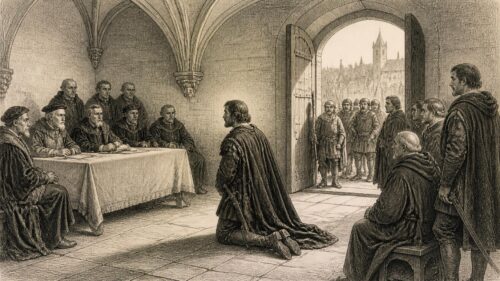
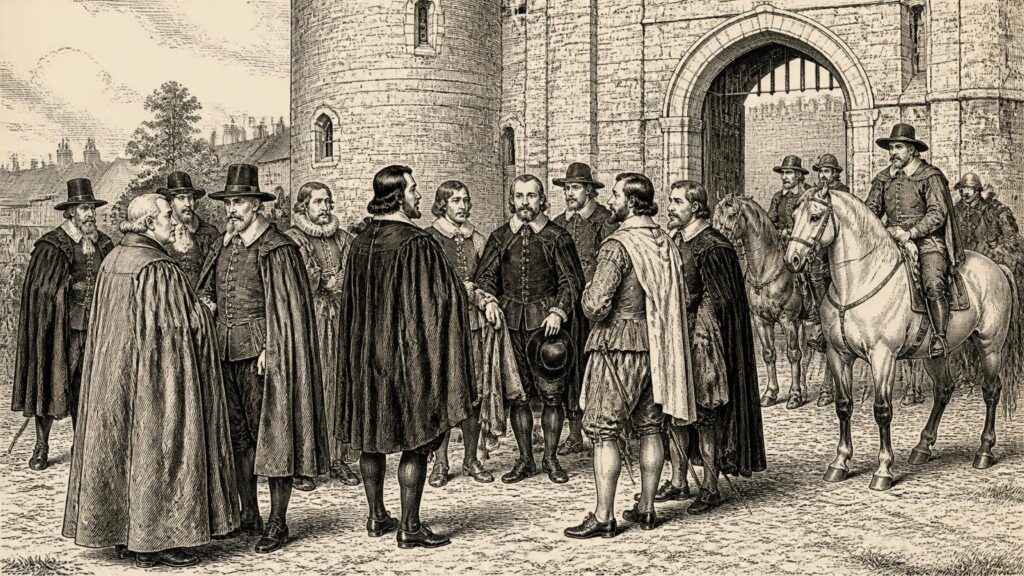
Falkland’s great council in the spring did not produce an acceptable agreement. During June, however, a convention selected eleven agents to negotiate in England. Eight were Old English Catholics: Lord Killeen, Sir Thomas Luttrell, Sir William Talbot, Sir Lucas Dillon, Sir Henry Lynch, Sir Edward FitzHarris, Sir John Meade and Lord Power. They were joined by three Protestants, Richard Osborne, Arthur Forbes and Andrew Stewart. The composition mattered. It presented the mission as a kingdom-wide landed interest rather than an exclusively Catholic petition, while the Catholic majority made clear whose grievances required attention.
The agents did not yet carry a final, agreed package called the Graces. That name properly belongs to the fifty-one articles accepted at Whitehall the following year. In 1627 they represented an attempt to turn diffuse complaint into authorised negotiation. The key concerns later visible in the articles were already present: confirmation of titles, protection against disruptive legal processes, better administration of justice, and changes that would ease the position of Catholics who were otherwise shut out by the oath of supremacy and recusancy laws. The constitutional importance of the moment lay in this use of collective representation. A royal government accustomed to dealing with magnates individually now had to reckon with a formally chosen Irish agency.
For ordinary tenants, labourers, town dwellers and artisans, no seat at the convention translated directly into a voice. Yet the issue was not remote from daily life. Land titles affected landlords’ ability to sell, mortgage, settle and improve estates; demands for military funding travelled through rents, local levies, provisioning and the obligations of landholding. The prospect of renewed religious enforcement also reached beyond elite households, touching priests, schools, worship and the social networks that sustained Catholic practice. The record of high politics therefore reveals pressures felt, in unequal ways, across parishes and estates.
Alarm across the sea
Security fears gave urgency to these talks, but they must not be mistaken for evidence that Ireland was invaded in 1627. On 27 April Falkland reported intelligence and rumour concerning a proposed Spanish-backed descent, connected with Irish Catholic exiles in the Spanish Netherlands, including Shane O’Neill, titular earl of Tyrone, and Hugh Albert O’Donnell. Falkland relayed the striking report that O’Neill might arrive with a Spanish force and be crowned king of Ulster. Such claims show what Dublin Castle feared and what stories circulated; they do not prove that an invasion was ready to sail.
Indeed, the Spanish project was never carried out. Spain had reasons to encourage or hear Irish émigré schemes during the wider contest with England, but Philip IV did not commit to creating an independent Ireland. Still, the possibility was politically powerful. It reinforced the Crown’s argument for an Irish-funded military establishment, while anti-Catholic suspicion made Protestant officials more reluctant to trade religious concessions for revenue. Ireland’s domestic settlement was therefore being argued over in the shadow of continental diplomacy, exile politics and maritime uncertainty.
Office, law and rank
Several firmly dated acts in 1627 reveal the working machinery of government. On 12 May, Charles I directed that Adam Loftus, the lord chancellor, attend him in England and surrender the Great Seal for it to be placed in commission. Loftus’s removal from the day-to-day centre of Irish chancery business came amid his prolonged rivalry with Falkland. Their quarrel was personal and factional, but it also concerned policy: Loftus became an important intermediary with Catholic landowners, whereas Falkland’s handling of the negotiations had foundered. The dispute demonstrates that “Dublin Castle” was not a single-minded institution. Its leading servants competed over access to the king, law, patronage and the terms on which Ireland might be governed.
On 23 May, a patent created the office of Second Serjeant-at-Law in Ireland, appointing Nathaniel Catelyn as its first holder. The Crown justified an additional law officer by the need for diligence in cases concerning royal service. It was a small institutional innovation, but a revealing one. Litigation, title inquiries and Crown business required trained legal personnel, and government depended increasingly upon courts and paperwork as well as soldiers. The same year also saw William Brabazon, second Baron Ardee, created earl of Meath, on 16 April. Such an elevation was not merely ceremonial: peerage ranked families within the political order through which the Crown sought influence in the Irish House of Lords, county society and local administration.
Learning Irish at Trinity
Another appointment pointed in a different direction. William Bedell was admitted provost of Trinity College Dublin on 16 August, though he did not begin active residence until the following summer. His appointment belongs securely to 1627; his better-known initiatives at the college chiefly followed in 1628 and 1629. Bedell believed that Protestant clergy should be able to address Irish speakers in their own language, rather than treating English alone as the vehicle of reform. That conviction would bring him into contact with the Irish scholar and translator Muircheartach Ó Cíonga, also known as Murtagh King.
It would be misleading to portray 1627 as the year in which Bedell completed a linguistic programme or an Irish Bible translation: neither happened then. But his selection marked the arrival at Trinity of a provost who considered Irish learning necessary to pastoral work. In an era when state power often equated English language, Protestantism and political conformity, this was a significant, if instrumental, recognition of Irish as a learned and living medium. It also hints at continuities beneath political conflict: bardic and scribal expertise remained valuable, even within institutions founded to advance the Reformation.
A birth at Lismore
On 25 January 1627, Robert Boyle was born at Lismore Castle in County Waterford, the fourteenth child and seventh son of Richard Boyle, earl of Cork, and Catherine Fenton. The date is sometimes rendered 25 January 1626 in contemporary English reckoning, because the legal new year then began on 25 March; in modern calendar usage it is 25 January 1627. His birth did not alter Irish politics, but the setting is instructive. Lismore was a seat of the enormously wealthy Boyle estate, built from the opportunities and dispossessions of the Munster plantation world.
Robert Boyle would later become a major natural philosopher, remembered for experimental work on air and for his role in the intellectual culture that formed around the Royal Society. Nothing in 1627 permits a retrospective claim that this future was visible at his cradle. What the year does show is the social environment from which he came: a powerful Protestant landed household, closely interwoven with Crown administration, commercial estate-building, education and Atlantic-facing politics. The infant at Lismore and the eleven agents chosen at Dublin belonged to very different strands of Irish society, yet both illuminate the same unsettled kingdom: one seeking revenue and security, struggling over faith and land, and still sustaining Irish scholarship amid profound change.

Primary Sources
- Calendar of the State Papers Relating to Ireland of the Reign of Charles I, 1625–1632
- Calendar of the Patent and Close Rolls of Chancery in Ireland, of the Reign of Charles the First: First to Eighth Year, Inclusive
- State Papers Ireland 1509–1782: Government Papers on Irish Affairs
- Cary, Henry
- Loftus, Adam
- Bedell, William
- Boyle, Robert
- William Bedell: Former Provosts
- History of the Irish Language in Trinity College
- Ó Cionga, Muircheartach
- Robert Boyle Project: Introduction
- Robert Boyle: Science in the Making
- Robert Boyle
- Robert Boyle (1627–1691)
- The Irish Admiralty: Its Organisation and Development, c.1570–1640
- Ireland Under the Stuarts, Volume I
- Studies in Irish History, 1603–1649
- Ireland Under the Stuarts and During the Interregnum
- Hugh O’Neill in Irish Historical Discourse, c.1550–2021
- Resolución Varonil or the Manly Resolve of Countess Mary Stuart O’Donnell
- Charles I and the Spanish Plot: Anglo-Habsburg Relations and the Outbreak of the War of Three Kingdoms, 1630–1641
- Making Ireland British, 1580–1650
- Buckingham and Ireland, 1616–1628
- The Old English in Ireland, 1625–42
- Ireland 1460–1630: Politics, Kingdom and Society