Shane O’Neill1564 CE
In 1564, Ireland experienced interconnected struggles over lordship, succession, tribute and fortified places rather than a unified war. Shane O’Neill, strengthened by Crown recognition but constrained by unresolved negotiations and Dublin’s weakness, raided Tír Chonaill, exploited O’Donnell divisions at Donegal, supported Hugh Boy O’Rourke in Breifne, and fought the MacDonnells near the Bann. His setback and ensuing truce demonstrated limits to his power; decisive MacDonnell defeats came later. In Thomond, rival O’Briens, mercenaries and raids devastated communities, cattle and church resources. Religious institutions remained politically important, while William Bathe’s birth reflected Dublin society. The year intensified conflicts without resolving them.
Dateline
In 1564 Ireland’s most consequential struggle was not a single war between two neatly defined sides, but a series of connected contests over lordship, tribute, castles and allegiance. In Ulster, Shane O’Neill sought to turn the influence he had recovered after his visit to Elizabeth I’s court into durable regional supremacy. His opponents included the Scottish MacDonnells of the Antrim coast, the O’Donnells of Tír Chonaill, rival branches of his own wider kindred and neighbouring dynasties whose submission he expected. The Dublin government, meanwhile, was too weak, divided and financially constrained to dictate events. It could encourage one power against another; it could not reliably settle the North.
An Unsettled Settlement
The year opened in the shadow of the agreement made at Drumcree in September 1563 between Shane and representatives of the crown. It had recognised him as “the lord O’Neill” and appeared to promise a route towards confirmation of his claims in Tyrone. Yet its central political problem was deferred, not solved. A parliamentary act was envisaged to extinguish the rival title of baron of Dungannon and settle wider questions of authority, but no Irish parliament was summoned. By the winter and spring of 1563–64, negotiation had become an exchange of delays, demands and mutual suspicion.
That impasse mattered because Shane’s authority rested on more than any arrangement made in Dublin or London. He needed followers, tribute, hostages and military success within Ulster. A crown recognition that enlarged his standing would threaten the MacDonnells, whose Scottish kindred had created a powerful maritime lordship in the Route and the Glens of Antrim. It would also alarm O’Neill rivals and neighbouring rulers who had reason to fear his claims to old services and overlordship. The formal language of Tudor administration and the political language of Gaelic lordship therefore collided in 1564. Neither side accepted that the other had the final word.
In May, Sir Nicholas Arnold became lord justice in Ireland during the Earl of Sussex’s absence. Arnold had been sent to investigate the costs and alleged abuses of government, and economy was a central concern of his administration. The crown’s military establishment was reduced substantially. This did not mean that Dublin had abandoned Ulster, but it did mean that Arnold had few means to impose a settlement there. His government could watch Shane’s initiatives, receive reports and attempt diplomacy, while finding it convenient that O’Neill might curb the MacDonnells without a costly royal campaign.
Donegal’s Contested Tower
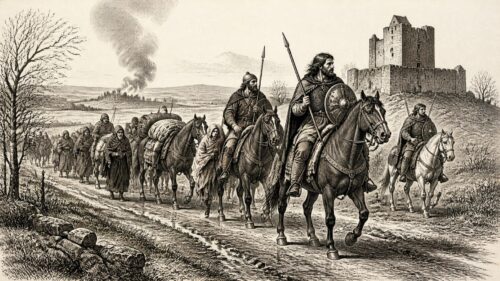
Shane moved first against Tír Chonaill. The sequence is unusually well anchored in the annalistic record, though its exact wider chronology should not be over-elaborated. Earlier in 1564 An Calbhach O’Donnell, lord of Tír Chonaill and Shane’s former captive, had been released on terms involving Lifford and a promised ransom. The release did not bring peace. In May, Shane raided O’Donnell territory before opening operations against the MacDonnells, an attack that helped secure his rear but also asserted his capacity to punish an old enemy.
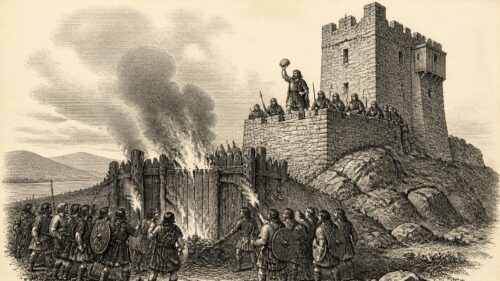
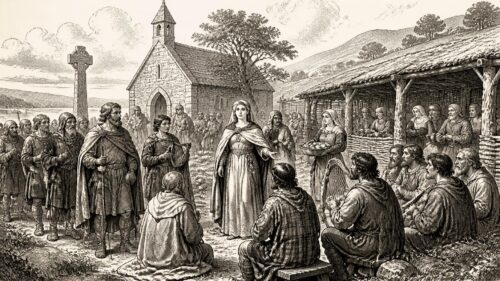
The Annals of the Four Masters describe a sharp episode at Donegal town. An Calbhach and Turlough O’Boyle had gone to Dublin to confer with the lord justice. During their return, Con O’Donnell, An Calbhach’s son, attempted to seize Donegal from Hugh, son of Aodh Dubh O’Donnell, who held the new tower. The attempted coup exposed the divisions inside the O’Donnell dynasty. Shane O’Neill and Hugh, son of Manus O’Donnell, arrived with a large force after hearing of the conflict. Con was captured on 14 May, while raiding parties ranged through Tír Boghaine and killed leading members of the MacSweeney kindred.
This was not merely a castle intrigue. Donegal was a political and religious centre, associated with the Franciscan house founded by the O’Donnell dynasty as well as with its lordship. Control of its tower, town and approaches carried strategic weight. The episode also shows that alliances in 1564 were contingent. Shane did not simply invade a united Tír Chonaill; he intervened where family competition gave him an opening. Hugh McHugh Dubh, defender of the tower, would later be remembered as a nobleman and bardic poet. In 1564, however, he appears in the sources first as a man holding a fortified position in a contested succession.
The Bann and the MacDonnells
In the early summer Shane sought permission from figures at court and from Arnold in Dublin to make war on the MacDonnells. The request was politically astute. English officials had long regarded Scottish expansion on the Antrim shore as a danger, even while at other moments they had tried to use the MacDonnells against Shane. Silence or equivocation from Dublin enabled him to proceed without a clear royal commission. His campaign should therefore be understood as his own bid for mastery, although it overlapped with an English interest in limiting Scottish power.
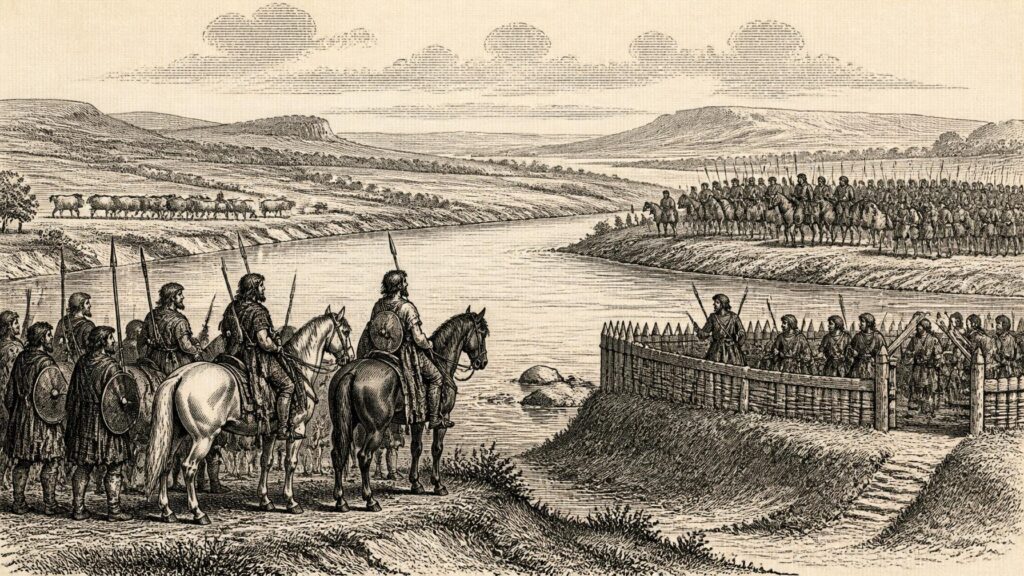
The first encounter did not yield the decisive triumph sometimes attached to the year in simplified accounts. Shane challenged the MacDonnells near the Bann, in the Coleraine region. His force was driven back across the river and its fortifications were destroyed; a truce was then hastily made. Sorley Boy MacDonnell was wounded in a battle near Coleraine in September. These reports establish serious fighting, but they do not justify treating 1564 as the final defeat of the MacDonnells. The major MacDonnell disaster, the capture of James MacDonnell and Sorley Boy at Glentaisie, belonged to May 1565.
Even so, the Bann encounter was important. It began a struggle that drew together the sea routes of Scotland and Antrim, the grain and cattle resources of Ulster, local castle networks and Elizabethan policy. The MacDonnells could recruit and communicate across the North Channel; Shane could call upon a much broader Ulster following and press claims of precedence over neighbouring lords. Neither advantage was absolute. The truce revealed the limits of force, but it did not remove the causes of conflict.
Lordship in Breifne
Violence and succession were equally intertwined in West Breifne. The Four Masters record that Hugh Gallda O’Rourke was killed at Leitrim in Muintir Eolais by his own people. The annalists say that the country then gathered around his brother Brian, though they report a rumour that Brian had not personally shared in the killing. Shane intervened by supporting another brother, Hugh Boy, as O’Rourke. The result was rival legitimacy: local backing favoured Brian, while Shane’s influence advanced Hugh Boy.
This episode clarifies the practical meaning of Shane’s expanding power. He did not need to annex Breifne to affect its succession. Supporting a claimant could secure a dependant, open demands for service, and deny a rival lord the freedom to decide matters internally. It also made local disputes more dangerous. A killing in Leitrim was connected to the balance of power across Ulster and the north-west, just as the Donegal tower affair and the Bann fighting were.
Thomond’s Cost of Conflict
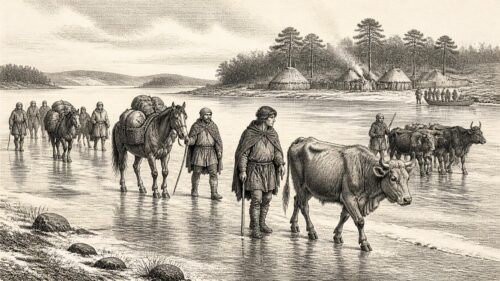
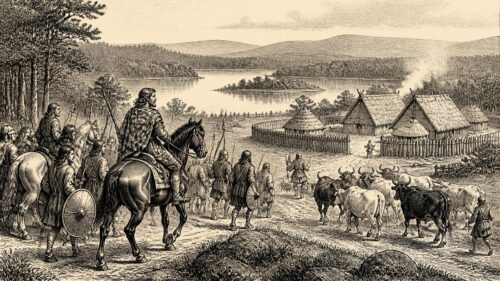
Events in Munster underline that Ireland’s instability was not confined to Shane O’Neill’s sphere. The Four Masters call Thomond a place of conflict in 1564. Rival O’Briens raided along the Abhainn Ó gCearnaigh in Clann Choilen, plundering and burning Ross-ruadh. The earl’s forces and local inhabitants pursued them, and the annals put the earl’s losses at close to a hundred men. The raiders escaped across the Fergus with their prey. Such accounts are not simple battle narratives: their repeated attention to livestock, plunder and the movement of armed companies points to the burden borne by ordinary households.
The O’Brien challengers then brought in bonnaghtmen and mercenaries of the MacSweeney and MacSheehy families from beyond the Shannon. Bonnaght was a recognised system of maintaining troops, but in practice its demands could devastate a district. The annalists state that the inhabitants were left without cattle beyond what those soldiers were permitted to take for their service. Cattle were wealth, food, rent and breeding stock. Their removal was therefore an immediate social and economic shock, not a marginal detail. In the winter, Corcomroe, its rents, customary services, landed profits and church livings were granted to Donnell O’Brien as compensation for accepting peace. Peace itself had a negotiated price.
Munster also saw a lethal local raid when Maurice Duv Fitzgerald, a kinsman of the Earl of Desmond, entered Muskerry on a predatory expedition and was killed by Dermot and Cormac MacCarthy. No large crown campaign followed in 1564, but the incident demonstrates the persistence of armed rivalry between great regional kindreds. Dublin’s effort to reconcile the earls of Desmond and Ormond at Clonmel in May belonged to the same wider setting of tension, even though their celebrated armed clash at Affane lay in the following year.
Religion, Learning and the Limits of Evidence
There is no securely dated, island-wide religious turning point to place in 1564. It would be misleading to make the year a landmark of either Protestant advance or Catholic recovery. Yet religion was embedded in political life. Donegal’s contested centre stood beside a Franciscan foundation central to O’Donnell prestige; in Thomond, church livings formed part of the resources transferred in a political settlement. Ecclesiastical income, buildings and patronage remained inseparable from lordship. The surviving evidence says more about power and property than about the beliefs of ordinary worshippers.
One firmly dated personal event offers a small, contrasting glimpse of learned Ireland. William Bathe, later a Jesuit, diplomat and pioneering writer on language learning, was born at Drumcondra Castle on Easter Sunday, 2 April 1564. His future career should not be projected backwards as a general condition of the island. But his birth into a legally and politically connected Dublin family reminds us that the Ireland of raids, garrisons and disputed towers also contained households shaped by law, education, multilingual exchange and continental connections.
Thus 1564 was a year of escalation rather than settlement. Shane O’Neill’s raid into Tír Chonaill, intervention in Breifne and confrontation with the MacDonnells showed how far his ambitions reached, while the failed push at the Bann exposed their limits. In Thomond, the cost of rival lordship fell visibly on cattle-owning communities and church resources. The year did not decide Ireland’s future, but it made the next phase of conflict harder to avoid.

Primary Sources
- Annals of the Four Masters, Volume 5 English Translation
- O'Neill, Shane (Seaán)
- MacDonnell, Sorley Boy
- MacDonnell, James
- Arnold, Sir Nicholas
- O'Donnell (Ó Domhnaill), An Calbhach
- O'Donnell, Hugh McHugh Dubh (Aodh Ó Domhnaill)
- O'Rourke (Ó Ruairc), Brian Ballach
- Bathe, William
- O'Brien, Conor
- Plunket, Sir John
- Fitzgerald, James fitz Maurice
- O'Donnell, Manus (Ó Domhnaill, Maghnas)
- O'Donnell (Ó Domhnaill), Sir Aodh mac Maghnusa
- O'Donnell, Sir Niall Garvach
- Calendar of the State Papers Relating to Ireland, 1509–1573
- Calendar of the Carew Manuscripts: 1515–1574
- State Papers Ireland 1509–1782: Government Papers on Irish Affairs
- The Fiants of Elizabeth I (1558–1603)
- Calendar of State Papers, Ireland, Tudor Period, 1568–1571: Introduction and Editorial Conventions