Carrickfergus Hostages1507 CE
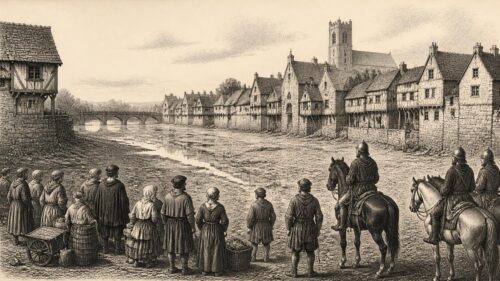
In 1507, Ireland comprised overlapping systems of royal lordship, Gaelic dynasties, churches, learned families and corporate towns. The Annals of Ulster, strongest for the north, records Henry Ó Néill’s death, an Ó Domhnaill attack on Dungannon, and conflict at Carrickfergus, where Niall Ó Néill was captured, released after sixteen hostages were demanded, then seized the castle and mayor. Clogher monastery and Achadh Beithe church burned, while clerics, a brehon and several poets died. Kildare exercised limited deputy authority, and Galway maintained civic government. These events reveal power secured through kinship, pledges, warfare, learning, patronage and institutional resilience across the island.
Dateline
In 1507 Ireland was not governed from a single, evenly effective centre. Henry VII was lord of Ireland, and Gerald FitzGerald, eighth earl of Kildare, remained his deputy; but the reach of Dublin government varied sharply by region. In Ulster especially, lordship rested on kinship, cattle, military followings, negotiated submission and the capacity to hold a castle or compel pledges. The year’s best contemporary narrative, the Annals of Ulster, is consequently not a record of royal proclamations or parliamentary statute. It is a compact sequence of deaths, burnings, captives, hostages and learned men. Read together, its entries show a society in which political conflict, religious institutions and hereditary learning were inseparable.
A Year Preserved in Annals
The year is unusually significant for the history of the annals themselves. The manuscript tradition of the Annals of Ulster reaches its final dated entry at 1507 before passing into other hands. Its record should not be treated as a complete chronicle of Ireland: it is strongest for Ulster and the north-west, and it selects what its compilers deemed memorable. Yet its notices offer exceptionally close evidence of the values of Gaelic political society. A leader could be praised for knowledge; a woman for charity and hospitality; a judge for conscientiousness; poets by name and patronymic. Churches and monasteries were not passive backdrops but major holders of people, goods, learning and local standing.
Some dates can be stated with care. Henry, son of Aodh Ó Néill, died about the feast of the Finding of the Holy Cross, observed on 3 May. Muirchertach Ó Flannagáin died at the beginning of spring. The monastery at Clogher burned around the feast of St Patrick, 17 March. Other notices are assigned only to the year. The annalist supplies neither a full explanation for every death nor a reliable day-by-day sequence of campaigning; the proper response is not to fill those silences with invented detail.
Pressure Within Ulster
Henry Ó Néill’s death removed an “eminent leader”, in the annalist’s phrase, who was also distinguished by knowledge of every science in his time. Such praise does not mean modern experimental science. It signals breadth of elite learning: genealogy, history, law, language, religious knowledge and the inherited disciplines expected among high-status Gaelic households. In a world where authority depended partly upon remembered descent and precedent, intellectual accomplishment had political value. The death of a leader celebrated in those terms mattered beyond his immediate family.
Ulster’s political geography was already volatile. Rival branches of the Ó Néill kindred contended for influence; the Ó Domhnaills of Tír Chonaill, the Maguires of Fermanagh and lesser lordships all shaped the balance of power. Modern biographical synthesis, drawing on several annals, places an Ó Domhnaill incursion into Tyrone in 1507 and records the destruction of Dungannon. That event is securely associated with the year, though the surviving evidence does not permit a confident reconstruction of its day, route, numbers or precise tactical course. Its importance lay in the target: Dungannon was a principal Ó Néill centre. Raiding and burning there were statements about supremacy as well as seizures of movable wealth.
Castle, Captive and Pledge
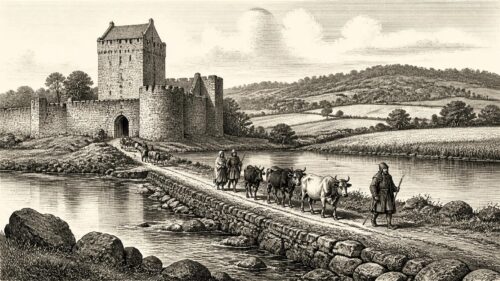
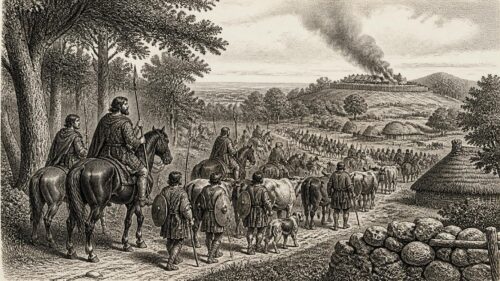
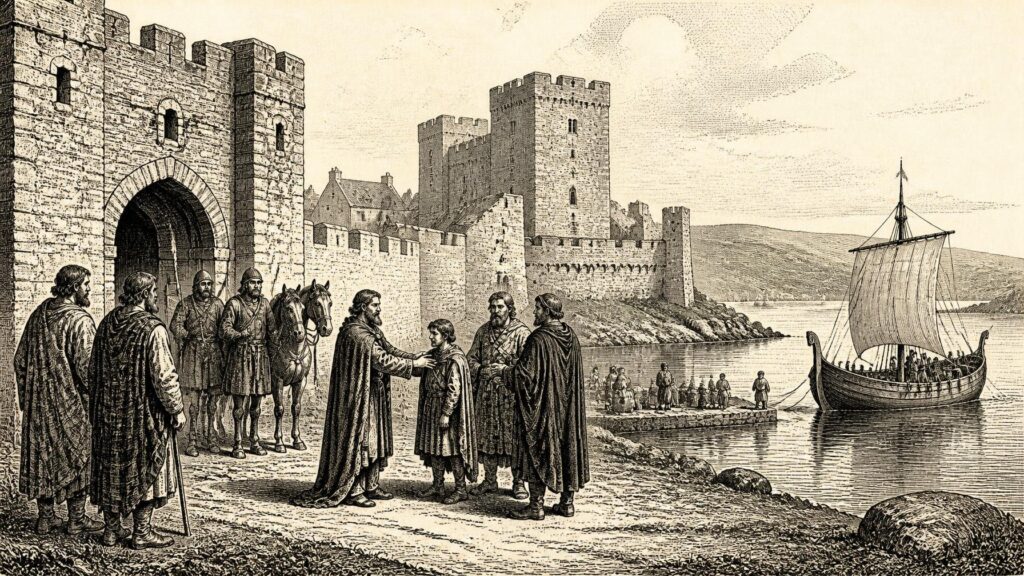
The sharpest episode in the Annals of Ulster concerned Niall, son of Conn Ó Néill, and Carrickfergus. The annalist says that the people of Carrickfergus captured Niall and held him for a time. On his release they exacted sixteen hostages. Niall subsequently took the same castle, and the town’s mayor was captured there. The entry gives no date and does not explain whether the two seizures followed a siege, surprise, negotiation or a rapid change in local alliances. What it does establish is a remarkable reversal: the captor became captor, and a civic officer became a prisoner.
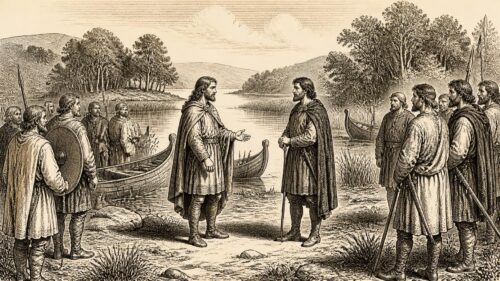
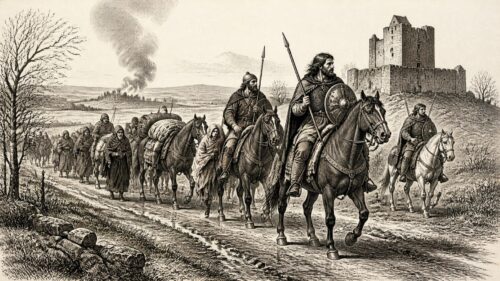
Hostages were neither incidental nor merely symbolic. They were living pledges for an agreement, payment, submission or safe conduct, normally drawn from families whose fate could influence the conduct of a lord. Sixteen was a substantial demand. Their extraction demonstrates both the political weight attached to Niall and the capacity of Carrickfergus’s community to act collectively in a military crisis. Conversely, Niall’s later seizure of the castle showed that a garrisoned port and its urban government could be drawn into the fierce competition of neighbouring Gaelic dynasties. Carrickfergus was not simply an English enclave facing an undifferentiated Irish hinterland; it was a strategic place whose people bargained, fought and suffered within regional politics.
Fire at Clogher
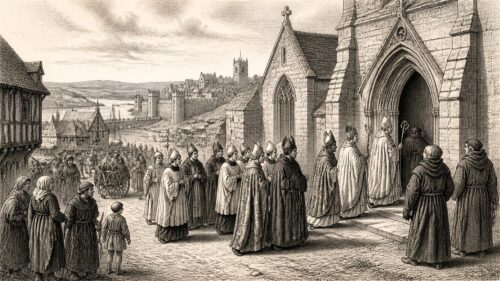
About St Patrick’s feast, the monastery at Clogher was burned. The annal does not name an attacker or state whether fire came through raid, accident or a wider conflict. It should therefore not be labelled a siege or attributed to a particular lord. Nevertheless, the damage was serious enough to enter the year’s record. Clogher was a major ecclesiastical centre in a contested Ulster landscape, and the burning of a monastery threatened far more than walls and roofs. It endangered liturgical objects, food stores, livestock, books, the accommodation of clerics and travellers, and the prestige attached to a church community.
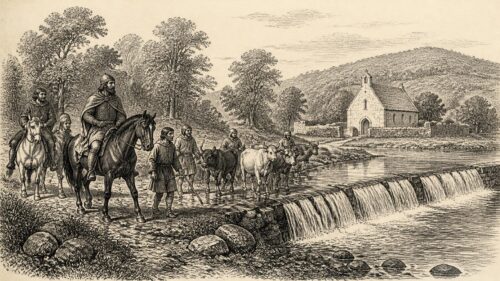
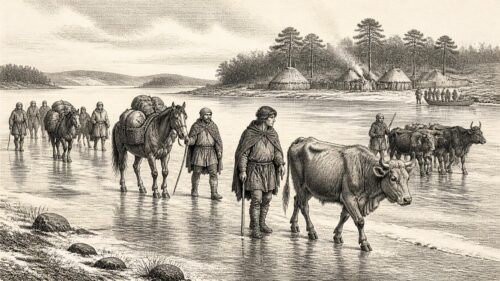
Another church, Achadh Beithe, was also burned, together with much of the chattel of the surrounding country. “Chattel” makes the social cost visible: animals, household goods and other portable resources were central forms of wealth. The annalist noted that this was the third remembered burning, almost fifty years after the first and twenty after the second. That retrospective calculation conveys local memory as well as loss. Repeated destruction of a church was sufficiently exceptional, and sufficiently meaningful, to be placed in a remembered sequence.
Ecclesiastical personnel also changed. The Annals of the Four Masters records the deaths of John Painte, Dominican bishop of Meath, and Pierce Ó Maolúire, abbot of Clogher. John Payne, master of the rolls in the Dublin administration, died on 6 May. These notices belong to different institutional worlds, but together they underline the overlap between government, religious office and personal networks. The established Church remained fully within western Christendom, while diocesan and monastic life was also shaped by local lordship, patronage and insecurity.
Law and Learned Service
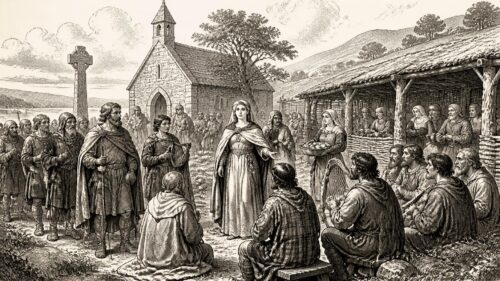
The death of Feidhlimidh Mac Giolla Sheanáin was one of the year’s most revealing losses. The Ulster annalist calls him brehon to Ua Domhnaill, official of Tír Chonaill, a distinguished cleric, and a man notably conscientious and charitable. A brehon was a learned legal expert, trained in Gaelic law and serving patrons through judgement, counsel, arbitration and the custody of legal knowledge. The title “official” indicates ecclesiastical legal responsibility as well. Feidhlimidh’s career therefore crossed jurisdictions which modern readers often separate: he served a secular lord, held church authority and belonged to a hereditary world of scholarship.
His death should not be made into proof that Gaelic law was isolated from the wider island. English common law and Irish legal custom operated in different settings and could overlap through people, landholding and political negotiation. But the annal’s praise confirms that Gaelic legal learning was alive and respected in 1507. It was not an antique survival. It was practical expertise, sustained by families of professionals and required by rulers who needed agreements interpreted, compensation assessed and obligations remembered.
Poets and Patronage
The same annal lists an extraordinary cluster of poetic deaths: Thomas Mac Craith, Solomon Mac Conmidhe, Cennfaolaidh Ó Cuill, Godfrey Ó Dálaigh, Aonghus Ó Dálaigh, called the Carbery man, and John Ó Gairéin. It gives no cause, so an epidemic or single catastrophe must not be presumed. What can responsibly be said is that their collective commemoration demonstrates the standing of poets in public life. Their work preserved genealogies, praised patrons, recorded conflict, instructed elites and shaped political reputations. A lord without learned dependants lacked one important means of making power intelligible and durable.
These deaths followed those of a leader and a lawyer in the annalist’s sequence, not because poetry was an ornament beside “real” politics, but because poets belonged to the machinery of lordship. Their learning travelled between households; their verse could confer honour or expose failure; and their schools formed part of the intellectual infrastructure of Gaelic Ireland. The year’s obituary record is thus also a map of cultural loss.
Deputyship and Towns
While Ulster’s events were being fought and recorded in local terms, Kildare’s deputyship supplied a different but limited political framework. Gerald FitzGerald was the dominant magnate within the lordship’s administration and estates. A letter dated 27 May 1507 from his castle at Castledermot confirms the place as one of the working centres of his authority. Castledermot, Maynooth, Dublin and the Pale were connected by lordly estates, councils, courts and military obligations, but this did not amount to direct government of the entire island. Kildare’s influence depended on relationships with Gaelic and Anglo-Irish powers as much as on commands issued in Henry VII’s name.
Galway offers another perspective. Its merchant corporation elected mayors from leading families under the chartered arrangements established in the late fifteenth century. Arthur Lynch held the mayoralty in 1507 and died by drowning on 20 November, according to later civic tradition preserved in Galway’s historical record. The town’s annual office, courts and commercial networks represented a form of organised urban life quite unlike the lordships of Tyrone or Tír Chonaill, though no less dependent on family reputation and corporate solidarity. Its trade linked the Gaelic hinterland with Atlantic and European markets.
What the Year Reveals
1507 was not a year of island-wide conquest or constitutional revolution. Its evidence is more granular, and for that reason valuable. A northern castle changed hands; sixteen hostages were demanded; Dungannon was attacked; churches and a monastery burned; bishops, an abbot, a legal scholar and a group of poets died; a deputy governed from his estates; and an urban mayoralty continued in Galway. The pattern reveals an Ireland of several political languages and institutions. Royal lordship, corporate town government, Gaelic dynastic power, church authority and hereditary learning all coexisted, sometimes collaborating and sometimes colliding.
The annals leave no comprehensive portrait of ordinary households in 1507. But their attention to chattel, hospitality, local churches, learned service and captive pledges makes everyday stakes visible. Livestock and goods could be consumed by fire; kin could be surrendered as security; monasteries could be ravaged; and social standing rested on the ability to protect dependants, reward experts and maintain memory. In that unsettled landscape, Carrickfergus’s sixteen hostages were not a side-note. They were a measure of how power was made, contested and painfully guaranteed.
Source References
Hover over a number to see the source. Select it to open the source.

- [1] The Annals of Ulster, Year U1507
- [2] The Annals of Ulster: Introduction and Manuscript Description
- [3] Annals of the Four Masters
- [4] Annals of the Kingdom of Ireland, by the Four Masters, Volume V
- [5] FitzGerald, Gerald (Gearóid Mór)
- [6] O'Neill (Ó Néill), Conn
- [7] Payne, John
- [8] County Kildare Urban Archaeology Survey
- [9] The Annals of Ulster, Year U1497
- [10] Medieval Galway
- [11] The History of the Town and County of the Town of Galway
- [12] Irish Historic Towns Atlas: Galway
- [13] Law, Poetry and Medicine: The Literate Professionals in Autonomous Gaelic Ireland, c.1250–c.1630
- [14] Of the Lawes of Irelande
- [15] Index to Bardic Poems and Sources
- [16] Irish Script on Screen: MS 23 P 12, The Book of Ballymote
- [17] The Diocese of Dromore in the Sixteenth Century
- [18] Liber Primus Kilkenniensis: The Earliest of the Books of the Corporation of Kilkenny Now Extant
- [19] FitzGerald, Gerald (Gearóid Óg, Garrett McAlison)
- [20] The History of the Town and County of Galway
- [21] National Library of Ireland Sources Database: Galway City Manuscripts
Primary Sources
- The Annals of Ulster, Year U1507
- The Annals of Ulster: Introduction and Manuscript Description
- Annals of the Four Masters
- Annals of the Kingdom of Ireland, by the Four Masters, Volume V
- FitzGerald, Gerald (Gearóid Mór)
- O'Neill (Ó Néill), Conn
- Payne, John
- County Kildare Urban Archaeology Survey
- The Annals of Ulster, Year U1497
- Medieval Galway
- The History of the Town and County of the Town of Galway
- Irish Historic Towns Atlas: Galway
- Law, Poetry and Medicine: The Literate Professionals in Autonomous Gaelic Ireland, c.1250–c.1630
- Of the Lawes of Irelande
- Index to Bardic Poems and Sources
- Irish Script on Screen: MS 23 P 12, The Book of Ballymote
- The Diocese of Dromore in the Sixteenth Century
- Liber Primus Kilkenniensis: The Earliest of the Books of the Corporation of Kilkenny Now Extant
- FitzGerald, Gerald (Gearóid Óg, Garrett McAlison)
- The History of the Town and County of Galway
- National Library of Ireland Sources Database: Galway City Manuscripts