Donegal Succession1505 CE
In 1505, Aodh Ruadh Ó Domhnaill died at Donegal after forty-four years as lord of Tír Chonaill and was buried in its Franciscan friary. His son, Aodh Dubh, secured succession through a campaign in Tír Eógain, taking Castlederg, before inauguration at Kilmacrenan. Feuds killed military and local leaders, while drowning claimed travellers on Finn Lough. Persistent rain ruined crops, particularly in Fermanagh, and plague affected Anglo-Irish nobles. Churchmen experienced both institutional continuity and violence. Meanwhile, Gerald FitzGerald received the Garter and Piers Butler became seneschal of Tipperary, illustrating Ireland’s plural, alliance-based political order during a year of contested regional authority.
Dateline
In 1505, the death of Aodh Ruadh Ó Domhnaill—Hugh Roe O’Donnell—ended one of the longest and most forceful lordships in late medieval Ireland. His passing at Donegal was not simply an obituary for a powerful regional ruler. It set in motion a carefully staged transfer of authority in Tír Chonaill, the north-western lordship centred on modern County Donegal, while persistent rain damaged crops across much of Ireland and local rivalries continued to bring violence into churches, lordly households and farming districts. The evidence for the year is unusually rich in northern annals, though it must be handled with care: some entries are contemporary or near-contemporary, while the expansive praise of O’Donnell in the Annals of the Four Masters was compiled more than a century later by historians connected to his dynasty.
A Lord Dies at Donegal
The firmly dated event that dominates 1505 occurred on Friday, 11 July. Aodh Ruadh Ó Domhnaill died in his own stronghold at Donegal, aged seventy-eight according to the annals, after forty-four years of lordship. He was buried the following day in the Franciscan Observant friary at Donegal. The Annals of Ulster and the Annals of the Four Masters agree on the date, place and burial, making these details unusually secure for a Gaelic lord of this period. Aodh Ruadh had ruled Tír Chonaill from 1461, apart from a brief dynastic interruption in 1497, and had spent decades contesting influence with the O’Neills of Tír Eógain and with Connacht powers.
The language of his obituary is emphatically political. The Annals of Ulster credited him with securing tribute from Inis Eoghain and military service from Cenél Moen, while the Four Masters listed hostages from Fermanagh, Oriel, Clannaboy, the Route and the O’Kanes, and asserted claims in lower Connacht. Hostages were not incidental trophies: they were guarantees given by subordinate or negotiated partners, and their possession proclaimed a lord’s ability to compel obedience. Such lists should not be read as a modern map of direct administration. They are claims to overlordship, and their inclusion in an obituary also served to define what a successor was expected to inherit. Yet they accurately convey the breadth of O’Donnell ambition: Tír Chonaill was not an isolated mountain lordship but an active force reaching into Ulster and Connacht.
The later Four Masters portrayal is especially lavish, calling Aodh Ruadh a protector of churchmen and learned people, a generous giver of alms, a prudent ruler in peace and war, and even an ‘Augustus’ of north-west Europe. That rhetoric tells readers as much about seventeenth-century Franciscan historical culture and Ó Domhnaill patronage as about 1505. Still, several concrete claims can be corroborated or responsibly retained. Aodh Ruadh had supported the Observant Franciscans at Donegal, and the friary formed the setting for his burial. He was also associated with the first castle at Donegal, a strategically placed lordly residence beside the estuary. Castle and friary together expressed a pattern of Gaelic power: military security, dynastic visibility, religious patronage and the accommodation of scholars and clergy were mutually reinforcing rather than separate concerns.
Succession by Campaign and Ceremony
O’Donnell’s successor was his son Aodh Dubh, also called Aodh Óg in the annals, or Hugh the Black/Young in English. His accession was not treated as an automatic inheritance. Gaelic lordship was dynastic, but succession depended upon the acceptance of leading kin, allies and churchmen, and rival branches could contest it. Aodh Dubh had already governed jointly with his father after the death of his elder half-brother Conn in 1497. That experience, and his presence with Aodh Ruadh in Kildare’s victorious army at Knockdoe in 1504, gave him standing. It did not remove the need to demonstrate command in 1505.
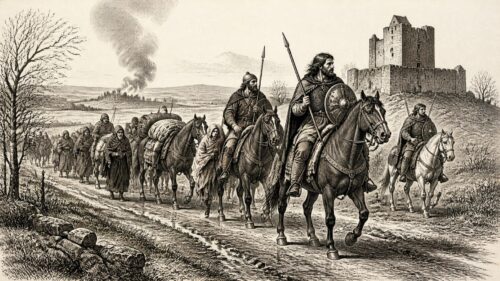
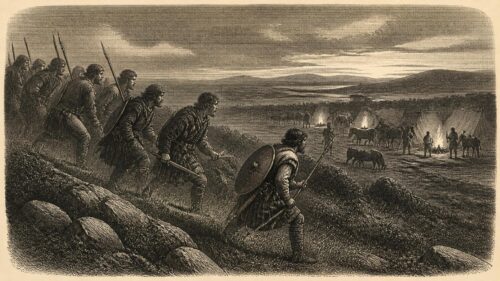
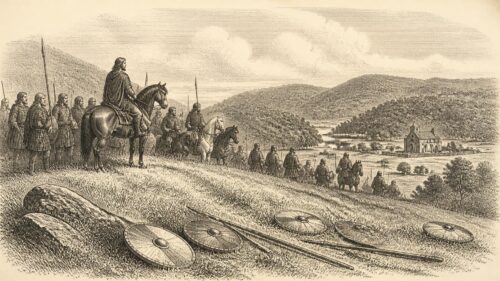
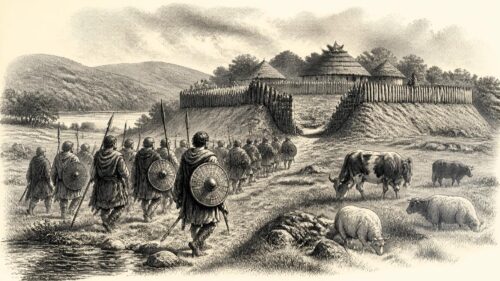
Before his inauguration, Aodh Dubh led a hosting into Tír Eógain. The Annals of Ulster record the burning of the settlements of Domhnall O’Neill and two of his sons; the force travelled inland from the Abhainn Mhór without effective opposition. On its return, it besieged and took Castlederg, leaving an O’Donnell garrison there. These were calculated operations rather than a war of conquest in the modern sense. Burning a lord’s town attacked his food stores, housing, prestige and capacity to support followers; taking a castle placed a visible challenge upon a frontier. The campaign announced that the new lord could protect Tír Chonaill’s position against its longstanding O’Neill rival.
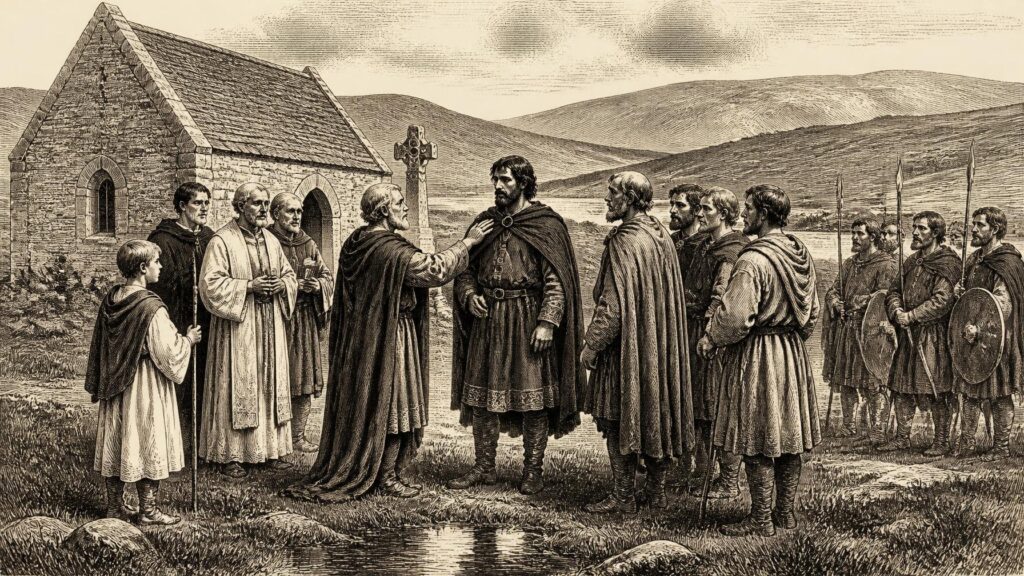
On 2 August, Aodh Dubh was inaugurated as lord of Tír Chonaill at the church of Kilmacrenan. The annalistic phrase ‘by the will of God and men’ captures the dual authority being invoked. The ceremony was religious, public and political: a church site with deep dynastic associations supplied sacred legitimacy, while the consent of people—meaning above all the leading political community—validated the new lord. The gap of just over three weeks between burial and inauguration should not be mistaken for uncertainty. It was time in which the successor campaigned, occupied a strategic castle and assembled the support needed for a durable settlement.
Violence Close to Home
Not all the year’s conflict concerned the great lordships. In and around Armagh, Colla Mac Domhnaill Gallóglaigh, constable to O’Neill, was killed in what the Annals of Ulster calls treachery by members of another Mac Domhnaill branch. Gallóglaigh were professional heavy infantry, commonly recruited from families of Hebridean and Irish-Scottish origin, but their leaders were also political actors with their own kin rivalries. The killing of a constable in Armagh therefore exposed both the importance and the fragility of military service within O’Neill’s lordship.
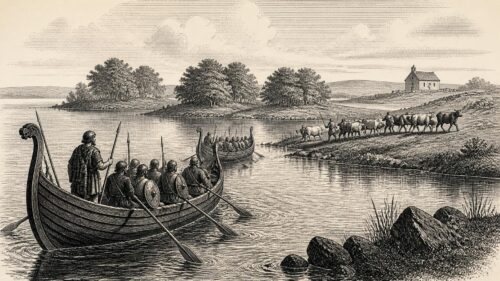
Other notices reveal conflict at a more local scale. Domhnall, son of Art O’Neill, was killed by Brian, son of Conn O’Neill. In Fermanagh, a dispute over a prey—movable livestock driven off in a raid—cost the lives of Eógan Mag Uidhir and Fergus Mór Mac Cába. Raiding was a means of extracting wealth, retaliation and testing local authority, but it also made cattle, horses and household labour vulnerable. A separate disaster on Finn Lough drowned Toirdelbach Mag Uidhir, several Mac Caffreys and Mac Gallóglaigh, and eighteen people in a single small boat. The record does not explain their journey, but it is a sharp reminder that lakes were routes of movement as well as barriers, and that travel by cot could be perilous.
Rain, Crops and Disease
The most consequential condition affecting ordinary households in 1505 may have been the weather. The Annals of Ulster reports continuous wet weather, which destroyed crops across a great part of Ireland and especially in Fir Manach. This is firm evidence of a damaging season, not proof of a nationwide famine. The annalist does not specify individual crops, prices, mortality or the length of subsequent scarcity. Nonetheless, in a predominantly rural society dependent on grain, livestock and stored fodder, prolonged rain could disrupt sowing, ripening, harvesting and the drying of hay. Its special notice of Fermanagh suggests that the effects there were severe enough to enter a chronicle otherwise preoccupied with elites and warfare.
Disease also touched the upper ranks. The Annals of Ulster notes that a daughter of Gerald FitzGerald, eighth earl of Kildare, wife of the baron of Slane, died of plague; the baron’s wife had likewise died from the same cause. The wording does not permit a wider reconstruction of an epidemic, nor should the term automatically be equated with a particular modern diagnosis. It does show that contemporaries identified a serious infectious illness within a prominent Anglo-Irish kin network. In the same year, the death of Friar Patrick Ó Feidhil, an Observant Franciscan praised as a distinguished preacher in Ireland and Scotland, points to continuing religious travel and communication across the North Channel world.
Church Authority and Lordly Discipline
Religion was deeply embedded in secular conflict. Donnchadh Ó Catháin, abbot of Magh Cosgrain, was hanged during 1505. The two principal annalistic traditions differ over the exact identification of the perpetrator, but agree on the abbot’s execution; the Four Masters adds that the killer was maimed in punishment. That agreement and variation are instructive. The event itself was memorable, while detailed genealogy could shift in transmission. More importantly, an abbot was not beyond the reach of lordly violence. Ecclesiastical office carried land, income, standing and connections, and monasteries could become entangled in family politics.
Yet the same year also records quieter institutional continuities: Edmund FitzSimon, prior of Fore, and Laurence Ó Flannagáin, prior of Devenish, died; Concobur Ó Caiside was remembered as a hospitable and industrious master who kept a guest-house. These brief notices should not be inflated into a picture of tranquil religious life, but they show the social functions expected of clerics and learned households. Hospitality, teaching, prayer, administration and the care of travellers were part of the infrastructure through which lordships worked.
Recognition Beyond the North-West
1505 also marked the continuing ascent of Gerald FitzGerald, the powerful earl of Kildare and royal governor. Henry VII rewarded Kildare’s victory at Knockdoe in August 1504 by investing him as a knight of the Garter during 1505. The honour recognised a magnate who could mobilise both English and Gaelic allies, but it did not make the lordship of Ireland a centrally governed realm. Kildare’s authority rested on alliance, office, private estates and military success—precisely the mixture visible in Aodh Ruadh’s participation at Knockdoe and Aodh Dubh’s rapid action in Tyrone.
On 21 June, Thomas Butler, the absentee seventh earl of Ormond, appointed Sir Piers Butler seneschal of the liberty of Tipperary. This was a significant local consolidation rather than a national transformation. Piers, Kildare’s son-in-law and former fosterling, had struggled to establish his authority in the Ormond lordship; the appointment confirmed his position as the earl’s deputy in Ireland. It illustrates another feature of 1505: across the island, political power was exercised not only through kingship or royal office, but through delegated liberties, family claims, service and the management of landed jurisdictions.
Thus 1505 was a year of transition rather than a single national turning point. At Donegal, a celebrated old lord was buried and his successor publicly made. In Tír Eógain, raids and castles tested the new order. In Fermanagh, relentless rain threatened harvests; elsewhere plague, drowning and feud brought sudden loss. Kildare’s Garter and Piers Butler’s Tipperary office showed that English royal connection mattered greatly, but the political landscape remained plural. Ireland’s histories in this year were made in castles, churches, lake boats, wet fields and inauguration grounds—by rival lordships whose authority depended above all on the ability to command people, protection and resources.
Source References
Hover over a number to see the source. Select it to open the source.

- [1] Annals of the Kingdom of Ireland
- [2] Annála Ríoghachta Éireann
- [3] The Annals of Ulster, Year U1505
- [4] The Annals of Ulster
- [5] Annála Connacht: The Annals of Connacht
- [6] Annála Connacht
- [7] Short Annals of Tirconaill
- [8] O'Donnell (Ó Domhnaill), Aodh Ruadh
- [9] O'Donnell (Ó Domhnaill), Sir Aodh Dubh
- [10] FitzGerald, Gerald (Gearóid Mór)
- [11] Butler, Piers (‘Piers Ruadh’)
- [12] Butler, Thomas
- [13] Butler, Edmund
- [14] Calendar of Ormond Deeds, Volume III, 1413–1509
- [15] Elegy of Aodh Ruadh Ó Domhnaill (d. 1505)
- [16] English Lordship of Ireland and the Irish Sea World: Re-assessing the Origins of the Kildare Ascendancy, c.1390–c.1513
- [17] The Annals of the Four Masters: Irish History, Kingship and Society in the Early Seventeenth Century
- [18] Annals of the Kingdom of Ireland: National Library of Ireland Catalogue Record
- [19] The Diamond, Donegal, Co. Donegal: Archaeological Impact Assessment
- [20] The Irish Annals—Annual Listings of Events in Ireland
Primary Sources
- Annals of the Kingdom of Ireland
- Annála Ríoghachta Éireann
- The Annals of Ulster, Year U1505
- The Annals of Ulster
- Annála Connacht: The Annals of Connacht
- Annála Connacht
- Short Annals of Tirconaill
- O'Donnell (Ó Domhnaill), Aodh Ruadh
- O'Donnell (Ó Domhnaill), Sir Aodh Dubh
- FitzGerald, Gerald (Gearóid Mór)
- Butler, Piers (‘Piers Ruadh’)
- Butler, Thomas
- Butler, Edmund
- Calendar of Ormond Deeds, Volume III, 1413–1509
- Elegy of Aodh Ruadh Ó Domhnaill (d. 1505)
- English Lordship of Ireland and the Irish Sea World: Re-assessing the Origins of the Kildare Ascendancy, c.1390–c.1513
- The Annals of the Four Masters: Irish History, Kingship and Society in the Early Seventeenth Century
- Annals of the Kingdom of Ireland: National Library of Ireland Catalogue Record
- The Diamond, Donegal, Co. Donegal: Archaeological Impact Assessment
- The Irish Annals—Annual Listings of Events in Ireland