Inis Castle’s Stone1454 CE
In 1454, Ireland’s fragmented political order was illustrated by conflict, succession and cultural exchange. At Inis Castle in Tír Chonaill, Domhnall O’Donnell killed rival Ruaidhrí O’Donnell with a stone during a siege, securing the lordship temporarily. Annals also record deaths and kin violence among the O’Reillys, Maguires and O’Molloys, alongside contested local successions and cattle raids. Sir Edward FitzEustace’s death led to Thomas fitz Maurice FitzGerald’s election as justiciar in Dublin. Notices commemorate elite women and a notable Fermanagh sermon. Meanwhile, Edmund MacRichard Butler’s manuscript, copied by Gaelic scribes during campaigning, vividly demonstrates interconnected Anglo-Irish patronage, learning, warfare and mobility.
Dateline
For Ireland, 1454 is unusually vivid in one place and unusually thin almost everywhere else. Its clearest episode occurred in the north-west, where a disputed lordship in Tír Chonaill turned on a siege, a burning gate and a stone thrown from a castle wall. Elsewhere, terse annalistic notices record deaths, killings, a sermon and a change in the Dublin administration. A manuscript copied for an Anglo-Irish lord, meanwhile, preserves an exceptionally human glimpse of campaigning and book-making at the year’s end. Together these records show a country of overlapping political worlds: Gaelic lordships, Anglo-Irish estates and towns, church communities, and households of professional scribes.
A Dated Turning Point in Tír Chonaill
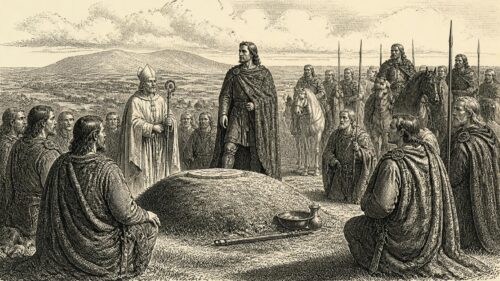
The most securely dated event was the killing of Ruaidhrí O’Donnell, son of Neachtan, on 7 April. The Annals of Ulster give that precise date and place the death at the castle of Inis, during a struggle for the lordship of Tír Chonaill, broadly corresponding to much of present-day County Donegal. Ruaidhrí was the leading representative of one branch of the O’Donnell kindred; his rival Domhnall, son of Niall Garbh O’Donnell, represented another. Their quarrel was not a simple contest between two isolated men. It was the latest phase of a prolonged dynastic conflict that followed the death of Neachtan in 1452 and involved the wider balance of power in Ulster.
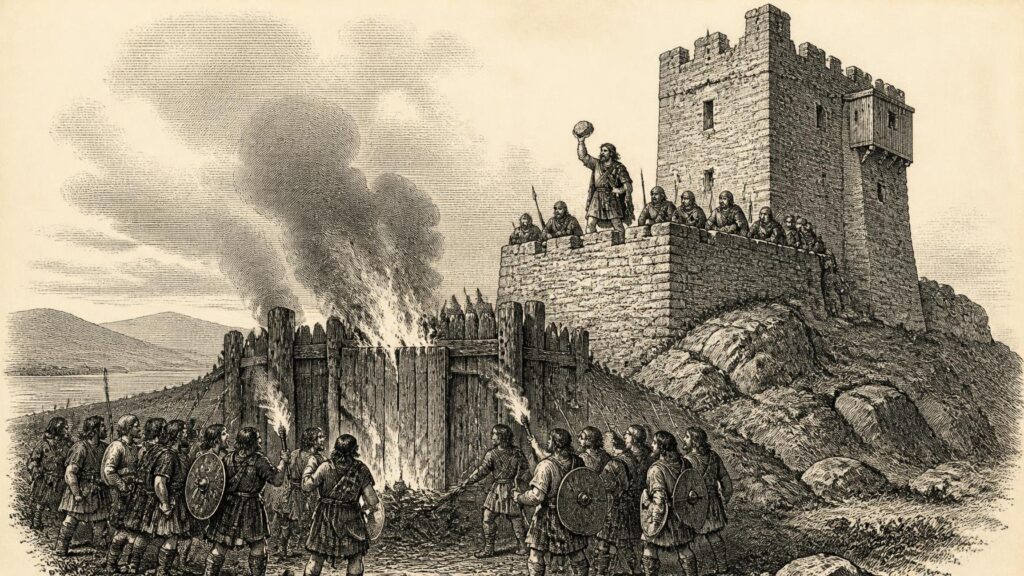
The sequence described by the annals is dramatic but should be read carefully. Domhnall was captured through the action of an O’Doherty and placed in the castle of Inis. The guards then turned against their own leader, made the O’Doherty prisoner and freed Domhnall. On learning of the capture, Ruaidhrí assembled a host and besieged the castle. The Annals of Ulster name Mac Uibilin among the attackers; the later Annals of the Four Masters also name O’Kane and describe the besiegers setting the entrance and stairs alight. Both traditions agree on the decisive outcome: Domhnall reached the top of the castle and cast down a stone which killed Ruaidhrí. He then emerged, defeated the besiegers and gained control of Tír Chonaill.
The stone was not merely an arresting detail. In a lordship where personal command, fortified places, captives and allied fighting-men were instruments of rule, Ruaidhrí’s death removed the immediate rival to Domhnall’s claim. The annalist’s statement that Domhnall took “Tír-Conaill in its entirety” marks a real political consequence, even if it did not end the family feud. Ruaidhrí’s brother Toirdhealbhach Cairbreach would kill Domhnall in 1456, while another brother, Aodh Ruadh, remained a figure of consequence. Thus 1454 was a victory and a change of lordship, not the permanent settlement later readers might imagine.
Power, Kinship and Violence Beyond Donegal
The year’s shorter notices reveal similar fragility elsewhere. Domhnall O’Reilly, called “the Fair” in the Annals of Ulster, died. This was significant within east Ulster and Breifne, where the O’Reilly lordship occupied a strategically important zone between the Pale and the Gaelic north. The annals do not describe a succession crisis in 1454, so none should be invented; but the recording of his death confirms the importance attached to the passing of a ruling-family member.
In Fermanagh, the annalist records a killing within the extended Maguire kin-group on 11 May. John Mac Amhlaim, called “the Tawny”, and his brother Gilla-Patraig were slain “in treachery” by Niall, another descendant of Donn Carrach Maguire. The long genealogy supplied by the annalist is itself revealing. Political standing rested not simply upon a surname but upon demonstrable descent within particular branches, and disputes over status could be expressed through violence among close kin. The language of treachery also shows that the annalist was passing moral judgement, not supplying a detached police report.
A further local contest occurred in Firceall, in the midlands. Following the death of Hugh O’Molloy, his son Cú Choigcríche took the lordship, faced the rival claims of Theobald O’Molloy, seized cattle, and was then killed during pursuit near a bog. The Annals of the Four Masters says rival chiefs were subsequently set up. Cattle-taking was therefore more than routine theft: it was a means of financing followers, denying resources to opponents and declaring a claim to authority. The entry offers a rare, sharply focused view of how succession, livestock and landscape could become inseparable in late medieval local politics.
Government in the English Lordship
In Dublin’s sphere of authority, Sir Edward FitzEustace, Lord Justice of Ireland, died in 1454. In October, Thomas fitz Maurice FitzGerald was elected justiciar. The Four Masters presents this as the moment when the son of John Cam asserted the earldom of Kildare; modern biographical research is more cautious, placing formal recognition of Thomas as seventh earl around 1455. That distinction matters. In 1454 he was an ambitious Kildare claimant and a newly chosen governor, not yet a securely uncontested earl in the fullest legal sense.
This administrative change did not mean that Dublin governed the whole island directly. The lordship of Ireland was politically fragmented. English common law, royal officials and civic institutions had their strongest reach in Dublin and the counties around it, while magnates such as the FitzGeralds and Butlers exercised extensive local power beyond that core. Gaelic lords controlled most regions outside the effective reach of Dublin government, although they also made alliances, traded, raided and intermarried across supposed political boundaries. The accession of a Kildare figure to the justiciarship was important precisely because government depended so heavily on local landed power.
Women, Religion and Reputation
The annals preserve several notices that interrupt the male and martial concentration of the record. Gráinne, daughter of Conchobhar Mac Maghnusa, died on 8 January; Lasairfina, daughter of Cathal Mac Maghnusa and wife of John O’Fialain, died on 8 June. Lasairfina is praised as charitable and well mannered. Such phrases cannot recover the texture of either woman’s life, and they chiefly reflect elite values, but they show that female members of leading families were remembered through kinship, marriage, conduct and generosity. Their entries also underline the dense marriage connections binding lordly families across Ulster.
Religious life appears in a particularly intriguing entry from Fermanagh. Tadhg Ua Donnchadha preached at Cloch-cuir on the feast of St Lawrence, 10 August. The Annals of Ulster’s writer explicitly says he recorded it because the sermon was being spoken of by many people. Neither its doctrine nor its congregation is described, and Cloch-cuir should not be assigned a modern location without stronger evidence. Yet the notice securely indicates that a sermon could acquire a reputation beyond its immediate setting and be considered worth preserving in a chronicle otherwise dominated by lordship and war.
Books on Campaign
The most remarkable evidence for cultural life comes not from an annal but from Bodleian Library manuscript Laud Misc. 610, often called the Book of Pottlerath. It was assembled mainly in 1453 and 1454 for Edmund MacRichard Butler, a leading member of the Polestown Butler family. Its Irish and Latin contents include religious, historical, genealogical and literary material, copied by professional Gaelic scribes at several places in the Butler orbit, including Pottlerath, Kilkenny, Gowran and Carrick. The project demonstrates that the cultural worlds labelled Gaelic and Anglo-Irish were not sealed apart: an Anglo-Irish lord actively patronised Irish-language learning.
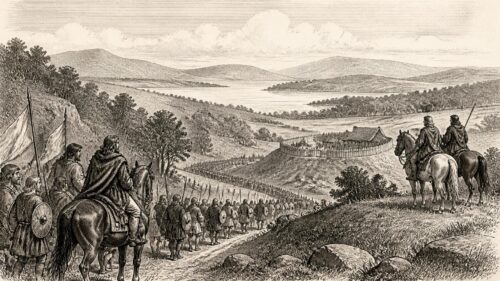
A colophon associated with the manuscript places its scribes with Edmund on a Christmas 1454 expedition into Uí Peilme, in the Carlow–Wexford borderlands. They say that they had remained there for eight days and eight nights despite opposition from the men of Leinster. The writer also recalls the food, wine and hospitality received while lodged with his lord. This is not a neutral account of campaigning: it is the perspective of a dependent scribe celebrating a patron. Even so, it captures an everyday reality often missing from formal political history. A military hosting required mobile households, provisions, servants, horses, armed retainers and clerks; writing could continue amid movement and conflict.
There is no securely dated evidence for a national harvest, epidemic, major building programme or island-wide commercial shift in 1454, and the year should not be made to bear such claims. Fifteenth-century Ireland nevertheless remained tied to Irish Sea trade, with ports such as Dublin, Drogheda, Waterford, Wexford and Cork linked to Bristol and other markets. The year’s recorded cattle raids, sieges and hostings remind us that warfare could interrupt local production and redistribute wealth, while the Pottlerath colophon reveals the high-status consumption that sustained lordly followings.
What survives for 1454 is therefore an uneven but coherent picture. At Inis, a single missile decided an immediate succession struggle; in Fermanagh and the midlands, kinship and lordship remained contested; in Dublin, a new justiciar entered office; and in the south-east, scribes carried a learned manuscript culture alongside a campaigning lord. Ireland was not politically uniform, but its regions were connected by rivalries, marriage, travel, religious reputation, trade and the movement of armed households.
Primary Sources
- The Annals of Ulster: Year U1454
- Apparatus Criticus 13 for The Annals of Ulster
- The Annals of Ulster: Background Details and Bibliographic Information
- Annals of the Four Masters: Annal M1454
- Annals of the Four Masters: Background Details and Bibliographic Information
- FitzGerald, Thomas ‘fitz Maurice’
- O’Neill (Ó Néill), Enrí
- Butler, Edmund (‘MacRichard’)
- O’Donnell (Ó Domhnaill), Neachtan
- O’Donnell (Ó Domhnaill), Aodh Ruadh
- O’Donnell (Ó Domhnaill), Niall Garbh
- O’Carroll (Ó Cearbhaill), Maolruanaidh
- Colophon from Oxford, Bodleian Library, Laud Misc. 610, Being an Annal for the Year 1454
- A Middle-Irish Fragment of Bede’s Ecclesiastical History: TEI Header
- Oxford, Bodleian Library, MS. Laud Misc. 610
- Tuileagna Ó Maoil Chonaire and the Book of Pottlerath
- Edmund MacRichard Butler: Books and Warfare in Fifteenth-Century Ireland
- The Later Middle Ages
- ‘Herring of Sligo and Salmon of Bann’: Bristol’s Maritime Trade with Ireland in the Fifteenth Century
- The Impact of War and Piracy
- Tudor Policy and the Kildare Ascendancy in the Lordship of Ireland, 1496–1534