Castlefin Cession1442 CE
In 1442, James Butler, earl of Ormond, resumed the Irish lieutenancy, governing through fragile alliances rather than centralised power. In the north-west, Énrí and Eóghan Ó Néill secured assistance from the English settlement and compelled Neachtain Ó Domhnaill to cede Castlefin, Cenél Moen and Inis Eógain’s tribute. Other struggles involved Enniskillen, Oriel, Ulster raiding and Wicklow warfare. After Muircheartach Caomhánach’s killing, his father won prisoners and compensation from Wexford. Obituaries recorded lords and clergy, while Ormond rental accounts reveal farming, rents and seigneurial justice. Together, the sources portray a connected, contested Ireland shaped by castles, kinship, tribute, negotiation and authority.
Dateline
The Irish annals open 1442 with the usual machinery of time: the Kalends of January, the day of the week and the age of Christ. Yet the year that follows was anything but routine. Across Ireland, lordship was exercised through castles, hostages, marriage alliances, military service, tribute and negotiated compensation. The most consequential recorded development was in the north-west, where an O’Neill prince sought aid from the English settlement and helped force a settlement at Castlefin. It was a sharp illustration of how little the island’s politics can be reduced to a simple opposition between “Irish” and “English”.
Ormond Returns to Office
In February, James Butler, fourth earl of Ormond, returned as king Henry VI’s lieutenant in Ireland. Ormond was the most powerful magnate within the English lordship, with extensive interests in Kilkenny, Tipperary and, through his marriage to Elizabeth FitzGerald, much of the Kildare inheritance. His authority nevertheless rested on personal connections, local military resources and cooperation from other lords, rather than on a government capable of directing the whole island from Dublin.
His appointment came at a politically fraught moment. Ormond’s long rivalry with the Talbot interest, centred on Archbishop Richard Talbot of Dublin and his brother John Talbot, earl of Shrewsbury, had repeatedly disturbed the administration. The quarrel did not mean that every conflict in Ireland was a proxy struggle between two Anglo-Irish factions; most local disputes had their own causes. But it limited the unity and credibility of government in the lordship just as Ormond was again expected to preserve royal interests.
Ormond’s northern connections mattered particularly in 1442. He had reached an accommodation with Eóghan Ó Néill of Tír Eógain in the previous year. Later evidence and modern research connect Ormond with a northern expedition in 1442 intended to assist Eóghan against pressure from Tír Conaill. The annals do not name Ormond as commander of the force at Castlefin, so that identification must be treated as historical context rather than as a detail supplied by the contemporary narrative itself.
Castlefin and the O’Donnell Settlement
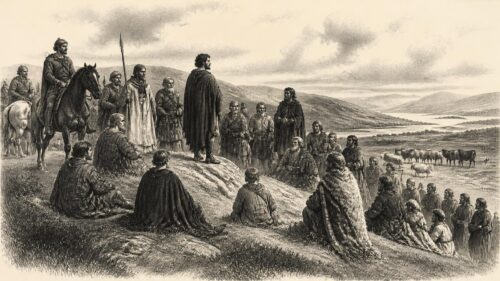
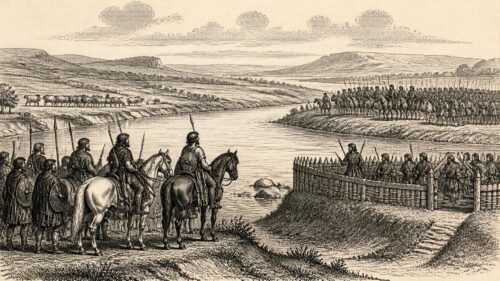
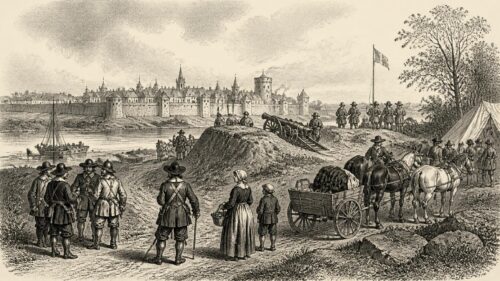
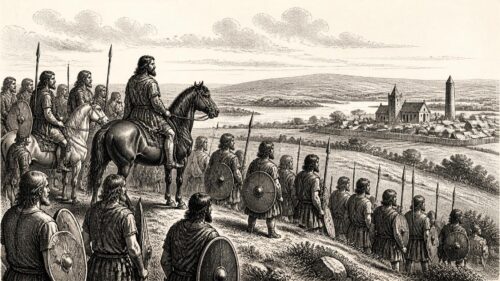
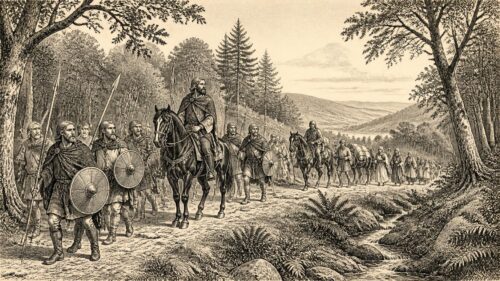
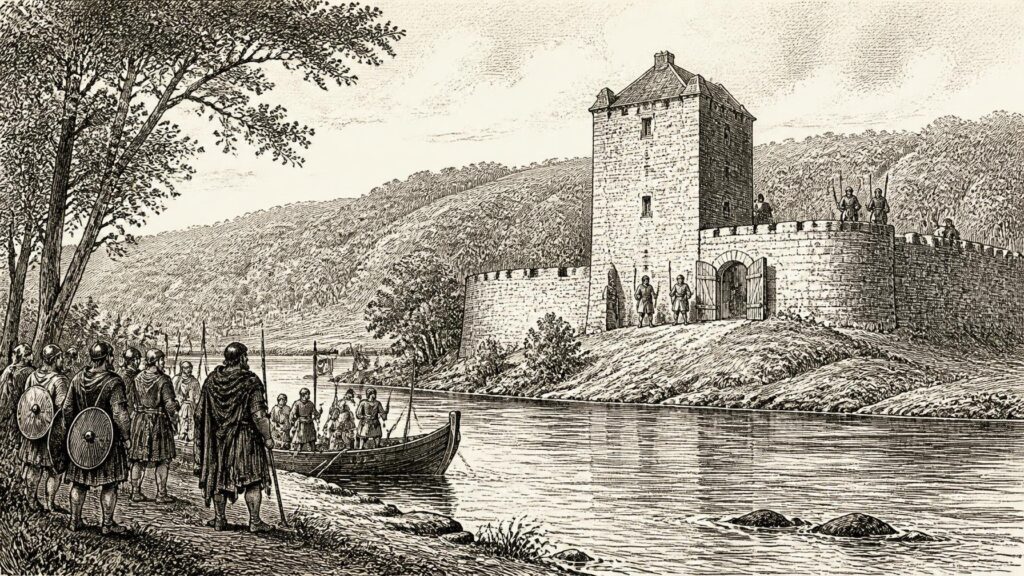
The annals record that Énrí, son of Eóghan Ó Néill, “went for aid” to the Foreign settlement and brought a large force to the castle on the River Finn, at Castlefin in modern County Donegal. In the annalists’ language, the “Foreigners” meant the English or Anglo-Irish political community, not an army newly arrived from overseas. Eóghan then came with a numerous host to join his son. Their presence carried a clear message: the O’Neill ruler of Tír Eógain could mobilise not only his own following but also allies from the lordship.
Neachtain Ó Domhnaill, king of Tír Conaill, advanced to oppose them. He did not risk a battle against a stronger force. Instead, peace was made with Eóghan. The price was substantial: Neachtain surrendered Castlefin, the territory of Cenél Moen and the tribute of Inis Eógain. Énrí left warders in the castle, while father and son returned home “in triumph”. The wording is partisan in its emphasis on O’Neill success, but its essentials are unusually precise. A castle changed hands; a district and revenue claim were conceded; and a garrison was installed to make the agreement real.
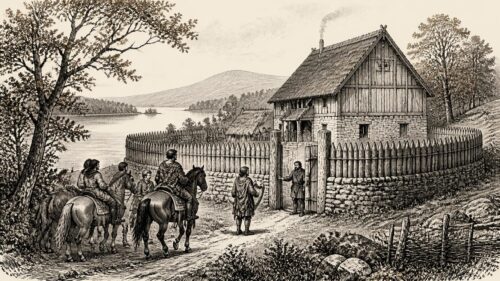
The settlement reveals the importance of fortified places in later medieval Irish politics. A castle was not merely a defensible building. It was a base for a lord’s household and soldiers, a store for food and equipment, a point of control over roads and river crossings, and a visible claim to authority. Castlefin lay on the Finn route between Tír Eógain and Tír Conaill. Holding it extended O’Neill influence into a contested borderland and weakened Neachtain’s ability to control the approaches to his lordship.
The diplomacy was also unstable by nature. The settlement did not erase the underlying Ó Néill–Ó Domhnaill rivalry, nor did it settle the contested inheritance within the O’Donnell kindred. It should therefore be understood as a demonstrated advantage in 1442, not as the creation of a durable peace. Neachtain remained king of Tír Conaill until his killing a decade later, and the rivalry of northern dynasties continued to shape the region.
Enniskillen, Oriel and Northern Feuds
Another castle transaction took place at Enniskillen. Tomás Óg Maguire gave the castle of Inis Ceithleann to Pilib Maguire after Éamonn, Tomás Óg’s son, had been released. The brief annal entry exposes a longer family struggle in Fir Manach. Captivity, the exchange of hostages and control of a stronghold were instruments through which rival branches of a ruling family bargained over power. The handover was a concession, not evidence that the succession dispute had ended.
Brian Mac Mathghamhna, king of Oriel, also died in 1442. Annála Connacht says that he died at home after unction and repentance, while the Annals of Ulster likewise stress a penitential death. Their praise of his family’s generosity—horses, treasure and money distributed to petitioners—was not empty ornament. Hospitality and largesse were central political virtues: a lord sustained followers, clerics, learned people and dependants through gifts, protection and food. Brian’s death therefore mattered beyond his household, in a region where the Mac Mahons balanced ties to the Ó Néills with dealings involving neighbouring English settlements.
In the north-east, war between the Ó Cáin and Mac Uidhilín, or MacQuillan, produced raids, killing and counter-raiding. MacQuillan and the sons of Brian Óg Ó Néill routed Ó Cáin’s people, reportedly killing thirty-two; later, Ó Cáin killed MacQuillan’s son. These notices are concise but convey the destructive rhythm of a local war, in which livestock, crops, movable goods and human security were all exposed to depredation.
Leinster’s Violent Frontier
The frontier south of Dublin was no quieter. Men described by the annals as the English of Dublin and Meath raided the country of the Byrnes and the Tooles in the Wicklow uplands, taking great spoil. The Byrnes and Tooles caught them, defeated them, killed eighty and recovered abundant plunder. Exact casualty totals in medieval annals deserve caution, but the episode clearly records a serious reverse for a force drawn from the lordship’s core counties. The mountains and wooded valleys of Wicklow were not a vacant margin: they were defended homelands whose inhabitants could strike raiders as they withdrew.
Further south, Muircheartach Caomhánach, son and heir of Mac Murchadha, lord of Leinster, was killed by the English of County Wexford. His father responded with war until seven prisoners taken on the day of the killing were released and an éraic of eight hundred marks was paid. The annal’s use of éraic, a word associated with compensation for killing in Irish legal tradition, is significant. It does not permit a reconstruction of a formal court case, but it shows that violence could end in a settlement expressed through prisoners and payment, as well as through revenge. At a border where English common law, lordly custom and Gaelic legal ideas met, practical negotiation could matter more than neat constitutional boundaries.
Deaths, Churches and Recorded Society
The year’s obituary notices stretch from Munster to Connacht and Ulster. Donnell Glas Mac Carthaigh, lord of Uí Chairbre; Mac Con Ó Driscoll, lord of Corca Laoigh; and Gilla Dubh Ó Flaithbheartaigh, lord of Iar Connacht, all died. Their recorded deaths remind us that political authority was dispersed among many regional lordships. No island-wide sovereign directed them. Kingship and lordship were instead layered, competitive and personal, grounded in kin groups, territories, clientships and the capacity to reward followers.
Churchmen appear in the same record: an abbot Ó Cárthaigh, the son of William Barrett, dean of Killala, and Mac Maolruanaidh, dean and son of Giolla Chríost Mac Donnchadha. The deaths of clerics alongside secular rulers reflect the church’s place within local society. Clergy were religious figures, but ecclesiastical offices also possessed land, revenues, learning and influence. The language of unction, repentance and victory over sin in notices of elite deaths shows how Christian ideals framed public memory.
Evidence for ordinary life is fragmentary, but a contemporary Ormond rental gives a valuable glimpse into the settled south-east. Its Michaelmas 1442 accounts list tenants and rents in the earl’s manors and note cases in the lord’s court, including trespass, bloodshed and failures connected with the lord’s corn. Such material sits beside the annals’ castles and campaigns. It points to fields under cultivation, grazing, household obligations, tenants with Gaelic and English names, and disputes brought before a seigneurial court. Ireland in 1442 was not defined only by raiding armies: it was also sustained by farming, rents, local justice and the daily work of households whose names rarely reached the chronicles.
What survives for this year is uneven and selective. Annalists favoured lordly deaths, warfare and ecclesiastical standing; documents preserve the concerns of landholders and administrators. Taken together, however, they show a politically connected island. A northern prince could call on forces from the English settlement; a Donegal castle could secure tribute from Inis Eógain; a bereaved Leinster lord could obtain prisoners and compensation from Wexford; and rents due at Michaelmas anchored power in the routines of the countryside.
Source References
Hover over a number to see the source. Select it to open the source.

- [1] Annals of the Four Masters, Part 7: Annal M1442
- [2] The Annals of Ulster, Year U1442
- [3] Annála Connacht, Annal 1442
- [4] Annals of Loch Cé, Annal LC1442
- [5] Butler, James (1392–1452), fourth earl of Ormond
- [6] O'Neill (Ó Néill), Eóghan (d. 1456)
- [7] O'Donnell (Ó Domhnaill), Neachtan (1392–1452)
- [8] Maguire (Mág Uidhir), Tomás Óg (d. 1480)
- [9] MacMahon (Mac Mathghamhna), Brian Mór (d. 1372)
- [10] O'Neill (Ó Néill), Aodh (d. 1475)
- [11] O'Neill (Ó Néill), Aodh Buidhe (d. 1444)
- [12] O'Donnell (Ó Domhnaill), Aodh Ruadh (1429–1505)
- [13] English Lordship of Ireland and the Irish Sea World: Re-assessing the Origins of the Kildare Ascendancy, c.1390–c.1513
- [14] White Earl to the Great Earl, 1442–96
- [15] A Remonstrance to King Henry VI Showing the Expediency of Appointing the Earl of Ormond Lord Lieutenant of Ireland, 1442
- [16] Calendar of Ormond Deeds, Volume III, 1413–1509
- [17] Calendar of Ormond Deeds, Volume III, 1413–1509: Irish Manuscripts Commission digital edition
- [18] The Governing of the Lancastrian Lordship of Ireland in the Time of James Butler, Fourth Earl of Ormond, c.1420–1452
- [19] A Statute of the Fortieth Year of King Edward III, enacted at Kilkenny in 1367
- [20] Annals of Ulster: CELT Project Record and Editorial Information
- [21] Annála Connacht: CELT Project Record and Editorial Information
- [22] Annals of Loch Cé A.D. 1014–1590
Primary Sources
- Annals of the Four Masters, Part 7: Annal M1442
- The Annals of Ulster, Year U1442
- Annála Connacht, Annal 1442
- Annals of Loch Cé, Annal LC1442
- Butler, James (1392–1452), fourth earl of Ormond
- O'Neill (Ó Néill), Eóghan (d. 1456)
- O'Donnell (Ó Domhnaill), Neachtan (1392–1452)
- Maguire (Mág Uidhir), Tomás Óg (d. 1480)
- MacMahon (Mac Mathghamhna), Brian Mór (d. 1372)
- O'Neill (Ó Néill), Aodh (d. 1475)
- O'Neill (Ó Néill), Aodh Buidhe (d. 1444)
- O'Donnell (Ó Domhnaill), Aodh Ruadh (1429–1505)
- English Lordship of Ireland and the Irish Sea World: Re-assessing the Origins of the Kildare Ascendancy, c.1390–c.1513
- White Earl to the Great Earl, 1442–96
- A Remonstrance to King Henry VI Showing the Expediency of Appointing the Earl of Ormond Lord Lieutenant of Ireland, 1442
- Calendar of Ormond Deeds, Volume III, 1413–1509
- Calendar of Ormond Deeds, Volume III, 1413–1509: Irish Manuscripts Commission digital edition
- The Governing of the Lancastrian Lordship of Ireland in the Time of James Butler, Fourth Earl of Ormond, c.1420–1452
- A Statute of the Fortieth Year of King Edward III, enacted at Kilkenny in 1367
- Annals of Ulster: CELT Project Record and Editorial Information
- Annála Connacht: CELT Project Record and Editorial Information
- Annals of Loch Cé A.D. 1014–1590