Tirawley Orchards1386 CE
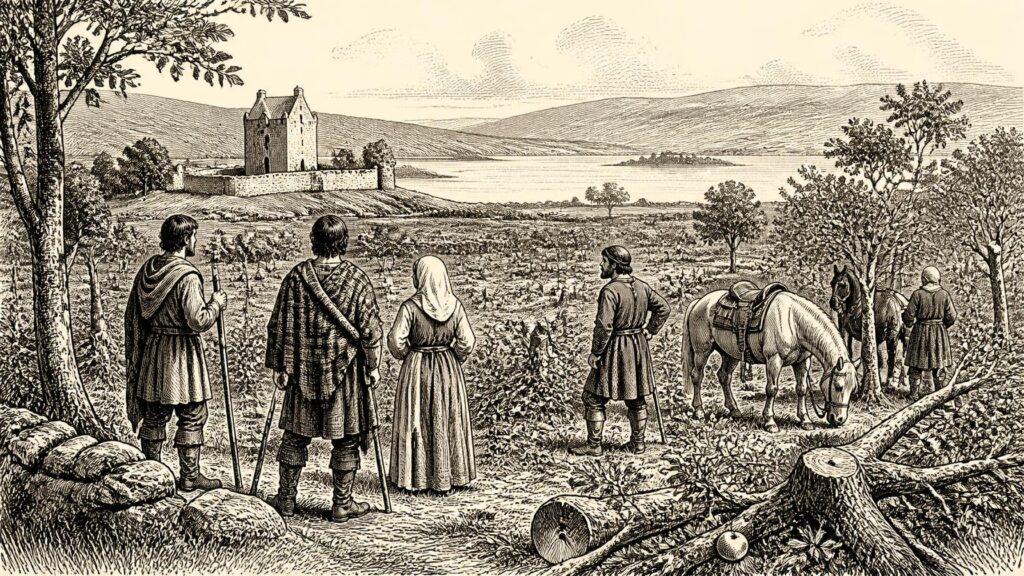
In 1386, Irish annals recorded local conflicts, raids and settlements rather than a single national event. Domnall Ó Conchobair’s coalition devastated Mac Wattin Barrett territory in Tirawley, killing leaders, taking a castle and destroying orchards. Connacht warfare shifted rapidly between raiding, pursuit, victory and negotiated peace among competing dynasties. Art Mór Mac Murchadha defeated the English of Ossory, while Midland feuds involved killings, castle seizures and hostage-taking. Richard II created Robert de Vere duke of Ireland, though he never visited; administration continued through deputies and chancery. Elite deaths and burials also marked status, kinship and lordship across a fragmented island.
Dateline
The record for 1386 is unusually revealing precisely because it does not offer a single, island-wide turning point. Instead, the annals preserve a succession of raids, killings, contested lordships and negotiated settlements stretching from north Mayo to Ossory and the midlands. At Westminster, meanwhile, King Richard II raised his favourite Robert de Vere to the unprecedented dignity of duke of Ireland. The contrast is instructive. In Ireland itself, power remained intensely local: it was exercised through kin, clients, castles, cattle, crops, hostages and alliances. Across the Irish Sea, Ireland could also be used as a grand title in English court politics, even when its recipient never set foot in the country.
What the Year’s Evidence Can Tell Us
The principal contemporary-style evidence consists of annalistic notices, compiled within Irish learned traditions and preserving events selectively rather than offering a continuous narrative. The Annals of Ulster, Annals of Loch Cé and Annals of the Four Masters agree on several leading events, though the later Four Masters sometimes gives fuller detail. Their language demands care. “Foreigners” normally means people of English or Anglo-Irish background, not necessarily recent arrivals; titles such as king, lord and heir describe authority in local political systems; and phrases praising penance, hospitality or generosity are moral judgements as well as information. Firmly dated records can establish that these events belong to 1386, but in most cases cannot supply a day, a precise battlefield or the full motives of those involved.
Tirawley Under Attack
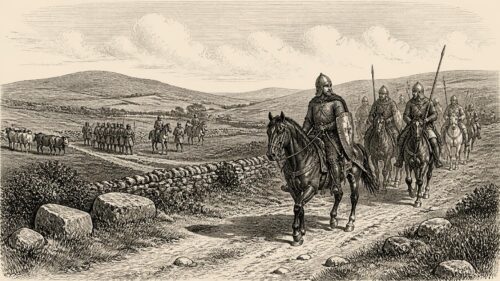
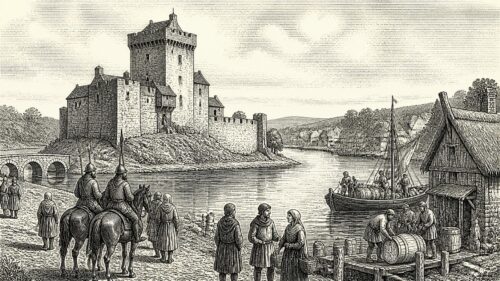
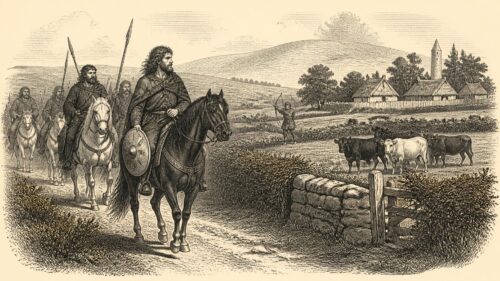
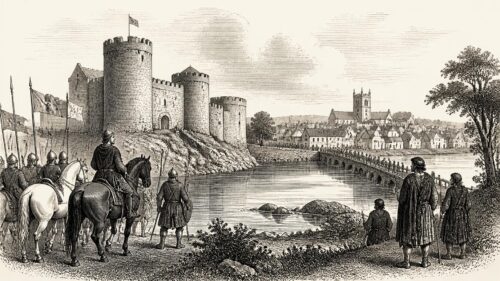
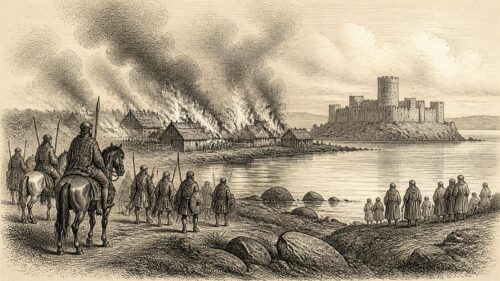
The largest operation recorded for the year struck Mac Wattin’s country in Tirawley, north Mayo. Domnall, son of Muircheartach Ó Conchobair of Sligo, led a substantial coalition with the Mac Donnchaidhs, Ó Dubhdas and Ó hEadhra into the territory. The Annals of Ulster tersely say that it was “all destroyed”; the Four Masters expands the picture. The raiders killed Robert of Dún Domhnainn, Mac Meyler of Corran and Maigeog Gallda, captured Lynott’s castle, and cut down orchards at Caerthannan and Inis Cua.
Those details show what a successful raid meant beyond a clash of armed men. A castle represented a defended local centre; an orchard was a long-term investment in managed land, vulnerable to deliberate destruction. Felling fruit trees could damage a household’s resources for years, while the taking of a stronghold threatened its owner’s ability to collect dues, protect dependants and project authority. The named places connect the campaign with the country around Lough Conn, Tirawley and Erris. Dún Domhnainn, the place attached to the slain Robert, lay in Erris; Inis Cua is modern Inishcoe on Lough Conn’s western side. The attack was therefore not an abstract war in “Connacht” but violence visited on settlements, woods, enclosed cultivation and local lordship in north-west Mayo.
Mac Wattin was the Gaelic form used by the leading Barretts of Tirawley, a family of Anglo-Norman descent that had become embedded in Connacht’s political world. That identity matters. The 1386 campaign was not a simple encounter between an Irish population and an outside English one. Domnall’s coalition was attacking a lordship whose ruling family had immigrant ancestry but used a Gaelic-style name and operated through the political practices of the region. Medieval Ireland contained many such overlapping identities. Descent, language, marriage, military service and territorial interest could matter more in any immediate conflict than a later national distinction.
Connacht’s Rapid Reversal
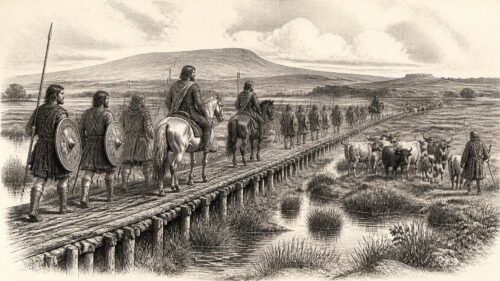
The raid did not settle Connacht. The annals next report that Ó Conchobair Ruadh gathered the Connachtmen he could enlist to assist Mac William Burke against Domnall of Sligo and the Clann Donnchaidh. This force carried off great preys from Tír Fhiachrach Muaidhe, then entered Clanricarde on another predatory expedition. There it was pursued by a very large army, including an Ó Briain and Mac William of Clanricarde. Ó Conchobair Ruadh turned to fight and defeated the pursuers; Conchobhar, son of Tadhg Ó Briain, was killed.
The sequence illustrates the rhythm of warfare: raid, counter-mobilisation, pursuit, reversal and fresh spoils. It also demonstrates that Connacht’s political geography could not be reduced to a contest between two blocs. Ó Conchobair Ruadh, a Burke Mac William, a second Mac William in Clanricarde, the Sligo branch of the Ó Conchobairs, the Clann Donnchaidh and an Ó Briain could appear in shifting combinations. Men crossed territorial boundaries with mounted forces, while communities in the path of armies lost livestock, stored food and standing crops. The sources call these movable resources “preys”; they were essential wealth and an immediate means of rewarding followers.
Yet the same year ended with a settlement. The Four Masters records that peace was made among the Connachtmen after the war. It adds that Mac William Burke went into the house of Mac William of Clanricarde and yielded lordship to him, while Mac Feorais Bermingham did likewise. The wording should not be made to bear more than it can: it does not provide the full terms or prove a permanent constitutional rearrangement. It does, however, preserve a public act of accommodation in which rival magnates acknowledged an altered balance of power. Peace, in this setting, was not the absence of politics but a negotiated outcome secured after force had shown its reach.
Mac Murchadha’s Leinster Victory
In Leinster, the annals record another important but frustratingly brief event: Mac Murchadha, described as king of Leinster, inflicted a defeat on the “Foreigners of Ossory”, and many of them fell. The king was Art Mór Mac Murchadha Caomhánach, who had by this period established himself as the leading ruler of Leinster. The notice does not name the battlefield, date the encounter, identify every opponent or state whether the forces of Ossory had entered his territory or been met in their own. Such gaps must remain gaps.
What can responsibly be said is that the defeat belonged to the continuing contest across the frontier zones of Leinster, where lordship was disputed among Gaelic rulers, Anglo-Irish landholders and communities tied to the towns and shires of the English lordship. Art’s success in 1386 was not the later royal expedition of Richard II, which would not occur until 1394–95. It was, rather, one indication of the military authority Art already possessed. His ability to defeat opponents identified by the annalist as the English of Ossory helps explain why the Leinster kingship was a major practical problem for the Dublin administration, not merely a ceremonial Gaelic survival.
Killings and Castles in the Midlands
Smaller notices reveal how violence also worked at a nearer scale. Niall Mac Eochagáin, considered fit to become chief of Cenél Fiachach, was killed by William Dalton and his son. Éireamhón Ó Máel Sechlainn was then slain by the Daltons and Mag Amhalghadha. The Four Masters additionally records the killing of Maghnus, son of Aodh Mac Diarmada, by the Daltons. These were not anonymous casualties: each death affected claims to inheritance, local leadership and the capacity of particular kindreds to defend their lands.
The Annals of Ulster also reports that the sons of Conchobhar, son of Cathal Ó Fearghail, captured Miles Dalton’s castle and gave it to Thomas, son of Cathal. Soon afterwards, Clann John Ó Fearghail and the Daltons jointly attacked the sons of Murchadh Ó Fearghail; the latter’s stronghold was assaulted and his wife, a daughter of Mac William de Burgh, taken prisoner. This is a sharp reminder that castle warfare and hostage-taking served family rivalries as much as broad ethnic divisions. Marriage linked the Ó Fearghails to the de Burgh world; conflict could nevertheless pit a Dalton–Ó Fearghail alliance against another Ó Fearghail branch.
An Absent Duke, A Present Administration
Events in England gave 1386 one of its most conspicuous Irish associations. On 13 October Richard II created Robert de Vere duke of Ireland, replacing de Vere’s earlier dignity as marquess of Dublin. The title was extraordinary: it elevated the king’s court favourite and made “Ireland” part of a struggle over royal patronage and authority at Westminster. It did not mean that de Vere ruled the whole island, nor that Ireland had become a unified duchy. His grant was tied to the English lordship’s claims, whose effective reach was limited and uneven.
De Vere nevertheless had an operating administration. Sir John Stanley had been appointed his lieutenant in June and reached Ireland later that summer; Alexander de Balscot, bishop of Meath, served as chancellor. The surviving calendar of Irish chancery letters for 1386–87 records commissions, licences, grants and appointments issued in de Vere’s name as marquess of Dublin. Such routine documents are important evidence that government continued through seals, offices, land rights and legal delegations even while military insecurity persisted.
But de Vere himself never crossed the Irish Sea. The duchy’s greatest significance in 1386 therefore lay less in a new Irish conquest than in its political symbolism. His elevation inflamed resentment among powerful English magnates during the parliamentary crisis of that autumn. Ireland was invoked as an enormous royal favour, while the actual work of defending the lordship fell to deputies, bishops, Anglo-Irish lords and local communities.
Loss, Burial and Remembered Standing
The year’s annals also preserve deaths outside battle. Aine, daughter of Tadhg Mac Donnchaidh and wife of Tigernán Ó Ruairc of Breifne, died at Tuaim Seancha by Lough Finvoy and was buried at Sligo. The Four Masters calls her the most favoured of the women of Leth Cuinn. Cairbre Ó Fearghail, lord of Caladh na hAnghaile, died after a life praised for generosity, bravery and protection. Domnall Mac Cochláín, king of Delbna, also died. These notices show the annalists’ concern with rank, kinship, pious death and burial, but they should not be mistaken for a complete account of ordinary life. They illuminate the elite households whose fortunes shaped the wider communities dependent on them.
Thus 1386 offers no single national narrative. Its strongest evidence is regional: devastated orchards in Tirawley, mobile armies in Connacht, a victory in Ossory, lethal feuds in the midlands and a Dublin-based administration working under an absentee magnate. Together they show an Ireland in which land, lineage and armed followings determined political life, while lofty titles bestowed in England could not by themselves command the countryside.
Source References
Hover over a number to see the source. Select it to open the source.

- [1] The Annals of Ulster
- [2] Annals of Loch Cé
- [3] Annals of the Four Masters
- [4] Annála Connacht
- [5] Annals of the Kingdom of Ireland, Volume IV
- [6] The Genealogies, Tribes, and Customs of Hy-Fiachrach: Note 968
- [7] Richard II | Dictionary of Irish Biography
- [8] Stanley, Sir John | Dictionary of Irish Biography
- [9] Balscot, Alexander | Dictionary of Irish Biography
- [10] Courtenay, Sir Philip | Dictionary of Irish Biography
- [11] MacMurrough Kavanagh (Mac Murchadha Caomhánach), Art Mór | Dictionary of Irish Biography
- [12] O'Brien (Ó Briain), Murchadh na Ráithníghe | Dictionary of Irish Biography
- [13] O'Toole (Ó Tuathail), Aodh | Dictionary of Irish Biography
- [14] CIRCLE, Patent Roll 10 Richard II (1386–7)
- [15] The ‘Calculus of Faction’ and Richard II’s Irish Policy
- [16] Urban Rebels in Medieval Connacht: The Revolt of Galway, 1388–9
- [17] Richard II | The National Archives
- [18] The Appeal of the Lords Appellant, February 1388 | The National Archives
- [19] History of the Viceroys of Ireland
- [20] The Lives of the Lord Chancellors and Keepers of the Great Seal of Ireland
Primary Sources
- The Annals of Ulster
- Annals of Loch Cé
- Annals of the Four Masters
- Annála Connacht
- Annals of the Kingdom of Ireland, Volume IV
- The Genealogies, Tribes, and Customs of Hy-Fiachrach: Note 968
- Richard II | Dictionary of Irish Biography
- Stanley, Sir John | Dictionary of Irish Biography
- Balscot, Alexander | Dictionary of Irish Biography
- Courtenay, Sir Philip | Dictionary of Irish Biography
- MacMurrough Kavanagh (Mac Murchadha Caomhánach), Art Mór | Dictionary of Irish Biography
- O'Brien (Ó Briain), Murchadh na Ráithníghe | Dictionary of Irish Biography
- O'Toole (Ó Tuathail), Aodh | Dictionary of Irish Biography
- CIRCLE, Patent Roll 10 Richard II (1386–7)
- The ‘Calculus of Faction’ and Richard II’s Irish Policy
- Urban Rebels in Medieval Connacht: The Revolt of Galway, 1388–9
- Richard II | The National Archives
- The Appeal of the Lords Appellant, February 1388 | The National Archives
- History of the Viceroys of Ireland
- The Lives of the Lord Chancellors and Keepers of the Great Seal of Ireland