Mac Murchada Drawn1354 CE
In 1354, Ireland experienced executions, warfare, dynastic killings, deaths and administrative inquiry amid the aftermath of plague. Annals recorded Mac Murchada’s execution by the Galls, followed by wider conflict, while Clann Aedha Buidhe and Dundalk’s Galls heavily defeated Aodh Ó Néill. Local struggles killed rulers in Laois and Connacht, although Domhnall Ó Dubhda succeeded his father in Uí Fhiachrach. Bishops and learned ollamhs also died. Justiciar Thomas de Rokeby governed through courts and inquiries, including valuation of the Pembroke estates at Wexford. Tenant complaints of poverty and high prices reveal hardship. The year demonstrates fragmented authority, cross-community alliances and insecurity.
Dateline
In 1354, Ireland’s surviving records register a year of execution, local warfare, deaths and administrative scrutiny rather than a single national turning point. The clearest contemporary-style annalistic notices come from Connacht and Loch Cé, with the Annals of the Four Masters preserving a fuller retrospective compilation. They agree on several major matters: a Mac Murchada was put to death by the Galls; the death or killing of rulers affected Laois, Uí Fhiachrach and other lordships; and an alliance of Clann Aedha Buidhe and the Galls of Dundalk inflicted a serious defeat on Aodh Ó Néill. Royal records, meanwhile, place the justiciar Thomas de Rokeby in Dublin and Wexford, conducting the ordinary but essential business of lordship after plague and war had weakened much of the English colony.
An Execution and Its Consequences
The starkest entry for the year says that “Mac Murchada was drawn by the Galls”, after which “great war resulted between Galls and Gaels”. The wording is deliberately brief. It does not securely identify the individual Mac Murchada, give a place, state the accusation, or permit a detailed reconstruction of the legal process. The Annals of the Four Masters, using a less specific formulation, says that Mac Murchada was put to death by the Galls and that a great war arose from it. What can responsibly be said is that an execution by the English or Anglo-Irish side was remembered as the immediate cause, or a highly visible trigger, of wider fighting.
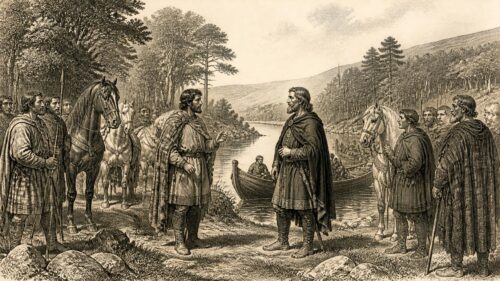
“Galls” in these annals should not be read as a simple modern ethnic label. Depending upon setting and writer, the term could encompass English newcomers, the descendants of earlier settlers, and the political community of the lordship. “Gaels” likewise described a broad Irish-speaking political world divided among many competing dynasties. The language conveys a real conflict between political formations, but it must not obscure alliances across that divide. Indeed, the same year offers a direct corrective to any neat two-sided picture: Clann Aedha Buidhe, an Ulster branch of the Uí Néill, fought alongside the Galls of Dundalk against Aodh Ó Néill.
The execution therefore belongs in a landscape where jurisdiction, lordship and military power overlapped. Public punishment could be a demonstration of authority, but it could also produce retaliation and amplify existing rivalries. The annals do not allow the war that followed to be mapped campaign by campaign. Nor do they prove that every ensuing clash sprang from this one death. Their phrasing nevertheless shows that contemporaries connected the killing to an escalation important enough to record in a year otherwise crowded with local notices.
Defeat in the North-East
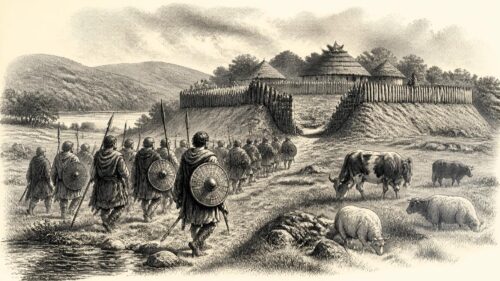
The defeat of Aodh Ó Néill was another firmly dated development. The annalists say that Clann Aedha Buidhe and the Galls of Dundalk dealt him a heavy reverse, with “great slaughter” in the encounter. No battlefield is named and no reliable total of the dead survives. It would be unsafe to supply either. Yet the participants themselves reveal the strategic character of the struggle. Dundalk was a major frontier town of the English lordship, linked by road and sea to Dublin and the wider Irish Sea world, while Clann Aedha Buidhe had its own interests in eastern Ulster. Their cooperation was practical politics, not an anomaly.
Aodh Ó Néill’s loss occurred amid fierce competition within and around Ulster. His son Brian died in the same year, according to the Connacht annals. The coincidence should not be turned into a claim that Brian died in the battle: the sources do not say so. Taken together, however, the entries indicate a difficult year for Aodh’s kin and underline how quickly military reverses could unsettle a lord’s position. Control depended on followers, cattle, fortified places, hostages, marriage connections and the ability to reward allies; defeat could strain all of them.
Violence elsewhere was often intensely local. Ruaidhrí Ó Mórdha, lord of Laois, was killed by his own brothers and household, a detail retained by the Four Masters. In the Connacht political sphere, Aodh, son of Cormac Bodur Mac Diarmata, was killed by the sons of Donnchad Riabach Mac Diarmata. Ruaidhrí, son of Seán Mag Mathgamna, was killed in the Mag Mathgamna stronghold. These notices describe kin-based struggles, not peripheral disturbances. Dynastic households were the principal institutions through which authority was exercised in many regions; conflict within them could be as consequential to local communities as a campaign by a king or justiciar.
Deaths, Succession and Church Authority
The annals’ long lists of deaths are not mere background detail. They record the removal of people whose households, clients, dependants and ecclesiastical connections shaped daily order. Brian Ó Dubhda, king of Uí Fhiachrach, died in 1354. The Four Masters adds an important succession notice: his son Domhnall took his place. That phrasing does not prove a smooth or universally accepted transition, but it indicates that the dynasty maintained continuity after Brian’s death. Uí Fhiachrach lay in the north-western Connacht world, where lordship was rooted in land, tribute, pastoral resources and networks of subordinate families.
Other deaths recorded include Sitriucc Mag Samradain, Seffraid Mag Ragnaill, Cathal son of Niall Ó Ruairc, Feidlim son of Cathal Ó Conchobair, Hoibert Burke and Derbforgaill daughter of an Ó Conchobair. The different kinds of people named—lords, kinsmen, women of leading families and figures bearing both Gaelic and settler surnames—offer a glimpse of a socially interwoven island. Annals generally preserve elite memory, so they do not tell us how most cultivators, herders, craftsmen, labourers or servants experienced the year. But elite deaths mattered materially: they could redirect protection, exactions, access to land and the disposition of livestock.
Church leadership also changed. Seán Ó Fínnachta, bishop of Elphin, died, ending an episcopate that had begun in 1326. The annals also record the death of Ó Lachtnáin, styled bishop of Connacht. Their notices employ the conventional Christian formula that each “rested in Christ”, placing political and ecclesiastical death within a shared religious language. Bishops were not merely spiritual figures. They participated in local patronage, oversaw clergy and church property, and could act as intermediaries between powerful families. Vacancies could consequently become moments of negotiation involving local interests, metropolitan authority and, ultimately, papal provision.
The death notices also point towards cultural continuity amid disorder. The Four Masters records the death of Saerbrethach Mac Aodhagáin, an ollamh of Conmaicne, and of Máel Sechnaill Mac Rithbeartaigh, an ollamh of Fermanagh in poetry. An ollamh was a learned master, and such men sustained professional traditions of law, genealogy, praise-poetry and historical memory. These entries do not demonstrate a flourishing school in a particular place during 1354, but they do show that learned offices and the reputations attached to them remained significant enough to enter the historical record.
Rokeby’s Lordship and Wexford Land
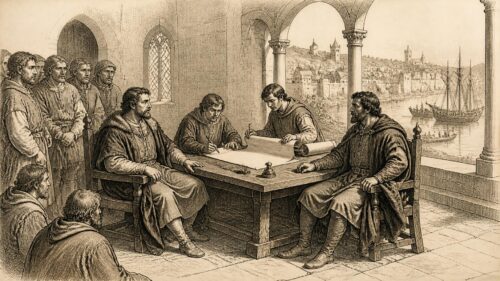
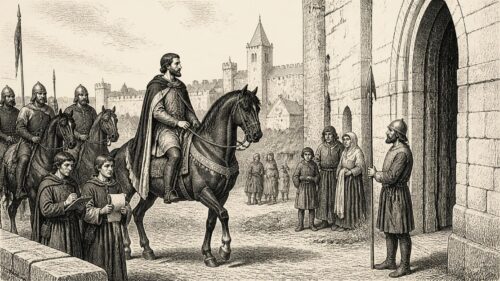
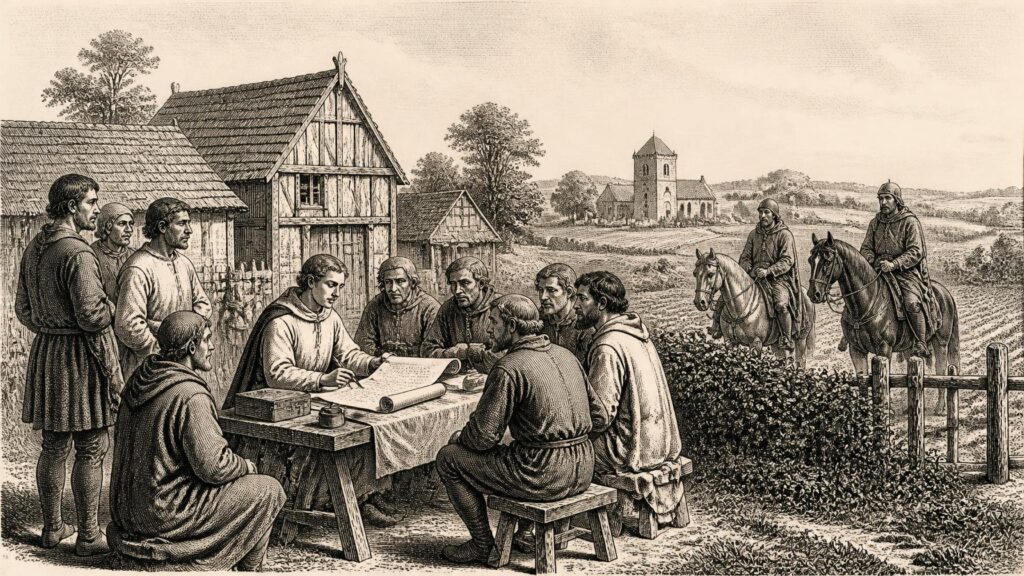
Within the English lordship, Sir Thomas de Rokeby remained justiciar in 1354. His government did not command the whole island, nor did it operate solely through warfare. Royal administration required courts, financial records, inquiries, grants, pardons and the assessment of estates. A writ concerning the Irish lands of Laurence Hastings, late earl of Pembroke, reached Rokeby at Dublin on 18 January 1354. On 30 May, an inquisition was held before him at Wexford to establish the value of Hastings’s Irish lands, tenements, liberties and other rights.
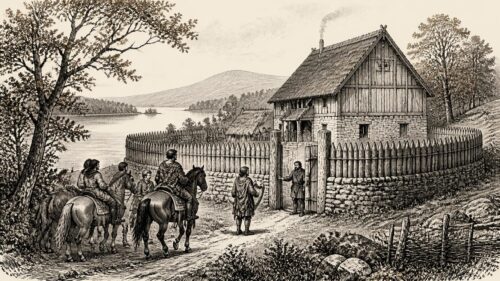
The surviving valuation makes rural economy unusually visible. Jurors listed carucates and acres at Ballymacarney, Malamore, Ballysampson, Ballyregan, Ballyrawrith and Ballybeg, assigning annual cash values to arable units and rents from free tenants at Assaly and Ballycorkey. A carucate was a fiscal and agrarian measure rather than a fixed modern acreage, so it should not be converted mechanically into hectares. Still, the inquiry shows officials attempting to measure productive land, rents and seigneurial rights in money. It is a useful counterpoint to the annals’ narratives of killing: power also rested on knowing who owed what, on maintaining tenants and on preserving income from cultivated ground.
That work was undertaken in an unsettled social climate. The first wave of the Black Death had reached Ireland in 1348–49, and its consequences were still evident. A 1354 complaint from tenants on royal manors stated that recent pestilence and the high prices charged by officials had reduced them to poverty. The complaint does not describe all Ireland, and it should not be used to calculate island-wide mortality. It does, however, offer rare testimony of hardship among tenants in the Crown’s estates: diminished resources, pressure over provisions and difficulty meeting obligations.
A Fragmented Island
Thus 1354 cannot be reduced to a contest between an advancing English administration and a uniformly resistant Gaelic Ireland. Rokeby’s officers could hold an inquisition at Wexford and record rents in detail, while elsewhere crown authority relied on frontier towns, negotiated alliances and armed force. Irish dynasties retained their own political languages and institutions, yet they also fought one another and sometimes joined forces with settlers. The killing of Mac Murchada, the defeat of Aodh Ó Néill, the murder of Ruaidhrí Ó Mórdha by his own circle and the succession of Domhnall Ó Dubhda each illuminate a different facet of that fractured political order.
For ordinary people, the sources leave much unsaid. Fields still required tillage, animals had to be tended, rents and food supplied, churches served and roads travelled. But plague’s aftermath, costly provisions, changes of lordship and recurring violence made these routines more precarious. The year’s record is consequently valuable not because it presents a complete story, but because its terse notices—read beside legal and fiscal evidence—show Ireland in 1354 as a place where force, land, learning, faith and survival were closely bound together.
Primary Sources
- Annála Connacht: Annal 1354 (English translation)
- Annála Connacht: Annal 1354 (Irish text)
- Annála Connacht: Edition and Bibliographical Information
- Annals of Loch Cé A.D. 1014–1590: Annal LC1354
- Annals of the Four Masters: Annal M1354 (Irish text)
- Annals of the Four Masters: Volume 3 English Translation
- Annals of the Four Masters: Edition and Bibliographical Information
- Annals of Ulster Otherwise Annála Senait
- Annals of Ulster: English Translation, 1350–1355 Section
- Rokeby, Thomas
- Inquisitions Post Mortem: Extents of Medieval Ireland
- Thomas de Rokeby, Named 1311 to 1502
- Materials for the History of the Franciscan Province of Ireland, A.D. 1230–1450
- Calendar of Ormond Deeds, Volume II, 1350–1413
- Castlekevin Conservation Report
- Food Security and Insecurity in Medieval Irish Towns
- The Construction of the Irish Annals, 429–466
- Ireland and the English Crown, 1171–1541
- Ireland in the 1350s: Sir Thomas de Rokeby and His Successors
- The Hospital in Medieval Ireland, 1170–1540: An Archaeology
- CELT: The Online Resource for Irish History, Literature and Politics
- Medieval Source Material on the Internet: Chancery Rolls