Boyne Bridges Washed Away1330 CE
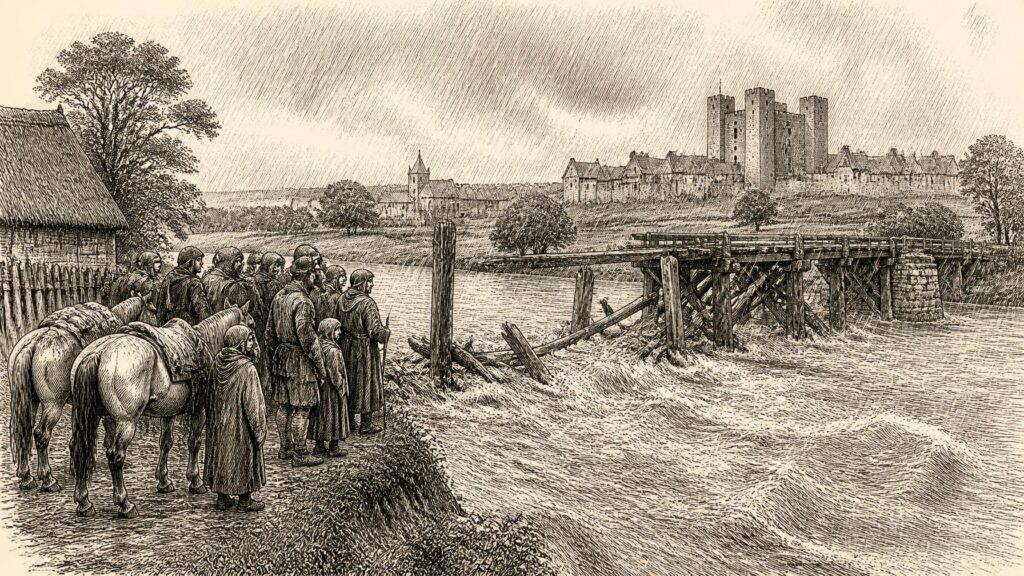
In 1330, violent storms and flooding devastated parts of Ireland, sweeping away nearly all Boyne bridges, damaging Trim and Drogheda, delaying harvests and raising grain prices. These disruptions hindered trade, travel, government and military movement. Meanwhile, Roger Outlaw’s Kilkenny parliament sought support against Brian Bán Ó Briain in Munster, exposing rival magnates’ uncertain loyalties. Edward III warned the earls of Ulster and Desmond against private warfare, while Adam de Lymbergh became chancellor. Violence afflicted Meath, although Wexford fighting is uncertainly dated. Gilla Ísu Ruad Ó Ragallaig died at Cavan’s Franciscan friary, illustrating the links between Gaelic lordship and religious patronage.
Dateline
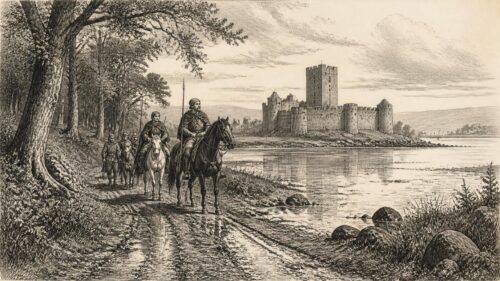
In 1330, Ireland’s most securely dated drama was not a battle or a coronation but a season of destructive weather. A chronicle associated with Kilkenny records exceptionally violent storms, the collapse of a house that killed the wife and daughter of Milo Verdon, and a great flood on the Boyne. It says that every bridge on the river except one called “Babe’s” was swept away, while Trim and Drogheda suffered further damage. The report is vivid, but it should be read as an annalistic record rather than as a modern survey: it does not identify every crossing, locate Babe’s bridge with certainty, or provide a precise day for the flood. What it does establish is that the Boyne valley endured a serious disruption in this calendar year.
The destruction mattered well beyond the immediate losses. The Boyne was a principal route through the lordship of Ireland, connecting Meath’s agricultural districts with the great walled towns of Trim and Drogheda and, through Drogheda’s port, with the Irish Sea. Bridges carried travellers, carts, livestock, rents, messengers and armed companies. Their loss made movement slower, riskier and more expensive at precisely the time when lordly government depended on rapid communication between Dublin, Meath and the northern and western frontiers. Floodwater therefore had political as well as local consequences.
Rain, Harvest and Scarcity
The same chronicle links the storms to a failed or badly delayed harvest. It reports that much wheat could not be brought in before Michaelmas, 29 September, because of the rainy season. A crannock of wheat was said to cost 20 shillings and a crannock of oats 8 shillings. Medieval measures varied by place and record, so those prices cannot responsibly be converted into a modern quantity or used to calculate a neat rate of inflation. Their relative scale, however, is unmistakable: grain had become dear, and the writer understood weather damage as the cause.
This was not necessarily a universal famine throughout Ireland in 1330. The evidence is strongest for the regions known to the chronicler and for grain marketed within the English lordship. Yet wet weather, damaged infrastructure and a late harvest could quickly affect many households. Tenants owed rents and labour; towns depended on supplies brought in from surrounding countryside; religious houses needed grain for their own communities and for hospitality; armies and lordly retinues required food and fodder. Oats were essential both for human consumption and for horses. Higher prices thus bore on ploughing, transport and military mobility as well as on bread.
The episode also belongs to a longer, carefully qualified background of pressure. Ireland had experienced the Scottish invasion of 1315–18 and the wider northern European food crisis of those years. By 1330 the immediate emergency of the Bruce war was past, but rural production and local lordship had not simply returned to a settled earlier world. Contemporary and near-contemporary records show a country in which harvests, cattle, roads, rivers and security could still determine whether political plans were practical.
A Parliament and a Munster Campaign
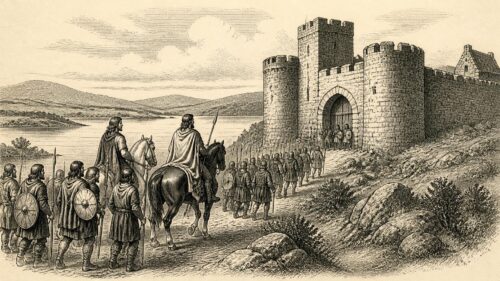
Against this difficult material setting, the administration of the English crown attempted to organise a major response to disorder in the south. Roger Outlaw, prior of the Hospitallers at Kilmainham and justiciar of Ireland since 1327, held a parliament at Kilkenny in 1330. The chronicle places there Alexander de Bicknor, archbishop of Dublin; William de Burgh, earl of Ulster; James Butler, earl of Ormond; William de Bermingham; Walter de Burgh of Connacht; and other leading magnates. It presents them as arriving with substantial armed followings to expel Brian Bán Ó Briain from territory around Cashel.
The wording matters. This was not a single united Irish army, nor an uncomplicated clash between ‘English’ and ‘Irish’. The assembled men represented competing aristocratic interests, overlapping lordships and kinship networks. The crown’s officials could summon them under the language of royal peace and the king’s enemies, but their co-operation rested on bargains, rivalries and local calculation. Gaelic rulers and Anglo-Irish lords alike drew power from cattle, land, clientship, fortifications and mounted followers; alliances could cross cultural and linguistic boundaries when advantage required it.
Brian Bán Ó Briain’s resistance in Munster exposed these limits. A modern reconstruction of the evidence indicates that a royal expedition in the summer of 1330 did not bring him decisively to heel. A jury at Cashel reportedly implicated Maurice Fitz Thomas, the recently created earl of Desmond, in Ó Briain’s depredations; Desmond denied that he had acted disloyally, claiming instead that his contacts sought to bring the Irish leader into the king’s peace. This was exactly the sort of ambiguity through which political life worked. Negotiating with an opponent could be sensible frontier policy, evidence of divided allegiance, or both, depending on who judged it.
Magnates Under Warning
In June, Edward III warned the earls of Ulster and Desmond not to continue assembling troops against one another and instructed them to submit their complaints to him. The warning reveals how fragile the apparently impressive Kilkenny mobilisation was. William de Burgh, earl of Ulster, dominated extensive interests in Ulster and Connacht; Maurice Fitz Thomas’s new earldom and liberty in Kerry made him one of the most powerful men in Munster. Neither was merely a servant acting at Dublin’s command. Each possessed his own affinities, revenues and political objectives.
The crown’s language of arbitration was therefore an attempt to prevent private conflict from consuming the resources needed for royal government. It did not erase the quarrel. Later records and chronicles differ over the sequence of custody, resistance and renewed war involving Desmond and Ulster in 1330–31. In particular, the formal arrest of Desmond is firmly reported under 1331 in one chronicle, while modern discussion connects the mounting accusations and attempts at restraint to 1330. It is safer not to assign every later development to this year. What can be placed in 1330 is the royal warning itself, and the visible failure of political peace to become secure.
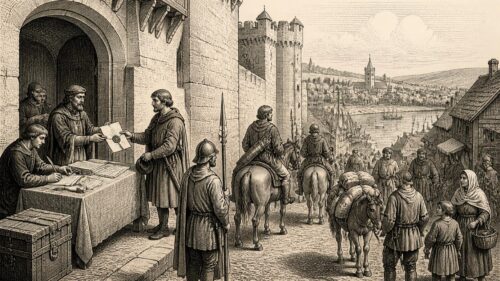
Administrative change formed part of the same effort. Adam de Lymbergh, an experienced English royal clerk with ecclesiastical income in Ireland, was appointed chancellor of Ireland in 1330. The chancellor was custodian of the great seal and a central figure in producing and validating royal business. His appointment did not mean that government was newly effective everywhere; rather, it underlines the crown’s continuing investment in written authority, office-holding and oversight at a moment when magnates were raising armed forces and roads and bridges could be broken by weather.
Meath, Wexford and the Problem of Dating
Conflict was not confined to Munster. The Kilkenny chronicle records that the English of Meath killed some Irish opponents, after which the Mac Geoghegans destroyed fifteen of their settlements and killed 110 men, including three sons of princes. Numbers in medieval annals should not be treated as audited casualty returns, but the entry conveys a serious escalation in the borderlands of Meath and western Leinster. Raiding and counter-raiding could destroy homes, seize livestock, interrupt cultivation and expose smaller communities to violence far beyond the ambitions of the leading lords.
A shorter set of annals assigns a striking Wexford encounter to 1330: the burgesses of Wexford killed 400 Irish rebels near the Slaney. Yet the fuller Kilkenny chronicle places what appears to be the same fighting among events of 1331, adding that many were drowned in the river. The disagreement is important evidence in itself. Annals were copied, compiled and sometimes dated according to differing year conventions; entries could also be displaced when a writer grouped related events together. The Wexford action should therefore be connected with the unstable opening of the 1330s, but not presented as an unquestionable event of 1330.
A Franciscan Death in East Breifne
One firmly associated death offers a quieter view of political and religious life beyond the crown’s main administrative centres. Gilla Ísu Ruad Ó Ragallaig, formerly lord of East Breifne, died in 1330 at the Franciscan house of Cavan. He had earlier withdrawn from active rulership and taken the Franciscan habit in a foundation associated with his family. His death should not be turned into a simple succession story: his son Máel Sechlainn had received the lordship years before and had himself died in 1328. Nevertheless, the death of the retired lord demonstrates how Gaelic dynastic power and the mendicant religious orders were entwined.
Friaries were not remote from secular life. They offered burial, prayer, education, record-keeping, hospitality and prestige to patrons, while noble families used them to express authority and piety. The choice of Cavan also points to the enduring regional character of Ireland in 1330. East Breifne was governed through Ó Ragallaig lordship, kinship and local ecclesiastical connections, not through the institutions meeting at Kilkenny alone. The island contained many such political worlds, interacting through warfare, trade, marriage, religious patronage and diplomacy.
Thus 1330 was a year in which rain and flood became historical forces. The washed-out bridges of the Boyne, expensive grain and delayed wheat harvest were immediate hardships. At the same time, parliament at Kilkenny, campaigning in Munster, a royal warning to Ulster and Desmond, violence on the Meath frontier and the Franciscan death at Cavan show a country where authority remained dispersed. The English crown could issue commands and appoint officers, but its lordship depended on magnates whose loyalties were negotiable, communities whose food supply was vulnerable, and landscapes that could overturn official plans in a single violent season.
Primary Sources
- Annales Hiberniae
- Annales Hiberniae
- Annales Breves Hiberniae
- Annals of the Four Masters, Part 16
- Annals of Loch Cé, Volume 1
- Annals of Loch Cé
- Annals of Loch Cé
- List of Published Texts at CELT
- FitzGerald, Maurice fitz Thomas
- O'Reilly (Ó Ragallaig), Matthew (Matha) Ruad
- O'Reilly, Gilla Ísu Ruad
- Climate, disease and society in late-medieval Ireland
- ‘Geographical loyalty’? Counties, palatinates, boroughs and ridings
- What was the distribution of wealth in Ireland c. 1300?
- The Ethnic Mix in Medieval Wexford
- Two nations, one order: the Franciscans in medieval Ireland
- Churches and Ecclesiastical Enclosures / Shéipéil agus Ráthanna
- Earthworks / Talamh Oibrithe
- Decline of the Norman Colony
- The King's Peace in Ireland