Roscommon’s Fallen Fortress1277 CE
In 1277, authority in Ireland was contested through dynastic rivalry, warfare, castles and law. In Thomond, Brian Ruad Ó Briain allied with Thomas de Clare, holder of Edward I’s grant to Thomond, against his nephew Toirrdelbach. Defeated, Brian sought refuge at Bunratty but was seized and executed on de Clare’s orders. In Connacht, Irish forces led by an Ó Conchobair and Domnall Ó Domnaill demolished Roscommon Castle, challenging royal control. Irish people reportedly offered 7,000 marks for English common law, seeking legal protections. The year also recorded ecclesiastical continuity and local raiding, illustrating Ireland’s plural, unstable political order throughout society.
Dateline
In 1277, the most revealing Irish events were not the acts of a single government, but contests over who could command land, allegiance and justice. In Thomond, Brian Ruad Ó Briain, a claimant to the regional kingship, was killed after seeking help from Thomas de Clare, an Anglo-Norman lord with a royal grant to the same country. In Connacht, Irish forces again pulled down Roscommon Castle, an expensive and strategic expression of royal authority. At the same time, a remarkable proposal reached Edward I: Irish people were said to be offering 7,000 marks for access to English common law. These developments belong together, not because Ireland was becoming politically uniform, but because power was being tested through very different means—kinship, military force, castles, royal grants and law.
Brian Ruad and Bunratty
The death of Brian Ruad Ó Briain is securely associated with 1277, though no contemporary source supplies a day or month. He had ruled, or claimed to rule, Thomond, the Ó Briain kingdom west and north of the lower Shannon. His position was challenged by his nephew Toirrdelbach Ó Briain, whose support among important Thomond kindreds made the succession struggle much more than a private family quarrel. It was a contest for control of tribute, cattle, followers and the right to speak as king for the region.
That conflict became entangled with a new English initiative. On 26 January 1276 Edward I had granted the whole of Thomond to Thomas de Clare as a hereditary fief, for the service of ten knights. Such a grant did not mean that de Clare possessed the country on the ground. It proclaimed a royal claim and licensed him to make it real. De Clare had acquired Bunratty and held major interests in Munster through marriage as well as royal favour. For him, the division among the Ó Briains created an opening; for Brian Ruad, de Clare’s soldiers and political connections offered a possible route back to predominance.
The alliance was represented in exceptionally solemn terms. Annála Connacht says Brian and the “Earl of Clare’s son”—Thomas was the son of Richard de Clare, earl of Gloucester—became spiritual kin, mixed their blood in one vessel, and pledged themselves on the relics, bells and croziers of Munster. “Gossipry”, a relationship of spiritual kinship, was not casual language. The ceremonial use of revered church objects demonstrates that political bargains could be framed through sacred obligations intelligible in Gaelic as well as Anglo-Norman society.
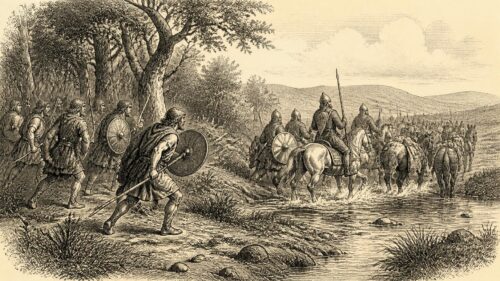
Yet the alliance did not settle Thomond. Toirrdelbach obtained assistance from the de Burgh interest in Connacht and from local allies. Brian Ruad and de Clare were defeated in 1277; Brian fled to Bunratty, the very castle controlled by his ally. There he was seized and killed on de Clare’s orders. The annals give a stark account of execution by being drawn between horses. Later retellings differ over particulars, and the precise mechanics need not be treated as certain, but the central fact is not in doubt: a king of Thomond was put to death after entering the protection of the lord with whom he had made a sacred alliance.
The episode was consequential because it exposed the limits of a royal grant and of personal diplomacy alike. De Clare could obtain a title to Thomond from Edward I and a pact from Brian Ruad, but neither automatically delivered a settled lordship. His choice also created a durable grievance. Brian’s sons would continue to matter in Thomond politics, while Toirrdelbach emerged with the stronger immediate position. The year did not bring a final conquest of Thomond; it ensured that the region’s internal rivalry and its relationship with the English lordship would remain closely intertwined.
Roscommon Castle Pulled Down
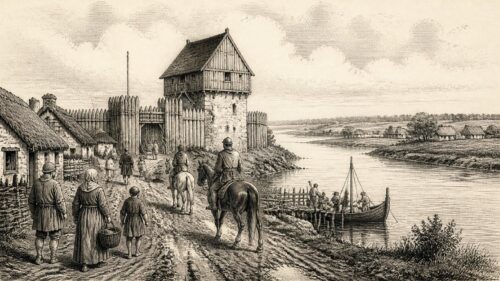
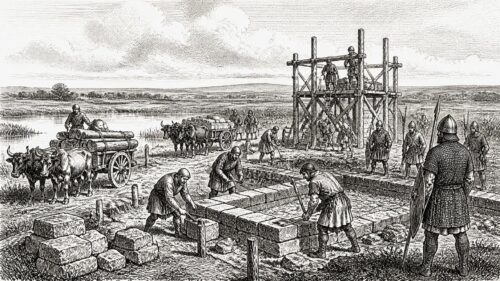
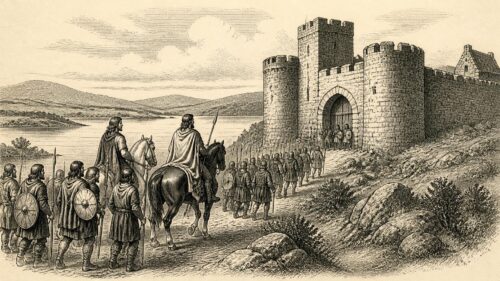
Farther north-west, the assault on Roscommon Castle was another direct challenge to planted authority. The castle had been selected as a royal site in 1262 and building began later in that decade. It stood near the centre of Connacht, in an area where the English administration sought to convert intermittent military intervention into durable control. Castles were not simply residences for knights. They were storehouses, garrison bases, judicial centres and physical statements that a lord or king expected rents, service and obedience.
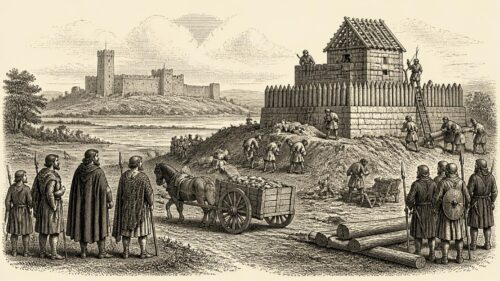
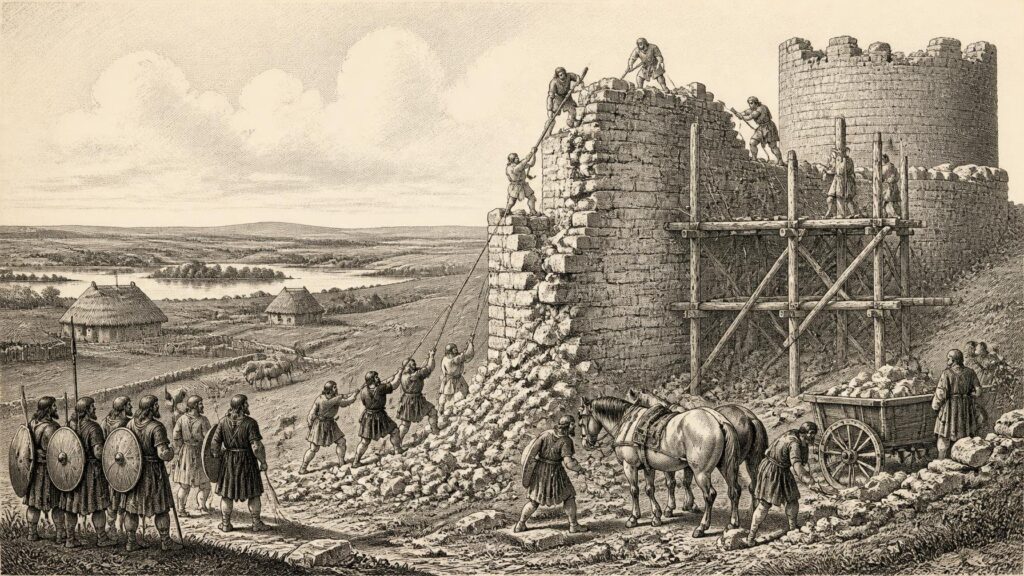
Annála Connacht records that Roscommon Castle was “pulled down” in 1277 by the son of Fedlim Ó Conchobair, Domnall Ó Domnaill and the Connachtmen. The later Annals of the Four Masters identifies the Ó Conchobair leader as Hugh Muimhneach. The wording matters. This was not merely a raid passing through a hostile district: the attackers targeted the fortification itself. Archaeological and documentary study confirms that the castle had repeatedly been taken or damaged in the 1270s and that costly reconstruction followed. The successful demolition of 1277 therefore belongs to a recurring struggle over whether the Crown’s presence in Connacht could be made permanent.
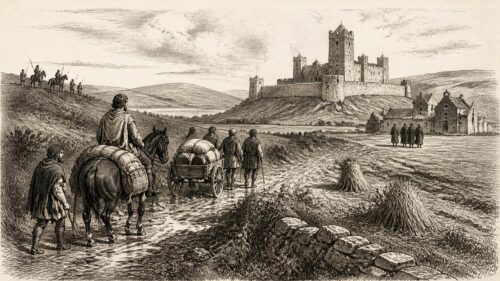
The event also shows the breadth of Irish political co-operation when interests aligned. An Ó Conchobair force and Domnall Ó Domnaill, a leading figure from Tír Chonaill in the north-west, appeared together against a royal stronghold. Such alliances should not be mistaken for national unity in a modern sense: Connacht itself remained divided among competing branches of the Ó Conchobair kindred, and wider alliances were contingent. But Roscommon demonstrates that the lordship’s castles could attract opposition extending beyond one locality. The practical burden of this warfare fell on surrounding communities, who supplied labour, food, animals, intelligence and fighting men, and whose farms lay near routes used by armies and raiders.
A Price for English Law
Military conflict was not the only means by which Irish people addressed the expanding lordship. A letter sent by Robert de Ufford, justiciar of Ireland, to Edward I in 1277 reported that “the Irish” offered 7,000 marks for a grant of the common laws of the English. The surviving exchange is firmly placed in 1277, although it does not name every prospective contributor or show money changing hands. Edward’s reply, made after consultation with his council, was favourable in principle but required wider consent in Ireland, at least from suitably disposed prelates and magnates. The proposal was therefore an opening for negotiation, not a completed constitutional settlement.
Its importance lies in what it reveals about law as a valued protection. In the English-controlled parts of Ireland, access to royal courts, the rules of inheritance, legal remedies for violence and the status attached to the king’s peace could be consequential advantages. People outside the legal category of the king’s English subjects could find their position insecure, especially in disputes with colonists or officials. Seeking English law did not necessarily imply cultural surrender, nor did it mean that Gaelic legal learning disappeared. Rather, it shows actors within Irish society attempting to obtain useful rights from the Crown while continuing to live in a world of Gaelic lordship, kin obligation and local custom.
The Crown’s response also exposed the hierarchy embedded in the request. Edward’s council disparaged Irish laws in harsh terms, yet did not simply impose English law island-wide. Consent, political calculation and payment were all raised as conditions. The gap between this administrative discussion and the destruction of Roscommon Castle is striking. In the same year, royal authority was being bargained for in correspondence and resisted with force in Connacht.
Churches, Communities and Local Violence
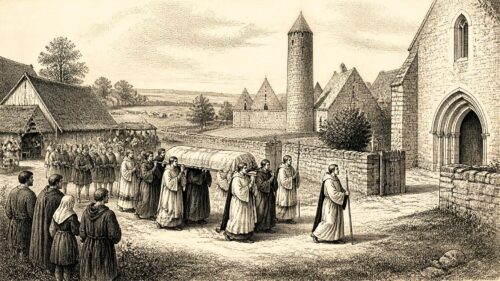
The annals preserve smaller notices that keep the year from being reduced to magnates and castles. Broen Ó Máelmocheirge, abbot of Kells, died in 1277. His brief obituary is evidence of the continuing institutional life of major Irish churches: an abbot administered property, hospitality, worship and learned networks as well as religious observance. The sacred objects invoked in the Brian Ruad–de Clare agreement likewise remind us that churches remained repositories of authority, memory and public trust.
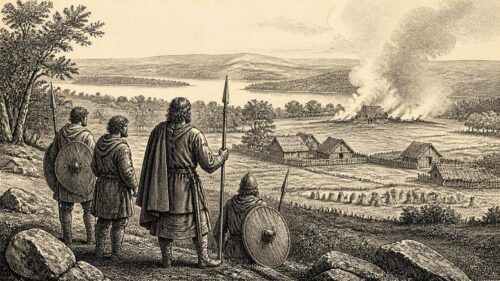
One annal also records a major raid by Tellach Echach upon Cenél Luachain in Glenn da Duile, in which Conchobar Mac Dorchaid and many others were killed. The exact circumstances are not recoverable, and it would be irresponsible to inflate a terse notice into a full campaign narrative. Nevertheless, it records the kind of local violence that shaped ordinary life: the seizure of movable wealth, the risk of death for retainers and neighbours, and the disruption caused when one community crossed into another’s territory. Raiding was a political instrument, but its consequences were felt in households, herds and cultivated ground.
A Year of Contested Authority
1277 thus offers no simple story of advance or retreat. Thomas de Clare’s grant and Bunratty alliance show an Anglo-Norman magnate attempting to turn royal title into lordship; Brian Ruad’s death shows the human cost and instability of that effort. The fall of Roscommon Castle shows that even substantial fortification could not secure Connacht against determined Irish coalitions. The request for English law reveals another, less violent form of engagement with royal power. Across these episodes, Irish politics remained plural. Authority could be sanctified by relics, asserted in a royal charter, embodied in stone walls, pursued in a legal petition or won and lost through force. In 1277, none of these methods proved decisive on its own.
Primary Sources
- Annála Connacht: Annal 1277
- Annála Connacht: Irish Text, Annal 1277
- Annals of the Four Masters: Annal M1277
- Annals of Ulster
- Annals of Ulster: Irish Text, Years U1271–U1278
- Annals of Inisfallen: Annals AI1277–AI1280
- Annales Breves Hiberniae
- O'Brien (Ó Briain), Brian Ruad
- Clare, Thomas de
- Edward I and the Proposed Purchase of English Law for the Irish, c. 1276–80
- The Request of the Irish for English Law, 1277–80
- County Roscommon Urban Archaeological Survey: Roscommon Castle
- Roscommon Castle Excavation Report, 2002
- The Great Gatehouse at Harlech Castle
- The Annals of Multyfarnham: Roscommon and Connacht Provenance
- The Normans in Thomond
- The Battle of Dysert O’Dea and the Gaelic Resurgence in Thomond
- English Rule in Ireland, c.1272–c.1315
- The Medieval Irish Plea Rolls: An Introduction
- Foreign Affairs Before 1509: Research Guide
- Exploring the Irish Annals
- Irish History Online: Edward I and the Proposed Purchase of English Law for the Irish, c.1276–80