Glún Iairn’s Fatal Cup989 CE
Dateline
The annals for 989 preserve a year of abrupt reversals. Ireland was not a single kingdom, nor was its political life divided neatly between ‘Irish’ and ‘Viking’. Kingship was exercised through shifting local alliances, hostage-taking, tribute, raiding and control of major churches. The most striking entry is the death of Glún Iairn, king of the foreigners of Dublin, killed while drunk by his own slave. Yet 989 mattered just as much in the north: Dún Lethglaise, modern Downpatrick, was plundered and burned; a ruler of the Isles was killed in Dál Riata; and the successor of St Patrick at Armagh acquired the successorship of Colum Cille with assent recorded from Ireland and Alba.
The surviving notices must be used carefully. The Annals of Ulster, whose entry is assigned 988 ‘alias 989’ in its internal chronology, is conventionally placed in 989. The later Annals of the Four Masters places its corresponding material under 988 but explicitly corrects this to 989. These are not day-by-day reports, and they do not supply a full narrative of the year. They do, however, offer a remarkably concentrated view of power, violence and ecclesiastical authority across the Irish Sea.
A Dublin King Killed
Glún Iairn, son of Amlaíb, was king of the Gall, the ‘foreigners’: in this context, the Scandinavian and Hiberno-Scandinavian political community centred on Dublin. The annalist’s wording is unusually vivid but also limited. It says that he was killed by his own slave while drunk. The later Four Masters names the slave as Colbán; the nearer annalistic record does not. There is no secure contemporary explanation of motive, no description of a palace coup, and no basis for turning the episode into a tale of national revolt. What can responsibly be said is that the killing removed Dublin’s ruler at a moment when the town was closely entangled in the politics of Leinster, Meath and the Irish Sea.
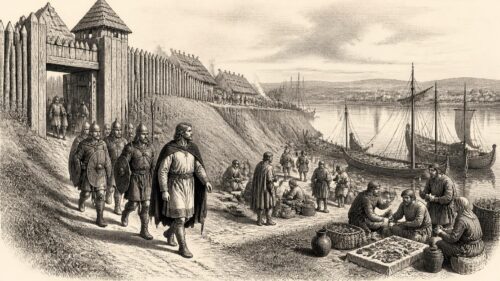
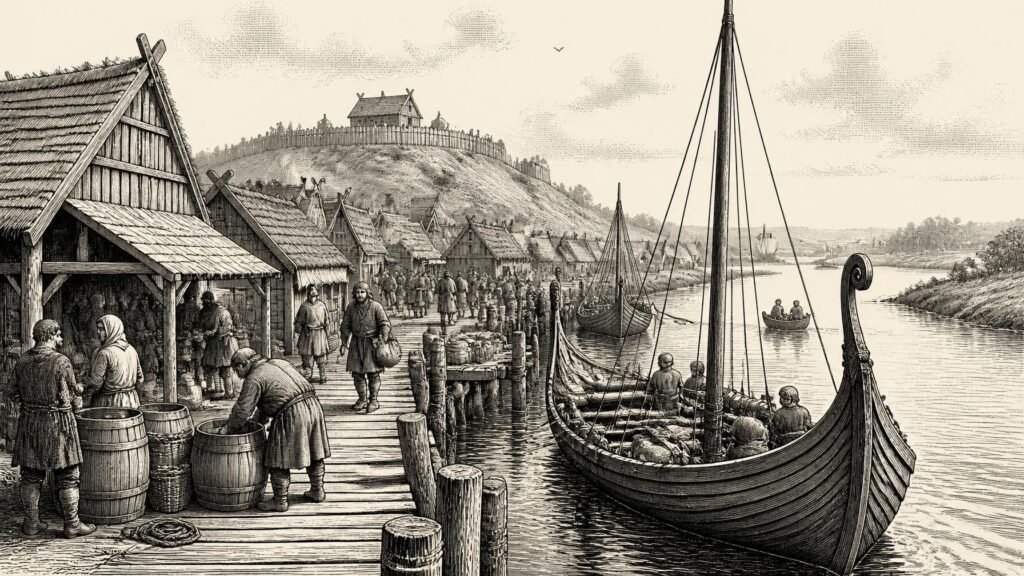
Glún Iairn’s position itself shows why an apparently domestic killing could have wider consequences. He belonged to the dynasty commonly called Uí Ímair, a kindred whose members and rivals held power at different times in Dublin, Waterford, York, Man and the Hebrides. Dublin was a defended port, an exchange point and a source of ships, silver, imported goods and military manpower. Its inhabitants included people of Scandinavian descent, Irish speakers and families formed across both communities. ‘Foreigners’ in Irish annals was therefore a political label as much as an ethnic one. Dublin’s rulers were not strangers standing outside Irish affairs; they were participants in them.
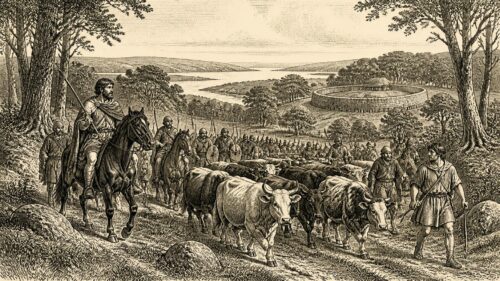
The immediate background was Máel Sechnaill mac Domnaill’s predominance in the midlands. Since his victory over Dublin and the Isles at Tara in 980, the king of Mide had exerted formidable pressure on the Dublin kingdom. A later annalistic account, entered under the corrected year 989, reports that Máel Sechnaill defeated the foreigners at Áth Cliath, besieged their fortress for twenty nights and forced terms: an ounce of gold for every garrda, or enclosed plot, on every Christmas Eve while he remained king. It adds the memorable detail that the besieged drank brine for want of water. The scale and exact terms should not be accepted uncritically from a later compilation, but the account strongly reflects Dublin’s subordination to Máel Sechnaill after Glún Iairn’s death. It also reveals the fiscal value attached to urban plots within the settlement.
For ordinary Dubliners, political transition did not mean that daily work stopped. The town depended on labour in houses, workshops, waterfront spaces and ships; on food brought through its hinterland and by sea; and on trading links across the Irish Sea and beyond. Archaeology from the Viking-age town has recovered successive timber buildings, streets, pits and exceptionally well-preserved organic materials. Those finds make it possible to see a dense working settlement behind the annals’ royal shorthand. But they cannot identify a particular household’s experience in 989, nor can they prove that the twenty-night siege occurred exactly as later described. The strongest conclusion is more modest: the death of its king exposed a commercially important, militarily valuable town to renewed pressure from its powerful midland neighbour.
Fire at Dún Lethglaise
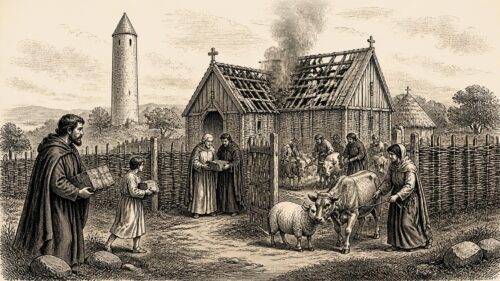
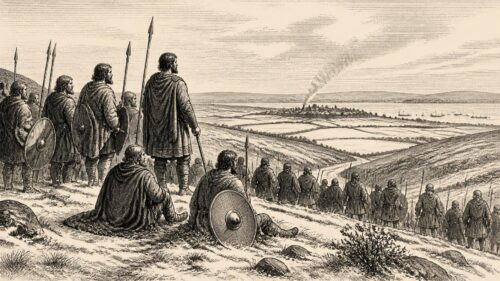
In the north-east, the annals record that Dún Lethglaise was plundered by the foreigners and burned. The place is Downpatrick, a major ecclesiastical centre in Ulaid, associated in later tradition with Patrick and with a long-established church. The annal does not name the raiding force, enumerate casualties or say which buildings burned. It would be wrong to imagine the total destruction of the settlement. Still, the pairing of plunder and burning conveys a serious assault on a wealthy centre whose stores, livestock, metalwork, books and dependent population could all be targets.
This raid should not be made into evidence for an uncomplicated war between Christian Irish and pagan Scandinavians. By 989, Scandinavian communities in Ireland and the Isles had long been woven into local politics, and Christians existed among them. Raiding nevertheless remained a practical means of extracting wealth and demonstrating power. Churches could be especially attractive targets because they concentrated movable riches and food renders, while their political connections made an attack a message to patrons and neighbouring rulers. The burning at Dún Lethglaise belongs to that hard political economy.
Other northern notices underline instability. Eochaid son of Ardgar, king of Ulaid, campaigned into Cenél nEógain and left behind a man called Ua hAitid dead. The terse phrase does not permit a reconstruction of the campaign, but it confirms hostilities between neighbouring northern powers. Echmílid son of Rónán, king of the Airthir, was killed by the descendants of Conall the Craftsman, a people of the Conaille. Meanwhile Mac Léiginn son of Ua Murchudáin, superior of Cúl Rathain, died. The political map was therefore intensely local: kings, churches and kindreds competed across short distances, even as Dublin and the Isles connected Ireland to a much wider seaborne world.
The Irish Sea and the Isles
The killing in Dál Riata of Gofraid son of Aralt, described as king of Inse Gall, or the Isles, was another event with Irish relevance. Dál Riata lay on both sides of the North Channel in earlier centuries, and by the late tenth century the sea between north-east Ireland and western Scotland was a corridor rather than a frontier. Ships carried raiders and armies, but also pilgrims, clerics, commodities and news. A king of the Isles dying in Dál Riata, alongside the fall of Dublin’s king, points to a volatile political environment spanning Ireland, western Scotland and the Hebrides.
That world had recently seen devastating attacks on Iona, the island monastery linked to Colum Cille. The community and cult of Colum Cille retained prestige on both sides of the sea despite such violence. It is against this background that the most consequential ecclesiastical development of 989 becomes clear: authority over Columban as well as Patrician interests could have major political meaning. Church leadership was not simply a spiritual office detached from secular power. It could command land, revenues, learned personnel, relics and the moral force of a saint’s name.
Patrick’s Successor and Colum Cille’s Heir
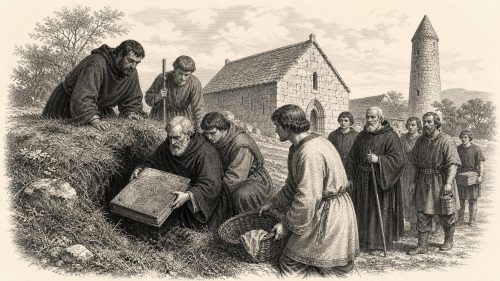
Dúnchad ua Braín, successor of Ciarán, died at Armagh while on pilgrimage, on 19 January according to the annal’s Roman-style date. He is praised as an excellent scribe and a deeply religious man. Such a notice is a rare direct acknowledgement that writing remained a valued specialised skill. Manuscripts, charters, genealogies, liturgical books and annals depended on trained readers and scribes, even though only a small fraction of that intellectual labour now survives.
More politically significant was the death of Dúnchad ua Robocáin, successor of Colum Cille. During the same year Dub dá Leithe, successor of Patrick, ‘took the successorship of Colum Cille by the counsel of the men of Ireland and Scotland’. The phrasing is extraordinary. It does not mean that every church attached to Colum Cille suddenly became Armagh’s property, and it should not be read as a modern bureaucratic merger. Rather, it records the recognition of Dub dá Leithe’s claim to the leadership and associated rights of two pre-eminent saintly federations: Patrick’s centred on Armagh and Colum Cille’s extending through Irish and Scottish communities.
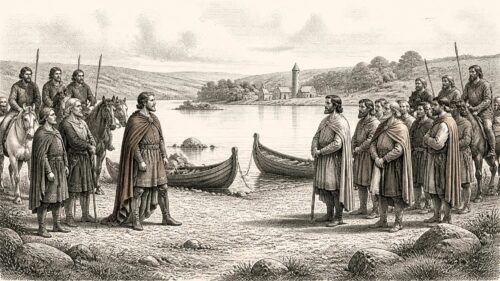
The reference to the counsel of the men of Ireland and Scotland is especially revealing. ‘Scotland’ here means Alba, where Columban churches and the monastery of Iona were central to religious and political networks. Consent from both sides of the sea gave the arrangement legitimacy. Dub dá Leithe had already been active beyond Armagh: an Inisfallen entry for 973 records his visitation of Munster and a dispute over ecclesiastical dues. His enlarged standing in 989 therefore belonged to an established pattern in which church leaders travelled, negotiated claims and relied on kings to enforce settlements.
A Year of Connected Vulnerability
Elsewhere, the Annals of Inisfallen record the deaths of Cétfaid, successor of Ailbe; Colum son of Ciarucán, successor of Barre; Congal son of Anrudán, king of Corcu Duibne; and Dubchrón Ua Longacháin, king of Uí Chuanach. These southern notices do not describe a single crisis. Their importance lies in their reminder that political and ecclesiastical succession was continual, regional and personal. A king’s death could alter a small kingdom; the death of a church superior could reshape control of a community’s lands and learning.
Nothing in the evidence permits a confident account of harvests, weather, population or prices in 989. The annals record no island-wide famine, epidemic or environmental disaster for this year. Nor is there evidence for a nationwide campaign by Brian son of Cennétig, later Brian Boru, in 989 itself. His growing power in Munster and Máel Sechnaill’s command in the midlands form essential context, but the year’s securely recorded drama lies elsewhere: a Dublin king slain within his own household, a northern church-centre burned, an Isles king killed across the sea, and an Armagh leader recognised as successor to both Patrick and Colum Cille.
Thus 989 was not a turning point because Ireland suddenly became united or because Scandinavian influence vanished. It was a year in which the fragility of rule was starkly visible. Kings could be killed by servants or in local conflicts; churches could be raided; authority over revered saints could be painstakingly assembled through counsel across the sea. The Ireland revealed by the annals was divided, connected and intensely competitive—yet bound together by routes of travel, tribute, learning and devotion.
Primary Sources
- The Annals of Ulster: Year U989
- The Annals of Ulster
- Annals of Inisfallen: Annal AI989
- Annals of Inisfallen
- Annals of the Four Masters
- Annals of the Four Masters (Irish text)
- Book of Leinster, formerly Lebar na Núachongbála
- Chronicon Scotorum
- Iona and the Shrine of Columba, c. 800–1200
- The Conversion of the Vikings in Ireland from a Comparative Perspective
- Vikings in Ireland and Scotland
- Dublin: Archaeological Background
- Archaeological Problems and Potential
- Significant Unpublished Irish Excavations 1930–1997
- Unpublished Excavations in the Republic of Ireland 1930–1997
- Archaeological Survey
- Clontarf in the Wider World
- Brian Boru: imperator Scotorum
- What the Sources Say
- Recording the Past: The Annals of Inisfallen and the Making of Irish History