Eclipse Over Kildare885 CE
On 16 June 885, a total solar eclipse, recorded as daylight darkening and stars appearing, provides a secure chronological anchor for conflicting Irish annalistic dates. The year also brought major losses at Kildare: Abbess Tuileflaith, Bishop Scannal and Muiredach son of Bran, king of Leinster and abbot, died, while a secret killing was reported without explanation. Máel Pátraic, king of Airgialla, was slain by associates. Other royal and ecclesiastical deaths affected Brega, Meath, Clonfert and Glasnevin. No campaign or Viking raid is attested. An alleged speaking infant at Craeb Laisre shows annalists preserved marvels alongside wider political and religious change.
Dateline
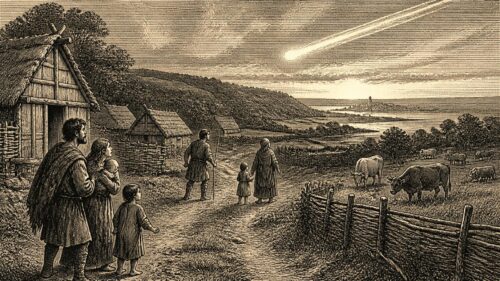
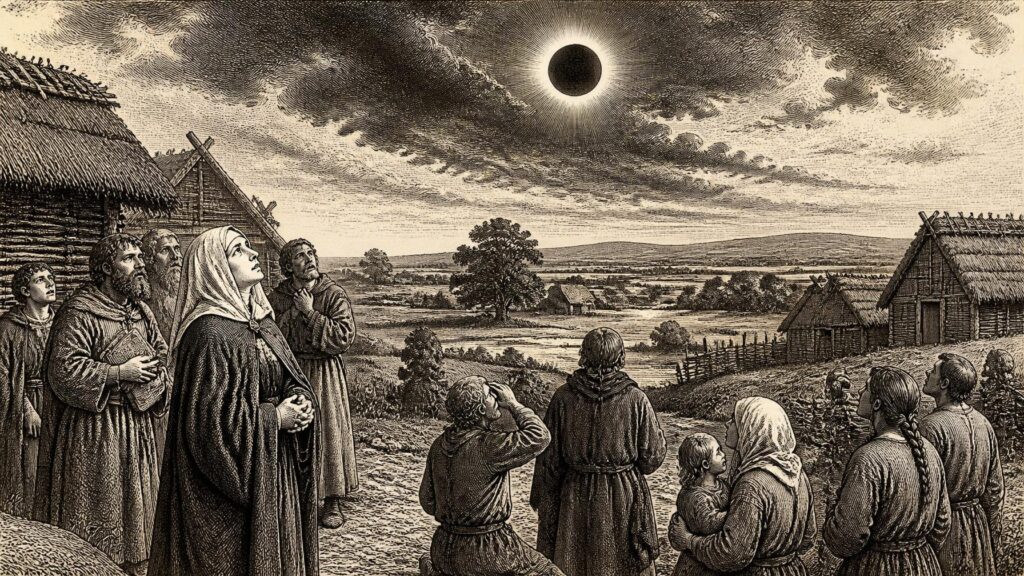
The most securely fixed moment in Ireland’s record for 885 is not a battle or a royal inauguration, but a sudden change in the sky. The annals report that the Sun was eclipsed and that stars became visible in heaven. Modern astronomical calculation identifies a total solar eclipse on 16 June 885. For observers within or near the path of totality, daylight would have fallen away with alarming speed. The wording is concise, yet unusually vivid: it preserves an experience rather than a theory.
That celestial event helps to anchor a difficult annalistic year. The surviving Irish chronicles do not always use calendar years in precisely the modern sense. In particular, the Annals of Ulster place these notices under U885 while retaining an internal AD 884 heading, and the Annals of the Four Masters put parallel notices under 882 but explicitly correct the year to 885. The eclipse, independently datable to 16 June 885, confirms that the cluster of events conventionally assigned to this year belongs here. It also cautions against attaching invented dates, sequences or motives to individual deaths and killings for which the sources provide none.
A Day of Darkness
The annalist’s phrase, “a solar eclipse, and stars were seen in the heavens”, conveys the depth of the phenomenon. The Sun was not merely crescented or clouded: enough of its light was obscured for bright celestial objects to be noticed in daytime. NASA’s eclipse calculations classify 16 June 885 as a total solar eclipse. The exact experience varied with location, weather and distance from the narrow track of totality, but the record strongly suggests that at least one Irish observer saw a striking darkening.
Such an observation belonged to a learned as well as a devotional world. Irish ecclesiastical communities maintained systems of calendrical calculation, above all to determine Easter; the study known as computus brought together the cycles of Sun and Moon, the week, the lunar month and the Christian year. Annalists also regarded unusual heavenly events as things worth preserving for posterity. That does not mean that every observer explained the eclipse in the same way, or that it was universally treated as an omen. What can safely be said is that the eclipse entered a record produced in communities where chronology, liturgy and celestial observation mattered.
The entry is an important reminder that ninth-century Ireland was connected to large intellectual traditions without ceasing to be local. A monastery or church settlement could calculate feasts according to inherited Latin learning, keep vernacular Irish genealogical and political memory, and observe the natural world immediately around it. In 885, the most memorable public event may have been one that crossed every provincial boundary: the temporary disappearance of the familiar daytime sky.
Kildare’s Concentrated Losses
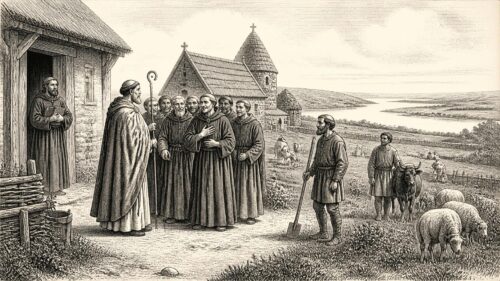
The year was also exceptionally consequential for Cell Dara, now Kildare, one of Ireland’s foremost ecclesiastical settlements. Its notices fill the annal. Tuileflaith, abbess of Kildare, died; the Annals of the Four Masters preserve the additional detail that her death fell on 10 January. Scannal, bishop of Kildare, also died. Later in the same annalistic year came the death of Muiredach son of Bran, described as both king of Leinster and superior, or abbot, of Kildare.
These titles show why Kildare’s losses mattered far beyond one religious household. Early medieval Irish churches were centres of worship, burial, learning, hospitality, landholding and political negotiation. Their leading offices could be held by members of powerful secular kindreds, while abbesses, bishops and abbots performed different roles within an institution whose authority was founded on the cult of Brigit. Muiredach’s combined designation is therefore not an accidental flourish: it records the close entanglement of Leinster kingship and Kildare’s leadership.
Muiredach had emerged as a prominent Leinster ruler in the preceding years. The Annals of Ulster record him leading the army of Leinster on a destructive expedition northwards in 875. By the time of his death notice, however, the annalist could simply call him “king of Laigin”. His death removed a ruler whose political standing and ecclesiastical office reinforced one another. A later poetic notice, preserved by the Four Masters, praised him as a king of all Leinster “to the sea of ships”; this is commemorative verse rather than a neutral map of effective rule, but it demonstrates the scale of reputation attached to him.
The annals do not state that Kildare’s three senior deaths occurred on one day, nor do they name their immediate successors. Nor do they explain a “secret murder” reported at Kildare later in the same year. It would be tempting to turn that terse notice into a story of succession violence, but the evidence does not permit it. The killing may have been related to institutional politics, or may have had an entirely different setting. Its very inclusion nevertheless suggests that violence inside, or connected with, one of Ireland’s pre-eminent churches was considered significant enough to record.
Deaths, Allegiance and Local Rule
Elsewhere, 885 brought a sharp political killing. Máel Pátraic son of Máel Cuararda, king of the Airgialla, was slain by his own associates. Airgialla was a network of peoples and dynasties centred broadly in the north-east and Midlands borderlands, rather than a unitary kingdom in the modern territorial sense. The formula “by his associates” is revealing but frustrating. It identifies insiders, not an invading army, as the agents of his death. No motive, site or named successor is supplied. Still, the notice illustrates the personal and negotiated character of lordship: a king’s position depended on relationships within his own following as much as on defence against external enemies.
Several further royal deaths underline the local scale of authority. Domnall son of Cinaed, king of Cenél Laegaire in Brega, died “in clerical life”, having apparently withdrawn into a religious vocation. Máel Dúin son of Aengus, king of Caille Follamain, also died. These were not kings of all Ireland, but rulers of important regional populations and territories. Their notices reveal a political landscape made up of many overlapping kingships, lordships and church jurisdictions. They also show that the boundary between lay and ecclesiastical careers could be crossed: Domnall’s retirement did not erase his royal identity from the annal.
No major campaign, treaty or foreign raid is recorded for Ireland in the surviving entries assigned to this calendar year. That silence deserves respect. Viking activity remained an important condition of late ninth-century Irish politics and coastal life, and the chronicles record attacks on Irish churches both shortly before and shortly after 885. But there is no responsible basis for claiming a Viking assault, a battle with Scandinavians, or a diplomatic settlement in 885 itself. The year’s surviving Irish record is instead dominated by death, succession and the management of powerful religious centres.
Churches Across the Island
Other obituaries map an ecclesiastical Ireland extending well beyond Kildare. Cormac, superior of Clonard and bishop of Duleek, died after a prolonged illness. The pairing of Clonard in the Boyne valley and Duleek in east Meath points to clerics moving within networks of associated churches and offices. Clonard’s reputation as a centre of learning was rooted in its association with Finnian, and its ninth-century superior remained an important figure even after decades in which the settlement had suffered disruption and raiding.
Mugrón son of Cenn Fáelad, superior of Clonfert, died in the west. Máel Tuile son of Fechtnach, superior of Glas Noíden, generally identified with Glasnevin, also died. Such entries are not merely clerical bookkeeping. They mark changes in the leadership of communities which held property, directed dependants and tenants, received travellers, sponsored worship and retained books, genealogies and local memory. The annals give no figures for crops, rents, craftsmen or trade in 885, and none should be invented. Yet the number and geographical spread of these notices reveal a densely institutional society in which church settlements were among the principal organisers of daily life.
The language of death is itself varied. Some people “rest” or “fall asleep”, conventional Christian expressions of peaceful death; Cormac’s illness is specifically noted; Máel Pátraic was killed. These distinctions reflect both the religious idiom of the annals and the importance attached to manner of death. Peaceful passing, clerical retirement, sudden murder and political assassination belonged to very different moral and social categories.
An Extraordinary Child
One final notice interrupts this catalogue of eclipse, death and violence. At Craeb Laisre, an unnamed child was said to have spoken two months after birth, “which had not been heard of from ancient times”. The claim cannot be treated as ordinary reportage or evidence for infant development. It is, rather, evidence that a story judged marvellous was circulating strongly enough to enter an annalistic chronicle. Medieval annals did not restrict themselves to kings and abbots: unusual natural phenomena, wonders and portents could also be historical matter.
Craeb Laisre cannot be located with confidence from this entry alone, and the annalist offers no explanation of what the child supposedly said or why the report mattered. Its survival is valuable precisely because it preserves the limits of our knowledge. In 885, as in other years, Irish communities interpreted extraordinary occurrences through inherited religious and historical frameworks. The eclipse above them was real and datable; the speaking child belongs to the realm of reported wonder. Both were considered worth writing down.
Thus 885 appears not as a year of one decisive battle but as a moment of transition. In Kildare, the deaths of an abbess, a bishop and a king-abbot exposed the importance and vulnerability of a major church. In Airgialla, a king was killed by men of his own circle. Across Leinster, Brega, Meath and the west, royal and ecclesiastical offices changed hands. And on 16 June, the darkened Sun gave Irish annalists an event against which the year can still be firmly measured.
Primary Sources
- The Annals of Ulster, U885
- Chronicon Scotorum, Annals CS883–CS887
- Annals of the Four Masters, M882 recte 885
- Annals of Inisfallen, I874–I886
- Besselian Elements: Total Solar Eclipse of 885 June 16
- NASA Five Millennium Catalog of Solar Eclipses
- An Evaluation of Astronomical Observations in the Irish Annals
- A Short History of Ireland’s Long Fascination with Eclipses
- The Annals of Ulster
- Chronicon Scotorum
- Annals of Inisfallen
- Annals of the Four Masters
- Fragmentary Annals of Ireland
- Vikings in Irish Chronicles, 794–902: Data
- Chronological Synchronisation of the Irish Annals
- On Reconstructing Medieval Irish Chronicles
- Kildare: Irish Historic Towns Atlas Text
- County Kildare Urban Archaeology Survey
- Feast Days of Early Medieval Irish Female Saints
- An Irish Eclipse Prediction of AD 754: The Earliest in the Latin West
- Viking Ireland: Afterthoughts
- Muiredach’s Leinster Expedition, Annals of Ulster U875