Druim Róbaig’s Connacht Battle758 CE
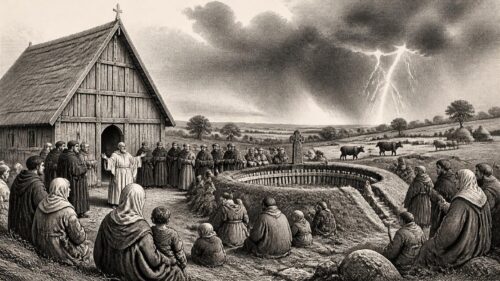
In 758, Irish annals record regional political and ecclesiastical transitions rather than an island-wide crisis. At Druim Róbaig in Connacht, Uí Briúin defeated Uí Fhiachrach; Ailill grandson of Dúnchad prevailed, while Tadc son of Muirdibur and three grandsons of Cellach were killed. Deaths included Niallgus, king of the Déisi of Brega, Cathal of Uí Chennselaig, and Aed of the Ciannachta. Céile Petair, abbot of Armagh, and Marthu, abbess of Kildare, also died. These notices reveal Ireland’s regional lordships, kin-based succession and influential churches, while their selectivity precludes claims about nationwide conditions, causes, or outcomes beyond the sparse surviving evidence available.
Dateline
The Irish annals preserve 758 less as a year of one island-wide crisis than as a sharp sequence of deaths, a battle in Connacht and changes at influential churches. Their brevity is itself revealing. Early medieval Ireland had no central government archive in the modern sense: records were kept and later copied within ecclesiastical and learned milieus, and the events most likely to survive were the deaths of rulers and church superiors, a violent encounter important to a dynasty, or an occurrence thought worthy of commemoration. The entry headed 758 in the Annals of Ulster is therefore a valuable but highly selective view of the year. It should not be made to say more than it does.
Chronology requires care. Different Irish annal compilations sometimes place related material under different year-numbers, and the seventeenth-century Annals of the Four Masters, for example, distributes several events associated with this dossier differently. The Annals of Ulster nevertheless provides the clearest concentrated notice for 758. It records the deaths of secular figures in Brega, Leinster and the Ciannachta, the deaths of major churchmen and women, and a battle between rival Connacht dynasties. It does not record a harvest failure, epidemic, foreign raid or general war in Ireland for this year; claims about any such event would exceed the evidence.
Battle at Druim Róbaig
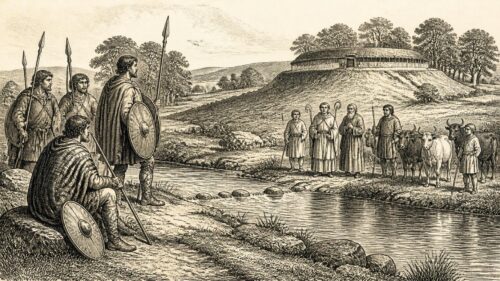
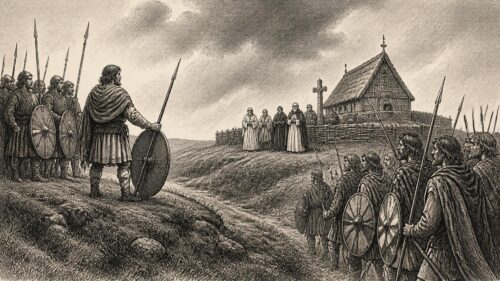
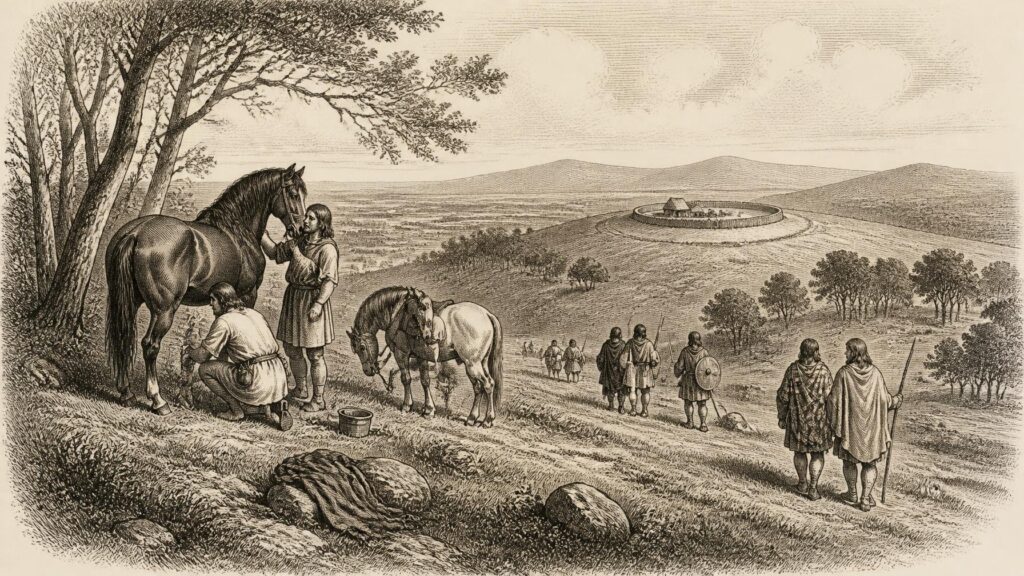
The year’s explicit conflict was the battle of Druim Róbaig, fought between the Uí Fhiachrach and the Uí Briúin. The annal names the dead on one side as Tadc son of Muirdibur and three grandsons of Cellach: Cathrannach, Cathmug and Artbran. Ailill, grandson of Dúnchad, was victor. This is a terse casualty record rather than a narrative of manoeuvre, and neither the precise location of Druim Róbaig nor the immediate cause is securely explained in the entry. It would be unsafe to portray it as a battle for all Connacht, let alone all Ireland.
Even so, the dynastic names show why the encounter mattered. Uí Briúin and Uí Fhiachrach were two major Connacht groupings, each claiming descent from branches of the wider Connachta ancestry. Their competition had long shaped the province’s political life. Uí Briúin Aí interests were particularly associated with Mag Aí, the fertile plain across parts of present-day north Roscommon and north-east Galway; Uí Fhiachrach lineages had their own powerful regional bases, especially in the west and south of Connacht. Kingship was not a fixed office moving automatically from father to eldest son. Rival eligible kin, their clients and allies could all make claims, and a local clash could affect the balance among much larger kindreds.
The named victims also point to the human scale of such politics. The three grandsons of Cellach were not anonymous fighters: their genealogy marked them as men whose deaths had consequences for inheritance, alliances and the standing of their descendants. Their grandfather Cellach had been an Uí Briúin Aí overking of Connacht in the early eighth century, while later Connacht politics remained contested among Uí Briúin branches and their older rivals. Druim Róbaig should therefore be understood as a documented episode in a continuing, multi-centred struggle for authority, not as proof that either dynasty had permanently mastered the province.
Deaths Across Political Ireland
The annal opens with an unusually crowded obituary list. Niallgus son of Báeth, king of the Déisi of Brega, died; so did Cathal, king of Uí Chennselaig, a major Leinster dynasty. Aed son of Cormac, described as one of two kings of the Ciannachta, also died. The language is significant. Ireland was made up of many overlapping kingdoms and peoples, rather than a single unitary realm administered from one capital. The death of a local king could alter the prospects of brothers, cousins and competing branches immediately, even when it attracted no surviving account of a succession dispute.
Brega, the rich central region north of the Liffey and Boyne, lay close to the political heartlands of the Southern Uí Néill. The Déisi there were a distinct people within that contested landscape. Uí Chennselaig, by contrast, were rooted in south-eastern Leinster and would later become one of the island’s most durable royal dynasties. The Ciannachta comprised several related groups, including communities around the Boyne and elsewhere in the north-east. That one annal entry notices figures from these different regions demonstrates the reach of ecclesiastical record-keeping and learned networks; it does not demonstrate that they were acting together in 758.
Other names in the same notice resist easy modern classification. Domnall son of Flann of the Derg, Eilpín of Glas Naide, and Fidbadach of Cell Deilge are recorded simply as having died. The annalist considered them worth naming, but does not always specify their office or status. This restraint matters. It is tempting to turn every named death into a major political transition, yet the source permits only a more modest conclusion: their standing, whether local, ecclesiastical or dynastic, was sufficient to enter the historical record.
Armagh and Kildare
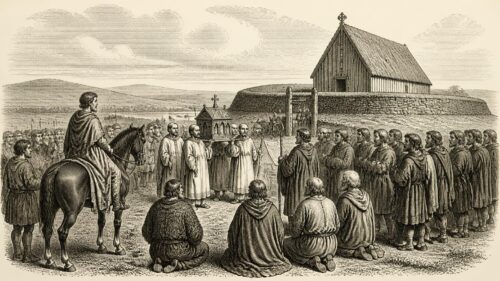
Two deaths especially illuminate the importance of churches as institutions of authority. Céile Petair of Crích Bresail, abbot of Armagh, died in 758. Armagh’s leading office was bound to the cult and inheritance of Patrick, and its superior was more than the head of a devotional community. The office joined religious prestige, claims over church property and dependants, learned activity, and relationships with powerful lay families. Céile Petair’s byname, identifying him with Crích Bresail, reminds us that even the foremost churches were embedded in local kin and territory. His death meant a vacancy at one of Ireland’s most consequential ecclesiastical centres, although the annal does not state how the succession was settled.
The same year saw the death of Marthu daughter of Mac Dubáin, abbess of Cell Dara, modern Kildare. Her commemoration is important evidence for the recognised leadership of women in early Irish Christianity. An abbess could preside over a substantial religious community and its estates, patrons, tenants and dependants. Yet Marthu should not be treated as a symbolic exception or assigned achievements which no source attributes to her. What can be firmly said is that the annalist named her parentage and office, treating the abbacy of Kildare as an office whose holder mattered beyond the immediate community.
Further ecclesiastical deaths extended the year’s record through a map of well-connected centres: Muiredach son of Cormac, abbot of Lugmad or Louth; Fidbadach of Cell Deilge, usually identified with Kildalkey; and men associated with Glas Naide, probably Glasnevin. The annals also record the deaths of leading churchmen at Clonard, Rahan, Ferns, Linn Dúachaill and Finglas under a different chronological arrangement. Such notices do not prove that all these establishments were uniform “monasteries”. Archaeology and recent scholarship instead stress a varied ecclesiastical landscape: large landed communities, smaller churches, pastoral centres and religious households could share features while fulfilling different roles.
Work, Land and Learning
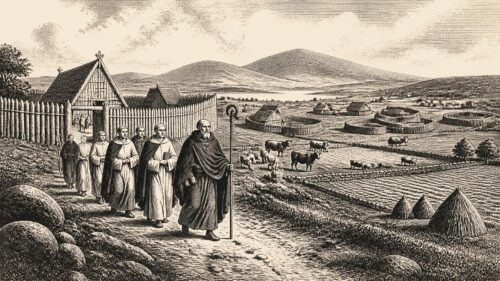
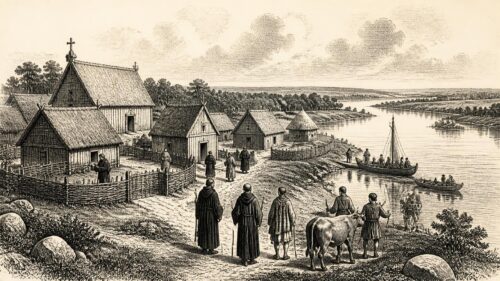
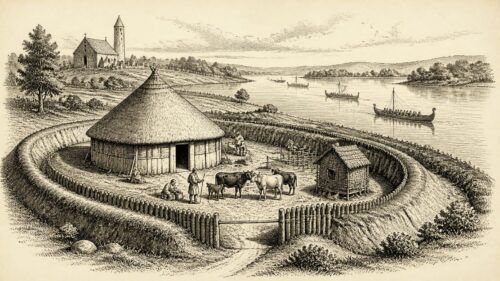
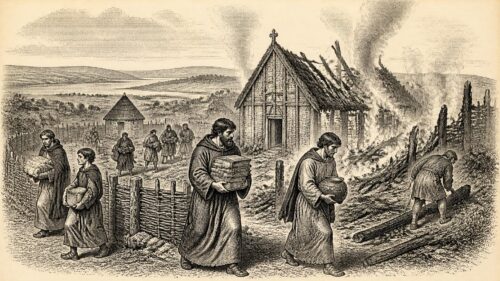
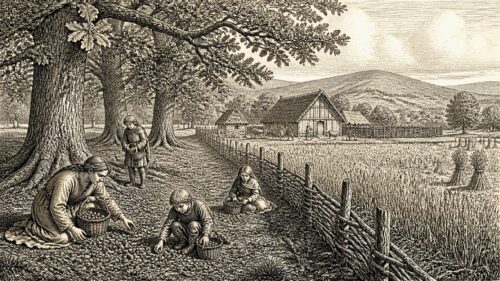
The succession of obits offers a glimpse of how deeply ecclesiastical institutions were interwoven with ordinary life. Churches were places of worship and burial, but also households requiring food, labour, buildings, livestock, books and craft skills. Their estates connected clerics and religious women to cultivators, tenants, artisans and travelling guests. Evidence from early medieval settlement archaeology supports a picture of mixed farming, cereal processing and cattle-centred production, while research on church sites shows that ecclesiastical communities varied greatly in scale and economic reach. This is the appropriate context for 758, not a claim that a particular harvest or market can be reconstructed for that specific year.
Learning also lay behind the record itself. The precise naming of genealogies, offices and churches reflects a culture in which memory, lineage and literacy reinforced authority. Annals were copied, arranged and interpreted over generations; they are not neutral transcripts from a single observer. Comparison between the Annals of Ulster, the Annals of Tigernach, Chronicon Scotorum and later compilations is therefore essential. Their agreements can preserve early material, but their differing year placements warn against forcing a false precision onto every entry.
A Year of Transitions
For Ireland, 758 is best seen as a year of transitions rather than a moment of national transformation. At Druim Róbaig, a Connacht conflict left named members of one kin-group dead and Ailill grandson of Dúnchad victorious. In Brega, Leinster and Ciannachta territory, the deaths of rulers opened unrecorded questions of succession. At Armagh and Kildare, the deaths of Céile Petair and Abbess Marthu created vacancies in institutions whose religious authority rested alongside landholding, patronage and political influence.
The surviving evidence gives no warrant for dramatic claims about the weather, trade, diplomacy or the experience of every household in 758. Its strength lies elsewhere: it preserves a cross-section of an Ireland governed through regional lordships, kin networks and powerful churches. The battle and obituaries show that political and religious change often arrived not through a single proclamation, but through deaths, contested inheritances and the quiet replacement of people at the centres of local power.
Primary Sources
- The Annals of Ulster: Year U758
- The Annals of Ulster
- Annals of the Four Masters: Annals M757–M765
- Annals of the Four Masters
- The Annals of Tigernach: Annals T748–T756
- Annals of Tigernach
- Chronicon Scotorum
- Annals of Inisfallen
- Chronological Synchronisation of the Irish Annals
- Domnall Midi
- Niall Frossach
- Donnchad Midi
- Sléibíne
- Cellach
- Muirgius
- Niall Noígiallach (‘of the nine hostages’)
- Reiclés in the Irish Annals to AD 1200
- How did early church sites differ from one another? A comparative approach within the kingdom of Fir Maige, Ireland
- Monasticism and its limits: rematerialising monastic space in early medieval Ireland
- Technological Change in the Agrarian Economy of Early Medieval Ireland: New Archaeological Evidence for the Introduction of the Coulter Plough
- Animals and the Economy of Medieval Ireland: a Zooarchaeological Analysis of the Faunal Remains from Caherconnell Cashel, Co. Clare
- Theme and Variations: Christianity and Regional Landscapes in Early Medieval Ireland
- The Corpus of Early Medieval Architecture of Ireland
- Exploring the Irish Annals