Bangor’s Patrick’s Day Fire756 CE
Dateline
For Ireland in 756, the annals offer no single, all-embracing story. Instead, they preserve a sharp cluster of incidents: the burning of the great church settlement of Bangor on St Patrick’s Day; a military expedition which brought Leinster forces into Mag Muirthemne; the death of a Connacht overking; fighting in the midlands and Connacht; and a catastrophic wreck on Lough Ree. Read together, these terse notices reveal an island in which kingship, ecclesiastical authority and movement by water were all deeply consequential. They also demand care. Medieval annals did not record every event, and they often give outcomes without causes. In particular, the chronological systems of surviving compilations do not align perfectly: the Annals of Tigernach place these notices under 756, while the modern edition of the Annals of Ulster marks its heading U756 as corresponding to AD 755. Modern historical reference works nevertheless connect Domnall’s expedition with 756. The year is therefore best approached with that dating caution clearly in view.
A Fire on Patrick’s Feast
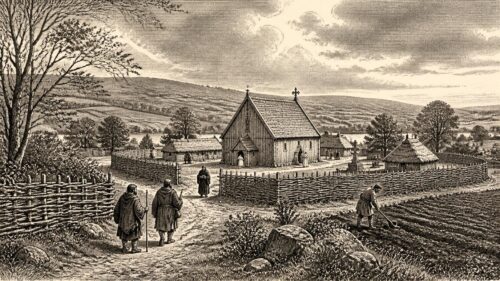
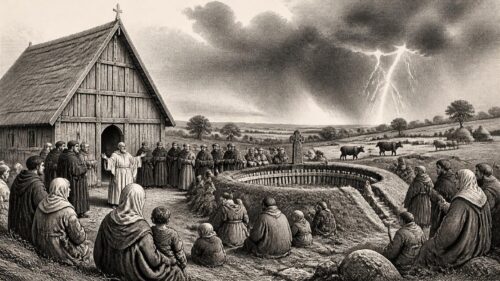
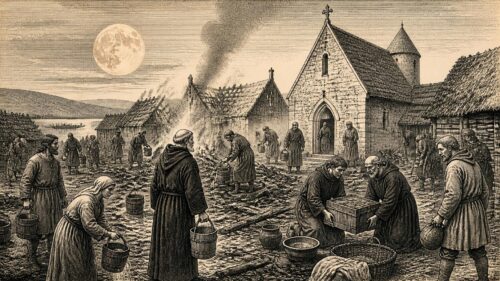
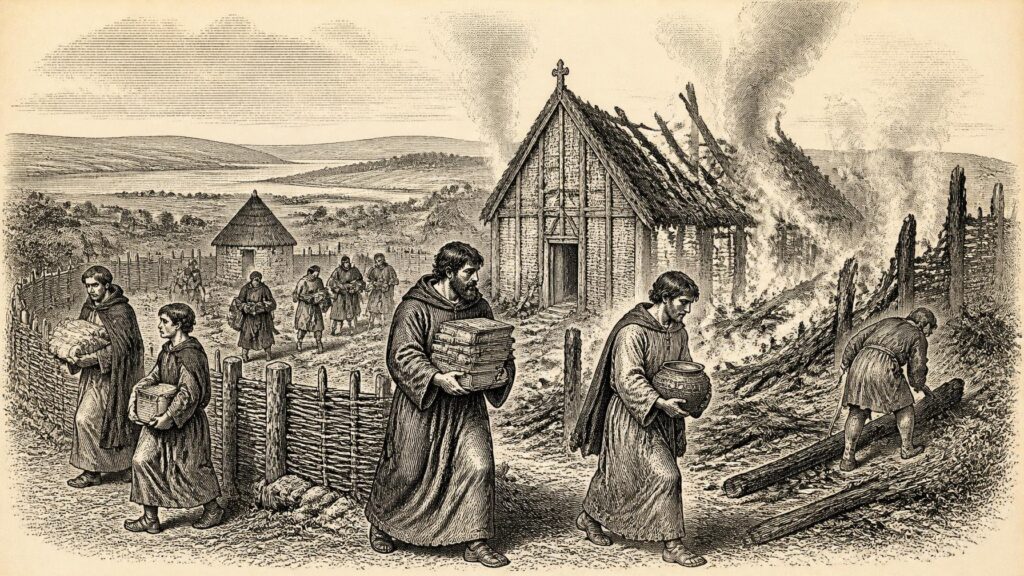
The most precisely dated Irish event is the burning of Bennchor Mór, ‘Bangor the Great’, on the feast of Patrick, 17 March. The notice is stark: it says that Bangor burned, but neither identifies the people responsible nor tells whether the fire was accidental, deliberate or spread from surrounding buildings. No responsible account can supply those missing details. Yet the choice to record it shows Bangor’s standing. A fire at a prominent ecclesiastical centre was not merely local misfortune. It endangered a community’s dwellings, church furnishings, food stores, books or documents, livestock and the accumulated resources on which clergy, dependants and visitors relied.
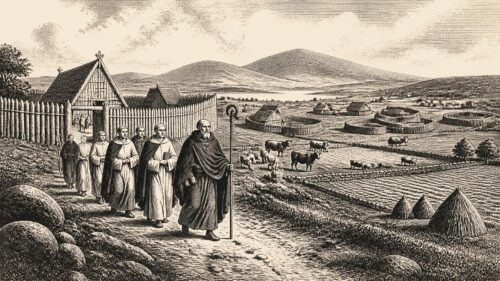
Bangor, in present-day County Down, belonged to the dense network of Irish churches and monastic communities that connected religious life to landholding, learning, hospitality and political patronage. Such places were neither isolated retreats nor institutions wholly separate from secular society. Their leaders could possess influence, their estates required labour, and their churches preserved objects and texts of great practical and symbolic value. The annal does not say what was lost in the blaze; neither should we imagine a complete destruction. It records a burning, not the extinction of the community. Bangor remained an important ecclesiastical site afterwards. Still, the fire on Patrick’s own feast day must have carried a special charge: the calendrical association made a calamity at a major Irish church all the more memorable to those who recorded it.
Domnall’s Northern Demonstration
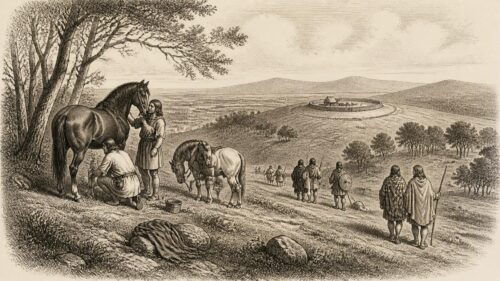
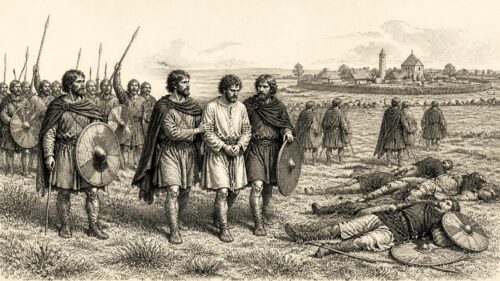
The principal political notice states that an army of the Laigin, the people of Leinster, went with Domnall against Niall and reached Mag Muirthemne. The brief wording does not explicitly supply surnames, offices, a battle or a settlement. Historians identify the opponents as Domnall Midi of Clann Cholmáin, dominant among the southern Uí Néill and ruler at Tara, and Niall Frossach of Cenél nÉogain, a leading northern Uí Néill dynast. Mag Muirthemne lay in the region of modern County Louth, between the northern and southern political worlds. Its selection was significant: it was not a remote edge of the island, but a strategically exposed zone close to routes linking Brega, Leinster, Ulster and the Irish Sea coast.
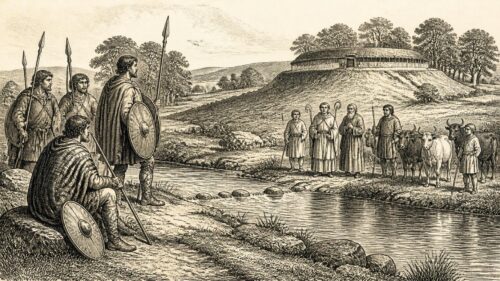
What happened there is less certain than the march itself. The annals say that Domnall’s force reached the plain; they do not record a battle, captives, tribute, hostages or a decisive submission. The expedition should therefore be understood as a show of armed capacity, perhaps an attempted intervention or challenge, rather than automatically as a victory. Its importance lies partly in the coalition it displays. Domnall could bring Leinster troops northwards, evidence of a workable relationship between Clann Cholmáin and Leinster’s ruling interests. That was politically valuable. A king of Tara did not command a uniform national army: power depended on negotiated alliances, kinship, clientship and the willingness of regional rulers to join a hosting.
The campaign also exposes the unsettled balance within the Uí Néill. Domnall had defeated and killed Áed Allán, Niall’s half-brother, in 743. Niall had thereafter emerged as a central figure in Cenél nÉogain. In 756 he was strong enough to be named as the object of Domnall’s expedition, but the silence about a pitched engagement suggests that neither side won a publicly memorable decision at Mag Muirthemne. Domnall retained his position until his death in 763; Niall later gained the kingship of Tara. The later outcome must not be projected backwards, however. In 756, the annal preserves an encounter within an ongoing contest, not a completed transfer of supremacy.
Connacht’s Uncertain Moment
The same annal-year records the death of Forggus, or Fergus, son of Cellach, called king of Connacht. He belonged to the Uí Briúin, one of Connacht’s most powerful dynastic groupings, and his death removed a ruler whose family had supplied earlier overkings. The entry gives no manner of death and does not name a successor. It should not be turned into a story of assassination or battlefield loss merely because 756 also contained warfare elsewhere. Medieval Irish kingship was regional and competitive; the title ‘king of Connacht’ represented pre-eminence among powerful kindreds rather than control exercised evenly over every community in the province.
Two further conflict notices show that rivalry was not confined to the northern frontier. The Annals of Tigernach report a battle at Belach Cró involving Crimthann and the Delbna of Uí Maine. Finn son of Ailb, king of the Delbna, was killed by Tipraite Finn, and the Delbna suffered a slaughter. The annal even explains local names, associating Lochán Belach Cró and Tipra Finn with the encounter. Such etymological explanations may preserve later commemorative tradition as well as historical memory; the secure point is that the annalist remembered a violent defeat and the death of a local king.
Another battle, at Gronne Magna or Móin Mór, ended with the overthrow of Cenél Cairpri. The name is glossed as ‘the great bog’, a reminder that terrain mattered in a country crossed by wetlands, lakes and river corridors. The annal does not name the victors, locate the battlefield beyond its name, or explicitly connect the fight to Forggus’s death. Any claim that all three Connacht-related notices were stages of one campaign would go beyond the evidence. What they do establish is a year in which the political landscape of Connacht and its borderlands was unsettled at several levels, from provincial overkingship to the fortunes of smaller peoples.
Disaster on Lough Ree
Perhaps the most arresting notice concerns the Delbna on Lough Ree. Both major annalistic traditions record their shipwreck and name their leader, Díumasach. The fuller reading preserved in the Annals of Ulster says that thirty boats were involved and that only the occupants of one boat escaped. That numerical detail appears as an addition in one manuscript witness, so it deserves to be reported with qualification; nevertheless, it conveys the scale in which later transmission understood the catastrophe.
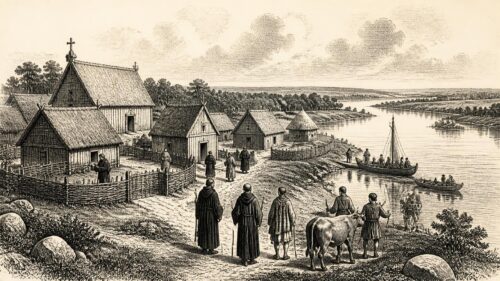
The loss matters because inland water was an artery of early medieval life. Lough Ree and the Shannon connected communities in the midlands and west, facilitating travel, exchange, communication and the movement of armed groups. A flotilla of this size was not necessarily a royal fleet or an invading force: the annals give no purpose for the journey. It may have carried a local people on business, military service, a political assembly or a seasonal movement. What can be said is that boats were numerous enough, and their passengers important enough, for the loss to enter the historical record. The wreck also corrects any impression that water routes were effortless highways. Weather, waves, loading, navigation and the limitations of small craft could turn routine mobility into sudden collective death.
The disaster had likely consequences beyond those drowned. A leader was lost, and surviving households may have faced bereavement, disrupted obligations and reduced capacity for travel or conflict. Yet the annals do not describe these effects. Their restraint is instructive. Annalists generally recorded the death of rulers, clerics and recognised leaders more readily than the experience of ordinary families. The silence around the people in the other boats is not evidence that they mattered less to their own communities; it is evidence of the social priorities of the surviving record.
Churchmen and the Record of Society
Several ecclesiastical deaths were entered alongside those of kings and armies. Ailgal, an anchorite of Cluain Chormaic, died; so did Forannán, bishop of Methus Truim, and Báethgalach, abbot of Áth Truim, modern Trim. Tigernach additionally names Cormac son of Faelán, grandson of Silne. The entries illustrate the wide range of religious roles recognised in eighth-century Ireland. An anchorite represented an ideal of penitential withdrawal, while bishop and abbot held offices embedded in communities with land, tenants, dependants and connections to secular patrons. The record does not tell us how these men lived or whether their deaths were related, but their inclusion beside rulers confirms that ecclesiastical personnel belonged to the political and social landscape, not outside it.
For most inhabitants, 756 is harder to see. Farmers tending cattle and crops, craftspeople, boat crews, dependants of churches, women within dynastic households and children appear only indirectly. Their world can be glimpsed through the events that reached the annals: a major church could burn; a hosting required food, roads, boats and followers; bogland could become a battlefield; a lake crossing could kill many at once. These were not isolated dramas performed by kings alone. They rested on the labour, resources and risks of wider communities.
Thus 756 was not defined by one national crisis, and Ireland was not a unified kingdom moving to a single rhythm. Bangor’s fire, Domnall’s advance to Mag Muirthemne, Forggus’s death, the fighting at Belach Cró and Móin Mór, and the Lough Ree wreck belong to different regions and scales of experience. Together they show a politically connected but fragmented island: one in which major churches were vulnerable, alliances could carry armies across provincial boundaries, local kingship remained precarious, and waterways bound communities together even as they exposed them to disaster.
Primary Sources
- The Annals of Ulster: U756
- CELT Project: The Annals of Ulster
- The Annals of Tigernach, Part 14: T756
- The Annals of Tigernach, original-language edition: T756
- CELT Project: The Annals of Tigernach
- Chronicon Scotorum: CELT project record
- Chronicon Scotorum: Navigator
- Annals of the Four Masters, Part 58: M756
- Annals of the Four Masters, original-language edition: M756
- Domnall Midi
- Niall Frossach
- Cellach
- Áed Allán
- The Annals in Cotton MS. Titus A. XXV
- Fragmentary Annals of Ireland
- Lebor na Cert
- Final Report: Waterways Study, Lanesborough to Shannonbridge
- Clonmacnoise, County Offaly
- Archaeological Survey
- Monasterboice, County Louth
- Rathbeagh Ringfort, County Kilkenny
- Ireland’s Maritime Archaeology