Birr’s Law of Innocents697 CE
In 697, Adomnán of Iona promulgated the Cáin Adomnáin, or Law of Innocents, at the Synod of Birr. The law sought to restrain warfare by protecting women, children, clerics, churches and other non-combatants from killing, injury, sexual violence and seizure. It relied on compensation, religious penalties and the guarantees of rulers and churchmen, including figures from Ireland, Dál Riata, Pictland and Northumbria. Although Ireland remained politically divided and conflict continued, the law represented a major effort to impose moral and legal limits on violence. Its later renewal suggests that enforcement required continuing support.
Dateline
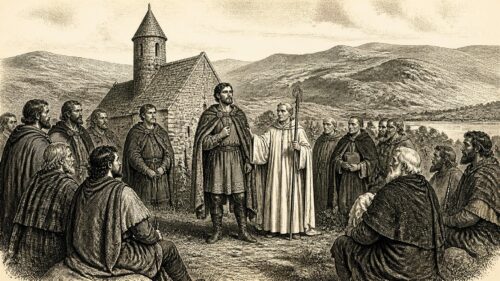
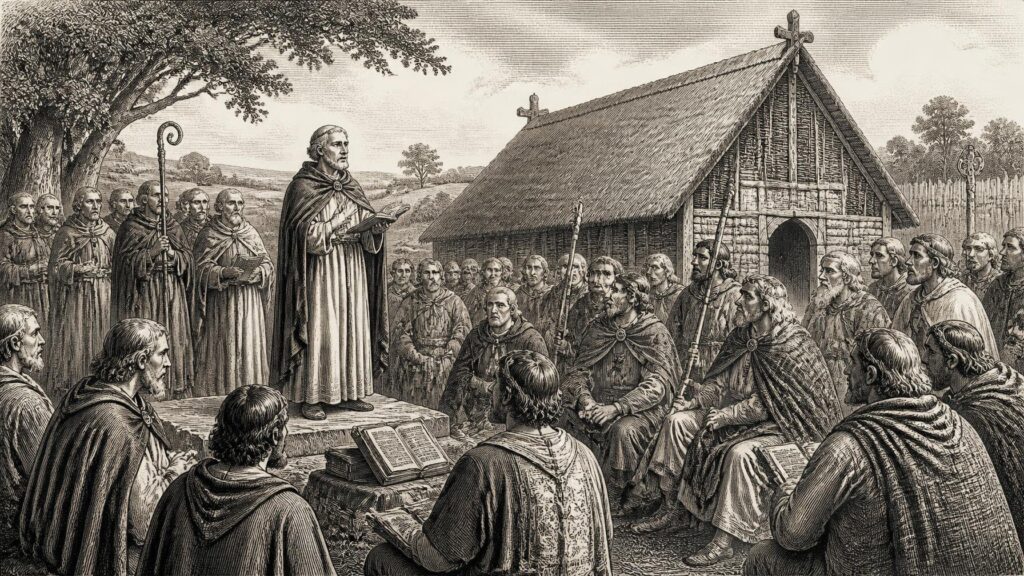
In 697 CE, the most consequential Irish development securely associated with the year was Adomnán of Iona’s promulgation of the Cáin Adomnáin, the ‘Law of Adomnán’, at Birr in what is now County Offaly. The Irish annals record tersely that Adomnán came to Ireland and gave the Lex Innocentium, or Law of Innocents, to the people. Behind that spare notice lies an unusually ambitious attempt to regulate the conduct of war across a politically divided island and, in principle, across the Irish Sea.
A Year with a Chronological Caveat
Early Irish annals do not always align neatly with modern calendar dating. The relevant entry appears as U697 in the Annals of Ulster, although the chronological heading in that manuscript tradition can appear one year earlier in modern printed reckoning. Other annalistic traditions, however, place Adomnán’s law in 697, and modern scholarship conventionally identifies the Synod of Birr with 697 CE. It is therefore responsible to treat the law as the central event of this calendar year, while avoiding invented dates for the assembly’s opening, duration or individual proceedings.
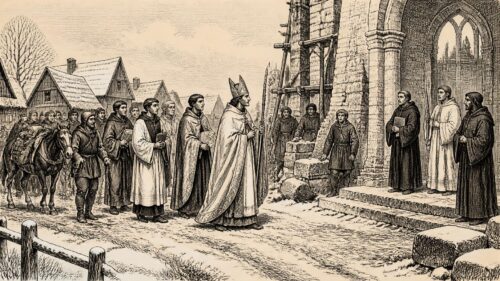
Birr was a fitting setting for such an initiative. It was an important ecclesiastical settlement in the Irish midlands, located near routes which connected the northern and southern halves of the island. A major church was not merely a place of worship. It could provide hospitality, literacy, legal expertise, stored resources, ritual authority and a relatively protected meeting-place for kings, clerics and their entourages. The gathering remembered as the Synod of Birr was thus both a religious assembly and a high-level political occasion.
Adomnán’s Ambition
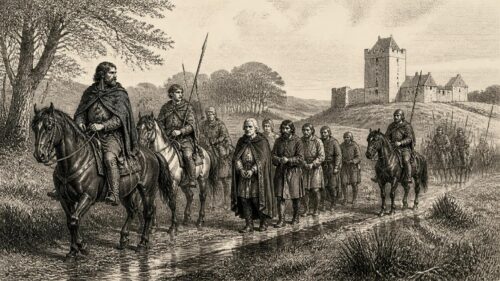
Adomnán, abbot of Iona from 679 until his death in 704, was exceptionally well placed to convene support. He belonged to Cenél Conaill, a leading branch of the northern Uí Néill, and was successor to Colum Cille at Iona, whose religious federation linked communities in Ireland and western Britain. He was also an author, scholar and diplomat. A decade earlier, the annals credit him with returning sixty former captives to Ireland after a mission in Northumbria. That experience cannot prove the immediate cause of the Birr legislation, but it makes the law’s concern with the victims of conflict especially intelligible.
The law’s Latin name, Lex Innocentium, is revealing. It did not seek to abolish warfare, raiding, lordship or the taking of military action. Such an aim would have been implausible in a landscape of numerous kingdoms and recurrent local conflict. Instead, it asserted that some people and places should receive a special measure of protection. The surviving text is not a verbatim official minute of Birr: it is a composite transmission preserved in later manuscripts, and its elaborate narrative preface contains material shaped after Adomnán’s lifetime. Nevertheless, the core enactment and, especially, its contemporary guarantor-list are widely accepted as authentic evidence for the law of 697.
Protection in a Violent World
The Cáin is often described as protecting women, children and clerics. That useful shorthand needs care. Its provisions were principally concerned with women, churchmen, youths and other non-combatants, as well as the immunity of churches, ecclesiastical personnel and property. It condemned killing, wounding, sexual violation and the seizure or abuse of protected people in the context of violence and raiding. It also addressed the coercive use of women in warfare. The text’s concern was not sentimental; it was legal, penitential and financial. Serious offences attracted severe payments and religious sanctions, while the injured person’s kin and lord, and the Columban church, had defined interests in enforcement.
This was a striking intervention because early Irish law ordinarily assigned legal value in ways that reflected status, kinship and social rank. The Law of Innocents did not dissolve that wider system. It worked through it: compensation, sureties, honour, ecclesiastical penalties and the authority of rulers. Yet it claimed that vulnerable people should not be treated simply as legitimate booty or expendable auxiliaries of war. Its moral language made violence against them an offence that injured both human order and divine order.
The famous story that Adomnán’s mother, Ronnat, witnessed the aftermath of a battle and urged him to secure women’s protection belongs to the law’s later explanatory tradition. It is valuable evidence for how the Cáin came to be remembered, but it should not be reported as an eyewitness account of 697. The historical achievement securely visible in the year is the public promulgation of a law which made protection of non-combatants a matter for kings and churches alike.
Guarantors Across the Sea
The scale of the undertaking is clearest in its guarantors. The surviving list names ninety-one ecclesiastical and secular figures. It includes Loingsech mac Óengusso, called king of Ireland in the text, though his effective power rested above all in the northern Uí Néill world; leading churchmen such as Fland Feblae of Armagh; and Adomnán himself. It also reaches beyond Ireland, naming rulers and churchmen connected with Dál Riata, Pictland and Northumbria. Brude son of Derile, king of the Picts, and Eochu grandson of Domnall of Dál Riata are among the most notable names.
Guarantorship did not necessarily mean that every named individual stood in Birr on the same day. Medieval legal documents could record assent, responsibility and authority more broadly than physical attendance. Nor should the list be read as a map of a united Irish state. Ireland remained a mosaic of overkingdoms, client peoples, dynasties and churches. But it is powerful evidence that Adomnán’s law sought recognition above the level of a single túath, or petty kingdom. The agreement was meant to travel through networks of lordship, kinship and ecclesiastical influence.
That cross-channel dimension mattered. Iona stood in the sea-lanes linking Donegal, the Hebrides, Dál Riata, Pictland and northern Britain. The presence of British and Scottish figures in the guarantee list shows that Birr’s political imagination extended beyond the island. The law was announced for the peoples of Ireland and Britain, even if its practical reach must have varied sharply from one region to another.
Conflict Did Not Pause
The annal for 697 offers a sobering corrective to any impression that legislation produced immediate peace. It records a skirmish at Crannach in which Feradach son of Máel Dóith fell, a battle at Uilchu, the killing of Écomras son of Congal grandson of Guaire, and the killing of Cú Chobo. These notices are too brief to reconstruct causes, armies or consequences. They do, however, show the ordinary background against which the Law of Innocents was framed: political competition could turn rapidly to lethal violence, and the annals often preserve no more than a place-name and a casualty.
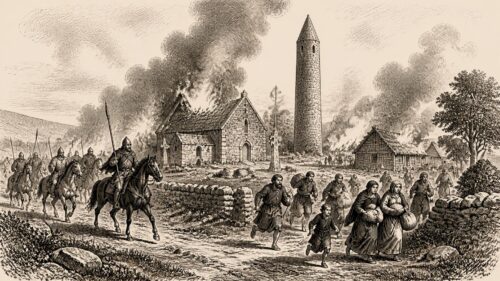
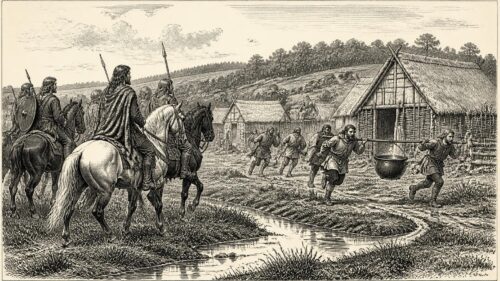
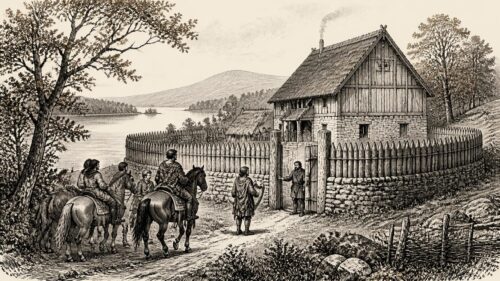
Another entry reports that Britons and the Ulaid ravaged Mag Muirtheimne, a fertile plain in the region of modern County Louth. The wording is important. It indicates co-operation between Ulaid forces and Britons, and it places warfare in a cultivated and inhabited district rather than an abstract battlefield. ‘Ravaging’ could mean the destruction or seizure of crops, livestock, stores and people: precisely the forms of violence that exposed households, dependants and church lands to danger. The entry does not say that this raid breached Adomnán’s law, nor does it identify the British group involved. Its significance is narrower but real: 697’s legal proclamation occurred amid continuing Irish Sea conflict.
The death of Máel Fothartaig son of Máel Dub, described as king of Airgíalla, is also noteworthy. Airgíalla was a politically important complex of peoples and dynasties in the north-central and north-eastern interior. The annalistic royal title should not be projected backwards into a later, fixed territorial kingdom; early medieval lordship was layered and contested. Still, the notice is early evidence for the use of a kingship of Airgíalla and reminds us that the north’s political geography was more complicated than a simple division between Uí Néill and Ulaid.
Church, Writing and Memory
Two deaths in the annal illuminate the cultural world in which Birr took place. Mo-Ling of Luachair ‘fell asleep’, the conventional monastic phrase for death. His community at St Mullins in Leinster was associated with an important saintly cult and later literary tradition. Casán, a scribe of Lusca—modern Lusk, County Dublin—also died. His entry is short, but the designation ‘scribe’ matters. Writing was a specialised and honoured activity in Irish churches: scribes copied scripture, liturgy, legal material, genealogies and learned texts, while monasteries acted as centres of record and education.
Adomnán himself embodied that learned ecclesiastical culture. Around these years he was composing, or bringing towards completion, his Life of Columba, a sophisticated Latin work grounded in Columban memory, written materials and living testimony. He had earlier compiled De locis sanctis, drawing on the travel narrative of the Gaulish bishop Arculf and on books available to him at Iona. Birr’s law should therefore be seen not as an isolated moral gesture but as part of a world in which Irish churchmen participated in international Christian learning while addressing local realities of war, captivity and political rivalry.
An Enforceable Ideal
The importance of 697 lies not in a claim that Ireland suddenly became peaceful or that every protected person gained effective safety. The surviving evidence cannot show consistent enforcement, and later renewals of the law suggest that its authority had to be actively maintained. Its importance lies in the attempt itself: Adomnán and his allies used the machinery available to them—assemblies, church authority, royal backing, named guarantors, fines and spiritual penalties—to limit particular harms of war.
Birr thus reveals an Ireland that was politically fragmented but capable of island-wide and cross-sea co-operation; violent, yet willing to articulate restraints on violence; and deeply local in its kingdoms and churches, yet connected to Iona, Pictland, Dál Riata and Northumbria. In 697 CE, the Law of Innocents gave those connections a durable legal and moral expression. It remains one of the clearest surviving statements from early medieval Ireland that power in war ought to meet obligations towards those least able to defend themselves.
Primary Sources
- The Annals of Ulster, Year U697
- The Annals of Ulster
- Chronicon Scotorum, Annal CS697
- Annals of Inisfallen, Annals AI687–AI696
- Annals of the Four Masters, Annal M697
- Cáin Adomnáin: An Old-Irish Treatise on the Law of Adamnan
- Adomnán
- Lex Innocentium (697 AD): Adomnán of Iona – Father of Western Jus in Bello
- Cáin Adomnáin and the Laws of War
- The Guarantor List of Cáin Adomnáin, 697
- Adomnán at Birr, AD 697: Essays in Commemoration of the Law of the Innocents
- Adomnán at Birr, AD 697: Table of Contents
- The Synod of Birr, 697 AD
- Origin Myths, Churches, and Kings
- The Picts Re-Imagined: Origin Myths, Churches, and Kings
- Adomnán’s De Locis Sanctis
- The Life of Columba, Written by Adomnán
- Life of St Columba by Adomnán: Manuscripts and Editions
- Exploring the Irish Annals
- List of Published Texts at CELT
- Part V: Place Names