Surrender Refused
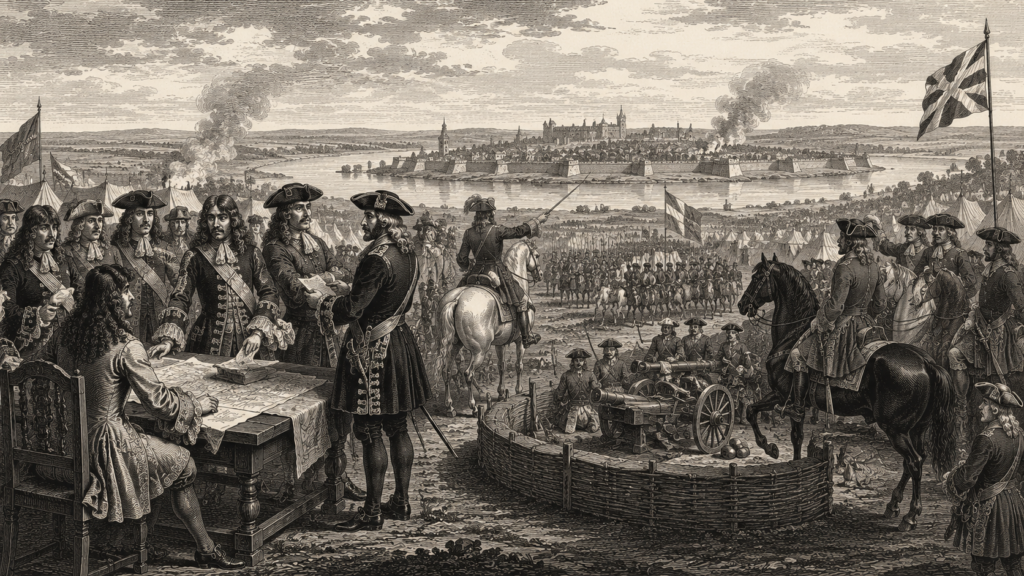
Limerick formally entered a state of siege on 9 August 1690 when William III’s army moved from its camp near Cahirconlish and established itself before the city. William sent a summons demanding surrender to Alexandre de Rainier de Droué, Marquis de Boisseleau, the French officer entrusted with commanding the Jacobite infantry within Limerick. The decision placed the city’s inhabitants, soldiers and defences at the centre of the war following the Boyne. William expected the remaining Jacobite resistance to collapse, but Limerick’s position behind the Shannon and the presence of a substantial garrison offered the defenders a final opportunity to continue the campaign.
Boisseleau returned his answer through Sir Robert Southwell, William’s secretary of state, rather than addressing William directly as king. George Story’s contemporary Williamite account records that Boisseleau expressed surprise at the summons and maintained that a determined defence offered a better means of earning the Prince of Orange’s respect than surrendering the place entrusted to him. The language was diplomatically careful but politically unmistakable. Boisseleau would not acknowledge William’s royal title, because he remained an officer of James II, yet he answered without insult and made clear that Limerick would resist rather than capitulate without an attempt at defence.
The refusal did not follow a final council attended by every figure named in later literary versions of the episode. Tyrconnell had already departed from Limerick after an earlier council at which he and most of the French officers had favoured accepting whatever terms William might offer. Boisseleau alone among the senior French officers opposed that recommendation and was left to command the city’s infantry. Patrick Sarsfield remained central to the Jacobite effort, but his principal responsibility lay with the cavalry stationed beyond the Shannon in County Clare. The summons therefore confirmed a division already established within the Jacobite leadership.
William’s encampment reflected the multinational character of the army assembled against Limerick. Dutch and English guards served alongside English, Scottish, Danish, German, Brandenburg and French Huguenot formations, supported by cavalry, artillery, engineers and supply units. These troops occupied positions across the ground east and south-east of the city while preparations began for trenches and batteries. Contemporary evidence supports the presence of these national contingents, although the precise right-to-left arrangement described in later popular accounts is less secure. The familiar claim that Danish soldiers were deliberately stationed inside an ancient Irish earthwork called a “Danish fort” appears to belong to later literary embellishment.
Boisseleau’s answer transformed William’s summons into an active siege. The defenders had already strengthened the vulnerable Irishtown sector by digging a shallow ditch and using the excavated earth to form a rampart protected by palisades. Williamite engineers opened their trenches during the night of 9 August, beginning the methodical approach towards the city walls. For Limerick people, the refusal meant exposure to bombardment, shortages, military labour and the threat of assault, but it also preserved the Jacobite position in western Ireland. The struggle that followed would establish Boisseleau as the practical commander of one of the most important urban defences of the Williamite War.
- George Warter Story, An Impartial History of the Wars of Ireland, with a Continuation Thereof, London: Richard Chiswell, 1693.
- John Stevens, The Journal of John Stevens, Containing a Brief Account of the War in Ireland, 1689–1691, edited by Robert H. Murray, Oxford: Clarendon Press, 1912.
- John White, Descriptio Obsidionis Urbis Limericensis, 1690; translated and discussed by M. Lloyd and E. O’Flaherty, “A Descriptive Poem of Limerick in 1690,” Old Limerick Journal, no. 28, Winter 1990.
- John Childs, The Williamite Wars in Ireland, 1688–1691, London: Hambledon Continuum, 2007.
- Pádraig Lenihan, “The Marquis de Boisseleau and the ‘Battle of the Breach’ at the First Siege of Limerick, 1690,” History Ireland, vol. 28, no. 5, September–October 2020.