
Mammoth Cave Fauna
Around 31,959 BCE, Ireland was an unstable Late Pleistocene landscape, not a recorded society. Before the Last Glacial Maximum, exposed areas may have supported open steppe and tundra vegetation and fauna. Castlepook, or Mammoth Cave, County Cork, contains bones of mammoth, reindeer, giant deer, bears, wolves, foxes and hyaenas, although its disturbed deposits represent long periods rather than a single moment. A cut-marked reindeer femur may indicate human butchery about 33,000 years ago, but remains contested and lacks context. It cannot prove settlement, culture or routes of arrival. Glaciation, sea-level change and poor preservation leave human presence uncertain, pending research.
View Record
Exposed Celtic Sea Shelf
Around 31,960 BCE, Ireland was a cold, glaciated Late Pleistocene landscape, though not uniformly ice-covered. Lower sea levels exposed surrounding shelf lands, but changing channels, ice and difficult terrain still impeded access. Castlepook Cave in County Cork preserves important, imperfectly excavated animal remains, including mammoth, reindeer, giant deer, bear and hyaena, indicating open habitats and diverse fauna accumulated over long periods. A cut-marked reindeer bone may record butchery by Upper Palaeolithic visitors, potentially Ireland’s earliest human trace. However, no tools, hearths or settlements confirm occupation. Later glaciation and disturbed cave deposits limit interpretation; Ireland remains an intermittently habitable Ice-Age frontier.
View Record
Castlepook’s Marked Bone
31,961 BCE is an imprecise label for a Late Pleistocene MIS 3 interval, when Ireland experienced cold conditions and advancing ice preceding the Last Glacial Maximum. Geological and cave-faunal evidence, especially from Castlepook Cave, records mammals including cold-adapted and open-country species, though deposits span long periods and were imperfectly excavated. A reportedly cut-marked reindeer bone may indicate human activity around 33,000 years ago, but lacks secure context and remains under investigation. No contemporary settlement, tools, hearths or cultural assemblage is known. Later bear-bone evidence confirms human presence only about 10,800–10,500 BCE. Ireland’s period remains an environmentally documented, uncertain human prehistory.
View Record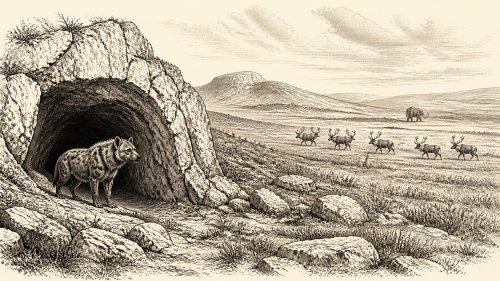
Herb-Rich Tundra
Around 31,962 BCE, Ireland lay in the climatically unstable Late Pleistocene, before the Last Glacial Maximum, when much of the island may still have been ice-free. Open herb-rich tundra, grassland and sparse shrubs supported mammoth, giant deer, reindeer, bear, wolf, Arctic fox, lemmings and hyaena. Castlepook Cave, County Cork, preserves crucial but complex faunal evidence, accumulated and disturbed over long periods. A possibly stone-tool-marked reindeer bone suggests fleeting Upper Palaeolithic human activity, but does not prove settlement. Lower sea levels altered geography, while advancing ice later destroyed records. Ireland’s history at this time is therefore chiefly environmental, fragmentary and uncertain.
View Record
Derryvree Interstadial Deposits
Approximately 34,000 calendar years ago, Ireland lay in the unstable later Marine Isotope Stage 3, before the Last Glacial Maximum. Derryvree and Greenagho deposits show intervals without overriding ice in north-central Ireland, although conditions varied regionally. Periglacial terrain, local or expanding glaciers, lower sea levels and episodic milder phases shaped the landscape. Cave faunas document mammoth, giant deer, reindeer, horse, predators and other animals, indicating open, shifting habitats and links with north-west Europe. No secure evidence demonstrates people in Ireland then; the earliest accepted sign of human activity is much later, from butchered bear bone dated about 12,700 cal BP.
View Record
Castlepook Reindeer Toolmarks
Around 31,964 BCE, Ireland lay on Europe’s north-western fringe during Marine Isotope Stage 3, before the Last Glacial Maximum. Castlepook Cave in County Cork preserved remains of mammoth, reindeer, giant deer, bear and hyaena, demonstrating intermittent Late Pleistocene ecological connections despite uncertain routes across changing seas and ice. A reindeer femur reportedly dated about 31,000 BCE bears marks potentially made by stone tools, suggesting human carcass processing. However, mixed cave deposits and absent associated artefacts prevent confirmation. Open steppe-tundra supported diverse fauna, but advancing ice later erased evidence. The human presence remains unproven, while climate and shifting coastlines governed survival.
View Record
Crag Cave Calcite Growth
Around 31,965 BCE, a retrospective and imprecise date, Ireland lay within the climatically unstable Upper Palaeolithic. It was not yet uniformly covered by the later maximum ice sheet: Fermanagh sediments and calcite growth at Crag Cave indicate local ice-free or intermittently unfrozen ground, although regional glaciation was advancing. Lower sea levels altered coastlines without guaranteeing land access. Open steppe-tundra supported fauna including reindeer, giant deer, mammoth and hyaena, though cave deposits are complex. No secure human settlement is known. A possibly cut-marked reindeer bone suggests brief human visitation, but not occupation. This glacial era shaped Ireland’s terrain and remains uncertain.
View Record
Before the Ice Maximum
Around 31,966 BCE, Ireland lay in the unstable later Marine Isotope Stage 3, before the fullest advance of the Last Glacial Maximum. Sea levels were lower, coastlines and possible routes changed, and expanding ice later destroyed much evidence. Southern caves, especially Castlepook, preserve remains of reindeer, mammoth, giant deer, bears and hyaenas, indicating cold, open mosaic habitats. A cut-marked reindeer femur, dated about 33,000 years ago, may record an early hunter visit, but lacks archaeological context or settlement evidence. No peoples, polities, beliefs or permanent communities can be identified. Knowledge relies on radiocarbon dating, faunal analysis, stratigraphy and ice-sheet reconstruction.
View Record
Castlepook Faunal Assemblage
At roughly 31,967 BCE, Ireland was a climatically unstable Late Pleistocene landscape approaching expanded glaciation, rather than uniformly ice-covered. Lower sea levels reshaped coasts and connections with Britain, though no specific land route or migration can be demonstrated. Castlepook Cave, County Cork, preserves Ireland’s richest pre-Last Glacial Maximum vertebrate assemblage, including reindeer, mammoth, giant deer, hyena, wolf, Arctic fox and lemmings. Its bones accumulated over long periods and reflect carnivore activity as well as natural processes. A marked reindeer femur may indicate early human butchery, but remains unconfirmed. Evidence supports intermittent fauna and possible human visits, not permanent occupation then.
View Record
Fermanagh Subglacial Organics
Around 31,968 BCE, Ireland lay in the climatically unstable Late Pleistocene, before the Last Glacial Maximum and without evidence permitting calendar-year reconstruction. Greenagho deposits indicate that parts of north-central Ireland remained ice-free until roughly 34,000 years ago, although ice, coastlines and sea levels were changing. Later glaciation created many familiar landforms. Castlepook Cave preserves evidence of diverse cold-climate fauna, including mammoth, reindeer, giant deer, bear and hyena, but accumulated remains cannot define a single moment. No secure human settlement is known. A possibly tool-marked reindeer bone suggests an uncertain brief visit. Ireland was a dynamic, ecologically connected, increasingly glaciated landscape.
View Record