Archived: 6 November 2026
Abstract
Year FrameFor 634 CE, the safest starting point is the annalistic year itself rather than any attempt to build a continuous event story. The surviving Irish annals do not present a modern narrative; they list brief notices under year headings, and the preserved evidence for this year is uneven across texts. In the Annals of Inisfallen, the entry for 634 contains three short notices: the repose of Mo-Bae moccu Alldae, the death of Rónán son of Fergus, and the slaying of Catluan. In the Annals of the Four Masters, the equivalent year also preserves several notices, including deaths and battles,
Read Article
Archived: 6 November 2026
Abstract
Irish ContextThe supplied evidence begins with an important distinction: Aidan was Irish, but the mission discussed here did not unfold in Ireland itself. One source describes him as an Irish monk who had studied under St. Senan and then became a monk at Iona about 630, while another identifies him as an Irish monk from the monastery founded by St. Columba on Iona. That matters because the evidence links Aidan’s identity to Irish monastic formation, but the actual setting of the 635 mission was elsewhere. The sources therefore support an Irish connection through person and training, not through the geography
Read Article
Archived: 4 November 2026
Abstract
In 636 CE, the clearest Irish event is an expulsion rather than a battle or royal accession: Carthach, better known as Mochuda or Mo Chutu, was driven from the monastery of Raithen, modern Rahan in County Offaly, at Eastertide. The terse record in the annals gives neither a speech, a march nor a legal judgement. Yet this removal of a prominent abbot from a major midland community was politically meaningful, religiously charged and consequential for the history of southern Ireland. Modern reference scholarship places the expulsion in 636, while also warning that the early annals preserve difficult and sometimes displaced
Read Article
Archived: 4 November 2026
Abstract
In 637 CE, Ireland’s most consequential recorded development was a pair of connected battles: Mag Rath and Sailtír. Medieval annals place them on the same day and present them as a decisive victory for Domnall mac Áedo, the leading Uí Néill ruler of the north-west, over the challenge mounted by Congal Cáech, overking of Ulaid. The year also brought the death of Failbe Flann, king of Mumu, and the recorded repose of the churchman Mo-Chutu of Raithen. These notices are brief, but together they reveal a kingdom of rival dynasties, military followings and powerful churches, tied to western Scotland as
Read Article
Archived: 4 November 2026
Abstract
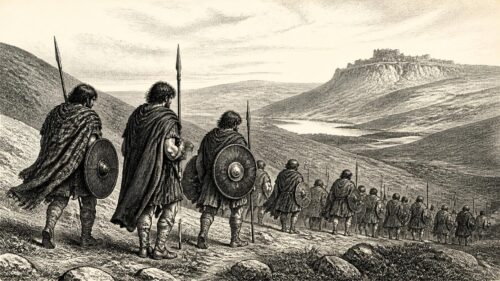
In 638 CE, the clearest event linked to Irish history was not fought on the island of Ireland itself, but in the Irish Sea world to which north-east Ireland belonged. Chronicon Scotorum records a battle at Glenn Muiresan in which the followers of Domnall Brec were put to flight, followed by the besieging of Eten. Domnall Brec was king of the Cenél nGabráin, the leading kindred of Dál Riata: a Gaelic sea-kingdom whose territories and connections extended between Argyll and the coast of Antrim. The annal therefore preserves a hard, if brief, sign that the political shocks of the late
Read Article
Archived: 4 November 2026
Abstract
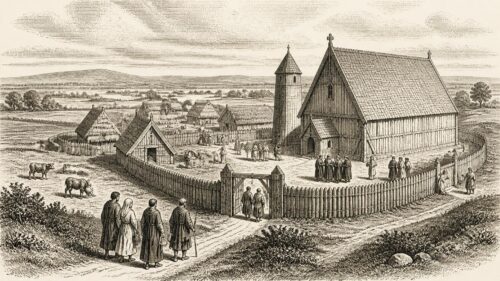
In 639 CE, the most significant Irish development that can be placed with reasonable confidence in this calendar year was the death of Áed Dub, bishop and abbot of Kildare. His obituary is brief, but it illuminates a great deal: in seventh-century Leinster, an important church could be led by a member of a ruling dynasty, and religious office could be an instrument of regional authority as well as pastoral care. The year’s surviving notices also record deaths at Nendrum and Leighlin, the killing of a man named Congal son of Dúnchad, the death of Ailill son of Áed Rón,
Read Article
Archived: 4 November 2026
Abstract
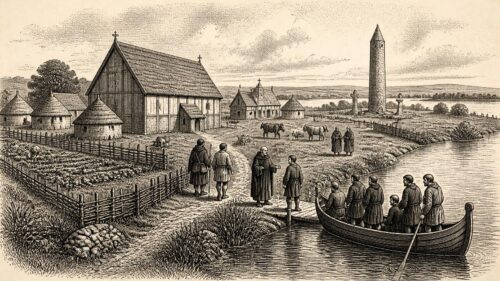
In 640 CE, the clearest securely reconstructed Irish annalistic notices are not of a decisive battle within Ireland or a change of high kingship, but of deaths in the ecclesiastical world. Crónán moccu Loégde, abbot of Clonmacnoise, died, and the annals also record the death of Mochua of Balla in Connacht. These brief notices are valuable precisely because they reveal what early medieval record-keepers considered worth preserving: the passing of men who led important religious communities. They also place Ireland in a year of wider Gaelic political tension, for a battle and siege involving the following of Domnall Brecc of
Read Article
Archived: 3 November 2026
Abstract
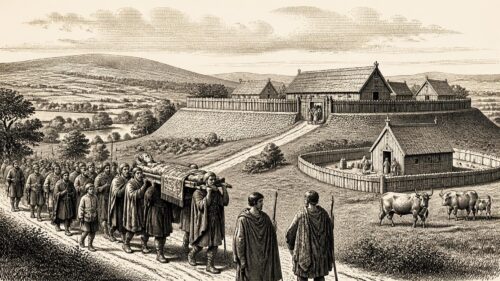
In 641 CE, the securely dateable Irish development is the death of Cúán mac Amalgado, a king of Munster from the Eóganacht Áine branch of the Eóganachta. The surviving annalistic notice is brief: it records his death without a place, cause, successor’s inauguration or account of public reaction. Yet the loss of a provincial overking mattered. In a country of many small kingdoms, Munster’s ruler stood within a dense hierarchy of client peoples, churches, kin-groups and rival royal lines. Cúán’s death therefore marks a real, if sparsely described, transition in the political life of southern Ireland. A Death in the
Read Article
Archived: 3 November 2026
Abstract
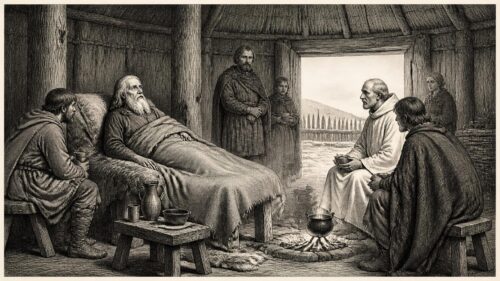
In 642 CE, the most consequential Irish event securely attached to the year was the death, at the end of January, of Domnall mac Áedo. The Annals of Ulster calls him rex Hiberniae, ‘king of Ireland’, an unusually emphatic title in an island divided among many kingships. Its notice is brief, yet its language makes Domnall’s death a landmark: a powerful overking had gone, and the political arrangements he had sustained were left to be tested. The same annal also records the killing of Ailill son of Colmán, king of Cenél Loegaire, a Uí Néill people of Brega. Thus the
Read Article
Archived: 3 November 2026
Abstract
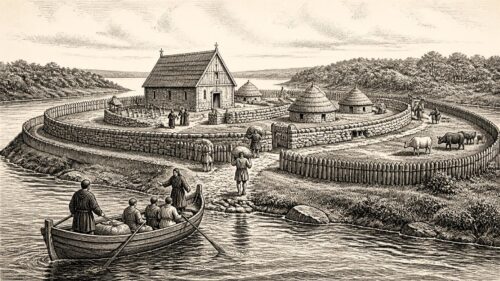
In 643, Irish annals recorded disputed succession after the death of Domnall mac Áedo, a prominent northern Uí Néill ruler. Sources variously named his nephews Cellach and Conall Cáel as successors or described shared authority with Diarmait and Blathmac of the southern Uí Néill. Chronological differences place these events around 642–643, but all reflect uncertainty over wider kingship. Regional conflict, including the battle of Cenn Con, demonstrated the independence of Munster dynasties. The death of Bishop Crónán of Naendruim also illustrates the political and economic importance of churches. Ireland remained a network of competing kingdoms, kin groups and ecclesiastical communities.
Read Article
