Reunion Talks(c.1890s)
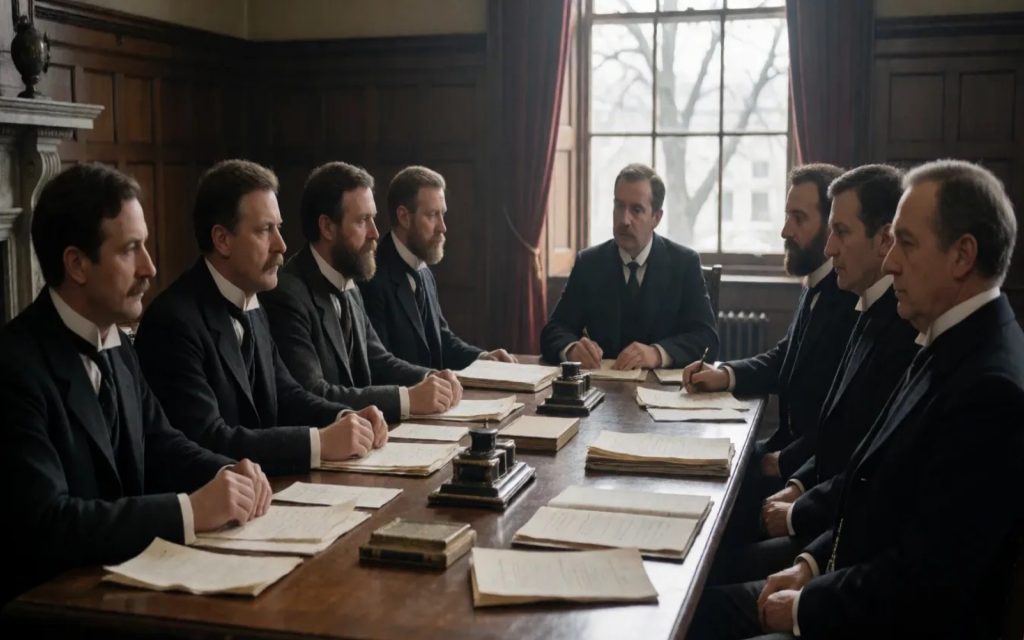
John Redmond’s Parnellite followers entered formal discussions with their former anti-Parnellite opponents as pressure mounted to end nearly a decade of nationalist division. Redmond had led the minority that remained loyal to Charles Stewart Parnell after the Irish Parliamentary Party split in December 1890. The larger anti-Parnellite body was principally associated with John Dillon, while Timothy Healy commanded another influential grouping. Their separate organisations had competed for authority, funds and electoral support throughout the 1890s, weakening the parliamentary movement and leaving constitutional nationalism without the concentrated leadership it had possessed under Parnell.
A documented step towards negotiation came on 24 July 1899, when Redmond wrote from the House of Commons to Dillon and Healy, asking whether they would convene representatives of the Irish National Federation and Irish National League to discuss nationalist reunification. Dillon replied two days later that he had long been willing to confer with Redmond or any other nationalist MP and argued for cooperation at Westminster. The correspondence did not erase old suspicions, but it established that the opposing leaderships were prepared to treat reunion as a practical political question rather than merely an aspiration expressed at public meetings.
The discussions unfolded while William O’Brien’s United Irish League was expanding rapidly and challenging the divided parliamentarians from outside their established organisations. Founded in 1898, the League combined agrarian demands with a campaign for national political reconstruction. Its branches gave tenant farmers and local activists a platform from which to condemn factional quarrels and demand effective representation. Redmond and his followers therefore entered negotiations from a position that offered opportunity as well as danger. Reunion could restore parliamentary authority, but it could also become necessary to prevent the newer popular organisation from displacing sitting MPs and controlling future candidate selection.
The negotiations carried clear importance for Limerick, although the available evidence does not establish a distinct local intervention in these particular discussions. Electoral reform had greatly enlarged political participation in the city: Limerick Archives records that the municipal electorate increased from 709 to 5,521 before the local elections of 1899. Constitutional nationalists representing Limerick city and county could not remain untouched by a national settlement governing leadership, discipline and parliamentary cooperation. Local electors concerned with Home Rule, land reform and democratic government had a direct interest in whether competing nationalist organisations would continue exhausting themselves through rivalry or combine their strength at Westminster.
Agreement remained difficult because reunion required more than polite correspondence. The factions disagreed over leadership, organisation, election funds and the relationship between MPs and the United Irish League. Redmond had previously resisted proposals that appeared likely to subordinate the Parnellite tradition, while Dillon and Healy remained divided from one another as well as from him. Nevertheless, the opening of formal discussions helped create the path towards the meeting of 30 January 1900, when the parliamentary factions reunited. Redmond subsequently became chairman of the reconstructed Irish Parliamentary Party, though the compromises that brought unity did not permanently remove the personal and organisational tensions beneath it.
- John Redmond to John Dillon and T. M. Healy, 24 July 1899, copy letter proposing a meeting of the Irish National Federation and Irish National League to discuss nationalist reunification, John Redmond Papers, National Library of Ireland, MS 15,182/2/1.
- John Dillon to John Redmond, 26 July 1899, letter declaring his willingness to confer on reunion and parliamentary cooperation, John Redmond Papers, National Library of Ireland, MS 15,182/2/2.
- Philip Bull, “The United Irish League and the Reunion of the Irish Parliamentary Party, 1898–1900,” Irish Historical Studies, vol. 26, no. 101, May 1988, pp. 51–78.
- F. S. L. Lyons, The Irish Parliamentary Party, 1890–1910, London: Faber and Faber, 1951, pp. 79–88.
- Margaret A. Banks, Edward Blake, Irish Nationalist: A Canadian Statesman in Irish Politics, 1892–1907, Toronto: University of Toronto Press, 1957, pp. 206–229.
- Mayo News, 27 January 1900.
- The Times, 31 January 1900.
- Limerick Archives, Franchise and Elections, 1869–1954, electoral records and historical summary concerning the enlarged Limerick municipal electorate and the local elections of 1899.