Ice Before History31975 BCE
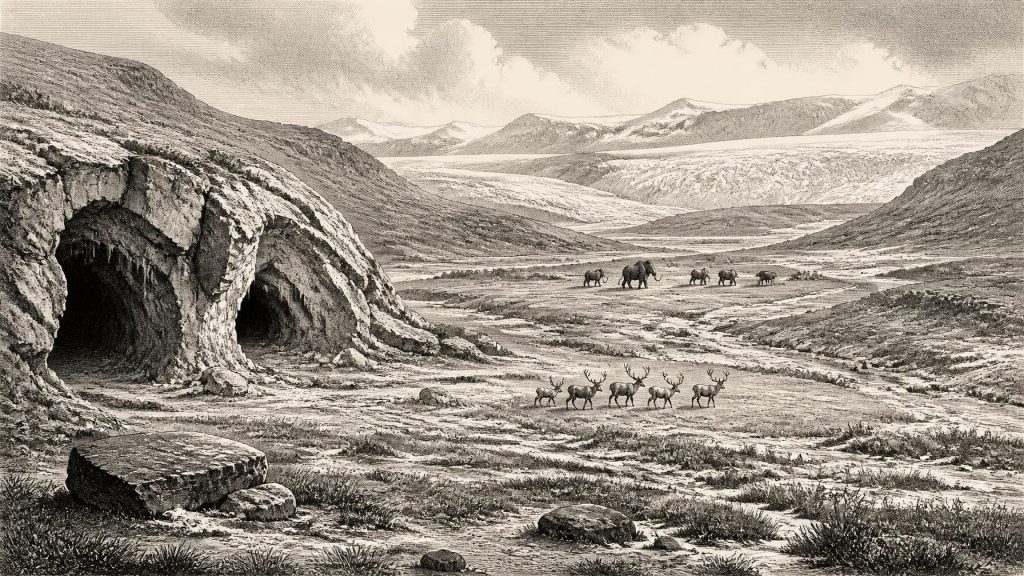
About 31,975 BCE, Ireland was a cold, unstable Late Pleistocene landscape during Marine Isotope Stage 3, before maximum glaciation. Expanding ice, changing seas and open tundra-steppe created varied environments rather than a uniformly frozen island. Cave evidence, especially from Castlepook, County Cork, records reindeer, mammoth, giant deer, bears, wolves, hyaenas and other fauna. A reindeer bone bearing a possible stone-tool cut mark, dated broadly near 31,000 BCE, offers potentially Ireland’s earliest human trace. It suggests brief Upper Palaeolithic visits, not permanent settlement. No associated tools, hearths, dwellings, communities or practices are known. Ice and rising seas may have destroyed evidence.
Dateline
A Date Beyond Calendar History
31,975 BCE is a modern way of labelling a point almost 34,000 years before the conventional radiocarbon “present” of 1950—roughly 33,925 calendar years ago. It must not be mistaken for a year in which an Irish event can be dated. No written record, settlement sequence, ruler, battle, voyage or named community exists for Ireland at this depth of time. Even radiocarbon dates from this period produce calibrated ranges rather than single calendar years, and cave deposits often preserve material accumulated over long intervals. The responsible subject is therefore Ireland in the later part of Marine Isotope Stage 3, before the Last Glacial Maximum, not an imagined episode on a particular day or in a particular year.
This was the Upper Palaeolithic world: a cold, unstable phase of the Late Pleistocene in which climate repeatedly shifted between milder interstadials and harsher stadials. Ireland lay at the north-western fringe of Europe, in a landscape that was changing on geological as well as human timescales. The evidence is thin, but it is significant. It comes principally from animal bones, cave sediments, glacial landforms and modern re-dating programmes, especially in the limestone country of southern Ireland. These remains tell us much more securely about environments and animals than about people. Yet one disputed-looking but potentially momentous trace from County Cork means that humans can no longer be excluded from Ireland at this early date.
A Cold, Changing Island
At around 31,975 BCE, the great British–Irish Ice Sheet was growing, but it had not yet reached the full extent associated with the Last Glacial Maximum, conventionally placed around 26,000–19,000 calendar years ago. BRITICE-CHRONO research indicates a long phase of ice-sheet expansion from about 31,000 to 26,000 years ago, with major ice build-up over Ireland later in that interval. This does not licence a simple picture of an entirely ice-covered island in 31,975 BCE. Conditions differed sharply by region, season and century. Some uplands and central areas may already have been affected by expanding ice, while evidence from caves in the south shows that animal communities occupied at least parts of the Irish landscape during the wider period.
The landscape was not Ireland as modern visitors know it. There were no oak woods, hedgerows, enclosed fields, bog roads or familiar coasts. Cold, open vegetation—varying between tundra, steppe-tundra and sparse grassland according to climate and locality—would have supported grazing animals where land was exposed. Strong winds, frost action and seasonal snow shaped slopes and soils. Lower global sea levels altered the outline of surrounding seas, but that does not establish a straightforward, dry land route from Britain into Ireland. Marine geology and relative sea-level history are complex, while ice, water and changing coastlines created barriers as well as possible corridors. Any human movement to or within Ireland would have depended on conditions we cannot reconstruct in detail.
The environment was also dynamic rather than uniformly frozen. The animal record at Castlepook Cave, near Doneraile in north County Cork, demonstrates that Ireland could support substantial mammals in the pre-maximum glacial world. Re-dating has shown that several older cave collections are considerably earlier than once thought, while also warning archaeologists that old radiocarbon measurements may require revision. A date from a bone establishes when that animal died, not necessarily the exact moment when a cave was used, when a mark was made, or when people passed through the surrounding countryside.
Castlepook and the Human Question
Castlepook Cave is central to any account of Ireland near this date. Excavations in the early twentieth century recovered thousands of bones from a complicated cave system. The material is now important precisely because it includes a broad Late Pleistocene fauna and because researchers can apply modern zooarchaeological and radiocarbon methods to historical collections. Reindeer, woolly mammoth, giant deer, brown bear, wolf, Arctic fox, mountain hare, lemmings and spotted hyaena are among the species represented. Their presence should not be compressed into a single imagined herd or a single moment: the cave assemblage was accumulated through different episodes and natural agencies, including carnivores.
A reindeer leg bone from Castlepook, reported as dating to about 31,000 BCE, bears a cut mark identified by specialist study as consistent with a sharp stone tool used on fresh bone. If that interpretation is sustained, it is the earliest known evidence of human activity in Ireland by a very large margin. It would indicate that Upper Palaeolithic people had killed or butchered a reindeer in Ireland, or at least processed its carcass there. The find is directly relevant to 31,975 BCE because its broad date lies within the same late-MIS 3 world, though it cannot be assigned to this numbered year.
Its limits matter as much as its importance. The bone was recovered from an old excavation, not from a newly excavated, sealed living floor. No associated hearth, stone-tool assemblage, dwelling, human bone or repeated occupation horizon of the same age has yet been published from Ireland. Nor can the bone prove that hunters butchered the animal inside the cave: carcass parts may have been moved by hyaenas or other scavengers after human processing elsewhere. The careful conclusion is therefore evidence of possible, and increasingly plausible, Palaeolithic human presence—not proof of a permanent population, a named culture, or continuous settlement.
Animals, Food and Survival
The faunal evidence nevertheless gives an unusually vivid outline of the ecological setting. Reindeer were well adapted to cold, open country and would have offered meat, fat, hide, sinew, bone and antler to any hunters able to take them. Giant deer, often called “Irish elk” despite being neither uniquely Irish nor an elk, were also part of the wider Late Pleistocene fauna. Woolly mammoth remains attest to an environment capable, at least intermittently, of sustaining very large grazing animals. Brown bears, wolves and spotted hyaenas were competitors, scavengers and predators rather than background wildlife. Castlepook is Ireland’s only known site for spotted hyaena remains, a reminder that the island’s Pleistocene animal world was far richer and less familiar than its later historic fauna.
For people, if present, life would have been mobile and precarious. Across contemporaneous north-west Europe, Upper Palaeolithic communities survived by skilled hunting, gathering, sharing food and maintaining clothing, shelter and tools in severe climates. Such comparative knowledge can suggest possibilities for Ireland, but it cannot fill the evidential gap. It is reasonable to infer that the processing of a reindeer required sharp-edged technology and practical knowledge of animal anatomy. It is not reasonable to state what language the people spoke, what garments they wore, whether they used bows, what group size they had, or whether they returned annually to Castlepook. Ireland has not yielded the securely dated toolkits needed to make those claims.
No Polities, No Monuments
Political affairs, diplomacy and organised warfare cannot be recovered for 31,975 BCE in Ireland. There is no evidence for chiefdoms, territories, borders, alliances or conflict between human groups. Nor is there evidence for farming, herding, metalworking, trade routes, towns, monuments or any settled economy. Those developments belong to vastly later periods. Even the word “Ireland” is an anachronism when applied to a Late Pleistocene landscape whose shorelines and ice cover differed from those of the modern island; it is used here only as a geographical convenience.
Religion, art and learning must be treated with the same restraint. Upper Palaeolithic Europe contains extraordinary evidence of visual art, ornament, burial practice and technical learning, but none can presently be demonstrated in Ireland at this date. A cut-marked bone records an action, not a belief. A cave containing fossils need not have been a shrine or a home. The most defensible cultural observation is that any humans who reached this far-western setting belonged to populations capable of making and using stone tools, navigating difficult landscapes, and exploiting large animals. Beyond that lies possibility, not evidence.
What This Date Means
The importance of 31,975 BCE lies not in a conventional historical event but in the revision of an old assumption: that Ireland had no human story before the end of the last ice age. The Castlepook reindeer bone, together with renewed study of cave faunas, makes that assumption untenable. It opens the prospect of brief, episodic Upper Palaeolithic visits or occupations in a landscape later heavily transformed by ice. Glaciation could have eroded or buried many open-air sites, while rising seas may have removed others from the modern coastline. The scarcity of evidence may therefore reflect preservation as much as absence.
Still, scarcity requires humility. Around this point in deep time, Ireland was a changing cold-world habitat, inhabited demonstrably by Pleistocene animals and perhaps visited by small groups of human hunters. It was not yet a landscape of recorded communities or enduring settlements. Future excavations at Castlepook and other karst sites may sharpen the chronology, identify securely stratified artefacts, or alter present interpretations. Until then, the archaeological record supports a compelling but narrow conclusion: long before the later Mesolithic settlement of Ireland, people may already have left a fleeting, cut-marked trace in its Ice Age south.
Primary Sources
- A Reconsideration of the Radiocarbon Dating of the Marine Isotope Stage 3 Fauna from Southern Ireland
- The Irish Quaternary Fauna Project
- First Evidence of a Late Upper Palaeolithic Human Presence in Ireland
- New Insights on the Fauna of Ireland’s Younger Dryas and Early Holocene from Alice & Gwendoline Cave
- Growth and Retreat of the Last British–Irish Ice Sheet, 31,000 to 15,000 Years Ago: the BRITICE-CHRONO Reconstruction
- Growth and Retreat of the Last British–Irish Ice Sheet, 31,000 to 15,000 Years Ago: the BRITICE-CHRONO Reconstruction
- Extent and Deglacial Chronology of the Last British–Irish Ice Sheet: Implications of Exposure Dating Using Cosmogenic Isotopes
- Radiocarbon Constraints on the History of the Western Irish Ice Sheet Prior to the Last Glacial Maximum
- Response of the Irish Ice Sheet to Abrupt Climate Change During the Last Deglaciation
- Dimensions and Chronology of the Last Ice Sheet in Western Ireland
- Vertical Dimensions and Age of the Wicklow Mountains Ice Dome, Eastern Ireland, and Implications for the Extent of the Last Irish Ice Sheet
- The Deglaciation of the Western Sector of the Irish Ice Sheet from the Inner Continental Shelf to its Terrestrial Margin
- The Island of Ireland: Drowning the Myth of an Irish Land-Bridge?
- The Archaeology of Caves in Ireland
- Quaternary Site Descriptions
- Heritage Artefacts of County Cork
- Archaeological Heritage of County Cork
- 2022:564 – Castlepook Cave, Castlepook South, Cork
- 2019:148 – Alice & Gwendoline Cave, Clare
- The IntCal20 Northern Hemisphere Radiocarbon Age Calibration Curve (0–55 cal kBP)
- IntCal20
- The Wonder Cabinet
- Mammals: National Museum of Ireland Natural History Collections
- The Irish Elk: When and Why Did this Giant Deer Go Extinct and What Did it Look Like?