Herb-Rich Tundra31962 BCE
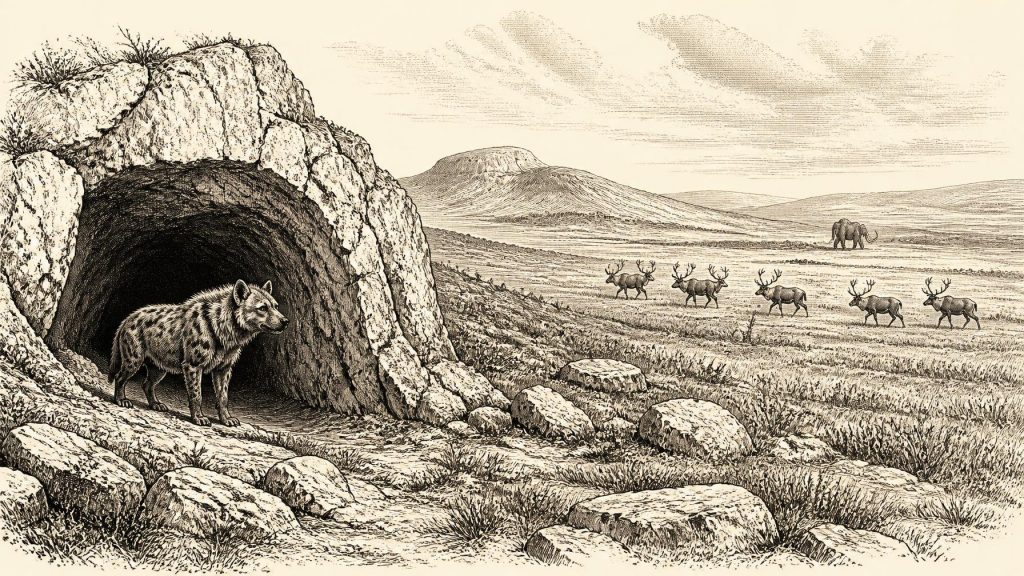
Around 31,962 BCE, Ireland lay in the climatically unstable Late Pleistocene, before the Last Glacial Maximum, when much of the island may still have been ice-free. Open herb-rich tundra, grassland and sparse shrubs supported mammoth, giant deer, reindeer, bear, wolf, Arctic fox, lemmings and hyaena. Castlepook Cave, County Cork, preserves crucial but complex faunal evidence, accumulated and disturbed over long periods. A possibly stone-tool-marked reindeer bone suggests fleeting Upper Palaeolithic human activity, but does not prove settlement. Lower sea levels altered geography, while advancing ice later destroyed records. Ireland’s history at this time is therefore chiefly environmental, fragmentary and uncertain.
Dateline
31,962 BCE is a modern label, not a date at which an event can be identified in Ireland. Archaeology cannot resolve a particular calendar year this far back. In terms more meaningful to Quaternary science, the date falls roughly 33,900 years before AD 1950, within the Late Pleistocene and Marine Isotope Stage 3 (MIS 3), a long, climatically unstable interval before the height of the last glaciation. The evidence available for Ireland consists principally of cave bones, sediments, landforms and laboratory dates, not chronicles, settlements or named peoples. It can illuminate an Ice Age landscape; it cannot furnish a year-by-year history in the ordinary sense.
An Island in a Changing Ice Age
Ireland at this broad point in time was not the uniformly ice-covered land often imagined from the phrase “Ice Age”. The fullest expansion of the last Irish Ice Sheet, conventionally placed around 27,000–23,000 calibrated years ago, lay later. Research on sub-till organic deposits suggests that much of Ireland was ice-free until about 32,000 years ago, though the growth and extent of the ice sheet varied between regions and remain the subject of active investigation. A date around 33,900 cal BP therefore belongs to the period immediately before, or during the early stages of, the major advance that would transform the island’s surface.
That does not mean a mild or stable country. MIS 3 contained sharp climatic oscillations recorded especially clearly in Greenland ice cores and in marine sediments. Ireland lay on the north-western edge of Europe, exposed to Atlantic weather and vulnerable to shifts in temperature, precipitation and ice-sheet growth. Open grassland, herb-rich tundra, patches of shrub vegetation and bare or thinly vegetated ground are more defensible images than the familiar wooded “Emerald Isle”. The precise mixture altered over centuries and millennia, and it cannot be reconstructed for one chosen year. Nor should a modern coastline be projected backwards without qualification: lower global sea levels and changing ice loads altered shores, river courses and the extent of land now submerged beneath the Irish and Celtic Seas.
Glacial geology preserves the large-scale consequences. Ice later eroded bedrock, laid down till, reshaped valleys and displaced or destroyed older deposits. This matters profoundly for archaeology. A sparse record may indicate that few people came to Ireland, but it also reflects the survival problem: any camps on exposed lowlands, river terraces or former coastal plains were vulnerable to ice, water and later landscape change. Caves are exceptional because they sometimes protected bones and sediments from complete removal. They are not neutral archives, however. Animals dragged carcass parts into them, water moved deposits, and many Irish caves were excavated before modern recovery and recording standards existed.
Castlepook and the Evidence of Animals
The key locality for this period is Castlepook Cave near Doneraile, County Cork. Geological Survey Ireland describes it as Ireland’s richest known site for vertebrate fauna leading up to the Last Glacial Maximum. Its collections and deposits have produced remains attributed to woolly mammoth, giant deer, reindeer, brown bear, wolf, Arctic fox, lemmings and spotted hyaena. This is substantial evidence that, during warmer phases before the glacial maximum, parts of Ireland could support a varied cold-stage mammal community. It is not evidence that every one of these animals stood together in the same valley in 31,962 BCE: cave assemblages often accumulate over long periods, and individual bones require direct dating and taphonomic study.
The fauna nevertheless gives the year its proper setting. Reindeer imply open country and seasonal movement; lemmings and Arctic fox point towards severe, northern conditions; mammoth and giant deer indicate the capacity of the wider landscape to sustain very large grazers and browsers. Spotted hyaena is especially revealing. A hyaena den could bring bones from the surrounding countryside into a cave, gnawing and scattering them in the process. Thus, a concentration of mammoth or deer remains is not automatically a hunting site, a human meal or even a natural death-place. It may instead record predation and scavenging by carnivores.
Older radiocarbon work dated some Castlepook material to the middle of the last glacial cycle, including a mammoth bone with a result around 33,400 radiocarbon years BP. More recent scholarship has stressed that many Irish cave dates produced before improved collagen pretreatment and ultrafiltration should be reassessed rather than treated as final. The responsible conclusion is broad but important: Castlepook preserves evidence for an MIS 3 Ice Age fauna in southern Ireland, while the exact ages and relationships of particular specimens remain under refinement.
A Possible Human Trace, Not a Settlement
A reported reindeer femur from Castlepook has particular relevance to this nominal year. County Cork heritage publications identify it as a Palaeolithic specimen, approximately 31,000 BC, with a mark interpreted by zooarchaeologist Ruth Carden as having been made by a sharp stone tool during butchery. If the interpretation and chronology are sustained through full specialist publication and further analysis, it would be powerful evidence that a person, or a very small group, handled a reindeer in Ireland during the Upper Palaeolithic. It would push the island’s known human story far earlier than the long-accepted record.
Yet this must not be enlarged into an invented community. The bone is not a house, hearth, tool-kit, burial ground, artistic tradition or continuously occupied camp. No securely associated Palaeolithic stone-tool assemblage has been recovered from Castlepook. A cut mark must also be distinguished from damage caused by carnivore teeth, sediment movement, excavation or handling; identifying it requires microscopic and comparative taphonomic judgement. Furthermore, a date obtained from the bone establishes when the animal lived or died, not automatically the date of any mark if the find context is disturbed. The cave’s long history of water action, animal activity and earlier excavation increases the need for caution.
This uncertainty is not a reason to dismiss the find. It is precisely why it is historically valuable. It directs research towards the possibility of fleeting Upper Palaeolithic visits to Ireland—perhaps hunters following animal movements, perhaps people using exposed coastal and shelf landscapes that no longer survive above water. It does not presently prove permanent colonisation. The National Museum of Ireland still describes unambiguous human presence in the Irish Palaeolithic as unresolved, while the better-established evidence for people comes much later, after deglaciation, in the Late Upper Palaeolithic and Mesolithic.
Society Beyond the Evidence
There is no responsible basis for describing political affairs, diplomacy, leaders, tribal territories or warfare in Ireland in 31,962 BCE. There are no written records, no known human graves of this age in Ireland, and no demonstrable settlements from which social organisation can be reconstructed. Nor is there direct Irish evidence for religion, formal ritual, language, music, visual art or teaching. Upper Palaeolithic communities elsewhere in Europe made sophisticated stone and organic tools, ornaments, images and structured use of caves; those achievements show what contemporary Homo sapiens were capable of, but analogy cannot turn continental culture into an Irish fact.
The same boundary applies to everyday economy. If people did enter Ireland, the reindeer femur makes animal processing a plausible activity, not a documented subsistence system. A small visiting party might have hunted, scavenged or butchered a carcass encountered in the landscape; the evidence cannot decide between these possibilities. There is no sound basis to claim farming, herding, pottery, metalworking, trade networks or organised exchange. The most that can be said is that any human presence would have depended closely on mobile animal resources, local stone, shelter and knowledge of a difficult seasonal environment.
Crossings and connections also remain uncertain. Sea level was lower than today, exposing additional shelf land and altering the geography of the Irish Sea. Researchers have debated whether temporary links, islands or ice routes ever assisted movement between Ireland and Britain. The evidence does not justify a confident route for people or animals at this particular time. Ireland’s position at Europe’s western margin would nevertheless have made any arrival environmentally and logistically significant. A brief incursion is more consistent with the present evidence than a populous, enduring settlement.
Approaching Transformation
The great historical development around this date was therefore environmental rather than political: the approach of the Last Glacial Maximum. Over the following millennia, the Irish Ice Sheet expanded, in some reconstructions covering almost all of the island and extending onto the surrounding shelves. Faunal communities contracted, shifted or disappeared locally; later glaciation interrupted the terrestrial record. The eventual retreat of the ice opened a very different chapter, allowing plants, animals and later hunter-gatherers to recolonise landscapes newly released from ice.
For 31,962 BCE, Ireland should be understood as a place of cold-climate ecosystems, mobile animals, unstable climate and fragmentary evidence. Castlepook Cave offers a rare window onto that world and a tantalising, still qualified possibility of human activity. The durable fact is not a named event on a precise day. It is that Ice Age Ireland was ecologically inhabited and geographically changing, while its earliest possible visitors left—at most—traces so slight that each mark on bone and each recalibrated date can alter the story.
Primary Sources
- Prehistoric Details
- Stone Age
- The Irish quaternary fauna project
- A reconsideration of the radiocarbon dating of the Marine Isotope Stage 3 fauna from southern Ireland
- Cork_CGS_Castlepook_Cave
- Heritage Artefacts of County Cork
- The Last Irish Ice Sheet: Extent and Chronology
- Response of the Irish Ice Sheet to abrupt climate change during the last deglaciation
- Growth and retreat of the last British–Irish Ice Sheet, 31 000 to 15 000 years ago: the BRITICE-CHRONO reconstruction
- The timing and magnitude of the British–Irish Ice Sheet between Marine Isotope Stages 5d and 2: implications for glacio-isostatic adjustment, high relative sea levels and ‘giant erratic’ emplacement
- Late Pleistocene chronostratigraphy and ice sheet limits, southern Ireland
- Dimensions and chronology of the last ice sheet in Western Ireland
- The problem of a late quaternary landbridge between Britain and Ireland
- Celtic Sea linear tidal sand ridges, the Irish Sea Ice Stream and the Fleuve Manche: Palaeotidal modelling of a transitional passive margin depositional system
- Sea-level change and inner shelf stratigraphy off Northern Ireland
- First evidence of a Late Upper Palaeolithic human presence in Ireland
- New insights on the fauna of Ireland's Younger Dryas and Early Holocene from Alice & Gwendoline Cave
- The Mesolithic in Ireland: when was it?
- Irish Fossil Brown Bear (Ursus arctos) Records
- TCD Researchers Trace the Ancestry of Polar Bears to Ireland
- Pleistocene vertebrates in the British Isles
- Occurrence of mammalia relicts at site Castlepook Cave