Castlepook’s Marked Bone31961 BCE
31,961 BCE is an imprecise label for a Late Pleistocene MIS 3 interval, when Ireland experienced cold conditions and advancing ice preceding the Last Glacial Maximum. Geological and cave-faunal evidence, especially from Castlepook Cave, records mammals including cold-adapted and open-country species, though deposits span long periods and were imperfectly excavated. A reportedly cut-marked reindeer bone may indicate human activity around 33,000 years ago, but lacks secure context and remains under investigation. No contemporary settlement, tools, hearths or cultural assemblage is known. Later bear-bone evidence confirms human presence only about 10,800–10,500 BCE. Ireland’s period remains an environmentally documented, uncertain human prehistory.

Dateline
31,961 BCE is a modern calendar label, not a year that can be recovered from Irish archaeology. No person living then recorded it, and no Irish deposit can presently be dated with calendar-year precision. In archaeological terms, it falls broadly in the Late Pleistocene, within Marine Isotope Stage 3 (MIS 3), at roughly 34,000 calendar years before 1950. Such conversions must be handled carefully: radiocarbon years, calibrated calendar ranges and BCE dates are not interchangeable without uncertainty. The responsible question is therefore not what happened in Ireland in one exact year, but what evidence can illuminate the island during this cold and changing interval.
A Landscape in Transition
Ireland stood on the north-western edge of Upper Palaeolithic Europe, in a climate far colder and less stable than today’s. The great Last Glacial Maximum, when the British–Irish Ice Sheet became most extensive, still lay ahead, conventionally placed broadly between about 27,000 and 21,000 years ago. Yet recent reconstructions show that the growth of the ice sheet was neither simple nor simultaneous everywhere. Ice had begun to advance in parts of the wider British–Irish system during the later stages of MIS 3, while other areas could remain exposed or experience shifting ice margins. Around the date represented here, Ireland should be envisaged not as a uniformly buried white continent, nor as familiar green pasture, but as a severe, regionally varied Ice Age landscape approaching major glaciation.
Glaciers, frost action, meltwater and later erosion have profoundly altered that older landscape. This matters because the absence of camps, hearths or tools is not straightforward proof that people never entered Ireland. Ice sheets can scour and rearrange deposits; rising seas and changing coastlines can hide former lowlands; caves preserve only selected materials. Nevertheless, archaeology must distinguish between what may have been destroyed and what has actually been found. For 31,961 BCE, the surviving evidence is chiefly geological and palaeontological rather than the remains of a known human community.
Caves and Animal Evidence
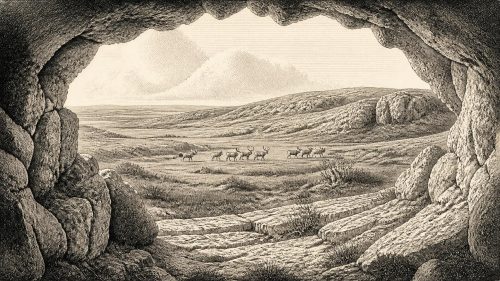
Southern Irish cave collections provide the clearest window into the island’s pre-Last Glacial Maximum fauna. Castlepook Cave near Doneraile in north County Cork is particularly important. Excavations conducted principally in the early twentieth century recovered many animal bones, although the original methods did not meet modern stratigraphic standards and much of the collection has been lost. Subsequent research and redating have shown that Irish caves retain evidence of mammals living on the island between at least about 45,000 and 20,000 years ago. That is a very wide span, so an assemblage must not be treated as a photograph of one moment.
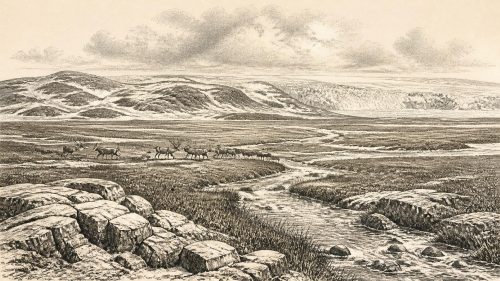
The known pre-LGM fauna includes reindeer, giant deer, red deer, brown bear, wolf, Arctic fox, mountain hare, lemmings, horse, spotted hyena and woolly mammoth. These names evoke a rich Ice Age ecosystem, but they do not establish that every species occupied Castlepook, or Ireland as a whole, at precisely 31,961 BCE. Bones accumulated through different episodes, and carnivores, water, sediment movement and excavation could mix them. Still, their presence shows that parts of Ireland could support substantial animal life during MIS 3. Reindeer and lemmings indicate cold-adapted conditions; mammoth and horse belong to open-country communities; predators reveal food chains rather than an empty wilderness.
The likely vegetation was correspondingly open. Treeless or sparsely wooded tundra-steppe, grasses, herbs, sedges and low shrubs would have offered seasonal grazing and browsing, while exposed rock, rivers, wetlands and sheltered valleys created local variation. It would be misleading to imagine an unchanging polar desert. Climate in MIS 3 shifted repeatedly over centuries and millennia, and animal ranges followed resources, snow cover and ice margins. The physical setting was dynamic: a route usable by grazing animals in one phase might have been blocked by sea, ice or difficult terrain in another.
The Question of People
The date is especially interesting because Castlepook has been associated with a reported reindeer bone bearing a mark interpreted as the result of cutting with a sharp stone tool. Public accounts have presented this as evidence of human activity around 33,000 years ago, approximately the period under discussion. The bone is important enough that a Royal Irish Academy-funded project has sought new excavation, museum study and securely contextualised evidence from the cave. But the claim must remain carefully framed: the specimen derives from an old collection, not an excavated living surface with tools, a fireplace and dated sediment preserved together.
A mark on one animal bone, even if confirmed as a cut mark, records a limited action on a carcass. It does not demonstrate a permanent settlement, a family group, a named people or a continuous population. No securely dated Irish house, hearth, stone-tool assemblage, burial, cave art or workshop of this age has yet been established. Earlier descriptions of the Castlepook collection even stressed the lack of recognised human traces in the material then studied; the subsequently reported modified bone is therefore a potentially significant but still isolated clue. The distinction between direct evidence and interpretation is crucial.
The earliest widely published direct evidence for a human presence in Ireland remains much later: a butchered brown-bear patella from Alice and Gwendoline Cave, County Clare, radiocarbon dated to about 12,800–12,600 calibrated years before present, roughly 10,800–10,500 BCE. That find demonstrates Late Upper Palaeolithic activity after the main glaciation, but cannot be used to fill the much earlier gap at Castlepook. It does, however, show why individual bones, examined with modern dating and microscopic methods, can transform a long-held chronology.
Connections Without a Known Community
Elsewhere in Europe, humans were certainly present. Around 34,000–24,000 years ago, archaeologists recognise a varied set of hunter-gatherer traditions often grouped under the Gravettian technocomplex. These were not one people or state: recent work emphasises regional cultural diversity across Europe. Northern European sites demonstrate sophisticated stone technologies, hunting practices, ornaments and social networks. None of this can responsibly be assigned to Ireland, because no Irish tool assemblage of this date links the island to a Gravettian group. It supplies context for the possibility of visitors, not an Irish cultural label.
Nor can a definite route into Ireland be reconstructed. Sea level was lower than today and coastlines were different, but lower water alone does not prove a walkable land bridge between Ireland and Britain. The Irish Sea basin, changing ice fronts and hazardous coasts made access a complex geographical problem. Any humans who reached the island may have travelled over a combination of exposed terrain, ice-edge environments and short sea crossings, but that is inference rather than evidence. No trade goods, imported raw materials or repeated route markers show organised exchange at this time.
No Politics, But Real Survival
There is no evidence from which to reconstruct political affairs, diplomacy, warfare, leadership, language, kinship rules or territorial boundaries in Ireland in 31,961 BCE. It would be anachronistic to invent tribes, kingdoms or “first Irish” identities. If hunters briefly visited, their immediate concerns may have included tracking animals, sheltering from weather, maintaining stone cutting edges and sharing food. Yet even these are informed possibilities drawn from wider Upper Palaeolithic life, not observations of an excavated Irish camp.
Religion, formal learning and artistic practice are equally beyond recovery in Ireland at this date. The absence of Irish cave art or ritual deposits should not be interpreted as proof that visitors had no beliefs or cultural knowledge; it means only that no such material has survived or been recognised. A proposed butchery mark may suggest practical processing of an animal, perhaps reindeer, but it cannot reveal a ceremony, myth or teaching tradition. Archaeological restraint is not a failure of imagination: it is what allows the sparse record to remain meaningful.
The major development represented by this period is environmental rather than political. Ireland was part of a northern world in which animal populations moved through cold open habitats while the British–Irish Ice Sheet expanded and reshaped the land. The possible Castlepook human trace gives this setting unusual historical significance, but it should be seen as a question under active investigation rather than a settled origin story. The National Museum of Ireland’s fossil collections, renewed cave excavations and improved radiocarbon methods may yet sharpen the picture. For now, 31,961 BCE belongs to Ireland’s deep prehistory: an Ice Age world securely attested by geology and fauna, with only the faintest, tantalising possibility of human footsteps beside it.
Primary Sources
- A reconsideration of the radiocarbon dating of the Marine Isotope Stage 3 fauna from southern Ireland
- The Irish Quaternary Fauna Project
- First evidence of a Late Upper Palaeolithic human presence in Ireland
- New insights on the fauna of Ireland's Younger Dryas and Early Holocene from Alice & Gwendoline Cave
- Growth and retreat of the last British–Irish Ice Sheet, 31,000 to 15,000 years ago: the BRITICE-CHRONO reconstruction
- Extent and timing of the Last Glacial Maximum (LGM) in Britain and Ireland: a review
- Dimensions and chronology of the last ice sheet in Western Ireland
- Radiocarbon constraints on the history of the western Irish ice sheet prior to the Last Glacial Maximum
- The timing and magnitude of the British–Irish Ice Sheet between Marine Isotope Stages 5d and 2: implications for glacio-isostatic adjustment, high relative sea levels and ‘giant erratic’ emplacement
- The problem of a late quaternary landbridge between Britain and Ireland
- The Archaeological Heritage of County Cork
- Archaeology Research Excavation Grant 2022: Final Report
- Excavation at Castlepook Cave, County Cork, 2022
- Irish Quaternary Vertebrates
- Guide to the National Museum of Ireland: Natural History
- Ice Age Ireland: Woolly Mammoth Activity Sheet
- Ireland's Palaeolithic Archaeology – Fleeting Footprints in a Frozen Land
- Palaeogenomics of Upper Palaeolithic to Neolithic European hunter-gatherers
- Evidence from personal ornaments suggest nine distinct cultural groups between 34,000 and 24,000 years ago in Europe
- Radiocarbon chronology for the Early Gravettian of northern Europe: new AMS determinations for Maisières-Canal, Belgium