Derryvree Ice-Free Interval31976 BCE
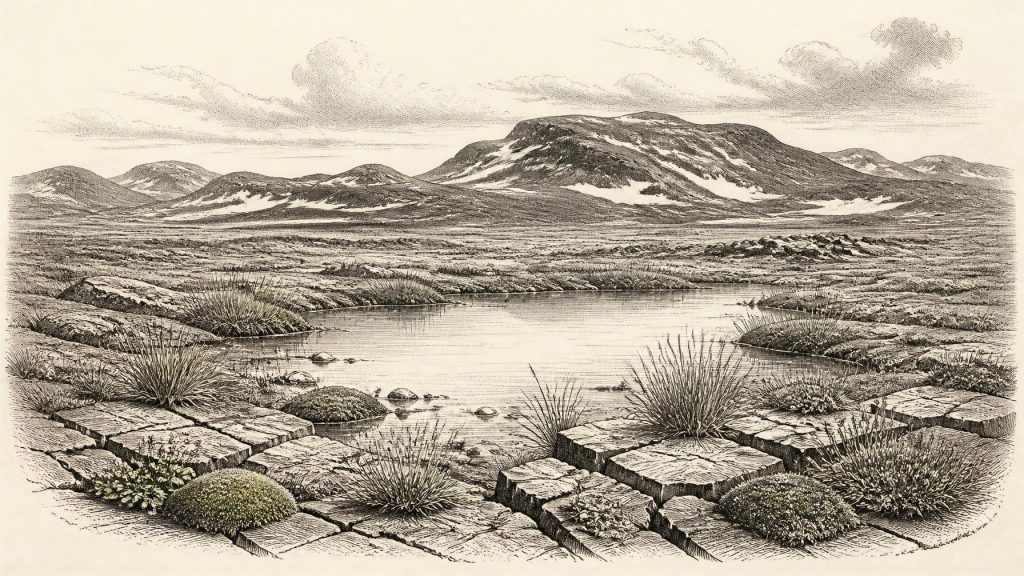
Around 31,976 BCE, Ireland had no securely attested human population, settlement or political history. Evidence from Derryvree, County Fermanagh, places the island within a later Marine Isotope Stage 3 ice-free interval, before major expansion of the last Irish Ice Sheet. Freshwater sediments, dated broadly to 36,900–31,700 years before present, indicate cold periglacial conditions and open tundra vegetation of herbs, grasses, sedges and mosses. Fossil records suggest shifting cold-adapted mammal communities, but cannot establish species present locally in that year. Approaching glaciation subsequently reshaped Ireland’s landforms and obscured much earlier evidence. The earliest persuasive human visit occurred over twenty millennia later.
Dateline
“31,976 BCE” is a useful point on a modern chronological scale, but it is not a year for which Ireland has an event, a ruler, a settlement or even a securely dated human presence. No prehistoric community counted time in BCE, and archaeological dating cannot normally distinguish one calendar year at this depth of time. The responsible approach is therefore to place this notional date within calibrated ranges. It falls about 33,925 years before the conventional radiocarbon-present of AD 1950, in the later part of Marine Isotope Stage 3, a cold and climatically variable interval of the Late Pleistocene.
For Ireland, the most important evidence close to this point comes not from monuments or tools but from sediments, pollen, animal bones and the marks left by ice. These records show an island poised before the great expansion of the last Irish Ice Sheet. They allow a partial reconstruction of a treeless, severe and changing environment. They do not permit a conventional political or social history. Around this date, Ireland’s story is principally one of climate, land and animal life.
A Date Within a Range
The nearest particularly informative sequence lies at Derryvree, near Maguiresbridge in County Fermanagh. Road works exposed freshwater silts and fine sands later buried beneath glacial deposits. Organic material from the deposit produced a radiocarbon age of about 30,500 radiocarbon years before present; when calibrated, the published range is approximately 36,900–31,700 calendar years before present. The nominal year 31,976 BCE lies within that broad interval. It is not possible to say that the deposit formed in that exact year, but it is responsible to regard it as evidence for conditions in northern inland Ireland at roughly this time.
That distinction matters. Radiocarbon ages are not calendar ages, calibration curves have ranges rather than single answers, and a deposit may have accumulated over time. Nor should one Fermanagh exposure be turned into a weather report for the whole island. Its value is substantial nonetheless: the sediments indicate that north-central Ireland was ice-free until at least about 34,000 calendar years ago, before the principal build-up of the last ice sheet. Nearby evidence at Greenagho, also in Fermanagh, similarly preserves an earlier ice-free episode. These sites are rare survivals, protected beneath younger glacial material, and make Ireland unusually visible for a short part of an otherwise fragmentary period.
Cold Ground, Open Country
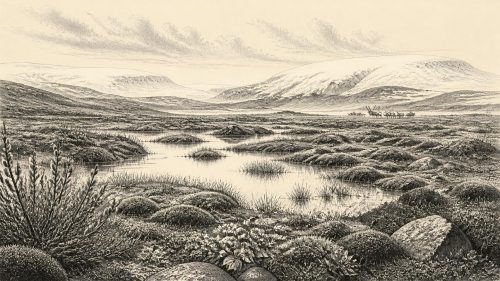
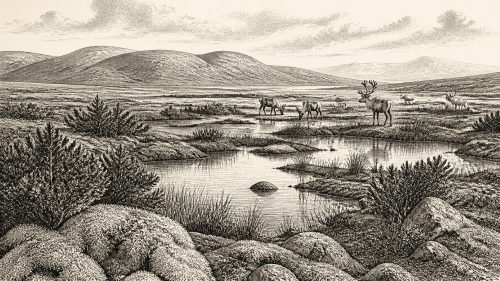
The plant evidence from Derryvree points to open tundra vegetation and a periglacial climate. Pollen was poorly preserved, as is common in ancient deposits, but it was chiefly from herbaceous plants; moss remains also survived. The landscape was therefore not the familiar green, wooded Ireland of later millennia. It was more likely a sparsely vegetated mosaic of grasses, sedges, herbs, mosses, wet ground and exposed mineral soil, shaped by intense cold, seasonal thaw and frost action. Patches of snow may have endured in sheltered uplands, while rivers and small lakes received sediment from unstable slopes.
“Periglacial” does not necessarily mean a land buried beneath an ice sheet. It describes a cold environment at or beyond a glacier’s margins, where repeated freezing and thawing can break rock, disturb soil and limit vegetation. At this point the Irish landscape was heading towards far more extensive glaciation, but the timing, thickness and exact limits of advancing ice varied between regions and remain matters of scientific reconstruction. The global Last Glacial Maximum is generally placed at about 26,500–19,000 years ago. In Ireland, dating and landform studies indicate a long transition from largely ice-free conditions around 34,000 years ago to a much enlarged ice sheet later in the glacial cycle.
This was thus neither a timeless frozen wasteland nor an early version of modern Ireland. The coastlines were also unlike those of today because much more of the world’s water was locked in growing ice sheets and sea level was lower. Yet local relative sea level around Ireland was affected by complex interactions among ocean level, crustal movement and the weight of ice. It would be misleading to draw a precise shoreline, land bridge or route of travel for 31,976 BCE from the available evidence. What can be said is that the Irish Sea world was changing rapidly in geological terms, and that later ice advance would heavily rework both terrestrial and offshore evidence.
Animals in a Fragmentary Record
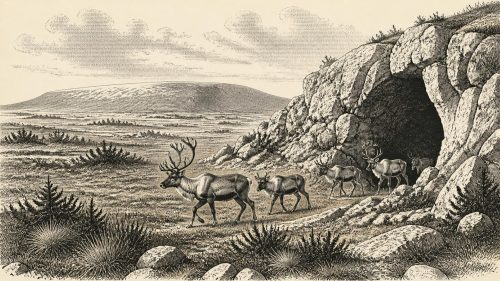
Ireland was not necessarily lifeless. Cave collections and other fossil deposits demonstrate that a varied large-mammal fauna occupied Ireland during parts of Marine Isotope Stage 3, before the Last Glacial Maximum. The recorded fauna has included brown bear, wolf, Arctic fox, hare, reindeer, mammoth, giant deer and spotted hyaena. Such lists should be used carefully. A fossil from an Irish cave proves that a species was present when that individual lived; it does not prove a stable population across every region, or that every listed animal was alive in the single nominal year under discussion.
Indeed, reassessment of old radiocarbon measurements has changed the picture. Improved pretreatment and redating of bones from southern Irish caves showed that several earlier results were too young by thousands of years. Some species once thought to have persisted nearer the Last Glacial Maximum may instead have disappeared locally much earlier, perhaps by about 40,000 calendar years ago. The correction is a useful warning against filling an imagined 31,976 BCE scene with a standard “Ice Age” menagerie. The evidence supports a cold-adapted and shifting Pleistocene fauna in Ireland; it does not support certainty about the precise local combination of animals at Derryvree on this particular date.
Predators, scavengers and herbivores would have belonged to ecological systems far different from those of historic Ireland. In open landscapes, animal movements could follow the availability of forage, shelter and seasonally accessible ground. Caves may have served as dens, traps for accumulated bone, or places where remains were later moved by water and sediment. Their contents are invaluable but taphonomically difficult: nineteenth- and early twentieth-century excavations often removed deposits before modern recording methods existed. Consequently, absence from the surviving record is not reliable proof that a species was absent from the island.
No Known Human Society
There is no secure evidence for people living in Ireland in 31,976 BCE. This means that there is no basis for identifying a population, language, kin group, leader, territory, ritual practice, camp, tool-kit, exchange network or conflict on the island. Political affairs, diplomacy and warfare are not merely unknown in detail: the archaeological record does not establish that any human society was present to undertake them. Nor can religion, learning, art, domestic routines, hunting practices, trade or social hierarchy be responsibly reconstructed for Ireland at this date.
That conclusion must not be softened by projecting the better-known Upper Palaeolithic cultures of continental Europe or Britain across the sea. Human groups elsewhere in north-west Europe demonstrably made sophisticated stone and bone tools, travelled widely, hunted, exchanged materials and created symbolic art. Those facts show what Homo sapiens could do in the wider world, not what people did in Ireland. Similarity of climate or geographical proximity is not evidence of an Irish occupation.
The island’s earliest reported stone object, a flint flake found at Mell in County Louth, illustrates the problem. It may have been made far earlier, perhaps 300,000–400,000 BCE, but was transported and redeposited by ice; it cannot establish an early Irish settlement. The first persuasive evidence of a human visit is vastly later: cut marks on a brown-bear kneecap from Alice and Gwendoline Cave in County Clare have been dated to roughly 12,810–12,590 calibrated years before present. That terminal-Pleistocene find is important, but it belongs more than twenty millennia after the date considered here. Substantial evidence for sustained settlement comes later again, with Mesolithic hunter-gatherers after the end of the Ice Age.
Approaching Transformation
The greatest development relevant to 31,976 BCE was therefore environmental rather than human: the approach of full glacial conditions. Global ice sheets were expanding, while Ireland was entering the sequence that would culminate in extensive cover by the Irish Ice Sheet, connected in places and phases to the wider British–Irish Ice Sheet. Later ice eroded bedrock, carried stones, laid down till and moulded landforms; its eventual retreat helped create the drumlins, corries, eskers, lakes and drainage patterns that remain conspicuous in Ireland.
At this earlier point, however, Derryvree preserves a fleeting counter-image: inland ground not yet overwhelmed by the last major ice expansion, with freshwater sediment accumulating amid sparse tundra vegetation. It is a small window, not a complete panorama. Ireland in 31,976 BCE had no recoverable history of kings, wars or monuments. Its recoverable history is quieter and deeper: cold air, open ground, plants close to the soil, mobile animals, and a landscape on the threshold of glaciation that would erase much of what had gone before.
Primary Sources
- Trimlines, blockfields and the vertical extent of the last ice sheet in southern Ireland
- Last Glacial Maximum cirque glaciation in Ireland and implications for reconstructions of the Irish Ice Sheet
- Dimensions and chronology of the last ice sheet in Western Ireland
- Late Pleistocene chronostratigraphy and ice sheet limits, southern Ireland
- Radiocarbon constraints on the age of the maximum advance of the British–Irish Ice Sheet in the Celtic Sea
- Timing and pace of ice-sheet withdrawal across the marine–terrestrial transition west of Ireland during the last glaciation
- Oscillating retreat of the last British-Irish Ice Sheet on the continental shelf offshore Galway Bay, western Ireland
- Stratigraphic and palaeo-geomorphological evidence for the glacial-deglacial history of the last British-Irish Ice Sheet in the north-western Irish Sea
- The Last Glacial Maximum
- The Irish Quaternary Fauna Project
- A reconsideration of the radiocarbon dating of the Marine Isotope Stage 3 fauna from southern Ireland
- Could brown bears (Ursus arctos) have survived in Ireland during the Last Glacial Maximum?
- New insights on the fauna of Ireland's Younger Dryas and Early Holocene from Alice & Gwendoline Cave
- First evidence of a Late Upper Palaeolithic human presence in Ireland
- The colonization of Ireland: A human ecology perspective
- The Mesolithic in Ireland: when was it?
- Palaeoecology
- Prehistoric Details
- Stone Age
- Quaternary Geomorphology
- Ireland Through Geological Time
- Geology of Ireland