Castlepook’s Deep Bone Archive30944 BCE
At 30,944 BCE, Ireland lay within the climatically unstable Late Pleistocene, not a datable historical year. Derryvree in County Fermanagh preserves freshwater silts between glacial tills, indicating locally ice-free, open, tundra-like wetlands with sparse vegetation. Castlepook Cave, County Cork, contains a mixed, long-lived MIS 3 fauna, including mammoth, giant deer, reindeer, bear, hyena and smaller cold-adapted mammals. Its bones document changing ecosystems, not a single community or date-specific census. A possibly butchered reindeer bone suggests human visits, but no secure evidence establishes settlement. Approaching glaciation later erased much evidence, leaving exceptional deposits to reveal life amid advancing ice and change.
Dateline
“30,944 BCE” is a modern chronological label, not a year that can be recovered from Ireland’s Ice Age record. No calendar, named community, political event or individual can be placed in that precise year. In archaeological terms it falls about 32,893 years before AD 1950, the conventional radiocarbon ‘present’, during the Late Pleistocene and Marine Isotope Stage 3 (MIS 3). At such depth in time, radiocarbon determinations, sediment layers and climatic correlations yield ranges measured in centuries or millennia, not annual dates. The responsible history of Ireland at this point is therefore one of landscapes, animal populations, ice and rare deposits rather than rulers, settlements or historical episodes.
A Date Within a Broad Range
The closest important Irish environmental sequence is at Derryvree, near Maguiresbridge in County Fermanagh. Road works exposed fine sands and organic freshwater silts trapped between two tills: stony sediments left by glaciers. A radiocarbon determination from the organic deposits of c. 30,500 ± 1,100 radiocarbon years BP was historically calibrated to a wide interval of roughly 36,900–31,700 calendar years BP. That range encompasses the modern label 30,944 BCE, but does not date the entire deposit, still less an event in a particular year. Calibration itself has improved since the original research; IntCal20 confirms that radiocarbon ages must be converted through a curve and retain substantial uncertainty at this antiquity. Derryvree is consequently a securely valuable window on a broad cold-stage environment, not a diary of a single Irish year.
Its preservation is exceptional. Later glacier advance buried the wetland beneath fresh till, protecting an interval that ice otherwise might have scoured away. Much of Ireland’s evidence for this part of the Pleistocene has been lost, redeposited or concealed by later glacial action, sea-level change and modern landscapes. The Derryvree sequence accordingly has an importance beyond its small original exposure: it demonstrates that, during part of the wider period relevant to this date, biologically active, locally ice-free freshwater ground existed in inland Ulster. It cannot establish that all of Ireland was similarly open, nor trace the exact position of every ice margin.
Wet Ground in a Cold Country
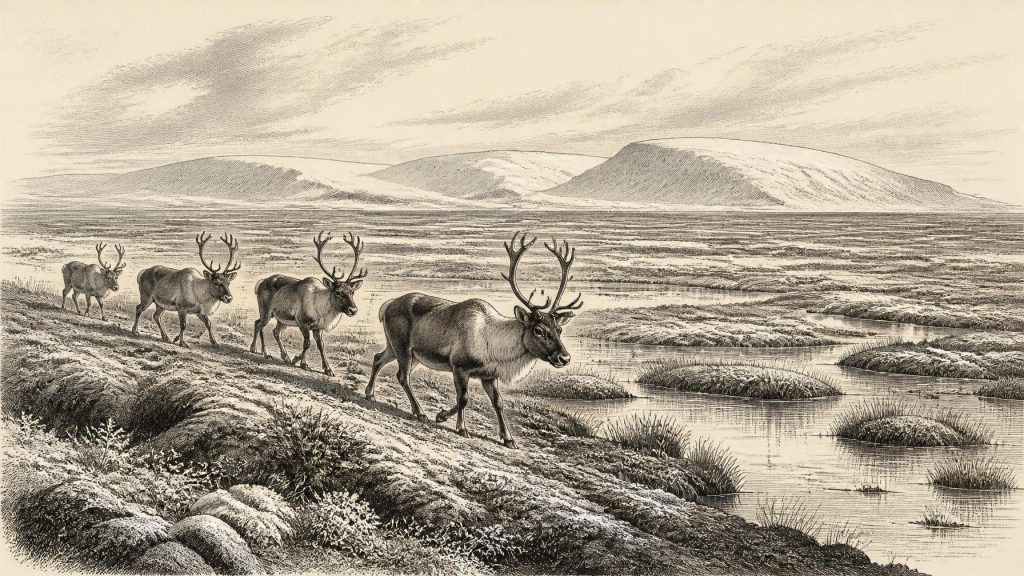
Plant remains, pollen and fossil insects from Derryvree indicate open, largely treeless country. The published interpretation is a cold-phase muskeg or tundra-like wetland, with mosses, sedges, grasses and herbs around shallow water and damp ground. Low shrubs, including juniper, may have occurred locally. Such evidence corrects the misleading picture of Ice Age Ireland as either a featureless white wilderness or an unbroken plain of grass. It was a mosaic: waterlogged hollows, pools, sedgy margins, frost-affected soils and more exposed mineral ground. The vegetation was sparse by later Irish standards, but it was ecologically productive during favourable seasons.
Seasonality mattered greatly. Winter cold, frozen or saturated surfaces, limited woody fuel and short growing seasons would have restricted plant growth and animal movement. Summer thaw, however, could create feeding grounds for insects and herbivores and replenish pools and streams. The deposits do not tell us the weather on a given day in 30,944 BCE, and they do not prove continuous habitation by any species. They do show that a living wetland developed between phases of glaciation. In the Irish story for this period, that environmental fact is more securely known than any human activity.
The Castlepook Fauna
The other principal archive lies far to the south at Castlepook Cave, also known as Mammoth Cave or Doneraile Cave, in north County Cork. Excavations between 1904 and 1918 recovered more than 2,000 bones from its narrow limestone passages and chambers. Castlepook is Ireland’s richest known source for vertebrate remains dating to the long interval before the Last Glacial Maximum. Direct radiocarbon dates on individual bones span approximately 45,700 to 19,950 years BP, meaning that the cave collection is a time-depth archive, not the remains of one animal community or one moment of occupation.
Its mammals include woolly mammoth, giant deer, reindeer, brown bear and spotted hyena, alongside wolf, Arctic fox, mountain or Arctic hare, and lemmings. The presence of such animals shows that Ireland was intermittently connected to wider north-west European ecological systems before the sea reached its later extent. It also reveals a landscape capable, at different times within MIS 3, of sustaining large grazers, browsers, scavengers and predators. Spotted hyena is particularly striking: Castlepook is the only Irish site known to have produced it. Hyenas probably helped accumulate and modify bones in the cave, while water movement and early excavation disturbed other deposits. These processes are essential to interpretation. A bone in a cave need not record where an animal died, and bones of very different ages can lie together.
Recent redating has made that caution more important. Improved pretreatment and ultrafiltration have shown that some 1990s radiocarbon dates for southern Irish cave fauna were too young, in certain Castlepook cases by thousands of radiocarbon years. The revised evidence places important elements of the fauna more firmly within MIS 3 and suggests that some, including giant deer and spotted hyena, disappeared locally before the Last Glacial Maximum. Thus Castlepook supports a broad picture of a cold, open-country fauna in Ireland around the wider period of 30,944 BCE, but it does not permit a precise census of which animals stood outside the cave in that notional year.
People: Possibility, Not Settlement
The question of human presence needs especially careful treatment. A reindeer femur from Castlepook has been presented in public discussion as bearing a deep mark compatible with stone-tool butchery and as dating to about 33,000 years ago. If that interpretation is ultimately sustained, it may indicate a brief human encounter with an animal during the broader era considered here. It would not, by itself, demonstrate a camp, a resident population, a family group or a route of regular migration. The object derives from an old cave collection with limited modern stratigraphic context, while carnivore activity and sediment movement complicate the setting.
There is, moreover, no securely excavated hearth, stone-tool assemblage, dwelling, burial, art or other directly associated material that can currently establish human occupation of Ireland around 30,944 BCE. Renewed excavation at Castlepook in 2022 identified surviving deposits and recovered animal remains, but found no cultural artefacts. The earliest published evidence widely accepted as humanly modified in Ireland remains much later: a butchered brown-bear patella from Alice and Gwendoline Cave, County Clare, dated to c. 12,810–12,590 cal BP. That later find proves that people reached Ireland in the terminal Pleistocene; it cannot be projected backwards twenty millennia. For 30,944 BCE, the sound conclusion is that human visits remain possible, perhaps even plausible in a wider European context, but unconfirmed as settlement.
No Polities, No Diplomacy
Accordingly, there is no evidence for political affairs, warfare, diplomacy, chiefs, territorial boundaries or institutions in Ireland at this date. Nor can archaeology identify religion, language, ritual practice, teaching, family structure, exchange networks or a domestic economy. It would be misleading to supply them by analogy with Upper Palaeolithic societies elsewhere in Europe. People in other regions demonstrably made sophisticated stone tools, ornaments and cave art, but no such Irish material belongs securely to this period. Absence of evidence is partly a consequence of later glaciation and difficult preservation; it is not proof that people could never have arrived. Yet historical reconstruction must distinguish that possibility from evidence.
The only economy that can be responsibly described is ecological. Wetland plants captured sunlight; insects occupied the damp margins; herbivores used the open country; and carnivores and scavengers followed them. Mammoth, reindeer and giant deer did not constitute an ‘Irish economy’ unless people hunted or processed them, which remains unproven for this date. If small human parties did reach the island, their survival would have depended on mobile hunting, careful knowledge of season and terrain, and access to fuel and shelter. That is an inference from comparable environments, not a discovery from Derryvree or Castlepook.
Approaching Greater Ice
At the scale of the British–Irish Ice Sheet, this was a period of climatic instability and developing glaciation rather than the later maximum of ice extent. BRITICE-CHRONO reconstructions begin at 31,000 years ago and show that ice growth could be rapid, though the timing and extent of Irish ice in earlier MIS 3 remain complex and locally debated. The important long-term development was the approach of a more severe glacial world. Subsequent ice reshaped drainage, stripped surfaces, carried debris across the island and sealed a few fortunate deposits such as Derryvree. The record’s patchiness is therefore part of the history: Ireland’s oldest recoverable landscapes survive not because they were typical, but because they escaped destruction by chance.
For this point in deep time, then, Ireland was neither a documented society nor an empty abstraction. It was a changing northern landscape in which freshwater wetlands could exist between glacial advances and large Ice Age mammals moved through open country. Castlepook’s bones and Derryvree’s silts offer different kinds of testimony: one a long, mixed animal archive; the other a local environmental sequence. Together they illuminate conditions around a broad chronological horizon that includes 30,944 BCE. They do not supply a year-specific event. Their enduring value lies in making that limit clear while revealing how much life persisted on the edge of advancing ice.
Primary Sources
- A Middle Midlandian Freshwater Series at Derryvree, Maguiresbridge, County Fermanagh, Northern Ireland
- Irish Pleistocene Biostratigraphy
- The Irish Quaternary Fauna Project
- A Reconsideration of the Radiocarbon Dating of the Marine Isotope Stage 3 Fauna from Southern Ireland
- Castlepook Cave: County Geological Site Report
- Spotted Hyena Skull
- 2022:564 – Castlepook Cave, Castlepook South, Cork
- First Evidence of a Late Upper Palaeolithic Human Presence in Ireland
- New Insights on the Fauna of Ireland’s Younger Dryas and Early Holocene from Alice & Gwendoline Cave
- The IntCal20 Northern Hemisphere Radiocarbon Age Calibration Curve (0–55 cal kBP)
- Growth and Retreat of the Last British–Irish Ice Sheet, 31,000 to 15,000 Years Ago: The BRITICE-CHRONO Reconstruction
- BRITICE-CHRONO
- Trimlines, Blockfields and the Vertical Extent of the Last Ice Sheet in Southern Ireland
- Quaternary Site Descriptions
- Figure 6.— The Subdivision of the Quaternary Period in Ireland
- References and Recommended Reading
- Archaeology Research Excavation Grant 2022: Final Report
- Archaeological Heritage of County Cork
- Ireland’s Palaeolithic Archaeology – Fleeting Footprints in a Frozen Land
- The Colonization of Ireland: A Human Ecology Perspective