Ireland at the Ice Margin31933 BCE
31,933 BCE is an artificial label for a period near the onset of the last Irish Ice Sheet’s expansion, rather than a datable event. Ireland experienced uneven cooling, changing coastlines and glaciated landscapes, while maximum ice extent followed later. Buried sediments in Fermanagh indicate areas remained ice-free until roughly 34,000 years ago. Castlepook Cave, Cork, preserves remains of mammoth, giant deer, reindeer, bear, hyaena and Ice Age animals, demonstrating open habitats and food webs. A possibly butchered reindeer bone suggests, but does not prove, human visits. No evidence establishes settlement, society or political history; environmental change dominates the fragile record.
Dateline
31,933 BCE is a modern calendar label, not a date at which archaeology can identify an Irish event. There were no written records, named communities, rulers or calendar systems on the island from which a precise “year” could be recovered. In scientific terms, the label falls roughly 33.9 thousand years before AD 1950, but even that conversion must not be mistaken for precision. Evidence from this depth of time is dated in broad calibrated ranges, often with sizeable uncertainties, and it usually records episodes rather than a single season or year.
The responsible picture is therefore one of late Pleistocene Ireland during Marine Isotope Stage 3, shortly before the fullest expansion of the last British–Irish Ice Sheet. It is a landscape known principally through cave bones, sediments beneath later glacial deposits, landforms, and measurements made on rocks and seabed sediments. These sources can illuminate climate, animals and changing ice cover. They cannot securely supply a political history, a chronology of conflict, or the daily experience of an identified human group in 31,933 BCE.
A Country Approaching Glaciation
Ireland was not simply a timeless white wilderness throughout the whole Ice Age. The climatic sequence was uneven, and the growth of the final great ice sheet was a process, not an instantaneous conquest of the island. Evidence from organic deposits sealed beneath till at Derryvree and Greenagho in County Fermanagh indicates that north-central Ireland had been ice-free until at least about 34,000 years ago. A synthesis of the evidence consequently places the principal build-up and expansion of the last Irish Ice Sheet between about 34,000 and 24,000 years ago. The numbered year in this article sits at or very close to the beginning of that long transition.
That chronology matters because it rules out two tempting but misleading certainties. It is not safe to picture every hill and valley in Ireland as already buried beneath the maximum ice sheet in 31,933 BCE; the best-dated maximum and shelf-edge advances came later, broadly between about 27,000 and 23,000 calibrated years ago in different sectors. Equally, it would be wrong to imagine a stable, hospitable island. Cooling conditions, accumulating snow and advancing ice were changing habitats and drainage over millennia. What was happening at one place could differ substantially from conditions in another.
At this stage, coastlines also differed from those familiar today. Large quantities of water were locked in global ice sheets, lowering sea levels and exposing parts of the continental shelves around north-west Europe. Yet a lower sea level does not automatically demonstrate an easy land bridge to Ireland at every point in the Ice Age. The routes available to animals or people depended on local sea depths, glaciers, sea ice, weather and changing shorelines. Any crossing would have been a formidable ecological and geographical matter, not a simple stroll across a modern map.
What the Caves Preserve
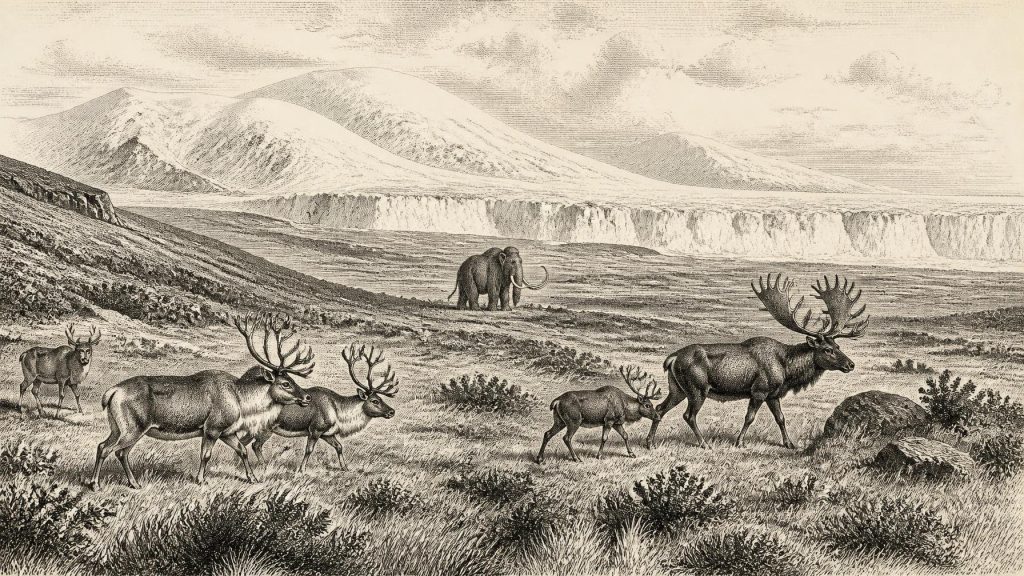
The most informative Irish archive for this broad period is Castlepook Cave near Doneraile, in north County Cork. Excavations and later study recovered more than 2,000 animal bones from deposits disturbed and accumulated over a very long span, with individual radiocarbon determinations ranging approximately from 45,700 to 19,950 years BP. This is not a neatly layered snapshot of one occupation. Water disturbance and the activity of carnivores have mixed and complicated the record. Nevertheless, it establishes that southern Ireland supported a striking assemblage of Ice Age mammals before the Last Glacial Maximum.
Its fauna includes woolly mammoth, giant deer, reindeer, brown bear and spotted hyaena; later material includes wolf, Arctic fox and lemmings. These remains are evidence for animal presence, not for all species living together at precisely the same moment. Nor does a bone in a cave necessarily prove that the animal died there: hyaenas could carry prey or carrion into dens, while water could move remains. But the assemblage demonstrates a wider food web than Ireland’s later, post-glacial fauna. Plant-eating animals relied on open vegetation, while large predators and scavengers exploited the herbivores and their carcasses.
A historically supportable scene around this date is thus not one of forested Ireland. Before the eventual Last Glacial Maximum, colder, more open environments supported grazing animals in at least some regions. Mammoths ate grasses, herbs and other low vegetation; reindeer were adapted to cold, open country; and hyaenas, wolves and bears occupied different places in the predator and scavenger community. The precise pattern of plant cover around Castlepook in any individual century remains uncertain, however. The cave tells us much more securely which animals reached the region than exactly what a particular slope or river valley looked like in 31,933 BCE.
The Human Question
The possibility of people in Ireland at this early date requires particular care. A reindeer femur from the Castlepook collection has been reported as bearing deep marks consistent with butchery by a stone tool and as dating to around 33,000 years ago. If the marks are confirmed as human-made and securely associated with the bone’s age, the find would be exceptionally important: it would suggest a brief Upper Palaeolithic human presence in Ireland more than 20,000 years earlier than the previously published Late Glacial evidence.
It does not, though, justify a settled population, a village, or an unbroken ancestry from Ice Age visitors to later Irish communities. No securely stratified stone-tool assemblage, hearth, dwelling, human burial or repeated camp of this age has yet established a permanent population. The National Museum of Ireland continues to describe clear Palaeolithic proof of humankind in Ireland as absent, while the best-published direct evidence for human activity is a brown-bear kneecap bearing fresh-bone cut marks from Alice and Gwendoline Cave, County Clare, dated to about 10,800–10,500 BCE.
The difference between those statements is not a contradiction to be smoothed away. It is the normal distinction between a promising reported find and a fully demonstrated archaeological record. Castlepook’s reindeer bone makes the prospect of an earlier visit worthy of renewed excavation, microscopic analysis of marks, dating and publication. It cannot tell us that people were definitely present in the calendar year 31,933 BCE. If small groups did reach Ireland during the broader period, they would have been highly mobile foragers whose survival depended on detailed knowledge of seasonal animals, shelter, fuel and routes through a severe landscape. That is an inference from comparable Upper Palaeolithic societies elsewhere in Europe, not an observed Irish settlement.
Society Beyond the Evidence
For the same reason, no responsible account can identify Irish political affairs, diplomacy, warfare, laws, kin groups or leaders at this date. There is no evidence for states, territories or organised polities, and no basis for projecting later Gaelic traditions backwards over more than thirty millennia. Nor is there Irish evidence for formal religion, art, language, schooling or ceremonial monuments in this period. The famous monuments, metalwork and manuscript culture of later Ireland belong to vastly different worlds.
Even everyday life is demonstrably elusive. If humans entered the island, food procurement may have involved the hunting or scavenging of large mammals and the gathering of plant foods where conditions allowed, but Castlepook itself cannot specify techniques, household arrangements, clothing or social roles. Its cave assemblage is more immediately a record of animal ecology and bone accumulation than a domestic site. Trade, too, cannot be identified: no artefact distributions or imported materials demonstrate exchange networks connected to Ireland at this time.
What can be said is that the physical foundations of later regional landscapes were being prepared. Glacial erosion, deposition and meltwater processes associated with the last glaciation helped create or reshape valleys, basins, ridges and sediment blankets. Eskers, drumlin fields, corries and glacially scoured terrain visible in Ireland today are products of repeated ice-age processes, though most cannot be assigned specifically to this one year. The later retreat of ice would alter drainage, create lakes and expose fresh ground for plants, animals and ultimately people.
A Fragile Record
The central development around 31,933 BCE was therefore environmental rather than political: Ireland stood near the opening of the final expansion towards the Last Glacial Maximum. In parts of the island, large mammals had recently ranged through cold open country; in others, ice conditions may already have been strengthening. Cave deposits in Cork and buried sediments in Fermanagh preserve fragments of that changing world. They also show why certainty is difficult. Glaciers eroded older surfaces, acidic soils destroyed organic remains, and later water movement disturbed caves and shorelines.
Absence of evidence is not proof that no person ever crossed into Ireland during this period. But neither is an intriguing bone sufficient proof of a society. The historically sound conclusion is more restrained and more revealing: around the artificial date 31,933 BCE, Ireland was a climatically unstable, increasingly glaciated frontier within north-west Europe, inhabited securely by Ice Age animals and possibly visited by people. Its human history, if there was one then, survives only as a question at the edge of the archaeological record.
Primary Sources
- A Reconsideration of the Radiocarbon Dating of the Marine Isotope Stage 3 Fauna from Southern Ireland
- Trimlines, Blockfields and the Vertical Extent of the Last Ice Sheet in Southern Ireland
- Timing and Pace of Ice-Sheet Withdrawal Across the Marine–Terrestrial Transition West of Ireland During the Last Glaciation
- Exploring Controls of the Early and Stepped Deglaciation on the Western Margin of the British Irish Ice Sheet
- Stratigraphic and Palaeo-Geomorphological Evidence for the Glacial-Deglacial History of the Last British-Irish Ice Sheet in the North-Western Irish Sea
- Maximum Extent and Dynamic Behaviour of the Last British–Irish Ice Sheet West of Ireland
- Deglaciation Chronology of the Donegal Ice Centre, North-West Ireland
- Maximum Extent and Readvance Dynamics of the Irish Sea Ice Stream and Irish Sea Glacier Since the Last Glacial Maximum
- New Data for the Last Glacial Maximum in Great Britain and Ireland
- Dating Constraints on the Last British-Irish Ice Sheet: A Map and Database
- Castlepook Cave, County Geological Site Report
- Archaeological Heritage of County Cork
- Prehistoric Details: Stone Age Collections
- Ice Age Ireland: Cool Fossils!
- The Mesolithic in Ireland: When Was It?
- Quaternary Geomorphology
- Ireland Through Geological Time
- Castlepook Cave, Co. Cork: Excavation Report 2022
- The Antiquity of Man in Ireland
- Late Glacial and Holocene Aeolian Deposition and Soil Formation in Relation to the Late Palaeolithic Ahrensburg Occupation, Site Geldrop-A2, the Netherlands