Awbeg Valley Faunal World31842 BCE
Around 31,842 BCE, Ireland lay in the unstable Late Pleistocene, before the Last Glacial Maximum, when expanding ice alternated with cold, open freshwater landscapes. Inter-till deposits in Fermanagh preserve evidence of grasses, sedges, tundra plants, insects and waterlogged ground. Castlepook Cave above the Awbeg Valley contains Marine Isotope Stage 3 remains of reindeer, mammoth, giant deer, hyaena, wolves and other cold-adapted fauna, demonstrating links with wider north-west Europe. A cut-marked reindeer femur may indicate brief human butchery, but disturbed cave contexts preclude certainty. No settlement, tools, hearths or cultural evidence confirms occupation. Scientific dating and environmental remains define it best.

Dateline
The label 31,842 BCE is a modern way of locating a point far beyond the reach of historical calendars. No event in Ireland can be assigned to that individual year, and no person, community or political act can responsibly be named for it. In archaeological terms, it lies roughly 33,800 years before AD 1950, during the Late Pleistocene and broadly within Marine Isotope Stage 3, an unstable interval of the last Ice Age. The evidence is measured in deposits, animal bones and scientific date ranges rather than annual records. This is therefore a portrait of conditions around the date, not an account of a year that contemporaries could have recognised.
A Landscape Not Yet Frozen Over
Ireland was approaching, rather than already deep within, the Last Glacial Maximum. The great British–Irish Ice Sheet later attained its greatest extent during roughly 27,000–19,000 years ago, but its growth was neither instantaneous nor uniform. Evidence from glacial landforms, offshore sediments and dated deposits points to a prolonged expansion from initially less extensively ice-covered conditions. At this earlier horizon, parts of Ireland could still support freshwater environments, vegetation and large mammals, even as colder conditions and advancing ice were reshaping the island.
That broad picture must not be mistaken for a map of every valley in 31,842 BCE. Ice margins moved, climates oscillated and deposits have survived unevenly. Northern Irish sites are especially valuable because organic sediments were sealed beneath later glacial material. At Derryvree in County Fermanagh, organic-rich silts between tills yielded a radiocarbon determination calibrated to approximately 36,900–31,700 cal BP. The range broadly embraces the notional date considered here. It indicates that, before subsequent ice overran the locality, waterlogged ground and vegetation existed there. It cannot tell us what happened in a particular season, nor prove that the whole island was ice-free at once.
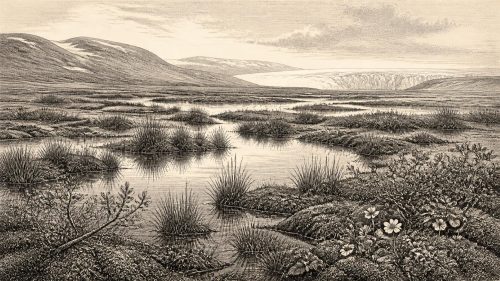
Nearby deposits at Greenagho and Hollymount, also in Fermanagh, reinforce the essential point: the Ireland of this phase was not simply a blank white sheet. Freshwater silts, plant remains, pollen and insects record cold, open environments between episodes of glaciation. Older reconstructions describe treeless, northern-looking vegetation, including grasses, sedges, dwarf shrubs and tundra plants. The precise correlation of every Irish sequence with continental climatic phases remains debated, but the evidence supports a generally exposed, cold and highly seasonal terrain rather than later Ireland’s wooded Atlantic landscape.
What the Animal Record Shows
The clearest direct witnesses to this world are animal remains, particularly those from limestone caves in southern Ireland. Castlepook Cave, near Doneraile in north County Cork and overlooking the Awbeg Valley, is central to the discussion. Its old collections include bones attributed to reindeer, woolly mammoth, giant deer, brown bear, wolf, Arctic fox, hare, lemmings and spotted hyaena. These species should not be turned into a literal roll-call for one day or year. Caves may act at different times as dens, traps, shelters, drainage routes and places where bones are redeposited. Nevertheless, improved radiocarbon methods have shown that some Castlepook fauna belongs to Marine Isotope Stage 3, well before the glacial maximum.
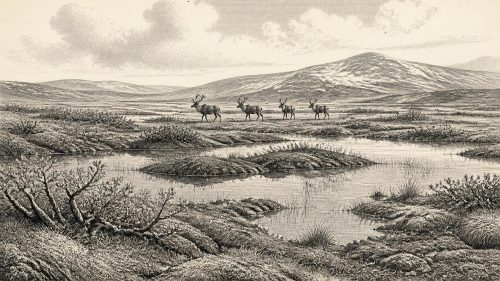
Reindeer are particularly evocative. Their presence is strong evidence for open, cold-adapted habitats with enough forage to sustain grazing and browsing herds. Mammoth and giant deer remains likewise show that, at intervals, substantial herbivores could enter and live in parts of Ireland. Their predators and scavengers mattered too. Spotted hyaena remains from Castlepook demonstrate that Ireland was connected to a wider north-west European animal world; hyaenas could accumulate and modify bones in caves, complicating any simple account of how individual specimens arrived there. Wolves, bears and foxes belonged to an ecological setting in which carcasses were contested resources.
This fauna implies movement across a changing north-west European landscape, but it does not settle the exact routes. Lower sea levels and the changing configuration of ice, coasts and shallow seas created opportunities for animals to disperse between Ireland and Britain or the continental shelf. Yet the presence of a species does not prove a permanent land bridge at a precise date. Nor can fossil finds establish population sizes, migration routes or whether all the named animals overlapped at Castlepook. The responsible conclusion is narrower and more important: Ireland contained, or was repeatedly reached by, a cold-stage mammal community long before the final retreat of the last ice sheet.
The Castlepook Human Question
Castlepook has acquired special importance because a reindeer femur from the cave has been reported as bearing a deep incision interpreted as a cut mark made by a sharp stone tool while the bone was fresh. County Cork heritage material has presented the specimen as evidence of human activity in Ireland about 33,000 years ago. If that interpretation is confirmed, it would place people in Ireland dramatically earlier than the previously recognised Late Upper Palaeolithic evidence from Alice and Gwendoline Cave in County Clare, where a butchered brown-bear patella has calibrated ranges of 12,810–12,590 and 12,810–12,685 cal BP.
For a date around 31,842 BCE, however, the Castlepook reindeer bone must be handled with care. A radiocarbon result dates the animal’s death, not necessarily the instant when a mark was made, the place where it was killed, or the length of any human visit. Identifying an incision as a stone-tool cut is a separate taphonomic judgement: natural damage, animal teeth, trampling and excavation history all require assessment. Much of Castlepook’s celebrated material was recovered during early twentieth-century excavations, before the stratigraphic standards now expected. The Irish Quaternary Fauna Project warned that many old cave deposits had been disturbed, and modern work at Castlepook has sought surviving undisturbed sediments precisely because context is crucial.
Thus the reindeer femur is best described as a potentially momentous but isolated indication of human butchery, not as proof of a settled Irish population. No securely associated hearth, stone-tool assemblage, dwelling floor, burial, food store or built shelter of this age has been found in Ireland. There is no demonstrated chain of occupation linking any possible visitors of this period with the hunter-gatherers who returned much later after the ice retreated. The distinction is not pedantry: an animal bone with a possible tool mark can reveal a brief encounter, whereas a settlement requires repeated and securely contextualised traces of life.
People, If Present
If people did reach the Awbeg Valley or another Irish locality around this horizon, the most reasonable interpretation is of a small, mobile Upper Palaeolithic foraging party, not a village or tribe in the later sense. The reindeer bone, if humanly modified, suggests carcass processing: the removal of meat, hide, sinew or marrow. It does not establish whether the animal was hunted, found dead, taken from predators or processed inside the cave. Nor does it disclose the group’s language, identity, kinship system, clothing, rituals or route of arrival.
There is consequently no evidence for political affairs, rulers, diplomacy, warfare, law or territorial boundaries in Ireland at this time. It would be misleading to imagine competing Irish peoples, even though people elsewhere in Upper Palaeolithic Europe certainly made social alliances, shared skills and negotiated dangerous landscapes. No Irish evidence identifies such institutions. Equally, there is no basis for claiming trade, regular exchange or seafaring. Any crossing to Ireland, if one occurred, might have been over land exposed by lower seas, across narrow water, or by a combination of routes; the evidence does not presently decide between these possibilities.
Everyday Survival Without a Settlement
Daily life can therefore be discussed only as conditional inference. A party exploiting a reindeer carcass would have needed sharp stone edges and practical knowledge of animal anatomy. In a landscape of wind, frost, sparse cover and large predators, mobility, fuel, shelter and seasonal timing would have been decisive. Caves could offer temporary protection, but Castlepook’s bones do not show that people lived there. Open-air camps, if they existed, were vulnerable to later glacial erosion, sediment movement and sea-level change; their absence is meaningful but cannot prove that no visitor ever came.
Religion, art, storytelling and learning leave no identifiable Irish trace for this period. There are no cave paintings, portable artworks, monuments, graves or symbolic objects securely dated to around 31,842 BCE. This silence should not be read as evidence that any possible people lacked culture. Rather, the archaeological record is too thin to recover it. The same is true of economic life: wild animals and local plant resources were the only demonstrable potential basis of subsistence, while farming, herding, pottery, metalwork and permanent settlement lay many millennia in the future.
An Island of Evidence and Uncertainty
The most important development around this date was environmental rather than political: Ireland remained capable, in some regions and intervals, of sustaining a cold-adapted fauna while the last ice sheet was gathering strength. Fermanagh’s inter-till deposits preserve wet, treeless landscapes; Castlepook preserves the remains of animals that ranged through a far broader Ice Age world. The reported reindeer cut mark adds the provocative possibility that humans briefly shared that world.
But possibility is not certainty. Modern calendar-year precision is unavailable, and calibrated ranges are essential rather than decorative. Around 31,842 BCE, Ireland was not yet a historical society waiting to be named. It was a shifting Pleistocene environment, known through silt, pollen, bones, cave sediments and the disciplined uncertainty of scientific dating. Future excavation and microscopic analysis may strengthen, alter or overturn the human interpretation at Castlepook. For now, the evidence supports an Ice Age fauna and changing glacial landscape with confidence, and a possible fleeting human presence with caution.
Primary Sources
- A Reconsideration of the Radiocarbon Dating of the Marine Isotope Stage 3 Fauna from Southern Ireland
- The Irish Quaternary Fauna Project
- First Evidence of a Late Upper Palaeolithic Human Presence in Ireland
- Trimlines, Blockfields and the Vertical Extent of the Last Ice Sheet in Southern Ireland
- Growth and Retreat of the Last British–Irish Ice Sheet, 31,000 to 15,000 Years Ago: The BRITICE-CHRONO Reconstruction
- Pattern and Timing of Retreat of the Last British-Irish Ice Sheet
- Dimensions and Chronology of the Last Ice Sheet in Western Ireland
- Maximum Extent and Dynamic Behaviour of the Last British–Irish Ice Sheet West of Ireland
- Sedimentology and Chronology of the Advance and Retreat of the Last British-Irish Ice Sheet on the Continental Shelf West of Ireland
- Inter-till Freshwater Deposit at Hollymount, Maguiresbridge, Co Fermanagh
- Irish Pleistocene Biostratigraphy
- The Subdivision of the Quaternary Period in Ireland
- Quaternary Data and Maps
- Ireland Through Geological Time
- Archaeological Heritage of County Cork
- 2022:564 – Castlepook Cave, Castlepook South, Cork
- New Insights on the Fauna of Ireland’s Younger Dryas and Early Holocene from Alice & Gwendoline Cave
- The IntCal20 Northern Hemisphere Radiocarbon Age Calibration Curve (0–55 cal kBP)
- The Mesolithic in Ireland: When Was It?
- Ireland: Submerged Prehistoric Sites and Landscapes