
Derryvree’s Dwarf Willow31752 BCE
31,752 BCE is a modern label rather than a precisely recoverable Irish year. Evidence from Derryvree, County Fermanagh, records an ice-free MIS 3 interval between glacial advances, with freshwater silts preserving tundra vegetation including dwarf willow, bogbean, sedges and mosses. Greenagho supports regional ice-free conditions, although Ireland’s ice cover, coastlines and connections remained variable. Castlepook Cave in Cork documents diverse cold-stage fauna, but revised dates prevent assuming contemporaneous species. A marked reindeer bone may indicate Upper Palaeolithic butchery, yet no secure settlement evidence exists. The period is best understood through fragmentary environmental records preceding major ice-sheet expansion across the island.
Dateline
31,752 BCE is a modern calendar label, not a year that can be recovered from the Irish archaeological record. No contemporary community in Ireland named it, and no written source, settlement layer or scientific measurement can be dated responsibly to that precise twelve-month interval. In radiocarbon terms it falls roughly 33.7 thousand calendar years before AD 1950, within the later Pleistocene and Marine Isotope Stage 3 (MIS 3). At this depth of time, calibrated ranges commonly extend across centuries or millennia. The appropriate subject is therefore Ireland around this horizon: a cold, changing landscape inferred from sediments, plant remains, animal bones and reconstructions of advancing ice, rather than a year of recorded events.
Dating an Uncertain Interval
The distinction between a radiocarbon age and a calendar age matters especially here. Radiocarbon years are calculated from the remaining carbon-14 in once-living material; they are not identical to calendar years. They must be calibrated against a curve that models changing atmospheric carbon-14 levels. IntCal20 extends such calibration to 55,000 calendar years before present, but its older sections draw on several natural archives and carry meaningful uncertainty. A date expressed as 31,752 BCE may be useful for arranging an archive, but it must not imply that Ireland’s climate, coastlines or inhabitants can be described with annual precision.
The most valuable evidence close to this broad horizon comes from Derryvree, near Maguiresbridge in County Fermanagh. Roadworks exposed organic freshwater silts and fine sands sealed between two bodies of glacial till within a drumlin. Their sequence records an earlier ice advance, an interval in which freshwater deposits accumulated, and a later advance that buried them. The organic layer yielded a conventional radiocarbon determination of about 30,500 ± 1,100 radiocarbon years BP. Published calibrations have placed it broadly at c. 36,900–31,700 calibrated years BP. The nominal date in this article lies within that wide interval, but cannot be located at a particular level, season or generation within it.
A Wet, Treeless Fermanagh
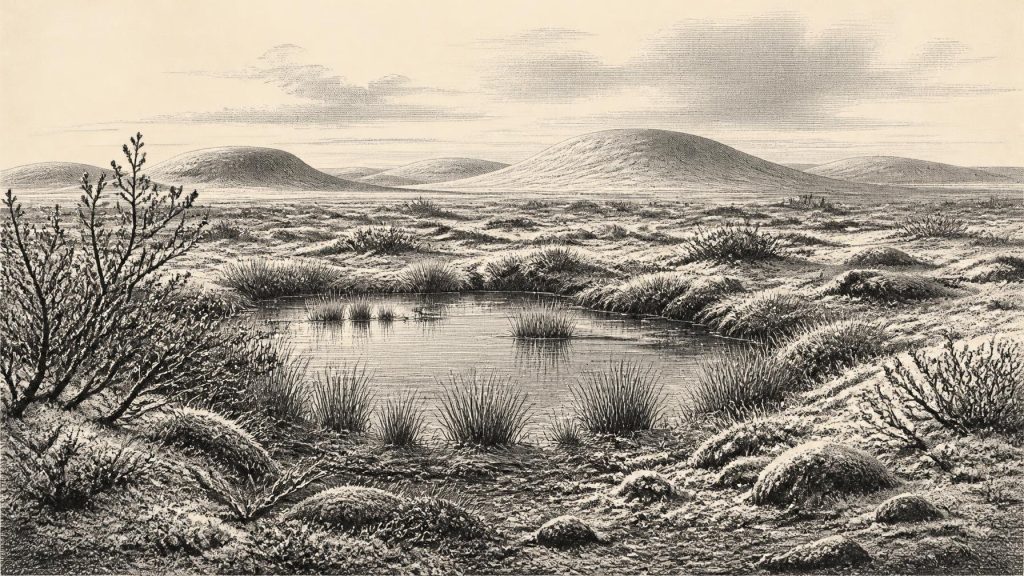
Derryvree is not evidence for all Ireland at once, yet it offers an unusually vivid local environmental record. Pollen, plant macrofossils, mosses and insects indicate open tundra or muskeg rather than mature woodland. Grasses, sedges, herbs, mossy ground and shallow freshwater pools characterised a landscape exposed to severe cold and frost action. Fossils include plants familiar today from Arctic-alpine or wetland habitats, among them dwarf willow (Salix herbacea), mountain avens (Dryas octopetala) and bogbean (Menyanthes trifoliata). Their presence shows that, during the formation of these sediments, suitable niches existed for cold-adapted vegetation and freshwater life.
This was neither the wooded Ireland of later prehistory nor simply a featureless white desert. In summer, wet hollows and pools could be biologically productive, with plant matter supporting insects and other small life; dry ridges and exposed ground would have offered different conditions. Winters were likely long and harsh, while the growing season was short. “Periglacial” is the useful term for a landscape profoundly shaped by freezing, thawing and seasonally frozen ground. It does not prove that an ice wall stood beside Derryvree throughout the interval. Local drainage, relief and distance from ice margins mattered, and the evidence does not permit a detailed weather map for the whole island.
Greenagho, also in Fermanagh, provides an important comparison. Organic detritus from lake deposits beneath till has been calibrated to roughly 37,200–35,700 calendar years BP. Together with Derryvree, it demonstrates that parts of north-central Ireland were ice-free during portions of MIS 3 before the major expansion of the last Irish ice sheet. That conclusion is firm at the regional scale, but it cannot establish that every Irish valley, mountain or coastline was simultaneously free of ice at 31,752 BCE.
Before the Great Ice Expansion
The broader British-Irish Ice Sheet was growing through an unstable climatic period. Reconstructions differ in detail because ice sheets do not advance as a single, even front and the evidence is incomplete, particularly where later ice eroded older deposits. A widely used working model places the main build-up after c. 35,000–32,000 years ago and maximum extent later, broadly c. 27,000–21,000 years ago. The large BRITICE-CHRONO project similarly reconstructed major advance across Ireland and Britain between 31,000 and 15,000 years ago. Around the notional date considered here, Ireland was thus approaching, rather than already experiencing uniformly, the later glacial maximum.
This changing ice geography affected coastlines and connections as well as inland habitats. Lower global sea levels exposed some continental shelf, but the Irish Sea region was altered by local crustal movements, marine conditions and glaciation as well as by falling oceans. It would be unsafe to draw a simple land bridge from Ireland to Britain or continental Europe for this exact moment. Submerged-landscape research instead stresses limited shelf exposure around Ireland and the destructive effects of later glaciation and high-energy seas on evidence that might once have survived. The absence of a known route is not proof that movement was impossible; it is a warning against treating a schematic Ice Age map as a travel itinerary.
Caves and Cold-Stage Animals
County Cork’s Castlepook Cave, near Doneraile, is the principal southern archive for Ireland’s pre-Last Glacial Maximum vertebrate fauna. It has yielded remains attributed to woolly mammoth, giant deer, reindeer, brown bear and spotted hyaena, alongside other cold-stage animals. The cave is exceptionally important because it preserves evidence from before and after the Last Glacial Maximum, but it is not a snapshot of one day or one ecosystem. Cave bones can arrive through carnivore activity, natural deaths, water movement, collapse and later disturbance. Early excavations also recorded context less precisely than modern archaeology requires.
Recent redating has made that caution more consequential. Improved pretreatment of bone samples revised several earlier Castlepook determinations substantially older, and a 2020 reassessment suggested that giant deer and spotted hyaena may have disappeared locally before about 40,000 calibrated years BP. Consequently, the Castlepook fauna establishes the range and changing character of an Irish MIS 3 animal world; it does not demonstrate that mammoth, hyaena, giant deer and reindeer all met in north Cork in 31,752 BCE. The responsible conclusion is smaller but still striking: suitable Irish refuges or corridors supported, at different times, a diverse cold-adapted fauna.
The Unresolved Human Question
A reindeer femur from Castlepook has made this period central to debate about Ireland’s earliest possible human activity. It has been reported as dating to about 33,000 years ago and bears a deep mark interpreted by zooarchaeologist Ruth Carden as damage made by a sharp stone implement during carcass processing. If that interpretation and the chronological association are confirmed, it would indicate that a person or small group handled a reindeer in Ireland during the Upper Palaeolithic, far earlier than the island’s long-established record of post-glacial settlement. It would be evidence of an action, however, not proof of a permanent population.
Important limits remain. The bone belongs to an old cave collection rather than a newly excavated occupation surface with securely associated tools, charcoal and animal remains. No published Irish hearth, dwelling floor, human burial, stone-tool assemblage or repeated settlement sequence is securely dated to around 33.7 thousand calendar years BP. The National Museum of Ireland accordingly continues to state that no clear evidence has emerged for human presence in Ireland during the Palaeolithic, while recent research proposals describe Castlepook’s modified bones as the strongest potential evidence requiring further excavation and testing. These positions are not contradictory: the find is significant, but not yet a foundation for certainty.
What Cannot Be Recovered
There is no evidential basis for political affairs, warfare, diplomacy, named peoples, language, religion, formal learning or trade in Ireland at this date. Nor can archaeologists identify farms, herds, fields, houses or a resident economy. If people did reach the island, the most defensible interpretation is a brief Upper Palaeolithic incursion within a much wider north-west European world of mobile hunter-gatherers, not an established Irish society. That remains an interpretation prompted by a modified bone and by the known presence of humans elsewhere in Europe, rather than an Irish settlement record.
For 31,752 BCE, the most meaningful Irish history is therefore environmental. Beneath a Fermanagh drumlin, silts preserve the signs of cold pools, dwarf willow, bogbean, mosses and sedges during an interval between ice advances. In Cork, cave deposits preserve a more fragmented history of animals moving through an unstable landscape. These records show that parts of Ireland were living places before the island’s later ice cover expanded dramatically. They do not supply a calendar-year narrative, but they illuminate a severe, dynamic world whose traces endured beneath ice and inside caves.
Primary Sources
- The IntCal20 Northern Hemisphere Radiocarbon Age Calibration Curve (0–55 cal kBP)
- A Reconsideration of the Radiocarbon Dating of the Marine Isotope Stage 3 Fauna from Southern Ireland
- Extent and Timing of the Last Glacial Maximum (LGM) in Britain and Ireland: A Review
- Growth and Retreat of the Last British–Irish Ice Sheet, 31,000 to 15,000 Years Ago: The BRITICE-CHRONO Reconstruction
- The Timing and Magnitude of the British–Irish Ice Sheet Between Marine Isotope Stages 5d and 2
- Trimlines, Blockfields and the Vertical Extent of the Last Ice Sheet in Southern Ireland
- Exploring Controls of the Early and Stepped Deglaciation on the Western Margin of the British Irish Ice Sheet
- Pattern and Timing of Retreat of the Last British-Irish Ice Sheet
- Radiocarbon Constraints on the Age of the Maximum Advance of the British-Irish Ice Sheet in the Celtic Sea
- Ireland: Submerged Prehistoric Sites and Landscapes
- Early Midlandian–Middle Midlandian, Pleistocene, Northern Ireland
- Castlepook Cave, County Geological Site Report
- Prehistoric Details: Mell Flint Flake
- Archaeology Research Excavation Grant 2022: Final Report
- First Evidence of a Late Upper Palaeolithic Human Presence in Ireland
- Occurrence of Mammalia Relicts at Site Castlepook Cave
- Archaeological Heritage of County Cork
- BSBI: Menyanthes trifoliata
- BSBI: Salix herbacea
- BSBI: Dryas octopetala