
The Castlepook Carcass31677 BCE
Dateline
“31,677 BCE” is a modern chronological label, not a year that can be recovered from the Irish archaeological record. No calendar, written testimony or event sequence allows historians to isolate a particular season, person or occurrence on the island at such depth of time. Expressed in the conventional archaeological scale of years before AD 1950, it falls roughly around 33.6 thousand calendar years ago. The responsible frame is therefore a broad one: later Marine Isotope Stage 3 (MIS 3), a volatile interval of the Last Glacial period conventionally spanning about 57,000 to 29,000 years ago. Ireland’s evidence is sparse, discontinuous and often derived from old cave excavations. Yet it is sufficient to illuminate an Ice Age world of changing ice margins, open habitats and large animals—and to raise a difficult, important question about very early human visits.
A Date Range, Not a Dated Event
Radiocarbon dates do not translate directly into calendar years. Atmospheric radiocarbon varied through time, so laboratory measurements must be calibrated against independently constructed curves; at around 34,000 years ago, the resulting calendar ranges are necessarily broader than a single historical year. The numbered date should consequently be read as an approximate point within a span of centuries or millennia, rather than as a precise anniversary. It belongs to the Pleistocene, long before farming, permanent villages, metalworking, Irish languages, kingdoms or even the persistent settlement that later made an identifiable human history of Ireland possible.
This was also before the fullest known expansion of the last British–Irish Ice Sheet. Research on the ice sheet shows that its growth, extent and timing were dynamic and remain actively debated, especially before the Last Glacial Maximum. The maximum advance in the Irish Sea sector is generally placed much later, around 25,000–23,000 years before present, while wider reconstructions treat the period from roughly 31,000 years ago onward as one of major ice-sheet growth. At the notional date used here, Ireland was not simply a uniformly frozen island. It was part of a shifting north-west European glacial environment in which ice, sea level, rivers, exposed ground and habitable refuges changed over long periods.
Castlepook’s Fragmentary Archive
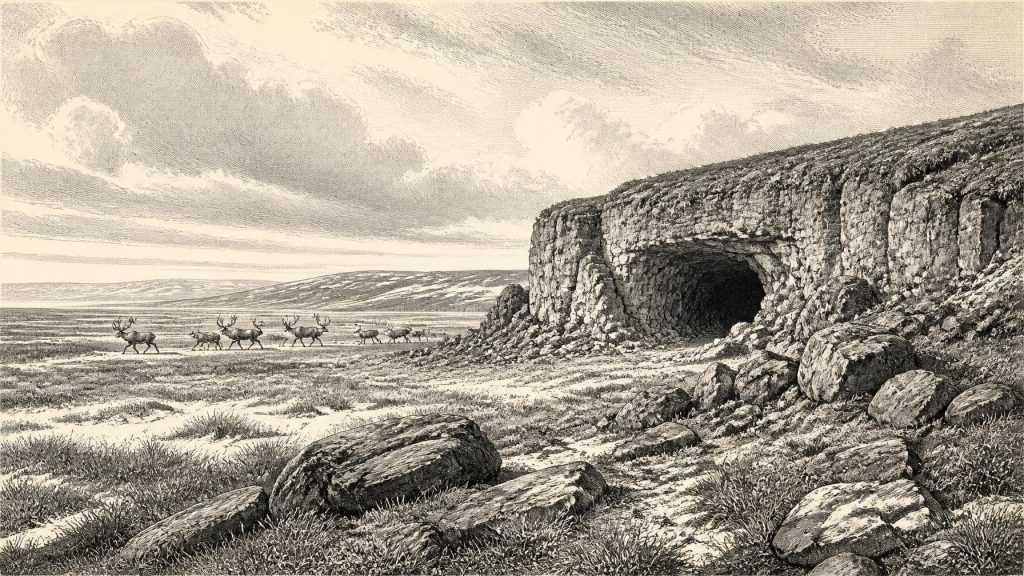
The chief Irish source for this period is Castlepook Cave, also called Mammoth Cave, near Doneraile in north County Cork. Excavated principally in the early twentieth century, it produced a remarkable accumulation of Pleistocene bones, now largely held by the National Museum of Ireland. Later re-examination and renewed radiocarbon work have made clear both the value and the complexity of the collection. The cave was not a neatly sealed prehistoric campsite. It was used or entered by animals over long intervals; bones could be carried in by carnivores, moved by water or sediment, and mixed through older excavation methods. Each specimen must therefore be assessed on its own provenance and date, rather than treated as proof that every recorded animal lived together at one moment.
Even so, Castlepook establishes that southern Ireland supported, at different points during MIS 3, a striking cold-stage fauna. The wider cave record includes woolly mammoth, reindeer, giant deer, brown bear, wolf, Arctic fox, lemmings and spotted hyaena. Directly dated Irish cave material indicates that a diverse mammal fauna colonised or re-colonised parts of Ireland between at least about 45,000 and 20,000 years ago. Re-dating has also demonstrated that some earlier determinations substantially underestimated the age of Castlepook specimens. The evidence is strongest for animal presence; it offers a real ecological record, but not a single snapshot of a 31,677 BCE landscape.
The most evocative find is a reindeer femur bearing a deep incision. County Cork heritage publications and zooarchaeologist Ruth Carden identify the mark as damage made by a sharp stone implement during butchery, and associate the bone with roughly 31,000 BCE in popular calendar terms. That makes it directly relevant to the period around this article’s notional date. If the diagnosis is accepted, the specimen may represent the earliest currently claimed evidence for human activity in Ireland, immensely earlier than the formerly accepted Late Upper Palaeolithic evidence from a cut-marked bear patella in County Clare, dated to around 12,800–12,600 calibrated years before present.
The Reindeer Bone Question
Its importance should not erase its limitations. The date of an animal bone is the date of the animal’s death, not automatically the date, place or agent of every mark upon it. Identifying a cut mark requires specialist taphonomic judgement: stone-tool damage must be distinguished from carnivore action, trampling, sediment abrasion, excavation damage and other processes. In addition, the femur comes from an old cave collection rather than a modern excavation of an undisturbed floor with associated hearths and tools. A cautious account can say that the bone is potentially compelling evidence that people processed a reindeer in Ireland during the Upper Palaeolithic. It cannot claim to have found a settlement, a hunting camp or an established population.
No securely associated stone-tool assemblage, hearth, dwelling, burial, artwork or repeated domestic refuse of this age has been identified in Ireland. Nor does the bone show whether a person killed the animal, encountered a carcass, removed meat, hide, sinew or marrow, or processed it elsewhere before a carnivore took part of the remains into the cave. The search for surviving Pleistocene deposits at Castlepook is therefore more than a local excavation project: intact stratified deposits could test whether this isolated clue belongs to a wider human presence or remains an exceptional trace.
Mobility Without a Map
If people did reach Ireland in this period, they were almost certainly highly mobile hunter-gatherers, but this is an inference from the marked bone and the wider Upper Palaeolithic world, not a demonstrated description of an Irish community. Reindeer were a valuable resource, supplying meat, fat, skins, sinews and bone. Groups elsewhere in northern Europe used stone technology, travelled through large territories and maintained social connections across considerable distances. None of that proves an Irish equivalent in detail. It does, however, make a brief visit or seasonal incursion more plausible than any image of a settled Ice Age village.
Travel itself is uncertain. Lower global sea levels exposed far more continental shelf than exists today, and animal movements between Britain and Ireland plainly occurred in some form during favourable phases: the Castlepook fauna is evidence of connection, not proof of a particular route. Whether a continuous land passage, temporary islands, shore routes, seasonal ice or short water crossings were available at one precise moment cannot be securely reconstructed for 31,677 BCE. It would be irresponsible to describe hunters simply walking from Britain, or to assign them a homeland, language, ethnicity or ancestral relationship with later Irish people.
Society Beyond the Evidence
There were no known political institutions in Ireland at this date. Archaeology provides no basis for naming chiefs, territories, alliances, wars or diplomatic relations. A cave bone cannot reveal a hierarchy, household size or social boundary. Likewise, there is no Irish evidence from this time for ritual practice, formal burial, religious belief, visual art, music or systems of learning. The rich cave art, ornaments and symbolic objects known from some contemporary parts of Europe show what Upper Palaeolithic Homo sapiens could create; they must not be transferred automatically across the sea to Ireland.
Economic evidence is equally narrow. There was no agriculture, stock-raising, field system, permanent market or demonstrated exchange network on the island. The possible processing of a reindeer is the only economic act that can be cautiously envisaged here, and even that rests on one contested but significant specimen. Carnivores were probably major agents in the cave’s formation: hyaenas, wolves and other scavengers could transport bones, consume carcasses and turn a cave into a den or feeding place. The cave archive records animal behaviour as much as, and perhaps more than, human behaviour.
An Open, Harsh Landscape
The fauna points towards a largely open, cold environment rather than modern Ireland’s wooded and pasture-rich scenery. Reindeer, Arctic foxes and lemmings are compatible with tundra or steppe-tundra conditions, while mammoth and giant deer evoke broad grass-and-herb landscapes capable of supporting large grazers and browsers. Such labels should be used cautiously: the island’s climate and vegetation altered repeatedly across MIS 3, and cave bones alone cannot map every valley. Local shelter, slope, soil moisture and proximity to ice would have created ecological mosaics. In southern Ireland, limestone caves could preserve the remains of this world far better than exposed surfaces later overridden, eroded or buried by glacial processes.
The scale of the subsequent transformation matters. Later ice-sheet advance reshaped landforms, removed or concealed many earlier deposits and helped explain why evidence for Palaeolithic Ireland is so much thinner than that of Britain or continental Europe. Absence of excavated camps is not absolute proof that nobody ever came; it is, however, a powerful warning against constructing a populated prehistoric landscape from a single bone.
What Can Be Said Responsibly
Around the modernly assigned date of 31,677 BCE, Ireland lay in a changing Ice Age zone, probably supporting open-country mammals during at least some phases and connected ecologically, if not always straightforwardly by dry land, to the wider north-west European world. Castlepook Cave preserves the country’s most consequential evidence for that setting. Its reindeer femur may record human butchery, but it does not yet establish permanent occupation. The principal development is therefore not a king’s accession, a battle or a foundation. It is the survival of a fragile archaeological possibility: that Upper Palaeolithic people briefly reached an Ireland whose animals, climate and physical geography were profoundly unlike those of the island today.
Primary Sources
- A reconsideration of the radiocarbon dating of the Marine Isotope Stage 3 fauna from southern Ireland
- The Irish Quaternary Fauna Project
- Spotted Hyena Skull
- Heritage Artefacts of County Cork
- Archaeological Heritage of County Cork
- Castlepook Cave, Cork, 2022
- Growth and retreat of the last British–Irish Ice Sheet, 31,000 to 15,000 years ago: the BRITICE-CHRONO reconstruction
- Extent and timing of the Last Glacial Maximum (LGM) in Britain and Ireland: a review
- The timing and magnitude of the British–Irish Ice Sheet between Marine Isotope Stages 5d and 2
- Last Glacial Maximum cirque glaciation in Ireland and implications for reconstructions of the Irish Ice Sheet
- Stratigraphic and palaeo-geomorphological evidence for the glacial-deglacial history of the last British-Irish Ice Sheet in the north-western Irish Sea
- Dimensions and chronology of the last ice sheet in Western Ireland
- The problem of a late quaternary landbridge between Britain and Ireland
- Deglaciation, Earth crustal behaviour and sea-level changes in the determination of insularity: A perspective from Ireland
- The IntCal20 Northern Hemisphere Radiocarbon Age Calibration Curve (0–55 cal kBP)
- The IntCal20 approach to radiocarbon calibration curve construction: a new methodology using Bayesian splines and errors-in-variables
- Archaeological Site Index to Radiocarbon Dates from Great Britain and Ireland
- First evidence of a Late Upper Palaeolithic human presence in Ireland
- First evidence of a Late Upper Palaeolithic human presence in Ireland
- Phylogeographic, ancient DNA, fossil and morphometric analyses reveal ancient and modern introductions of a large mammal: the complex case of red deer (Cervus elaphus) in Ireland
- New insights on the fauna of Ireland’s Younger Dryas