
Doneraile’s Reindeer Butchery31621 BCE
Around 31,621 BCE, a modern label within Marine Isotope Stage 3, Ireland experienced an unstable, cold Ice Age environment rather than a documented historical year. Derryvree sediments in Fermanagh record a locally ice-free tundra of wet hollows, sedges and mosses between glacial advances, while Crag Cave calcite demonstrates intermittent milder conditions. Castlepook Cave in Cork preserves mixed remains of mammoth, reindeer, giant deer and predators, indicating links with wider Eurasian fauna. A cut-marked reindeer femur may indicate exceptionally early human carcass processing, but its disturbed context prevents conclusions about settlement. No evidence supports permanent communities, agriculture, politics or named cultures.
Dateline
31,621 BCE is a modern calendar label, not a date at which Ireland can be observed year by year. There are no written records, settlements, graves or securely dated human occupations that can be assigned to that single year. In archaeological terms it falls at roughly 33,600 calibrated years before present (cal BP, where “present” is AD 1950), during the later part of the Late Pleistocene, or Ice Age. The responsible approach is therefore to examine broad calibrated ranges and the few surviving Irish deposits that illuminate this phase, rather than inventing an event for a precise calendar year.
At this horizon, Ireland lay within Marine Isotope Stage 3 (MIS 3), an exceptionally changeable interval of the last glaciation. It was not yet the climatic nadir known as the Last Glacial Maximum, when the British–Irish Ice Sheet expanded dramatically across Ireland and its shelf. But conditions were cold, landscapes were unstable, sea level was much lower than today, and the extent of ice, open ground and water altered repeatedly. A nominal date in the 31,620s BCE must consequently be treated as an approximate point within a long environmental history rather than as a historical anniversary.
A Landscape Between Ice Advances
The most informative Irish environmental archive for this general period is Derryvree, near Maguiresbridge in County Fermanagh. Roadworks in 1969 cut through a drumlin and exposed fine sands and organic freshwater silts lying between two distinct sheets of glacial till. The sequence is important because it records order: ice deposited the lower till; an interval without local ice allowed water, sediment and plant remains to accumulate; then a later advance sealed the deposit beneath the upper till.
Organic material from Derryvree produced a conventional radiocarbon age of 30,500 years BP, with a substantial uncertainty. When calibrated, scholarship places the deposit broadly at c. 36,900–31,700 cal BP. The modern year-label 31,621 BCE, roughly 33,600 cal BP, falls within that wide interval, but it cannot be pinned to a particular layer, season or generation at the site. The deposit is evidence for a cold, ice-free or locally ice-free phase in this part of northern Ireland; it is not proof that all of Ireland had the same conditions at the same moment.
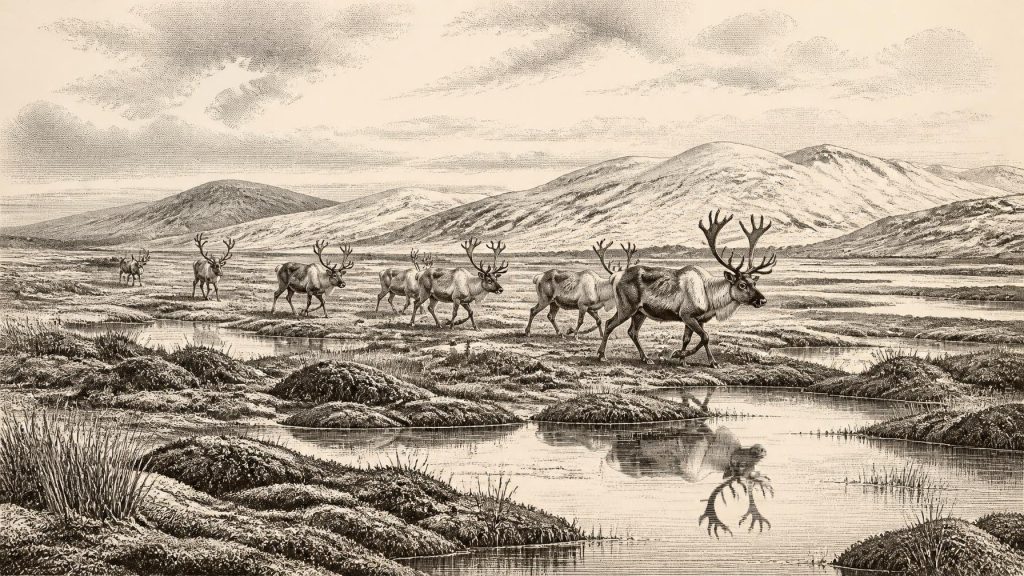
Derryvree’s plant and insect evidence indicates open, treeless, periglacial ground. Mosses, sedges, herb pollen and the fossil seed of bogbean point to wet hollows, pools and muskeg-like vegetation within a wider tundra landscape. Dry ground was probably sparse, exposed to frost and wind, and low in plant cover. A few grains of tree pollen do not demonstrate local woodland: pollen can travel long distances, while the pollen itself was poorly preserved. The evidence is strongest for a mosaic of damp freshwater habitats and open cold-country vegetation, not for a uniform frozen desert.
Crag Cave and the Rhythm of Climate
South-west Ireland offers another, differently measured record. Uranium-thorium dates from broken and reworked calcite formations in Crag Cave, County Kerry, show that stalagmite growth occurred episodically during MIS 3. Calcite formation in this shallow cave required liquid water and conditions generally warmer than persistent annual freezing. Its repeated growth and interruption provide independent support for the idea that Ice Age Ireland experienced abrupt shifts between relatively milder interstadials and much harsher stadials.
This does not allow a precise weather report for 31,621 BCE. Yet it matters because it corrects an older image of the Ice Age as one unchanging deep winter. Temperatures, soils, vegetation and the availability of running water could change markedly over centuries or millennia. The contrast between Derryvree’s cold freshwater tundra and periods of cave-calcite growth in Kerry is best understood as evidence for a dynamic island-edge environment, strongly affected by North Atlantic climate oscillations.
Castlepook’s Animal World
The richest Irish archive of animals from before the Last Glacial Maximum is Castlepook Cave, also called Mammoth Cave, near Doneraile in north County Cork. Its narrow limestone galleries and larger chambers yielded extensive bone assemblages during excavations in the early twentieth century. The cave contained remains of woolly mammoth, reindeer, giant deer, brown bear, spotted hyaena, wolf, Arctic fox, mountain hare and lemmings. These animals do not all belong to one moment. Radiocarbon dates show that bones accumulated across a long span of the middle and later Ice Age, and water movement later mixed parts of the deposits.
That cave history sets a necessary limit on certainty. Castlepook is compelling evidence that Ireland formed part of a wider north-west European faunal zone before the major ice expansion. It is not a neatly stratified camp-site. Some animals may have fallen into cavities; carnivores, especially hyaenas, probably dragged carcass parts into dens; water then redistributed material. The presence of mammoth or hyaena bone proves neither a mammoth hunt nor human use of the cave. It does, however, show a more varied and formidable animal community than the later, post-glacial Irish fauna.
Recent sedimentary ancient-DNA work at Castlepook reinforces the wider picture, identifying a range of Late Pleistocene animal taxa and genetic links between Irish fauna and Eurasian populations. It suggests that the island’s megafauna were not necessarily isolated relics but belonged to populations connected, intermittently, with Britain and continental Europe. The routes changed with sea level, ice and exposed shelf terrain. At this date, the evidence cannot settle whether particular movements used continuous dry ground, ice margins, coastal corridors or water crossings. It does show that the modern shoreline is a poor guide to the Ice Age geography through which animals moved.
The Reindeer Bone and Human Presence
The most consequential human question arises from a reindeer femur fragment in the Castlepook collections. Re-examination identified a deep mark interpreted by zooarchaeologist Ruth Carden as a cut made with a sharp stone tool during carcass processing. County Cork heritage material has presented the bone as dating to about 31,000 BC, and public reporting has described it as evidence of human activity in Ireland around 33,000 years ago. If that interpretation is sustained by further analysis, it would indicate that people reached Ireland far earlier than the previously secure terminal-Pleistocene evidence.
Nevertheless, the claim must remain carefully bounded. The find is a single modified bone from an old excavation, not a recovered hearth, stone-tool assemblage, dwelling floor or cemetery. Castlepook’s complicated sediment history makes association difficult, and public accounts of an age do not substitute for a fully published, specimen-specific calibrated range with modern laboratory detail. The mark is significant precisely because it may be humanly made; it cannot support confident claims about a permanent population, its language, identity, numbers or political organisation. Current fieldwork and re-study of the cave have been designed to improve the chronology, sedimentary context and biological evidence.
Life, Society and Absence
If people did visit Ireland in this interval, the most defensible model is of highly mobile Upper Palaeolithic foragers moving through a cold, seasonal landscape and drawing on social knowledge extending beyond the island. Reindeer would have offered meat, fat, marrow, hides, sinew and bone; other large herbivores could also have been attractive resources. But that is an ecological inference from comparable hunter-gatherer economies and from the apparent butchery mark, not direct evidence of a local Irish band, hunting strategy or camp.
There is no basis for identifying rulers, territories, diplomacy, wars, tribal names, trade goods or organised religion in Ireland at 31,621 BCE. Nor are there known Irish artworks, inscriptions, monuments or formal burials from this horizon. “Culture and learning” can be discussed only at the most basic level: any successful visitors would have possessed sophisticated practical knowledge of stone edges, animal bodies, changing terrain, shelter and routes. Such knowledge would have been social and learned, but it has not survived in identifiable Irish artefacts from this date.
The economy, likewise, was not agriculture or trade in the later sense. There were no farms, fields, livestock or permanent villages evidenced in Ireland. The relevant economy was one of wild resources, mobility and risk management. Caves such as Castlepook were not necessarily homes; in the animal record they were often traps, dens, repositories and geological mixers. The strongest conclusion for Ireland around this modernly numbered year is therefore modest but remarkable: during an unstable pre-maximum Ice Age interval, parts of the island supported cold-adapted plant and animal communities, and one controversial but potentially transformative reindeer bone may preserve a trace of human handling.
Much was then still to change. The Last Glacial Maximum would erase or bury many earlier land surfaces beneath expanding ice, helping to explain why the archaeological record is so thin. Ireland’s history at this depth is not a sequence of named events. It is a history recovered from silts under a drumlin, calcite in a cave, bones in limestone passages and a single marked reindeer limb—evidence powerful enough to widen the past, but too fragmentary to turn 31,621 BCE into a conventional year of history.
Primary Sources
- A Middle Midlandian Freshwater Series at Derryvree, Maguiresbridge, County Fermanagh, Northern Ireland
- A Reconsideration of the Radiocarbon Dating of the Marine Isotope Stage 3 Fauna from Southern Ireland
- The Irish Quaternary Fauna Project
- The Vertebrates of the Last Cold Stage in Britain and Ireland
- Episodic Speleothem Deposition Tracks the Terrestrial Impact of Millennial-Scale Last Glacial Climate Variability in SW Ireland
- Growth and Retreat of the Last British–Irish Ice Sheet, 31,000 to 15,000 Years Ago: the BRITICE-CHRONO Reconstruction
- Pattern and Timing of Retreat of the Last British-Irish Ice Sheet
- Trimlines, Blockfields and the Vertical Extent of the Last Ice Sheet in Southern Ireland
- Ireland: Submerged Prehistoric Sites and Landscapes
- The Colonization of Ireland: A Human Ecology Perspective
- Prehistoric Details
- Guide to the National Museum of Ireland
- Castlepook Cave: Cork County Geological Site Report
- 2022:564 – Castlepook Cave, Castlepook South, Cork
- Archaeology Research Excavation Grant 2022: Final Report
- Heritage Artefacts of County Cork 2021
- Palaeoecology
- The Subdivision of the Quaternary Period in Ireland
- Sedimentary Ancient DNA Reveals Late Pleistocene Faunal Connectivity Between Ireland and Eurasia
- Stratigraphic and Palaeo-Geomorphological Evidence for the Glacial-Deglacial History of the Last British-Irish Ice Sheet in the North-Western Irish Sea
- New Insights on the Fauna of Ireland's Younger Dryas and Early Holocene from Alice & Gwendoline Cave
- Menyanthes trifoliata