

Derryvree’s Ancient Bogbean31281 BCE
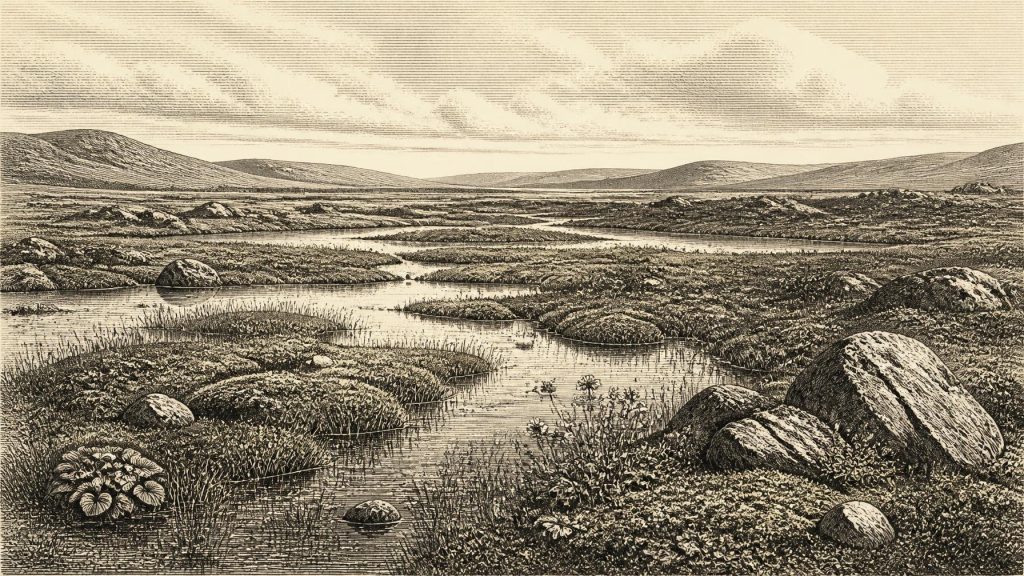
31,281 BCE is a modern label for a poorly resolved Late Pleistocene interval, rather than a recoverable Irish year. At Derryvree, County Fermanagh, freshwater sediments between glacial tills, dated broadly to 36,900–31,700 calibrated years BP, reveal treeless tundra wetland with bogbean, mountain avens and sedges. Castlepook Cave, County Cork, preserves evidence of diverse cold-climate fauna, including reindeer, mammoth, giant deer, predators and smaller mammals, demonstrating connectivity with north-west Europe. A marked, dated reindeer bone may indicate human butchery, but remains inconclusive. Ireland was an unstable frontier of ice-free habitats and advancing glaciers, without evidence for settled communities, polities or culture.
Dateline
31,281 BCE is a modern calendar label, not a year that can be recovered from Ireland’s archaeological record. Nobody in Ireland counted time in this way, and no excavation, fossil deposit or radiocarbon determination can identify an event that happened in this particular twelve-month span. In radiocarbon terms it lies roughly 33,230 years before AD 1950; in broader archaeological language it belongs to the later part of Marine Isotope Stage 3, within the Middle Midlandian cold-stage sequence used for Ireland. The responsible subject is therefore an interval, not an annal: a cold and increasingly unstable Pleistocene Ireland glimpsed through buried sediments, animal bones and the changing geometry of ice.
The evidence is both precious and limited. Later glaciers repeatedly eroded, redeposited or concealed older ground surfaces, while early cave excavations did not always preserve the stratigraphic information expected today. What survives can nevertheless show that parts of Ireland contained ice-free landscapes, freshwater habitats and sizeable mammals before the Last Glacial Maximum. It cannot identify a named people, polity, language, religion, settlement or campaign. This was long before the beginnings of the securely documented human story of Ireland.
Between Two Ice Advances
The most informative Irish environmental archive close to this notional date is Derryvree, near Maguiresbridge in County Fermanagh. Road works in 1969 cut through a drumlin and exposed an unusual sequence: organic freshwater silts and fine sands enclosed between two tills. Till is sediment left by glacier ice. The arrangement therefore records an important local sequence—glaciation, an ice-free interval in which water and vegetation accumulated sediment, and then renewed glaciation which sealed the deposit.
Organic material from the Derryvree bed produced the radiocarbon determination BIRM-166, conventionally reported as 30,500 ± 1,100 radiocarbon years BP. A radiocarbon age is not identical to a calendar age. When assessed through modern calibration, the deposit falls within a wide range, approximately 36,900–31,700 calibrated years BP. Thus 31,281 BCE falls near the younger end of an interval represented by the deposit, but cannot be attached to a specific season, landscape episode or human lifetime. The range is more historically honest than false precision.
Derryvree also warns against imagining a uniform Irish climate. It is a highly local record from one lowland site in Fermanagh, not a thermometer for the entire island. Yet its position between tills proves that this locality was not continuously ice-covered through the relevant span. The later advance that capped the sediments also demonstrates how vulnerable such habitable patches were as colder conditions intensified.
A Wetland in Open Country
Plant macrofossils, pollen and insect remains from Derryvree indicate a treeless, cold landscape with wet ground rather than a forested version of modern Ireland. Finds include mountain avens (Dryas octopetala) and bogbean (Menyanthes trifoliata), alongside mosses, sedges and other plants capable of growing in open, waterlogged or periglacial conditions. These are material traces, not artistic impressions: seeds, pollen grains and small biological remains preserved in sediment. Together they support the interpretation of a freshwater marsh or muskeg-like environment amid tundra or tundra-steppe vegetation.
Such a place would have changed with season. During brief summers, shallow pools, saturated margins and sedge-rich ground could have supported insects and water plants. In winter, frost, wind and snow would have imposed severe constraints. The country was probably largely open, with low vegetation rather than closed woodland, and with soils vulnerable to freeze-thaw disturbance. “Periglacial” does not mean permanently buried under ice; it describes ground shaped by intense cold at or near an ice margin.
There is no basis for reconstructing houses, campsites, fields, paths or cultivated land at Derryvree in 31,281 BCE. The wetland record instead supplies the environmental setting within which animals—and conceivably transient people—might have moved. It also preserves a feature of prehistoric Ireland that later history often obscures: freshwater habitats existed within a landscape repeatedly transformed by advancing ice.
Animals Before the Maximum
Southern Ireland offers a different, cave-based record. Castlepook Cave, near Doneraile in north County Cork, is associated with a substantial collection of Pleistocene animal remains, much of it recovered during antiquarian investigations in the early twentieth century. Studies of Irish Quaternary fauna show that a wide range of mammals reached Ireland sometime between at least about 45,000 and 20,000 years ago. Castlepook material includes reindeer, woolly mammoth, giant deer, brown bear, wolf, Arctic fox, mountain hare, lemmings and spotted hyaena.
These species must not be turned into one frozen tableau. Cave assemblages can accumulate over long periods, and individual bones may have different ages and depositional histories. A hyaena den, carnivore scavenging, water movement, collapse, later disturbance and the practices of early excavators can all complicate the record. The assemblage does, however, establish that Ireland formed part of a wider north-west European world in which cold-adapted and large grazing mammals could reach suitable terrain before the height of the last glaciation.
The animals imply ecological relationships rather than a simple list of curiosities. Reindeer could exploit open vegetation; mammoths and giant deer required substantial forage; hyaenas and wolves were predators or scavengers within the same broad food web. Their presence demonstrates biological connectivity with Britain and continental Europe during periods of lowered sea level and changing ice conditions. It does not prove that a stable land bridge existed at every moment, nor that any particular species crossed by one route alone.
The Castlepook Reindeer Question
A reindeer femur from the Castlepook collection has made this period especially important. Reassessment and accelerator radiocarbon dating have been publicly associated with an age of about 33,000 years ago, while a deep mark on the bone has been interpreted by zooarchaeologist Ruth Carden as damage made by a sharp stone implement during carcass processing. If that interpretation is confirmed, it would be striking evidence that a person handled a reindeer in Ireland during the Upper Palaeolithic, vastly earlier than the long-established record of post-glacial settlement.
But the conclusion requires caution. A dated bone establishes the age of the animal, not automatically the date or cause of every mark on its surface. Distinguishing a genuine stone-tool cut from natural abrasion, trampling, carnivore damage or excavation damage depends on microscopic form, placement and taphonomic context. Moreover, the old Castlepook deposits were disturbed and most were removed long ago. One possible butchery mark cannot demonstrate a village, a resident population, a migration route, or cultural continuity into later Irish prehistory.
The proper historical formulation for around 31,281 BCE is therefore deliberately modest: Ireland had an environment capable of supporting large Ice Age mammals, and a reindeer bone offers a serious but still limited possibility of human activity. Continued work at Castlepook, including new excavation, re-examination of museum collections, improved radiocarbon dating and sedimentary ancient-DNA research, may sharpen that picture. It should not be made to answer questions for which the evidence is presently too slight.
No Polities, No Proven Communities
Political affairs, diplomacy and warfare cannot responsibly be narrated for Ireland at this depth in time. There are no rulers, tribes, treaties, territories or battle sites known from the island in this interval. Equally, there is no direct evidence for formal religion, ritual monuments, visual art, spoken language, teaching traditions or named cultural identities. The imposing ritual landscapes often associated with prehistoric Ireland—passage tombs, henges, hillforts and medieval churches—belong tens of thousands of years in the future.
Nor can economy and trade be described in their usual historical sense. There is no evidence for farming, herding, pottery, metalworking, exchange networks or managed woodland. If people did enter the island, they would have done so as highly mobile hunter-gatherers using perishable equipment and stone technology comparable in broad principle to Upper Palaeolithic groups elsewhere in Europe. Yet no securely stratified Irish lithic assemblage has been demonstrated for this date. This is a plausible comparative framework, not direct proof of Irish daily life.
An Island Becoming Harder to Inhabit
The great development of the wider period was climatic deterioration. The Last Glacial Maximum had not yet reached its fullest extent—its principal maximum lay later, roughly 26,000–20,000 years ago—but the British–Irish Ice Sheet was beginning a rapid phase of growth. Reconstructions indicate that a Scottish-centred ice mass was advancing around 32,000–31,000 years ago and that the wider ice sheet expanded dramatically thereafter. Conditions in and around Ireland were consequently changing on timescales far larger than a single calendar year.
At 31,281 BCE, then, Ireland was neither simply an empty white ice sheet nor a temperate green island. It was a changing frontier of open ground, wetland, animal movement and encroaching ice. Derryvree’s bogbean and mountain avens preserve one local moment of life in that frontier; Castlepook’s bones preserve another, geographically distant record of its fauna. Together they reveal an Ireland with ecological potential but fragile habitability, on the eve of a glacial transformation that would erase much of the evidence it left behind.
Primary Sources
- A Middle Midlandian Freshwater Series at Derryvree, Maguiresbridge, County Fermanagh, Northern Ireland
- The Irish Quaternary Fauna Project
- A Reconsideration of the Radiocarbon Dating of the Marine Isotope Stage 3 Fauna from Southern Ireland
- Figure 6.— The Subdivision of the Quaternary Period in Ireland
- References and Recommended Reading
- BSBI: Menyanthes trifoliata
- BSBI: Dryas octopetala
- Growth and Retreat of the Last British–Irish Ice Sheet, 31,000 to 15,000 Years Ago: the BRITICE-CHRONO Reconstruction
- BRITICE-CHRONO: Project Introduction
- Project Findings Provide Essential Insight into the Last British–Irish Ice Sheet
- Dimensions and Chronology of the Last Ice Sheet in Western Ireland
- Trimlines, Blockfields and the Vertical Extent of the Last Ice Sheet in Southern Ireland
- Freshwater Organic Deposits and Stratified Sediments Between Early and Late Midlandian (Devensian) Till Sheets, at Aghnadarragh, County Antrim, Northern Ireland
- The IntCal20 Northern Hemisphere Radiocarbon Age Calibration Curve (0–55 cal kBP)
- First Evidence of a Late Upper Palaeolithic Human Presence in Ireland
- New Insights on the Fauna of Ireland’s Younger Dryas and Early Holocene from Alice & Gwendoline Cave
- Archaeology Research Excavation Grant 2022: Final Report
- Castlepook Cave, Castlepook South, County Cork: Excavation Report 2022
- Heritage Artefacts of County Cork
- Archaeological Heritage of County Cork
- Ireland’s Palaeolithic Archaeology – Fleeting Footprints in a Frozen Land
- The Problem of a Late Quaternary Landbridge Between Britain and Ireland
- Sedimentary Ancient DNA Reveals Late Pleistocene Faunal Connectivity Between Ireland and Eurasia
- Cenozoic: Tertiary and Quaternary