Aghavea’s Three-Leaved Seed30468 BCE
Around 30,468 BCE, Ireland lay in the climatically unstable later Ice Age, without written history or securely dated settlement. At Derryvree, County Fermanagh, organic freshwater sediments between glacial tills record an ice-free interval, broadly dated to 34,950–29,750 BCE. Bogbean, sedges, mosses, aquatic plants and cold-adapted species indicate open tundra wetland, not woodland. Castlepook Cave, County Cork, preserves remains of reindeer, mammoth, predators and other cold-climate fauna. A cut-marked reindeer bone may indicate Upper Palaeolithic butchery, yet cannot prove settlement. Ice erosion and disturbed deposits limit conclusions: evidence reveals local ecosystems and possible brief human visits, not communities, politics or culture.
Dateline
30,468 BCE is a useful modern label, not a date at which Ireland’s past can be resolved into a recorded year. There is no written evidence, no named community, no ruler, and no securely dated Irish settlement that can be assigned to this point on a calendar. In archaeological terms, the date falls about 32,417 calendar years before AD 1950, within the later part of Marine Isotope Stage 3, a long and climatically unstable phase of the last Ice Age. The responsible account is therefore one of broad ranges, deposits and probabilities rather than events. Ireland was a cold, changing place on the north-western edge of Europe, and the best evidence comes from buried wetlands, cave bones and the strata left by advancing ice.
A Date Within a Wide Window
The closest and most revealing Irish environmental record is at Derryvree townland, near Maguiresbridge in south Fermanagh, within the historic parish of Aghavea. Roadworks in 1969 cut through a drumlin and exposed an extraordinary sequence: glacial till below, freshwater sands and silts with organic material in the middle, and later glacial deposits above. This order matters. It shows that ice had covered the locality, that an interval without local ice allowed water, plants and animals to occupy it, and that ice later returned and sealed the evidence.
Organic material from the deposit, laboratory sample BIRM-166, returned a conventional radiocarbon age of 30,500 years BP, with a large uncertainty of +1,170/−1,030 years. Radiocarbon years are not calendar years: concentrations of atmospheric carbon-14 have varied, so a measurement must be calibrated against independent climate archives. Modern calibration produces a broad probability range, approximately 36,900–31,700 calibrated years BP, or roughly 34,950–29,750 BCE. The modern year-label 30,468 BCE falls near the younger end of that wide interval. It cannot identify a particular season, generation or episode at Derryvree, but the deposit provides unusually direct evidence for the sort of Irish landscape that could have existed around this point.
Freshwater Under an Open Sky
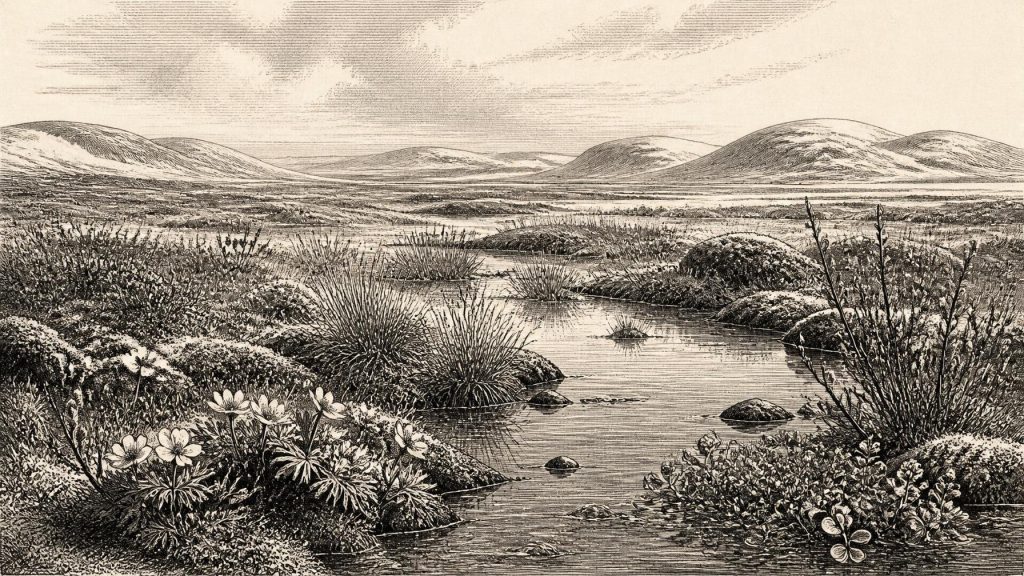
Derryvree was not a forested Ireland of the modern imagination. Its plant remains, pollen, mosses, insects and small animal remains point instead to a treeless, cold and frost-affected environment. Researchers have described it as open tundra and as a muskeg-like wetland: a mosaic of saturated ground, shallow freshwater, sedges, mosses, exposed sediment and low vegetation. Such terms are comparisons, not claims that Fermanagh was identical to any modern Arctic landscape. Yet the evidence is strong that persistent freshwater existed amid severe climatic conditions.
The three-leaved seed behind this article’s title belonged to bogbean, Menyanthes trifoliata, a plant of wet ground and freshwater margins. Other macrofossils included mountain avens, dwarf willow and cold-adapted mosses; water-milfoil pollen points to aquatic conditions. These finds establish more than a bare, wind-scoured desert. They show that sheltered pools and wet margins sustained plant life even while the wider landscape remained sparsely vegetated and subject to intense seasonal freezing and thawing. Tree pollen occurred only rarely and is not good evidence for local woodland: pollen can travel long distances, whereas the wider assemblage supports open ground.
Everyday life, if people were present, would have been shaped by this physical world: long winters, limited woody fuel, difficult travel over waterlogged or frozen ground, and seasonal shifts in the availability of animals and plants. But that conditional matters. Derryvree is an environmental archive, not a campsite. It contains no house floor, hearth, worked stone, human bone or refuse deposit from which an Irish household can be reconstructed.
Ice, Water and Regional Difference
The period preceded the fullest expansion of the last British–Irish Ice Sheet, generally placed later, during the Last Glacial Maximum. Ireland was not uniformly ice-covered throughout the whole Ice Age. Its ice margins advanced and retreated repeatedly, while local conditions varied markedly between uplands, basins, coasts and the interior. Derryvree’s sediments prove that this part of Fermanagh experienced an ice-free or non-glacial interval long enough for a freshwater ecosystem to form. The overlying till records a later return of glacier ice, which destroyed or buried much of the earlier ground surface.
That sequence also explains why the archaeological record is so thin. Moving ice erodes soils, scatters stones, reworks sediments and can remove campsites almost completely. Later meltwater and changing sea levels added further disturbance. The survival of an organic wetland horizon beneath a drumlin is therefore exceptional. It gives a local view, not a complete map of the island. It would be wrong to assume that every part of Ireland was simultaneously open tundra, equally habitable, or connected by an easy route to Britain or continental Europe.
Animals in the Cave Record
Caves in southern Ireland provide another, differently limited, source. Castlepook Cave near Doneraile in north Cork, sometimes called Mammoth Cave, yielded an important collection of Ice Age animal remains during early twentieth-century excavations. The wider collection includes animals associated with cold, open environments and with cave use by predators or scavengers, among them reindeer, brown bear, wolf, Arctic fox, hare, lemming, spotted hyaena and woolly mammoth. These bones were not all necessarily deposited together. Cave collections often accumulated over long periods and were affected by carnivores, water movement and older excavation methods.
Nevertheless, the fauna demonstrates that parts of pre-maximum-glaciation Ireland could support, or at least receive, substantial mammals and their predators. Reindeer are especially significant because they evoke an open, mobile animal world rather than woodland. Their movements could have followed changing forage and snow conditions. Hyaenas and wolves complicate any simple picture of human hunting: caves may have been dens or places where carnivores dragged bones, not shelters used by people. Animal remains are evidence of ecosystems first, and only indirectly evidence for human opportunity.
The Castlepook Human Question
A reindeer femur from Castlepook has transformed discussion of Ireland’s earliest possible people. It has been presented as roughly 33,000 years old and bears a deep linear mark which zooarchaeologist Ruth Carden has interpreted as damage made by a sharp stone tool while a fresh carcass was being butchered. If that interpretation is sustained, it indicates that a person processed a reindeer in Ireland during the Upper Palaeolithic—far earlier than the formerly accepted evidence for post-glacial settlement.
The conclusion must remain proportionate. The femur came from an old cave collection rather than a modernly excavated, sealed occupation floor. No securely associated lithic assemblage, hearth, dwelling, burial, human skeletal remains, artwork or concentrated butchered food waste of comparable age has yet been published from Ireland. A date on the bone establishes the age of the animal within a range; it does not by itself date the incision, reveal who made it, show where the animal was killed, or prove that the cave was a camp. The most that can responsibly be said is that Castlepook offers a serious, potentially momentous indication of brief human activity or visitation.
Society Without a Settlement Record
If people did reach Ireland in this broad period, they were almost certainly highly mobile hunter-gatherers using stone-edged tools, as were Upper Palaeolithic groups elsewhere in north-west Europe. That is an inference from the possible cut mark and wider European comparison, not direct evidence for an Irish band, language or cultural identity. Reindeer could provide meat, hide, sinew, marrow, antler and bone; a single cut mark cannot tell which resource was being taken. Nor can it show the size of a party, whether it travelled by land or water, how long it stayed, or whether it returned.
There is no evidence for farming, herding, pottery, metalworking, permanent villages, formal trade routes or monuments. Nor is there a basis for identifying social ranks, kin groups, marriage alliances or systems of authority. Exchange may have been possible wherever mobile people moved through connected Ice Age landscapes, but no imported object in Ireland demonstrates it at this date. The practical economy visible in the evidence is instead ecological: freshwater plants and insects at Derryvree, large mammals and carnivores at Castlepook, and landscapes repeatedly altered by ice.
No Politics, Diplomacy or Known Conflict
Political affairs cannot be recovered for Ireland around 30,468 BCE. There were no states, territories or diplomatic institutions known from the evidence, and it would be misleading to project later Irish kingship, tribal names or legendary histories back more than thirty millennia. Likewise, no weaponry, fortified site, battlefield or human injury provides evidence for conflict. Competition between predators, seasonal risk and the demands of survival were real features of the environment, but they are not evidence for warfare.
Religion, art and formal learning are equally beyond direct recovery in Ireland at this time. Upper Palaeolithic Europe elsewhere contains remarkable art, burials and symbolic objects, but none can be assumed for Ireland merely because the island lay within the wider European world. The absence of evidence is partly an effect of preservation and research history, rather than proof that people had no beliefs or cultural practices. It does mean that such practices cannot responsibly be described as Irish history for this date.
A Landscape Before the Great Advance
The enduring importance of this period lies in what it corrects. Ireland was not simply an empty, featureless island awaiting the end of the Ice Age. The Derryvree wetland preserves freshwater life beneath later glacial deposits; Castlepook preserves a cold-stage animal world and a provocative possible sign of carcass processing. Together they reveal a land of local refuges and severe constraints, where tundra vegetation could grow beside cold water and large mammals could move through open country before renewed ice transformed the terrain.
For this calendar-labelled year, certainty ends there. There is no year-specific Irish event to narrate. There is, however, a rare archaeological window onto an older Ireland: not yet the settled island of later prehistory, but a changing Pleistocene landscape in which plants, animals and perhaps small groups of people briefly found room between episodes of ice.
Primary Sources
- Palaeoecology
- Figure 6.— The Subdivision of the Quaternary Period in Ireland
- A Middle Midlandian Freshwater Series at Derryvree, Maguiresbridge, County Fermanagh, Northern Ireland
- Irish Pleistocene Biostratigraphy
- Landscapes and Environments of the Last Glacial-Interglacial Transition: A Time of Amazingly Rapid Change in Ireland
- Freshwater Organic Deposits and Stratified Sediments Between Early and Late Midlandian (Devensian) Till Sheets, at Aghnadarragh, County Antrim, Northern Ireland
- Middle Midlandian Interstadial Deposits at Greenagho, Near Belcoo, County Fermanagh, Northern Ireland
- The Irish Quaternary Fauna Project
- New Data for the Last Glacial Maximum in Great Britain and Ireland
- The Last Glacial Maximum
- The IntCal20 Northern Hemisphere Radiocarbon Age Calibration Curve (0–55 cal kBP)
- Northern Hemisphere 2020 Calibration Curve
- BSBI: Menyanthes trifoliata
- BSBI: Dryas octopetala
- Heritage Artefacts of County Cork 2021
- Archaeological Heritage of County Cork
- 2022:564 — Castlepook Cave, Castlepook South, Cork
- Reindeer Bone Found in Cork Cave Shows Human Activity in Ireland 33,000 Years Ago
- Ireland’s Palaeolithic Archaeology – Fleeting Footprints in a Frozen Land
- The Stratigraphic Position and Age of the Gortian
- The Quaternary History of Ireland
- A Reconsideration of the Radiocarbon Dating of the Marine Isotope Stage 3 Fauna from Southern Ireland