Castlepook Reindeer Horizon30948 BCE
30,948 BCE is not a date for reconstructing Irish events, but a broad MIS 3 Late Pleistocene interval. Ireland experienced unstable cold conditions, variable ice expansion and lower sea levels, while later glaciation obscured evidence. Derryvree sediments in Fermanagh record treeless, tundra-like freshwater wetlands between glacial episodes. Castlepook Cave in Cork preserves a time-averaged fauna including reindeer, mammoth, giant deer and predators, demonstrating intermittent links with north-west European ecosystems. A marked reindeer femur may indicate early human butchery, yet requires confirmation. No tools, hearths or settlements establish occupation. The evidence supports changing environments and possible fleeting visitors, not permanent society.
Dateline
30,948 BCE is a useful modern label, not a date at which an event in Ireland can be placed. No written calendar, settlement sequence or annually resolved archaeological record allows historians to describe this particular year. In scientific terms it falls about 32,897 years before AD 1950, within the Late Pleistocene, Marine Isotope Stage 3 (MIS 3), during the last glacial cycle. At this depth in time, even radiocarbon results must be calibrated into broad probability ranges; they cannot supply a dependable Irish history for a single year. The responsible account is therefore one of landscapes, animal remains, sediments and the limited possibility of human activity across an interval around the early-to-mid 30,000s calibrated years before present.
A Date Without a Diary
Modern calendar precision is especially misleading here. Radiocarbon years are not calendar years, and a measurement from a bone dates the death of that animal, not necessarily the formation of a deposit, the arrival of a predator, or a human encounter. Calibration curves such as IntCal20 extend back to 55,000 calibrated years before present, but uncertainties increase greatly in this period. A conventional radiocarbon determination from organic deposits at Derryvree, near Maguiresbridge in County Fermanagh, of roughly 30,500 radiocarbon years BP, with an error of more than a millennium, is informative precisely because it belongs to a broad interval rather than a pinpoint.
The same caution applies to the famous Pleistocene fauna of Castlepook Cave near Doneraile, County Cork. Some of its bones have yielded Middle Midlandian, or MIS 3, dates, while recent redating has shown that parts of the southern Irish cave fauna are substantially older than formerly believed. Castlepook was excavated largely in the early twentieth century, before modern recovery and recording standards. Its bone-bearing sediments were formed through more than one process and at more than one time. They are a remarkable archive, but not a sealed snapshot of one season or one community.
An Unstable Ice-Age Ireland
Ireland around this broad horizon was in neither a simple ‘Ice Age’ uniformity nor the later Last Glacial Maximum. The climate of the North Atlantic shifted abruptly between colder stadials and relatively milder interstadials, recorded particularly clearly in Greenland ice cores. Such shifts could occur over decades in Greenland records, although their local effects in Ireland varied with ocean circulation, latitude, relief and the changing extent of ice. It is safer to describe Ireland as cold, open and environmentally unstable than to assign a precise temperature or snowfall total to 30,948 BCE.
The British–Irish Ice Sheet was developing on a long and regionally varied timescale. Later, during the maximum phase roughly between 27,000 and 21,000 years ago, ice profoundly reshaped much of the island and its surrounding shelf. At the date considered here, however, researchers continue to debate the extent, timing and behaviour of earlier ice advances. Some land lay ice-free at least intermittently; other areas may have been affected by expanding local or regional ice. Subsequent glaciation also erased, buried or reworked many deposits that might otherwise preserve campsites, trackways and shorelines.
Sea level was lower than it is today, but that fact should not be converted into an easy map of a walkable Ireland. The Irish Sea basin, changing ice margins and exposed shelves created a complicated geography. Any people or animals reaching Ireland may have crossed landscapes now submerged, moved along temporary coastal corridors, or negotiated water and ice barriers. The evidence does not identify a route. Nor can it establish whether Ireland was occupied continuously, visited occasionally, or empty of people for long stretches.
Wet Ground at Derryvree
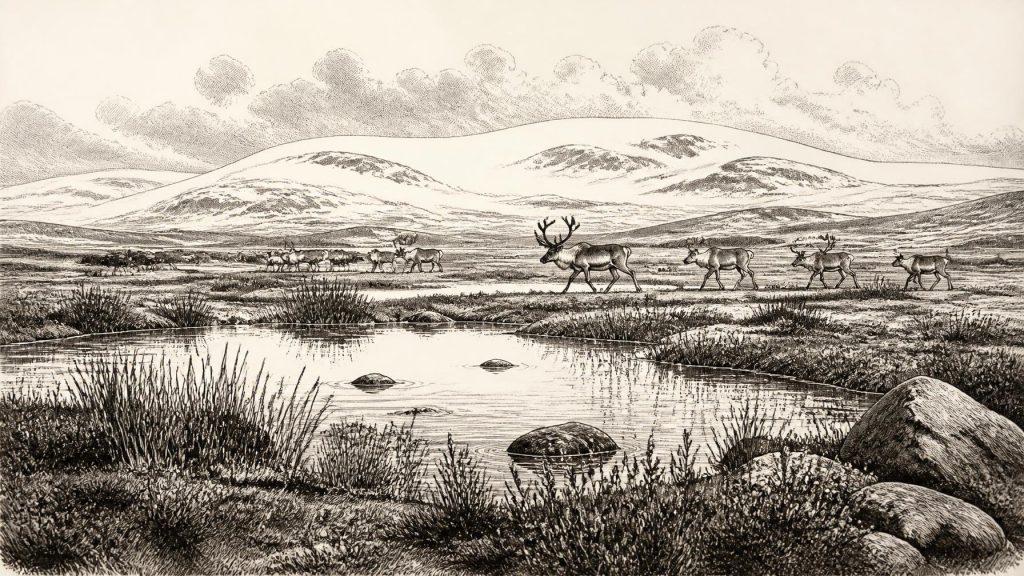
Derryvree offers a different kind of evidence. There, organic silts and fine-grained freshwater sediments were discovered between two tills beneath a drumlin. Till is the unsorted debris left by moving glacier ice; the deposits trapped between tills demonstrate that an interval of open water, wet ground and vegetation occurred between glacial episodes. Fossil plant remains include cold-tolerant taxa such as dwarf willow, mountain avens, sedges, mosses and bogbean. Water-milfoil points to freshwater conditions. Together these remains indicate a treeless or very sparsely wooded tundra-like wetland mosaic, not the familiar green, enclosed Ireland of recent centuries.
That inference has limits. Derryvree was a local basin in Fermanagh, not a weather station for the entire island. Plant macrofossils and pollen show what grew in and around a particular sedimentary environment; they do not map every valley, coast or upland. Nevertheless, they establish something important: parts of Ireland could support freshwater ecosystems during MIS 3. There were pools, saturated soils, sedge-rich margins and patches of low vegetation capable of sustaining insects, small mammals and larger herbivores. In a glacial world, such places would have been ecological refuges, though ‘refuge’ should not be mistaken for warmth or ease.
The Castlepook Fauna
The strongest Irish evidence for the wider animal world comes from Castlepook and a small number of other southern caves. The Castlepook assemblage includes reindeer, woolly mammoth, giant deer, brown bear, wolf, fox, Arctic fox, hare, lemmings and spotted hyaena, although not all specimens need be contemporary. This is not a roll-call for one mythical Irish ‘mammoth-steppe’ scene. It is a time-averaged collection accumulated under changing climatic conditions, and cave deposits can be affected by carnivores, water, collapse, later disturbance and antiquarian excavation.
Even so, the fauna establishes that Ireland was connected, at least intermittently, to wider north-west European ecological networks. Reindeer and lemmings fit cold, open conditions; mammoth and giant deer evoke extensive grazing landscapes; hyaenas, wolves and bears show that large carnivores also used the country. Caves were not necessarily peaceful shelters. They could be dens, scavenging places, traps for animals or repositories into which bones were washed and dragged. A bone in a cave therefore does not automatically mean that its owner lived nearby, still less that a human group occupied the cave.
The presence of giant deer deserves particular care. The animal conventionally called the ‘Irish elk’ was neither restricted to Ireland nor an elk. Its imposing antlers are well known, but its Castlepook remains are more significant as evidence of a large herbivore surviving in a cold and variable landscape. Recent reassessment suggests that giant deer and spotted hyaena may have disappeared locally before the Last Glacial Maximum. That is an interpretation based on dated samples, not proof of an island-wide extinction year.
The Reindeer Bone Question
The most arresting possible human evidence is a reindeer femur from Castlepook reported as about 33,000 years old and bearing a deep mark interpreted as having been made by a sharp stone edge while fresh bone was processed. If that reading is confirmed, it would suggest that people reached Ireland far earlier than the securely documented terminal-Pleistocene human evidence from County Clare. It would be a major discovery: not an origin story for a permanent nation, but a trace of a fleeting Upper Palaeolithic encounter with an animal.
It remains a proposition requiring stringent testing. A cut mark must be distinguished microscopically from damage by carnivore teeth, trampling, sediment movement, excavation tools or later handling. Moreover, the precise relationship between the mark, the bone’s date and its original cave context needs to be demonstrated. No securely associated stone-tool assemblage, hearth, dwelling floor, burial, structured refuse deposit or human bone of this age has yet been published from Ireland. Current work at Castlepook has located undisturbed Pleistocene deposits in parts of the cave, offering the prospect of better-contextualised evidence in future.
Accordingly, it would be wrong to write of an Irish tribe, chief, migration, language or settled hunting territory in 30,948 BCE. There is no basis for political affairs, diplomacy, law or warfare. Nor is there evidence for organised religion, ritual monuments, art, textile production, farming, trade or formal learning. Absence of evidence is not proof that people could never have been present; it is a statement about what the current archaeological record can support.
Life, If Visitors Came
If people did visit, their economy would have been that of mobile hunter-gatherers, reliant on knowledge of animal movements, weather, fuel, stone and safe routes. But this is a conditional comparison with Upper Palaeolithic communities elsewhere in Europe, not a description of a documented Castlepook camp. One possible butchered reindeer bone cannot tell us whether the animal was hunted, scavenged, carried from elsewhere, shared between people, or processed by a party that stayed for hours, days or longer. It cannot reveal kinship, belief, language or identity.
What can be said is that survival would have depended on close attention to a demanding environment. Open vegetation supported grazers; freshwater patches provided resources and movement corridors; caves offered terrain of practical importance but also danger from carnivores and unstable deposits. The human story, if there was one, was probably intermittent and vulnerable to rapid climatic deterioration. Later ice expansion would have made continuity still less likely and would have destroyed much of the evidence needed to establish it.
Evidence Before Narrative
The principal development relevant to Ireland around 30,948 BCE was environmental: a changing Late Pleistocene landscape in which cold wetlands, open ground, large herbivores and predators existed before more extensive glaciation. Derryvree preserves the ecological detail of freshwater tundra-like ground; Castlepook preserves the island’s richest known pre-Last Glacial Maximum vertebrate archive. The marked reindeer femur introduces the serious possibility of a very early human visit, but not yet a settled human history.
This is why the period matters. It places Ireland within the fluctuating climates and animal movements of Ice-Age north-west Europe while exposing the fragility of its evidence. Beneath later tills, in cave mud and in museum collections, a few sediments and bones are enough to change large questions. They are not enough to fill a year with invented events. For this remote point in time, intellectual honesty means allowing the archive to remain both extraordinary and incomplete.
Primary Sources
- A Reconsideration of the Radiocarbon Dating of the Marine Isotope Stage 3 Fauna from Southern Ireland
- The Exploration of Castlepook Cave, County Cork
- Pleistocene Vertebrates in the British Isles
- Occurrence of Mammalia Relicts at Site Castlepook Cave
- Castlepook Cave: County Geological Site Report
- The Irish Quaternary Fauna Project
- The Timing and Magnitude of the British–Irish Ice Sheet Between Marine Isotope Stages 5d and 2
- BRITICE-CHRONO: Constraining Rates and Style of Later British–Irish Ice Sheet Deglaciation
- Maximum Extent and Dynamic Behaviour of the Last British–Irish Ice Sheet West of Ireland
- Character of Advance and Retreat of the Southwest Sector of the British-Irish Ice Sheet During the Last Glaciation
- Stratigraphic and Palaeo-geomorphological Evidence for the Glacial-deglacial History of the Last British-Irish Ice Sheet in the North-western Irish Sea
- The IntCal20 Northern Hemisphere Radiocarbon Age Calibration Curve (0–55 cal kBP)
- A Stratigraphic Framework for Abrupt Climatic Changes During the Last Glacial Period Based on Three Synchronized Greenland Ice-core Records
- Extending and Globally Tuning the Greenland Ice-core Chronology (GICC05) Back to 120 ka
- New Insights on the Fauna of Ireland’s Younger Dryas and Early Holocene from Alice & Gwendoline Cave
- Archaeological Heritage of County Cork
- Irish Quaternary Association Field Guide 16: The Quaternary of the Fermanagh Drumlin Belt
- The Stratigraphic Position and Age of the Gortian
- Radiocarbon Dating and Chronological Modelling
- Ireland’s Palaeolithic Archaeology: Fleeting Footprints in a Frozen Land