
Greenland Stadial Five30953 BCE
Around 30,953 BCE, Ireland lay within Greenland Stadial 5, a climatically unstable Late Pleistocene cold interval rather than a recordable historical year. Ice advanced and retreated, leaving varied local environments. At Derryvree, County Fermanagh, freshwater sediments between tills show that treeless, cold wetlands supported plants during an ice-free phase. Castlepook Cave, County Cork, preserves remains of Ice Age mammals and predators, though they do not form a single contemporary fauna. A possibly stone-tool-cut reindeer bone suggests brief human carcass processing, but not settlement. No evidence supports societies, farming or trade. These records portray changing habitats before the Last Glacial Maximum.
Dateline
The label 30,953 BCE is a modern calendrical convenience, not a date that people in Ireland could have recorded or that archaeology can isolate to a particular year, season or lifetime. In scientific terms, it falls roughly 32,900 calendar years before present, within the Late Pleistocene and Marine Isotope Stage 3 (MIS 3), a long and climatically unstable part of the last Ice Age. The closest responsible account is therefore not a chronicle of events, rulers or settlements, but an assessment of the evidence for Irish landscapes, animals and possible human activity across broad calibrated ranges.
A Cold Interval, Not a Recorded Year
At this approximate point in time, the Greenland ice-core chronology places the North Atlantic in Greenland Stadial 5, a colder interval between relatively milder interstadials. Greenland Stadial 5 is conventionally bracketed at about 33,600–32,500 years before AD 2000, although its precise boundaries depend on the chronology used. That framework is valuable because Ireland lay on the Atlantic fringe, where climate was strongly shaped by changes in ocean circulation, sea ice and the growth of the British–Irish Ice Sheet. It does not mean that every shift registered in Greenland can be translated directly into a temperature or weather report for Ireland.
Ireland was not uniformly buried beneath ice throughout MIS 3. Its ice cover expanded and contracted over many millennia, while local conditions varied sharply between uplands, lowlands, coasts and sheltered basins. The important long-term development was the mounting environmental pressure that would eventually culminate in far more extensive glaciation during the Last Glacial Maximum, broadly after 30,000 calendar years ago. Around 30,953 BCE, however, the island’s history was still one of unstable cold-stage habitats rather than one simple image of an entirely ice-covered land.
Derryvree’s Buried Freshwater Record
The most revealing Irish evidence for this broad phase comes from Derryvree near Maguiresbridge, County Fermanagh. There, a road cutting through a drumlin exposed a remarkable sequence: glacial till, then freshwater silts and fine sands containing organic material, followed by another thick till. The middle deposit was dated conventionally to 30,500 ± 1,100 radiocarbon years BP, laboratory number BIRM-166. This is not identical to 30,953 BCE, and an old radiocarbon measurement cannot be converted into a single exact BCE year. Yet it securely demonstrates an important point: between glacial advances, part of Fermanagh contained open, ice-free freshwater environments during the Middle Midlandian, the regional term used for this part of Ireland’s last cold stage.
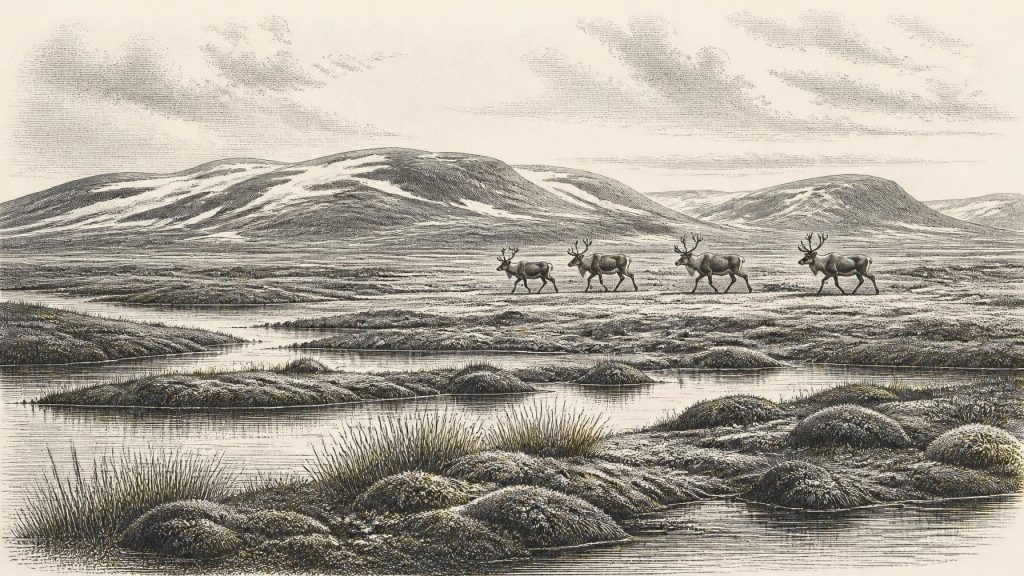
Plant and sediment evidence from Derryvree indicates a treeless, cold wetland or muskeg landscape. Sedges, mosses, aquatic plants and other cold-tolerant vegetation could exploit shallow water, saturated ground and summer thaw. Such evidence records organisms and habitats, not a picturesque frozen wilderness without life. The water must have remained seasonally available; fine sediment accumulated; plants grew, shed pollen and left identifiable remains. But the setting was open and exposed, not wooded countryside. Long winters, short growing seasons, frost action and strong seasonal contrasts would have placed severe limits on plant cover and animal food supplies.
The Derryvree sequence also explains why caution is essential. The freshwater layer survived because later ice and sediment sealed it between tills. It is a fortunate geological archive, not a complete cross-section of Ireland. It cannot establish that every region was simultaneously ice-free, nor can it tell us that a particular animal drank from a particular pool in 30,953 BCE. Its significance lies in demonstrating environmental possibility: cold, locally habitable wet ground existed in Ireland before renewed and more extensive ice-sheet expansion transformed the landscape again.
Mammals on an Open Island
Cave collections, especially from Castlepook Cave near Doneraile in north County Cork, add a different kind of evidence. They show that large mammals and carnivores reached Ireland during portions of the Late Pleistocene. Castlepook has produced remains attributed to reindeer, woolly mammoth, giant deer, brown bear, wolf, Arctic fox, hare, lemmings and spotted hyaena. This is an extraordinary assemblage by Irish standards, but it must not be treated as a single herd living together on one day. Cave bones can accumulate through natural deaths, carnivore activity, water movement, collapse and excavation over long periods.
Recent re-dating has changed the chronology of southern Irish cave faunas substantially. Improved bone pretreatment showed that several older radiocarbon determinations had underestimated their true age; some Castlepook specimens proved between roughly 5,000 and 12,000 radiocarbon years older than earlier results suggested. The revised work places important parts of the fauna within MIS 3 and suggests that giant deer and spotted hyaena may have disappeared locally before the Last Glacial Maximum, perhaps around 40,000 calibrated years BP. Consequently, Castlepook illuminates the ecological world that preceded and overlapped the long approach to glacial maximum, but it cannot securely furnish a species list for this one numbered year.
Even so, the evidence supports a broad reconstruction. Open ground, grass- and herb-rich patches, sparse shrub cover, wetlands and exposed mineral soils could support grazing or browsing animals and the predators that followed them. Reindeer were particularly suited to cold, open country; mammoth and giant deer signal a very different Ireland from the later wooded Holocene island. The presence of both herbivores and large carnivores indicates connected ecological opportunities, not permanent abundance. Animal populations may have moved repeatedly as ice margins, snow cover, vegetation and accessible ground changed.
The Castlepook Human Question
One reindeer femur from Castlepook has made this period unusually important for Irish human history. Re-examination identified a deep mark interpreted by palaeozoologist Ruth Carden as having been made with a sharp stone tool while a fresh carcass was being butchered. Public heritage accounts date the bone broadly to about 33,000 years ago. If the interpretation is confirmed, it would be evidence that one or more Upper Palaeolithic people handled a reindeer in Ireland vastly earlier than the island’s long-established post-glacial record.
The qualification matters. The bone was recovered from an older cave collection, not from a modernly excavated occupation floor with an unbroken stratigraphic sequence. A radiocarbon date indicates when the animal lived, not necessarily the precise moment at which a surface mark was made. Nor does one marked limb bone demonstrate that people killed the animal, camped in the cave, resided nearby or returned seasonally. Natural abrasion, trampling, carnivore damage and excavation damage all require careful exclusion when marks on bone are assessed. Renewed work at Castlepook has located stratified Pleistocene deposits, but no securely associated hearth, dwelling, human burial or stone-tool assemblage has yet established a settlement of this age.
The strongest conclusion is correspondingly modest. There may have been a brief episode of human carcass processing in Ireland during MIS 3. A more ambitious story – a named population, a regular reindeer-hunting territory, families living in Cork, or a migration route from Britain – remains interpretation rather than demonstrated fact. Lower sea levels altered the geography of north-west Europe, but the existence, timing and practicality of any land connection between Ireland and Britain remain debated; there is no basis for depicting an assured overland corridor at this date.
Society Beyond the Evidence
No political affairs, diplomacy, warfare, leaders, tribes or territorial boundaries can responsibly be described for Ireland around 30,953 BCE. There is no writing, no human skeleton securely dated to this time, no settlement plan and no material record from which language, kinship, belief or social rank can be recovered. Likewise, there is no evidence for farming, stock-keeping, fields, pottery, metalwork, monuments, formal burial rites, exchange networks or organised trade. These absences are not proof that no person ever crossed the island; they are limits on what the present record can show.
If Castlepook’s cut mark is human-made, it implies only the practical knowledge needed to use a sharp lithic edge on a large animal. Meat, hide, sinew, fat and bone would all have been valuable resources to mobile hunter-gatherers elsewhere in Ice Age Europe, but it cannot be shown which were taken in Ireland, by whom, or where they were consumed. European Upper Palaeolithic comparisons may help readers imagine the capabilities of contemporary people, yet they must not be imported as Irish evidence. Ireland has not yielded contemporary art, ornament, tailored clothing, ritual object or structure.
An Environmental History in Motion
The chief Irish development around this notional date was therefore environmental change. Derryvree preserves cold freshwater life between advances of ice. Castlepook preserves a time-depth of mammals suited to open Ice Age landscapes, alongside a provocative but still limited possible human trace. Together they show that Ireland was neither timelessly empty nor securely populated: it was a difficult, changing northern environment in which wetland, open ground, large animals, predators and ice margins repeatedly reshaped the conditions for life.
That is the appropriate scale for 30,953 BCE. Modern calendar precision gives the year an apparent sharpness that the evidence does not possess. Calibrated ranges, buried sediments, dated bones and contested surface marks provide something more valuable than invented certainty: a cautiously recoverable glimpse of Ireland before the Last Glacial Maximum, when the island’s later human history was still far in the future.
Primary Sources
- A Middle Midlandian Freshwater Series at Derryvree, Maguiresbridge, County Fermanagh, Northern Ireland
- A Reconsideration of the Radiocarbon Dating of the Marine Isotope Stage 3 Fauna from Southern Ireland
- Growth and Retreat of the Last British–Irish Ice Sheet, 31,000 to 15,000 Years Ago: the BRITICE-CHRONO Reconstruction
- Exploring Controls of the Early and Stepped Deglaciation on the Western Margin of the British Irish Ice Sheet
- Stratigraphic and Palaeo-Geomorphological Evidence for the Glacial-Deglacial History of the Last British-Irish Ice Sheet in the North-Western Irish Sea
- Figure 6: The Subdivision of the Quaternary Period in Ireland
- Quaternary Site Descriptions
- Irish Pleistocene Biostratigraphy
- Independent Tephrochronological Evidence for Rapid and Synchronous Oceanic and Atmospheric Temperature Rises over the Greenland Stadial-Interstadial Transitions between ca. 32 and 40 ka b2k
- A Stratigraphic Framework for Abrupt Climatic Changes During the Last Glacial Period Based on Three Synchronized Greenland Ice-Core Records: Refining and Extending the INTIMATE Event Stratigraphy
- Scientific Dating of Pleistocene Sites
- New Insights on the Fauna of Ireland’s Younger Dryas and Early Holocene from Alice & Gwendoline Cave
- 2022:564 – Castlepook Cave, Castlepook South, Cork
- Archaeology Research Excavation Grant 2022: Castlepook Cave Final Report
- The Archaeological Heritage of County Cork
- The Irish Quaternary Fauna Project
- Mammoth and Musk Ox ESR-Dated to the Early Midlandian at Aghnadarragh, County Antrim, Northern Ireland, and the Age of the Fermanagh Stadial
- The Problem of a Late Quaternary Landbridge Between Britain and Ireland
- Sea-Level Change in the Irish Sea Since the Last Glacial Maximum: Constraints from Isostatic Modelling
- Pleistocene Vertebrates in the British Isles