
Derryvree’s Silted Basin30952 BCE
At 30,952 BCE, Ireland’s history can only be reconstructed through geological and environmental evidence, not annual events or written sources. Derryvree, County Fermanagh, preserves freshwater organic silts between glacial tills, demonstrating locally ice-free, cold, wet, largely treeless conditions during Marine Isotope Stage 3. Plants, insects and comparable sites show episodic glaciation; Crag Cave confirms intermittent liquid water. Castlepook Cave, County Cork, records a mixed Late Pleistocene fauna accumulated over millennia, including reindeer, mammoth and predators. A possibly tool-marked reindeer femur may indicate brief human activity, but cannot establish settlement. Expanding ice later transformed landscapes and obscured earlier traces across Ireland.
Dateline
The label 30,952 BCE is useful for organising a modern chronology, but it cannot identify a recoverable Irish year. No calendar, written record, named community or datable event survives from Ireland at this depth of time. In archaeological terms, the point falls at approximately 32,900 calibrated years before present, with “present” conventionally fixed at 1950. It belongs to the Late Pleistocene, within Marine Isotope Stage 3, a long and climatically unstable part of the last Ice Age. The responsible history of Ireland at this date must therefore be told through broad calibrated ranges, geological sequences and probabilities, not through imagined annual events.
A Landscape Between Ice Advances
The closest Irish chronological anchor is Derryvree, near Maguiresbridge in County Fermanagh. There, road works exposed a remarkable sequence buried within a drumlin: glacial till at the base, freshwater sands and organic silts in the middle, and a later till above. The order matters. It proves that ice had occupied the site, that an interval followed in which open water and living communities developed, and that a renewed ice advance subsequently sealed the evidence. The organic deposit produced a radiocarbon determination of about 30,500 radiocarbon years before present, with a substantial laboratory uncertainty. Its calibrated age is generally placed broadly between about 36,900 and 31,700 calibrated years before present. That range encompasses the modern label 30,952 BCE, but does not date every particle of mud, plant remain or insect to that notional year.
Derryvree is consequently a window rather than a photograph. Its freshwater sediments indicate that at least part of Fermanagh was ice-free during a cold phase of MIS 3. The site does not establish that all Ireland was free of ice, nor can it draw a precise island-wide ice margin. Conditions differed between uplands, coasts, basins and the changing fringes of glaciers. Yet the sediments decisively reject a simple picture of an island continuously entombed beneath ice throughout this period.
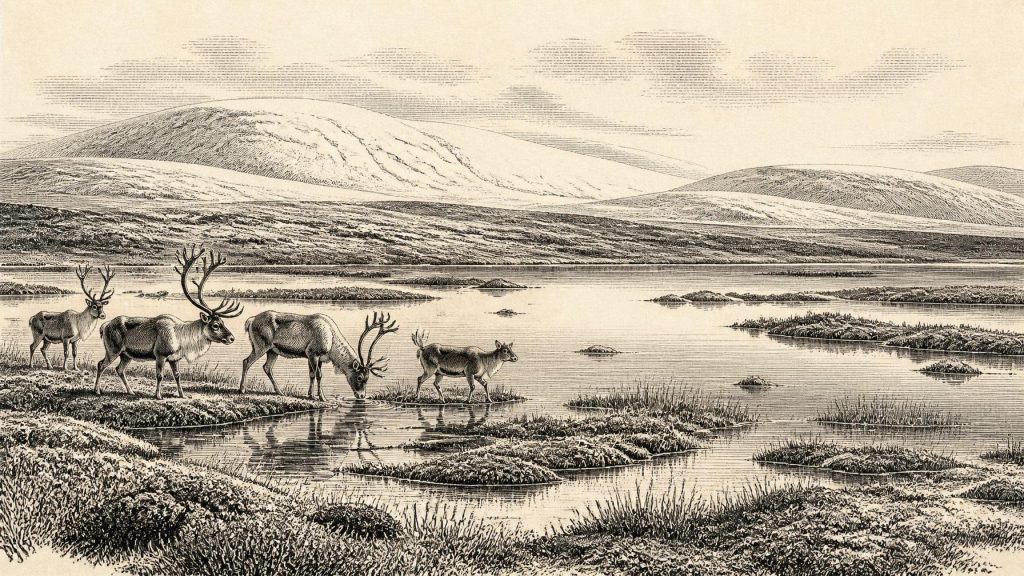
The landscape around the basin was harsh but biologically active. Pollen, plant macrofossils, mosses and insect remains point towards open, largely treeless terrain with sedges, grasses, herbs and low-growing shrubs. Wet hollows and shallow pools supported aquatic and waterside vegetation; exposed ground was likely frost-affected, thinly vegetated and vulnerable to wind. Terms such as tundra and muskeg are useful descriptions of this mosaic, provided they are not mistaken for an exact modern ecological equivalent. The evidence supports cold, open and locally waterlogged country, not a uniform plain of permanent snow.
Water, Plants and Short Seasons
For everyday life in the landscape, the strongest evidence is non-human. Derryvree’s plants and insects show that summer growing seasons, although short, were sufficient for wetland communities to flourish. Sedges and mosses occupied damp margins; herbs and grasses colonised more open ground; freshwater habitats offered food and shelter for invertebrates. Such environmental detail is historically important because later glaciation erased or buried so much of Ireland’s older surface. The organic silts survived largely by chance, protected between deposits left by separate ice advances.
Comparable sites in the north of Ireland, including Hollymount and Greenagho in County Fermanagh, reinforce the wider conclusion that glaciation was episodic. Their dates and correlations are not precise enough to turn them into a simple annual sequence, and scholars have long debated how individual deposits fit into the rapidly shifting climate pattern recorded in Greenland ice cores. Still, they demonstrate that Ireland experienced alternating cold, non-glacial and glacial conditions during MIS 3. Crag Cave in County Kerry adds a different form of evidence: phases of speleothem growth show that liquid water intermittently reached caves during this climatically variable period.
The main development relevant to 30,952 BCE was therefore environmental change. Ireland was approaching the fuller expansion of the last British–Irish Ice Sheet, but had not yet entered its final maximum phase. Large-scale reconstructions place the last maximum advance of the Irish Ice Sheet later, broadly between about 27,000 and 23,000 calibrated years before present. As ice expanded, it would scour bedrock, redistribute enormous quantities of sediment, alter drainage and destroy or conceal many traces of earlier land surfaces. The future drumlin country of Fermanagh was not yet the hedged agricultural landscape now familiar: it was a changing terrain of frost, water, sparse vegetation and encroaching ice.
Castlepook’s Mixed Fauna
Southern Ireland supplies a complementary but more complicated record. Castlepook Cave near Doneraile in north County Cork has produced Ireland’s richest known assemblage of mammals from before the Last Glacial Maximum. Its collections include remains attributed to reindeer, woolly mammoth, giant deer, brown bear, wolf, fox, hare, lemmings and spotted hyaena. These animals show that Ireland was intermittently part of a wider north-west European ecological world, capable of supporting cold-adapted grazers, predators and scavengers.
They should not, however, be placed together in a single imagined herd at 30,952 BCE. Castlepook was excavated principally in the late nineteenth and early twentieth centuries, before modern standards of stratigraphic recording, and cave deposits can combine material introduced at different times by carnivores, water movement and excavation. The Irish Quaternary Fauna Project demonstrated that the cave fauna represents more than one phase. More recent radiocarbon work, using improved collagen preparation, has revised several dates substantially older and suggests that some species, notably giant deer and spotted hyaena, disappeared locally before the Last Glacial Maximum. Castlepook records succession and accumulation over millennia, rather than one perfectly preserved Ice Age scene.
Nevertheless, the faunal evidence makes an important point about regional change and connectivity. Reindeer, mammoth and carnivores did reach Ireland at intervals during the Late Pleistocene. Lower global sea levels changed coastlines and exposed wider coastal shelves, but it would be unsafe to claim a permanent, easy land bridge at this particular date. The Irish Sea basin, local ice, shifting sea levels and changing topography made routes variable. Mammal remains demonstrate connection in some form; they do not reveal exactly where every animal crossed, how frequently movements occurred, or whether human travellers followed identical paths.
The Reindeer Femur Question
One Castlepook object gives this period its greatest archaeological significance: a reindeer femur reported as bearing a deep modification made by a sharp stone tool while the bone was fresh. The bone has been presented as dating to roughly 33,000 years ago, broadly close to the interval represented by 30,952 BCE. If the mark is correctly identified as a butchery cut, it may be evidence that one or more Upper Palaeolithic people processed a reindeer in Ireland long before the better-established terminal-Pleistocene human evidence at Alice and Gwendoline Cave, County Clare.
The distinction between evidence and interpretation is crucial. The direct evidence is a dated animal bone with a proposed anthropogenic mark. The interpretation is that people used a stone tool to butcher the carcass. Even if that interpretation is confirmed, it would demonstrate an episode of human activity, not a settled population. No securely associated hearth, stone-tool assemblage, dwelling floor, burial, human remains or repeated occupation sequence of comparable age has yet been published from Castlepook. Nor can the bone tell us whether hunters killed the animal, processed it beside the cave, visited once or returned repeatedly. Carnivores may have moved discarded remains into the cave after butchery elsewhere.
A brief visit by mobile hunter-gatherers exploiting reindeer is a plausible hypothesis, especially given the wider Upper Palaeolithic world of north-west Europe. It is not proof of a permanent Irish community, a named archaeological culture, language, ancestry or migration route. Later ice-sheet activity provides one reason why traces of temporary camps may be scarce, but loss of evidence cannot be used to invent what has not been found.
What Cannot Be Recovered
There is no basis for reconstructing political affairs, diplomacy, warfare, territorial rule or formal institutions in Ireland at this date. Equally, there is no Irish evidence for farming, domestic livestock, cereal cultivation, permanent villages, long-distance trade networks, metalworking, ritual monuments, art, writing or systems of formal learning. If people briefly entered the island, they certainly possessed social relationships, practical knowledge and beliefs; all humans do. But the Irish record at 30,952 BCE does not allow those things to be described responsibly.
The economy visible in the evidence is ecological rather than societal. Wetlands produced plant and insect communities; open ground could support grazing mammals; caves served, at least at times, as carnivore dens and traps for bone preservation. Reindeer and other animals were part of a mobile food web, not demonstrably the stock of a human hunting economy in Ireland. The possible Castlepook cut mark offers a tantalising exception, but it is too slight to support a wider narrative of trade, leadership or regular seasonal settlement.
Ireland around this point in deep time was thus neither an empty stage nor a known human homeland. Derryvree preserves a cold freshwater world between glacial episodes. Castlepook preserves scattered evidence of Ice Age animals, accumulated across a much longer span, and perhaps a single human encounter with a reindeer. Together they reveal a shifting western edge of Pleistocene Europe: locally ice-free, wet in hollows, open to cold winds, inhabited by animals, and increasingly vulnerable to the advance of ice that would transform the island’s landscapes and obscure much of their earlier history.
Primary Sources
- A Middle Midlandian Freshwater Series at Derryvree, Maguiresbridge, County Fermanagh, Northern Ireland
- The Irish Quaternary Fauna Project
- A Reconsideration of the Radiocarbon Dating of the Marine Isotope Stage 3 Fauna from Southern Ireland
- Pattern and Timing of Retreat of the Last British-Irish Ice Sheet
- Growth and Retreat of the Last British–Irish Ice Sheet, 31,000 to 15,000 Years Ago: The BRITICE-CHRONO Reconstruction
- Response of the Irish Ice Sheet to Abrupt Climate Change During the Last Deglaciation
- New Data for the Last Glacial Maximum in Great Britain and Ireland
- Landscapes and Environments of the Last Glacial-Interglacial Transition: A Time of Amazingly Rapid Change in Ireland
- Middle Midlandian Interstadial Deposits at Greenagho, Near Belcoo, County Fermanagh, Northern Ireland
- Episodic Speleothem Deposition Tracks the Terrestrial Impact of Millennial-Scale Last Glacial Climate Variability in SW Ireland
- Figure 6: The Subdivision of the Quaternary Period in Ireland
- Field Guides
- Introduction to the Late Quaternary and Holocene of Northern Ireland
- The Irish Biogeographical Society: Postglacial Colonisation Conference Proceedings
- Occurrence of Mammalia Relicts at Site Castlepook Cave
- Castlepook Cave, Castlepook South, Cork: 2022 Excavation Report
- Heritage Artefacts of County Cork
- Ireland’s Palaeolithic Archaeology – Fleeting Footprints in a Frozen Land
- First Evidence of a Late Upper Palaeolithic Human Presence in Ireland
- First Evidence of a Late Upper Palaeolithic Human Presence in Ireland
- New Insights on the Fauna of Ireland’s Younger Dryas and Early Holocene from Alice & Gwendoline Cave
- New Insights on the Fauna of Ireland’s Younger Dryas and Early Holocene from Alice & Gwendoline Cave
- The Standard Stratigraphic Nomenclature of Offshore Ireland
- Sedimentary Ancient DNA Reveals Late Pleistocene Faunal Connectivity Between Ireland and Eurasia