Derryvree’s Intertill Sedge Silts30764 BCE
Ireland around 30,764 BCE belongs to unstable late Marine Isotope Stage 3, not a recoverable historical year. Derryvree, County Fermanagh, preserves freshwater organic silts between glacial tills, indicating an ice-free tundra wetland during an earlier interval, though its radiocarbon date has wide calibrated uncertainty. Castlepook Cave, County Cork, contains a long, disturbed record of Ice Age fauna, including mammoth, reindeer, giant deer, bear and hyaena, demonstrating intermittent biological richness. A marked reindeer femur may indicate human butchery about 33,000 years ago, but remains disputed. No secure evidence establishes settlement, society, farming, politics or culture; environmental change dominates the record overall.
Dateline
30,764 BCE is not a year that can be recovered from Ireland’s prehistoric record in the way that a later annalistic year can. It is a modern calendar label projected far into the past, rather than a date known to the people, animals or landscapes of the time. Mechanically expressed in the archaeological convention of years before AD 1950, it falls at roughly 32,700 calendar years BP. At that depth, radiocarbon dates carry broad calibrated ranges, and deposits record phases rather than individual seasons or events. The responsible subject is therefore Ireland during the later part of Marine Isotope Stage 3 (MIS 3), a climatically unstable interval within the Last Ice Age.
There was no Irish state, king, tribe, treaty, battle or named community that can be placed in this notional year. Nor is there evidence for farming, villages, monuments, writing, organised religion or a continuous population. What survives is more fragmentary and, in its way, more remarkable: sediments sealed beneath later ice, fossil plants and insects, and the bones of animals from caves. Together they show that parts of Ireland could support life before the Last Glacial Maximum, while also warning against the tempting fiction of a fully peopled prehistoric landscape.
An Island in a Changing Ice Age
MIS 3, conventionally spanning about 57,000 to 29,000 years ago, was not a single uniform freeze. Climate swung repeatedly between relatively milder interstadial episodes and colder stadials. Around the broad horizon represented by 30,764 BCE, Ireland lay on the western fringe of north-west Europe, exposed to powerful shifts in temperature, snowfall, ice growth, sea level and vegetation. The later British–Irish Ice Sheet was beginning a major phase of expansion: recent reconstructions identify rapid growth in the wider ice-sheet system from about 31,000 years BP, with its eventual maximum coming much later, around 23,000 years BP. This means neither that every part of Ireland was ice-covered at once nor that its ice-free ground was hospitable by modern standards.
Sea level was substantially lower than today because immense quantities of water were stored in global ice sheets. Coastlines and shallow seas differed from their present form, but a low sea level must not be turned automatically into a proven walking route for people or animals. Ice margins, marine channels, fluctuating shorelines and local relief all mattered. The existence, timing and usefulness of any connection between Ireland and Britain remain palaeogeographical questions, not evidence that a particular group crossed at a particular date. Later modelling indicates Ireland had become separated from Britain by about 16,000 calendar years BP, but that result cannot simply be projected backwards to settle conditions more than sixteen millennia earlier.
Derryvree’s Buried Wetland
The clearest Irish environmental evidence relevant to this broader world comes from Derryvree near Maguiresbridge, County Fermanagh. Road works in 1969 cut through a drumlin and exposed organic freshwater silts and fine sands between two thick tills, deposits laid down directly by glacier ice. The order of the layers is eloquent. Ice occupied the locality; then an ice-free interval allowed fresh water, sediment and organic remains to gather; afterwards, another glacial phase buried and preserved them. It is a local archive of changing conditions, not a diary for all Ireland.
The Derryvree organic material produced a conventional radiocarbon determination of 30,500 +1,170/−1,030 radiocarbon years BP, known as Birm-166. Its age is relevant to the long MIS 3 setting but is not identical to 30,764 BCE, and calibration introduces a substantially older, broad calendar range. The distinction matters. Atmospheric radiocarbon levels changed through time, so a laboratory radiocarbon age is not a calendar date; modern IntCal20 calibration reaches back to 55,000 calendar years BP but properly preserves uncertainty at great antiquity.
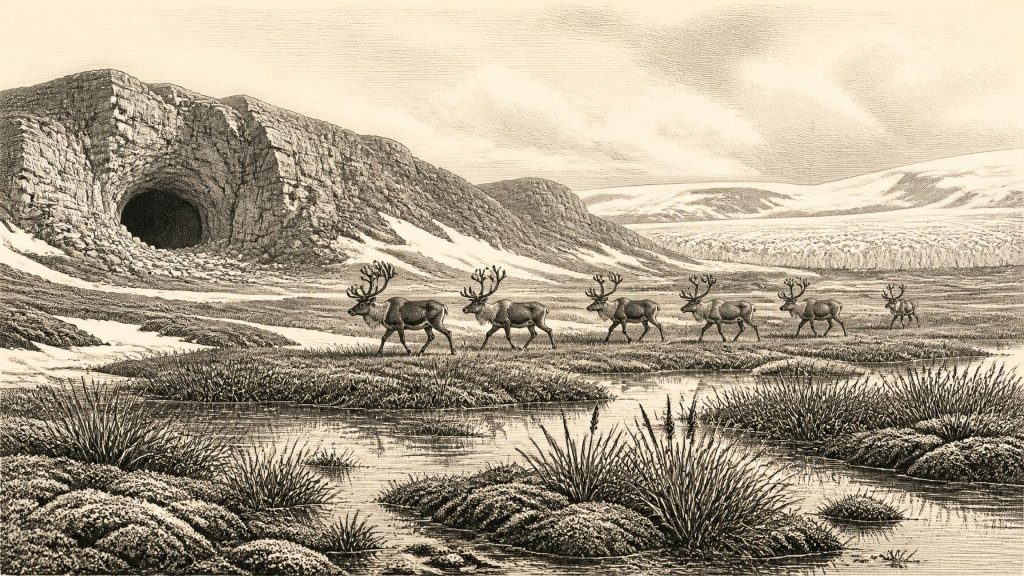
At Derryvree, pollen, plant macrofossils and invertebrate remains indicate open tundra vegetation and periglacial conditions. Sedge-rich wet ground, mosses, dwarf shrubs and cold-adapted herbs would have fringed shallow water. Such evidence supports a landscape with short growing seasons, frost disturbance and little or no woodland locally. It does not reveal a human settlement beside the pool: no hearth, stone-tool assemblage, house floor, burial or food waste of this age was recovered there. Nevertheless, the site decisively shows that a part of inland Ireland could be ice-free enough to sustain a freshwater ecosystem amid the wider advance-and-retreat history of the ice.
Castlepook and the Animal World
County Cork’s Castlepook Cave, near Doneraile, supplies the principal faunal counterpart to Derryvree. The limestone cave system, long known through galleries with evocative modern names such as Hyenahall and Elephant Hall, has yielded more than 2,000 bones. Its deposits were accumulated over a very long span and were disturbed by water, carnivores and early excavations. Consequently, Castlepook is not a neatly layered snapshot of one moment. It is an exceptional archive of Ice Age animals, but each bone requires its own dating, context and taphonomic assessment.
The cave fauna includes woolly mammoth, giant deer, reindeer, brown bear and spotted hyaena; later material includes Arctic fox, wolf, Norwegian lemming and collared lemming. These animals should not be imagined as living together everywhere or at exactly the same time. Their dated remains span different episodes from before and after the Last Glacial Maximum. Still, the assemblage establishes a basic and important fact for the period: Ireland was not biologically empty. Large herbivores and formidable carnivores could occupy or pass through suitable parts of the island during the Late Pleistocene.
The most evocative interpretation is that of a cold, largely open mosaic of grassland, herb-rich tundra, wet hollows and exposed ground. Reindeer were suited to seasonal movement through such country; mammoth and giant deer indicate that substantial grazing resources existed at least in particular episodes. Spotted hyaenas could drag prey remains into caves, helping to explain why bone collections are not automatically hunting camps. Their presence also reminds us that humans, if present, would have entered an ecosystem with dangerous competing predators. Geological Survey Ireland describes Castlepook as Ireland’s richest vertebrate-fauna site for the period leading up to the Last Glacial Maximum, while stressing the masking effect of water disturbance.
The Single Reindeer Bone
Castlepook has acquired additional importance because a reindeer femur fragment has been reported as bearing a deep mark interpreted as having been made by a sharp stone tool during carcass processing. Public discussion has associated the specimen with an age of about 33,000 years ago. If the mark is genuinely anthropogenic and contemporary with the animal’s death, it would be evidence that one or more people handled a reindeer in Ireland during the Upper Palaeolithic, vastly earlier than the long-established record of post-glacial settlement.
That possibility deserves attention, but not exaggeration. A date on bone dates the animal, while identifying a surface incision as a stone-tool cut is a separate specialist judgement. Castlepook’s old collection and disturbed cave deposits make secure association especially difficult. No contemporary hearth, stone toolkit, dwelling, human bone, formal working floor or repeatedly used butchery area has yet been recovered with the femur. Improved pretreatment and redating have already shown that some older Irish cave dates were significantly too young, demonstrating why claims based on legacy collections must remain open to revision.
The measured conclusion is not that Ireland possessed a settled hunting population in 30,764 BCE. At most, Castlepook presents a potentially important trace of human action within a broad late-MIS-3 interval. It might represent a short visit, opportunistic scavenging, a hunting excursion or some other episode impossible to reconstruct from one object. It cannot establish the size, ancestry, language, social organisation or duration of any human presence. Later, much stronger evidence from Alice and Gwendoline Cave in County Clare concerns a cut-marked brown-bear bone dating to about 12,800–12,600 calibrated years BP; that comparison underlines how unusually early, and how provisional, the Castlepook implication remains.
Society Beyond the Evidence
For political affairs, conflict and diplomacy, the honest answer is silence. There are no political institutions to identify and no material basis for describing alliances, territories or warfare. The same restraint applies to religion, culture and learning. No art, ornament, burial, shrine, musical object or symbolic artefact can responsibly be assigned to Ireland at this date. It would be reasonable, in a general European sense, to say that Upper Palaeolithic people elsewhere possessed sophisticated ecological knowledge, stone technologies and social networks. It would not be reasonable to transfer those documented practices into Ireland without Irish evidence.
Everyday economy is equally uncertain. The fauna makes hunting or scavenging conceivable if people were present, especially around reindeer, but the evidence cannot say whether anyone hunted locally, butchered a carcass brought to the cave, or merely passed through. There is no evidence for cultivation, herding, trade in imported materials or regular exchange routes. Nor should the low sea level be treated as proof of commerce or migration. In this era, environmental history is more securely visible than human history.
What can be said is that settlement, if it occurred at all, was likely precarious and episodic. A small mobile group would have needed to negotiate cold, changing ground, seasonal prey, scarce shelter and carnivores, while the expanding ice sheet repeatedly altered the geography of opportunity. Yet the archaeological record does not establish even this as a specifically Irish lived reality; it is an inference from the landscape and from better-documented Upper Palaeolithic lifeways elsewhere in Europe.
A Time Range, Not a Chronicle
Ireland around 30,764 BCE is therefore best approached through carefully bounded evidence. Derryvree records an earlier MIS 3 freshwater tundra interval in Fermanagh. Castlepook records a long, mixed history of Ice Age fauna in Cork and preserves a debated clue to human activity. Together they reveal an island—or a changing landmass on the Atlantic edge—where ice, water, vegetation and animal movement were continually reshaping the possibilities of life. They do not supply a year-specific event. Their value lies precisely in replacing invented certainty with a more compelling reality: a deep prehistoric Ireland whose history must be read from silt, bone, pollen and doubt.
Primary Sources
- A Middle Midlandian Freshwater Series at Derryvree, Maguiresbridge, County Fermanagh, Northern Ireland
- A Reconsideration of the Radiocarbon Dating of the Marine Isotope Stage 3 Fauna from Southern Ireland
- The Irish Quaternary Fauna Project
- Growth and Retreat of the Last British–Irish Ice Sheet, 31,000 to 15,000 Years Ago: the BRITICE-CHRONO Reconstruction
- Castlepook Cave: County Geological Site Report
- Archaeological Heritage of County Cork
- Heritage Artefacts of County Cork
- First Evidence of a Late Upper Palaeolithic Human Presence in Ireland
- New Insights on the Fauna of Ireland’s Younger Dryas and Early Holocene from Alice & Gwendoline Cave
- The IntCal20 Approach to Radiocarbon Calibration Curve Construction: A New Methodology Using Bayesian Splines and Errors-in-Variables
- Composition and Consequences of the IntCal20 Radiocarbon Calibration Curve
- IntCal: Radiocarbon Calibration Curves and Data
- The Island of Ireland: Drowning the Myth of an Irish Land-Bridge?
- Deglaciation, Earth Crustal Behaviour and Sea-Level Changes in the Determination of Insularity: A Perspective from Ireland
- The Problem of a Late Quaternary Landbridge Between Britain and Ireland
- Ireland: Submerged Prehistoric Sites and Landscapes
- Relative Sea-Level Changes and Crustal Movements in Britain and Ireland Since the Last Glacial Maximum
- Figure 6: The Subdivision of the Quaternary Period in Ireland
- Irish Quaternary Association Publications
- The Mesolithic in Ireland: When Was It?