BIRM-166 and Hyena Hall30704 BCE
30,704 BCE is a modern label rather than a precisely recoverable Irish year. During late Marine Isotope Stage 3, Ireland experienced unstable glacial and periglacial conditions, with evidence limited to broad dated ranges. Derryvree, County Fermanagh, preserves freshwater sediments dated around 36,900–31,700 calibrated BP, indicating a cold, open, largely treeless wetland with tundra plants, insects and pools between glacial episodes. Castlepook Cave, County Cork, records mammoth, reindeer, giant deer, predators and cold-adapted fauna, though deposits are mixed. A marked reindeer femur may indicate brief human butchery, not settlement. No evidence supports societies, polities or recorded events; environmental change dominates overall.
Dateline
“30,704 BCE” is a modern chronological label, not a year preserved in an Irish calendar or historical record. It corresponds approximately to 32,653 calendar years before AD 1950, the conventional reference point for cal BP dates. At this depth in time, however, calendar-year precision is not available. Ireland has no written evidence, named individuals, political events, settlements or securely dated seasonal activities that can be assigned to this particular year. The responsible subject is therefore Ireland during the later part of Marine Isotope Stage 3 (MIS 3), a long, climatically unstable phase of the Late Pleistocene.
The closest and most useful Irish evidence consists of environmental deposits and animal remains whose dates overlap broad intervals around this nominal point. It does not form an annal-like narrative. The crucial distinction is between evidence and interpretation: sediments can demonstrate that water, plants and insects existed at a place; bones can establish that particular animals reached Ireland; a mark on a bone may indicate human action. None of these things, alone, can identify a political community, a permanent population or an event in 30,704 BCE.
A Date Within a Range
The foremost environmental archive is at Derryvree, near Maguiresbridge in County Fermanagh. Roadworks in 1969 cut through a drumlin and exposed an extraordinary sequence: glacial till below, freshwater silts and fine sands with organic material in the middle, and a further till above. Till is the unsorted debris deposited by glacier ice. The stratigraphy establishes a firm order of events. Ice had affected the locality; an interval then permitted a wetland or shallow freshwater basin to accumulate sediment and organic remains; subsequently, later ice or ice-related deposition sealed the evidence.
Organic material from the Derryvree series yielded the conventional radiocarbon determination BIRM-166, reported as 30,500 radiocarbon years BP, with a large uncertainty of +1,170/−1,030 years. A radiocarbon age is not a calendar age. Because atmospheric carbon-14 levels have changed through time, results must be calibrated against independently dated records. At more than 30,000 years ago, calibration produces wide probability ranges rather than an annual answer. Published discussion has placed Derryvree broadly at about 36,900–31,700 calibrated years BP. The modern label 30,704 BCE falls within that wide chronological neighbourhood, but cannot be attached to a particular leaf, pool, animal or generation represented in the deposit.
This matters because Derryvree is a local record. It shows that an ice-free or ice-receded freshwater environment existed at that Fermanagh location between episodes of glaciation. It does not prove that the whole island was simultaneously free of ice, nor that its weather, vegetation or animal life were uniform from Fermanagh to Cork. Ireland stood at the north-western fringe of Europe, where shifting ice margins, changing sea level, exposed shelves and abrupt climatic reversals repeatedly altered the available land.
A Treeless Freshwater World
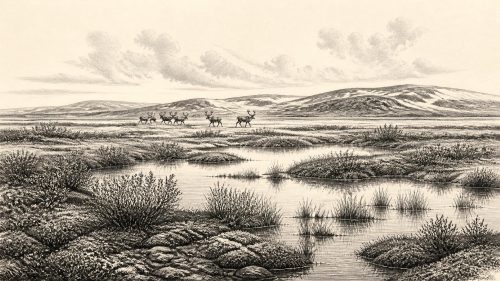
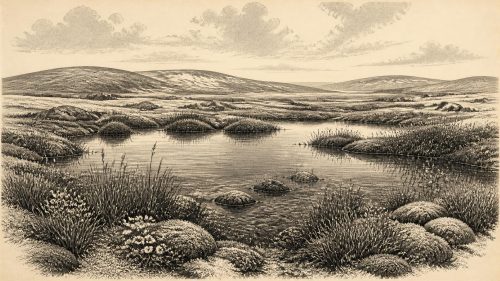
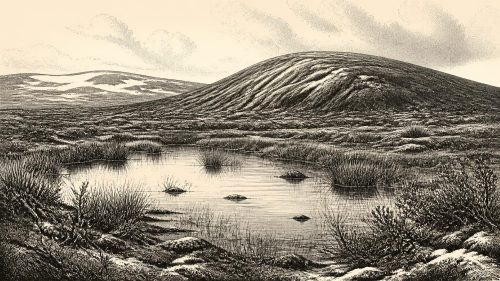
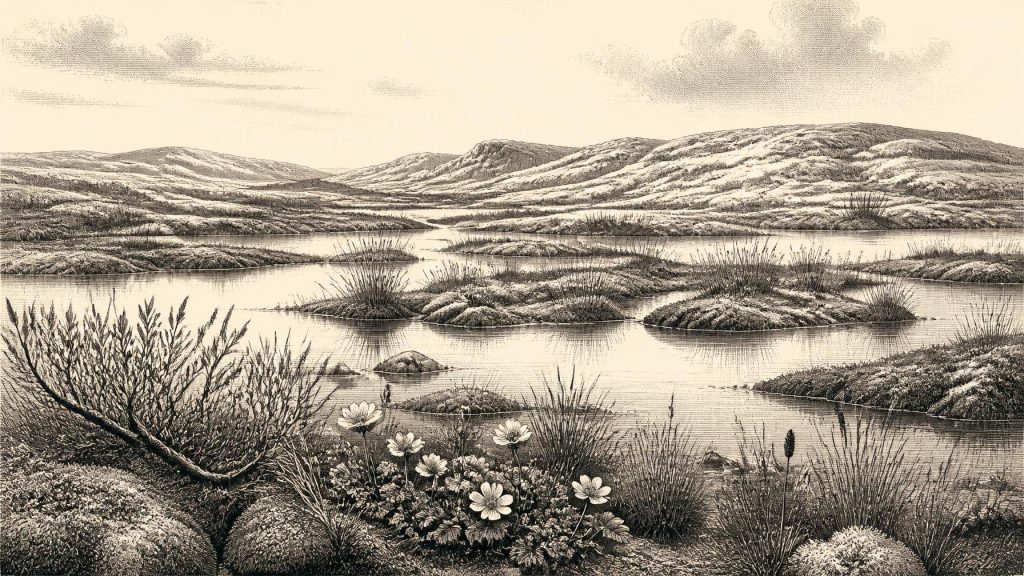
The biological evidence from Derryvree gives the clearest impression of the landscape relevant to this date. Plant macrofossils, pollen, mosses and insect remains indicate open tundra or tundra-like ground under periglacial conditions: severe cold, marked seasonality and ground influenced by frost. Grasses, sedges and herbs were important. Mosses were abundant enough to suggest wet ground, while aquatic and wetland plants included bogbean (Menyanthes trifoliata) and alternate water-milfoil (Myriophyllum alterniflorum). Fossils of mountain avens (Dryas octopetala) and dwarf willow (Salix herbacea) reinforce the picture of an Arctic-alpine flora.
Such evidence should not be turned into a picturesque but false vision of a continuous, uniform “Ice Age landscape”. Derryvree appears to have contained open pools, waterlogged vegetation and mossy margins: a cold freshwater mosaic, not simply barren snowfield. On better-drained ground, vegetation may have been sparse. The presence of juniper and a few tree pollen grains does not demonstrate nearby woodland. Pollen can travel considerable distances, while older grains may be reworked into younger sediments. The strongest conclusion is that the local landscape was largely open and treeless.
In everyday terms, this was an environment in which plant growth was restricted to a short productive season and winter conditions were harsh. Water, sedge beds and mossy ground would have supported insects and small animals as well as browsing and grazing mammals where suitable forage occurred. Yet the deposit is not a complete food web and cannot provide a census. Its importance lies in preserving a rare glimpse of life between glacial advances, when later ice elsewhere destroyed, mixed or buried older surfaces.
Castlepook’s Animal Evidence
Southern Ireland supplies a different sort of archive. Castlepook Cave, near Doneraile in north County Cork, yielded a major collection of Pleistocene animal bones during excavations led by Richard Ussher in the early twentieth century, with later investigation and radiocarbon dating by the Irish Quaternary Fauna Project and subsequent researchers. The cave’s galleries acquired evocative names, including Elephant Hall and Hyena Hall, which remain useful reminders that the fauna was far more varied than a simple image of an empty frozen island suggests.
Identified remains from Castlepook include woolly mammoth, reindeer, giant deer, brown bear, wolf, Arctic fox, lemmings and spotted hyaena. Several directly dated specimens belong to MIS 3, including material whose calibrated ranges overlap the broad period considered here. Reindeer and mammoth indicate open-country grazing landscapes; Arctic fox and lemmings suit cold conditions. Spotted hyaena is especially revealing, because the cave seems to have been used over time by carnivores as well as receiving bones through water movement and other processes.
That final qualification is essential. Castlepook is not a neatly sealed camp floor. Much of the early collection was excavated before modern recording standards, cave sediments have complicated histories, and bones from different episodes could be mixed or redeposited. A mammoth bone and a reindeer bone found in the same cave need not mean that the animals met, died or were consumed there together. The cave evidence is powerful for the presence of animals in Ireland over long spans, but weak for reconstructing a single day, herd or human encounter.
The Reindeer Femur Question
The most consequential possible human evidence is a reindeer femur fragment from Castlepook bearing a deep linear mark interpreted as a cut or chop made by a sharp stone implement on fresh bone. Public heritage interpretation has associated the specimen with an age of roughly 33,000 years ago. If that diagnosis is upheld, it would indicate that people processed a reindeer carcass in Ireland during the broad MIS 3 interval, vastly earlier than the formerly accepted evidence for human activity on the island.
It is not, however, evidence for an established Irish society in 30,704 BCE. Radiocarbon dating concerns the death of the animal, not automatically the moment at which the surface mark was made. The specimen does not identify its maker, establish where the reindeer was killed, reveal whether people stayed for hours or months, or demonstrate a local population. No securely associated dwelling, hearth, stone-tool assemblage, burial, artwork or stratified settlement of this age has yet been published from Ireland. The careful conclusion is that brief Upper Palaeolithic human presence is possible, perhaps increasingly plausible, but remains archaeologically slight and under investigation.
No Polities, No Recorded Beliefs
There is no evidence from which to reconstruct political affairs, diplomacy, warfare, law, leadership, religion or formal learning in Ireland at this date. There were no states, kingdoms, ports, farms or literate institutions known on the island. Nor can trade be documented. Lower sea levels changed the geography of the Irish Sea region and may have altered routes between Ireland, Britain and continental Europe, but there is no Irish evidence here for a trade network, regular crossings or exchange of goods.
If the Castlepook cut mark records human work, the most that can responsibly be inferred is a mobile foraging party equipped with a sharp stone edge and capable of obtaining or encountering a reindeer carcass. Hunter-gatherers elsewhere in Upper Palaeolithic Europe possessed extensive ecological knowledge, social relationships and cultural traditions, but those broader European facts cannot be imported as direct proof of a comparable community in Ireland. They are a context for possibility, not a substitute for Irish evidence.
An Island in Climatic Motion
The greatest historical force visible in Ireland around this notional date was environmental change. The full Last Glacial Maximum still lay ahead, conventionally dated broadly to about 26,500–19,000 calibrated years BP, but the British–Irish Ice Sheet was a dynamic and growing system. Research does not support a single fixed map for the island at 30,704 BCE. Some places may have supported cold open landscapes and freshwater habitats while other areas were glaciated, periglacial or rapidly changing. Later ice expansion profoundly reshaped the evidence, explaining why such fragments as Derryvree’s silts and Castlepook’s cave bones carry so much weight.
Thus the Ireland illuminated by this date was neither a recognisable nation nor an empty white void. It was a changing Late Pleistocene landscape, intermittently available to plants and animals and perhaps, on limited evidence, to people. Derryvree records its cold wetland life; Castlepook records its large mammals and predators; the marked reindeer bone poses a still-unsettled question about the first human visitors. Beyond that, precision would be invention rather than history.
Primary Sources
- Palaeoecology: IQUA Field Guide 16
- Castlepook Cave: County Geological Site Report
- County Geological Heritage Audit Reports
- Heritage Artefacts of County Cork
- 2022:564 – Castlepook Cave, Castlepook South, Cork
- A Reconsideration of the Radiocarbon Dating of the Marine Isotope Stage 3 Fauna from Southern Ireland
- The Irish Quaternary Fauna Project
- Irish Pleistocene Biostratigraphy
- Occurrence of Mammalia Relicts at Site Castlepook Cave
- The IntCal20 Northern Hemisphere Radiocarbon Age Calibration Curve (0–55 kcal BP)
- IntCal History
- Menyanthes trifoliata
- Salix herbacea
- Dryas octopetala
- Anthropogenic Changes to the Holocene Nitrogen Cycle in Ireland
- Pattern, Style and Timing of British–Irish Ice Sheet Advance and Retreat Over the Last 45,000 Years
- Maximum Extent and Dynamic Behaviour of the Last British–Irish Ice Sheet West of Ireland
- New Data for the Last Glacial Maximum in Great Britain and Ireland
- Timing and Pace of Ice-Sheet Withdrawal Across the Marine–Terrestrial Transition West of Ireland
- Investigating Seasonal Mobility in Irish Giant Deer (Megaloceros giganteus)
- New Insights on the Fauna of Ireland’s Younger Dryas and Early Holocene from Alice and Gwendoline Cave