
Leinster’s Turning Point1042 CE
In 1042, Leinster underwent a decisive political upheaval when Murchad mac Dúnlainge, king of Leinster, was killed at Mag Muilchet. His defeat ended the Uí Dúnlainge dynasty’s effective provincial claim and enabled Diarmait mac Máel na mBó of Uí Chennselaig gradually to establish supremacy, supported by Osraige. Conflict included the burning of Ferns and destructive retaliation at Glenn Uissen, illustrating warfare’s assault on ecclesiastical centres. In Mide, Flann mac Máel-Sechnaill was murdered amid dynastic rivalry. Sitriuc Silkbeard died, symbolising Dublin’s changing Hiberno-Norse era. Church deaths, pilgrimage to Rome, and Ailill of Muckno’s death in Cologne demonstrate Ireland’s European religious connections.
Dateline
The clearest political turning point in Ireland during 1042 occurred in Leinster. A provincial king was killed, a long-established royal dynasty lost its position, and Diarmait mac Máel na mBó began the rise that would eventually make him the most powerful ruler in southern Ireland. Elsewhere, dynastic murder disturbed Mide, the death of Sitriuc Silkbeard closed a remarkable chapter in Dublin’s history, and Irish churchmen remained connected to centres of religion and learning as distant as Rome and Cologne.
Reading a Fragmentary Year
The surviving annals provide no continuous narrative of 1042. They record selected battles, deaths, burnings and ecclesiastical successions, usually without exact dates or explanations. Their chronologies also differ. The burning of Ferns and the retaliatory attack on Glenn Uissen are placed under 1042 by the Annals of Ulster and Annals of Loch Cé, but under 1041 by Chronicon Scotorum and the Four Masters. These events can therefore be securely associated with the crisis culminating in 1042, though not assigned to a particular day or even, with complete confidence, to that calendar year.
War Across Leinster
The struggle concerned rival bids for the overkingship of Leinster. Murchad mac Dúnlainge represented Uí Muiredaig, one of the northern Leinster branches of the Uí Dúnlainge dynasty. His principal opponent was Diarmait mac Máel na mBó of Uí Chennselaig, whose power base lay in south-eastern Leinster. Their competition drew in Donnchad mac Briain, king of Munster and son of Brian Bóruma, as well as the neighbouring kingdom of Osraige.
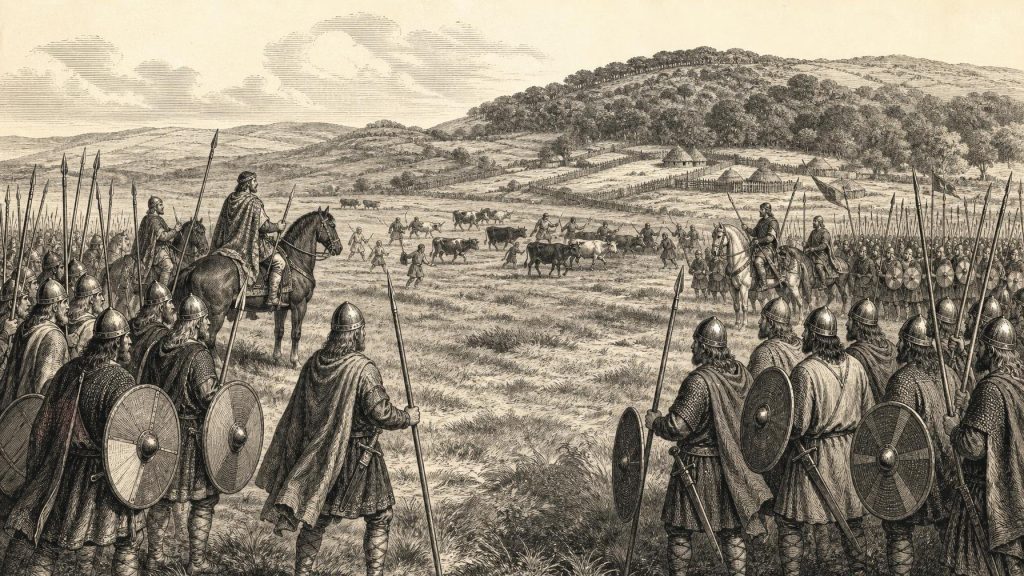
Murchad’s supporters had killed Diarmait’s brother, Domnall Remur, in 1041. Murchad then allied with Donnchad mac Briain, and Ferns, the principal ecclesiastical and political centre of Uí Chennselaig, was burned. Diarmait answered with an attack on Glenn Uissen, generally identified with Killeshin in modern County Laois. The Annals of Ulster and Annals of Loch Cé report that its oratory was broken down, 100 people were killed and 400 were taken away. Other annalistic compilations preserve different totals or describe cattle rather than captives, demonstrating why such figures should not be treated as exact statistics. All versions nevertheless agree that the retaliation was exceptionally destructive and that a religious settlement offered no reliable protection from political warfare.
The violence was not random. Burning Ferns struck at the authority and prestige of Diarmait’s dynasty, while the attack on Glenn Uissen carried the conflict into territory associated with his enemies. Churches possessed food, livestock, valuables and dependent communities, but they were also visible expressions of a ruling family’s power. Damaging one could punish both a saint’s community and the secular dynasty connected with it.
The Battle of Mag Muilchet
The decisive encounter came at Mag Muilchet in Loígis, within modern County Laois. Murchad, described by the annals as king of Leinster, faced Gilla Pátraic mac Donnchada, king of Osraige, and Mac Raith Ua Donnchada, a king of the Eóganachta. The Four Masters also name Cú Coigcríche Ua Mórdha of Loígis among the victors. The battle probably developed from the raiding and counter-raiding characteristic of the conflict, although the sources do not permit a detailed reconstruction of the armies or their movements.
Murchad was defeated and killed. Donnchad son of Áed, king of Uí Bairrche, fell beside him, as did Murchad’s brother and designated successor Echdonn. The Annals of Inisfallen add that many Osraige warriors and several other kings also died, suggesting that victory was costly. The casualties removed not merely a provincial ruler but much of the leadership surrounding him.
Mag Muilchet ended the last effective Uí Dúnlainge claim to the overkingship of Leinster. That dynasty had dominated the provincial kingship for centuries, but its internal divisions and the growing strength of Uí Chennselaig and Osraige had weakened it. The result marked a regional redistribution of power from northern and central Leinster towards the south-east.
Diarmait’s Opportunity
Diarmait mac Máel na mBó is conventionally regarded as king of Leinster from 1042. No surviving annal describes a formal inauguration immediately after Mag Muilchet, and his authority was probably consolidated gradually rather than accepted everywhere at once. Nonetheless, Murchad’s death removed his most important provincial rival, while Diarmait’s alliance with Osraige gave him valuable military support and access towards the central plain.
Kinship helped sustain that alliance: Diarmait’s mother, Aífe, belonged to the Osraige royal family. His position also rested on his Uí Chennselaig heartland around Ferns and the wealthy south-eastern approaches to the Irish Sea. During the following three decades he would extend his influence over Dublin and much of southern Ireland. In 1042, however, that future remained uncertain. Donnchad mac Briain still possessed considerable power, and the burning of Ferns showed that Diarmait’s enemies could reach the centre of his kingdom.
Murder in Mide
Another dynastic killing occurred in Mide. Flann, son of Máel-Sechnaill Got, was treacherously slain. The Annals of Ulster call him an heir designate of Ireland, while the Four Masters use the more limited title of royal heir of Tara and identify his killer as Conchobar Ua Máelshechlainn, king of Mide.
Such titles expressed ancestry, eligibility and political ambition rather than a guaranteed right to succeed to a unified Irish monarchy. Flann belonged to a collateral branch of Clann Cholmáin that competed with Conchobar’s line after the death of the former high-king Máel Sechnaill in 1022. His murder formed part of a prolonged family vendetta through which Conchobar secured his control of Mide. It also illustrates a recurring feature of Irish politics: rivals within a dynasty could be as dangerous as neighbouring kings.
The Passing of Sitriuc
The Annals of Inisfallen record the death of “Amlaíb’s son, king of Dublin”, while the Annals of Tigernach name him as Sitriuc and place the death of his daughter Caillech Finnéin in the same year. This was Sitriuc Silkbeard, the Hiberno-Norse ruler whose long career had included shifting alliances, the Battle of Clontarf, pilgrimage to Rome and the development of Dublin as a Christian trading town.
Sitriuc had already lost or relinquished the active kingship of Dublin to Echmarcach mac Ragnaill in 1036 and had gone overseas. His place of death is not securely known, although Gwynedd has been suggested. His death in 1042 therefore caused no sudden transfer of government, but it symbolised the passing of the ruler most closely associated with Dublin’s transformation around the millennium.
By this period Dublin contained closely packed timber houses, workshops, property boundaries and streets. Its craftspeople worked wood, iron, leather, bone, antler and precious metals, while merchants linked Ireland with Britain, Scandinavia and continental Europe. Silver pennies had been struck there under Sitriuc since about 997 or 998. Coinage was especially important in the town and its overseas commerce, although cattle, food rents, gifts and obligations remained fundamental to economic life across rural Ireland.
Churches, Schools and Pilgrims
The ecclesiastical notices of 1042 reveal both the importance and vulnerability of religious institutions. Mael Petair Ua hAilecáin, lector and master of the students at Armagh, was killed by the men of Fernmag. A lector was a senior teacher associated with reading, manuscript learning and the instruction of students. His violent death demonstrates that even Armagh’s scholarly community was entangled in regional conflict.
Mael Brigte, bishop of Kildare, died, as did Loingsech Ua Flaithéin, successor or coarb of Ciarán and Crónán. A coarb was not simply a monk but the recognised inheritor of a saint’s institutional authority, often exercising influence over lands, churches and dependent communities. These obituaries reflect an Irish church organised around powerful sacred families and federations as well as bishops.
The year also points beyond Ireland. The Annals of Inisfallen mention a descendant of Domnall son of Dub dá Bairenn on pilgrimage to Rome, though the terse entry does not explain whether it records his departure, presence there or death. More substantially, several annals record the death in Cologne of Ailill of Muckno, described as head of the Irish monks. Continental evidence associates him with the Irish communities at Groß St Martin and St Pantaleon. He had led Groß St Martin from 1009 and St Pantaleon from 1019. His career shows that Irish religious migration and learning remained active parts of European Christianity.
Connections between Cologne and Dublin may also have influenced the young cathedral church later known as Christ Church. Sitriuc’s pilgrimage to Rome occurred in 1028, and the traditional foundation of the cathedral with Bishop Dúnán belongs to the following years, although its precise chronology remains debated. By 1042, Dublin’s Christian institutions stood within networks extending across the Irish Sea and towards the Rhine and Rome.
Life Beyond the Annals
The annals say nothing about harvest conditions or ordinary domestic routines in 1042, so no famine, prosperity or climatic event should be invented for the year. Archaeology nevertheless provides responsible background. Most people lived in a rural landscape of enclosed farmsteads, fields, routeways and, in some regions, crannogs. Families tended cattle, sheep and pigs, cultivated grain, processed milk, ground cereals, spun wool and repaired houses, fences and farm buildings.
Cattle were both productive animals and measures of wealth, making herds natural targets during war. The recorded “preys” of kings were economic operations as much as military displays. Captives likewise represented power and value, although the sources do not reveal what happened to those removed from Glenn Uissen. In towns such as Dublin, a more specialised economy supported smiths, carpenters, textile workers, comb-makers, leatherworkers, sailors and traders.
Art and craftsmanship were also changing. Eleventh-century Irish metalwork increasingly combined native techniques with Scandinavian Ringerike and, later, Urnes ornament. No particular surviving object can be assigned to 1042 without independent dating, but the broader period witnessed an active fusion of Irish and Hiberno-Norse styles.
A Consequential Transition
The year’s lasting importance lies chiefly in the political transformation of Leinster. The death of Murchad at Mag Muilchet opened the provincial kingship to Diarmait mac Máel na mBó and helped shift power towards Uí Chennselaig. Yet 1042 was more than a sequence of royal deaths. Its evidence reveals violent competition over churches and cattle, dynastic feuds, an urban economy connected to distant shores, and Irish clerics travelling and teaching within a European Christian world.
Primary Sources
- The Annals of Ulster — Year U1042
- Annals of Inisfallen — Annal AI1042
- Annals of Inisfallen — Original Irish Text, Annal I1042
- Chronicon Scotorum — Annals CS1040–1044
- Annals of the Four Masters — Annal M1042
- The Annals of Tigernach — Annal T1042
- Annals of Loch Cé — Annal LC1042
- Diarmait (Diarmait mac Maíl (Máel) na Mbó)
- Murchad
- Donnchad
- Ua Máelshechlainn, Conchobar
- Sitriuc Silkbeard (Sitric, Sigtryggr Ólafsson Silkiskeggi)
- Donnchad Máel Na Mbó
- Donnchad, King of Osraige
- Máedóc (Áed, Áedán, Mogue)
- Reform in the Twelfth-Century Irish Church: A Revolution of Outlook?
- Viking — National Museum of Ireland
- 950–1450: Vikings, Normans and Medieval Mints
- Early Medieval — National Museum of Ireland
- Early Medieval Dwellings and Settlements in Ireland, AD 400–1100, Volume 1
- Early Medieval Ireland: Archaeological Excavations, 1930–2009
- The Economy of Early Medieval Ireland
- Why Sitric Silkenbeard Is the Greatest Dubliner of All Time
- Christ Church Cathedral Dublin: Conservation Management Plan